Gladys Shollei argues that viva voce evidence (oral testimony) of a petitioner “is just a summary of the documents he had already submitted.” Does Shollei and other inept Kenyan advocates understand the meaning of and reason for parties and witnesses to testify and be cross-examined UNDER OATH?
How would a court or quasi judicial tribunal assess one’s CREDIBILITY viz-a-viz that of others without ORAL TESTIMONY which is TESTED through cross-examination?
If a witness is not allowed to EXPLAIN the MEANING of the documentary evidence and any perceived inconsistencies with his/her case or evidence, how would a tribunal assess the reliability of evidence and weigh the evidence?
Until now, Kenya's referendum process has existed in a legal grey area, guided by scattered provisions of the Elections Act and shaped largely through constitutional interpretation by the courts.
The Referendum Bill, 2026 (Senate Bill No. 3 of 2026) seeks to change that by establishing, for the first time, a comprehensive legal framework governing how Kenyans initiate, conduct and challenge referenda.
The Bill seeks to define Kenya's constitutional future and the rules that will govern that process when the people are called upon to decide.
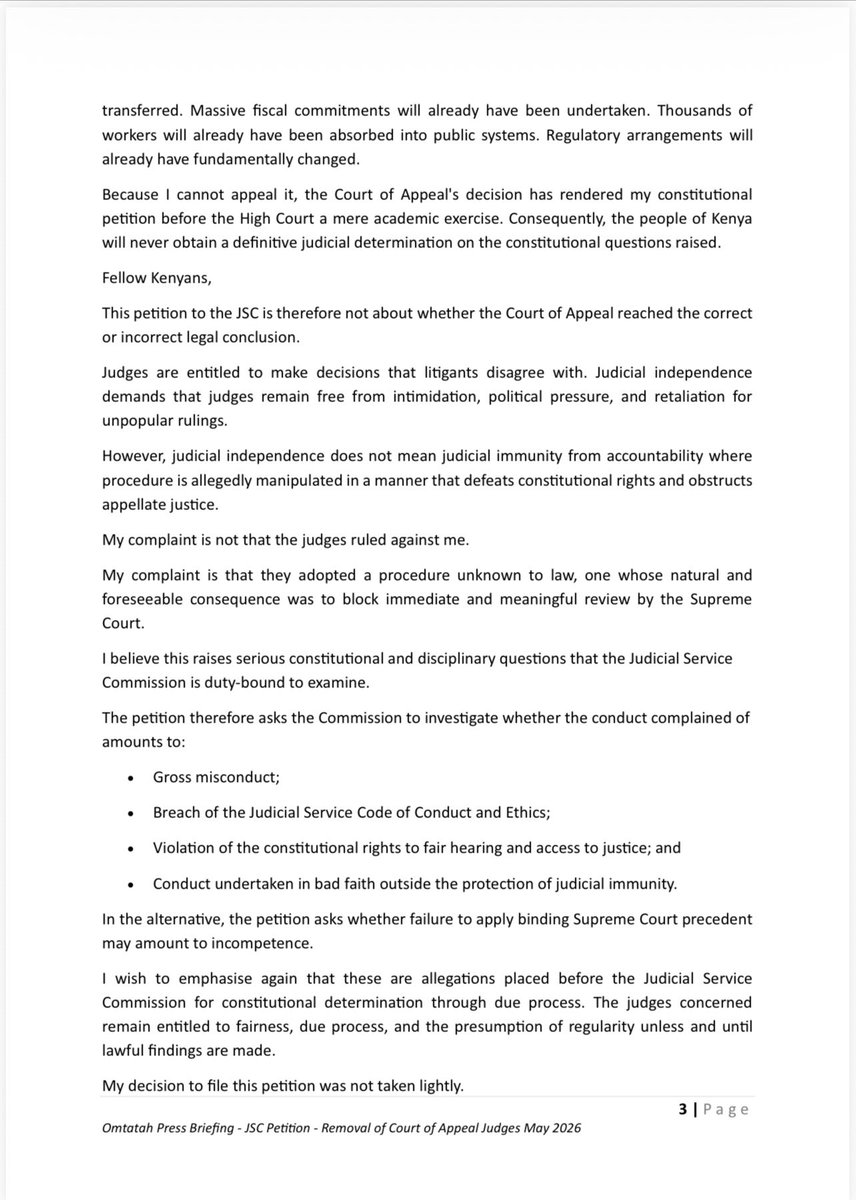
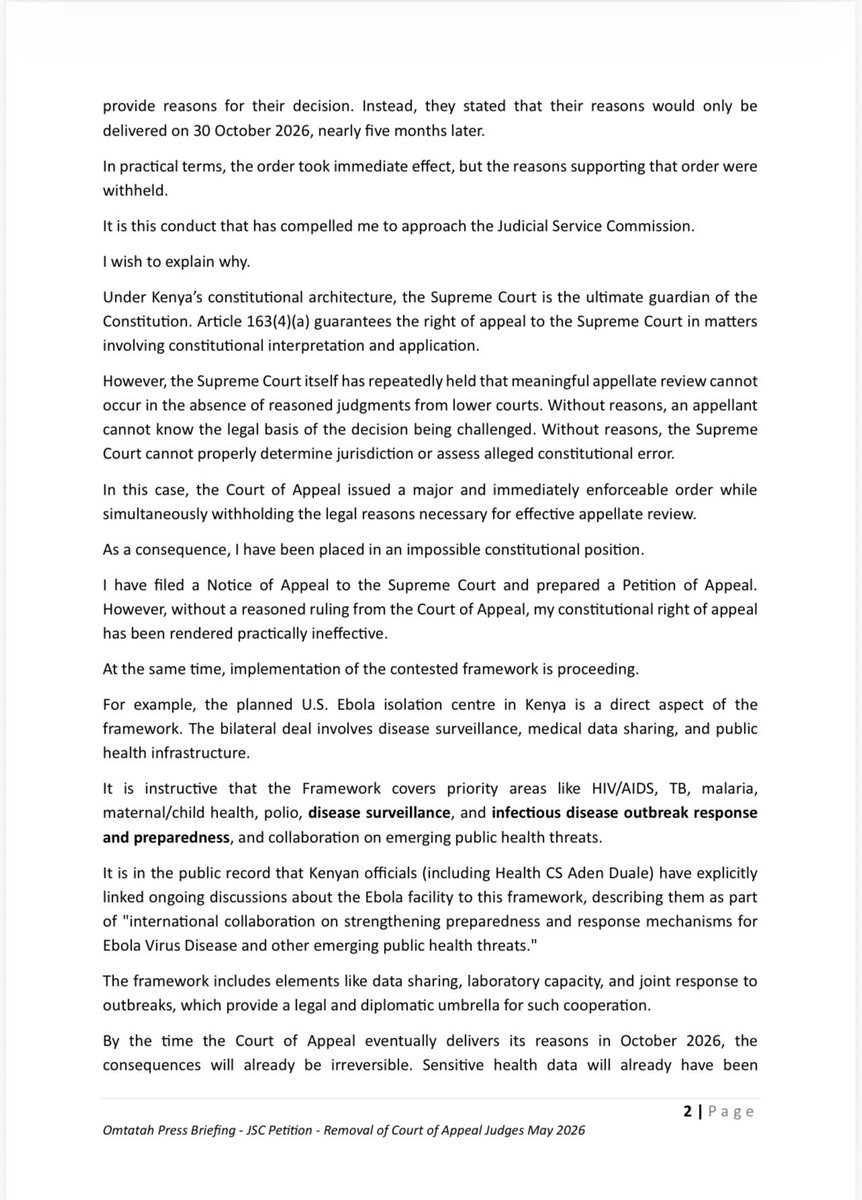
What @OkiyaOmtatah is raising is very Weighty about the conduct of the Court of Appeal judges in issuing abridged versions of their decisions on Rule 5(2)(b). We saw it in the Presidential Advisors case & now in the Kenya US Health Data Cooperation Deal. The court issues a brief version then sets a Full Ruling to a day beyond the time contemplated to Appeal the Ruling effectively to the Supreme Court. Because the day of the abridged version remains the day of Ruling & Appeal time starts to run. Two problems, can one lodge an Appeal to a decision given without reasons. Secondly, if the decision comes beyond the 14 days, is the statutory timeline already defeated. ✅️✅️
Fairly Valid Concerns.
Kenyans deserve justice that is transparent, reasoned, and accountable.
Today, I have petitioned the Judicial Service Commission @jsckenya to investigate three Court of Appeal judges who suspended High Court orders blocking the Kenya-US Health Cooperation Framework, but withheld their reasons for doing so until October 2026.
My concern is not that they ruled against me. It is that an immediately enforceable decision was issued without reasons, effectively frustrating a timely appeal to the @THE_SCOK and denying Kenyans meaningful access to justice.
Judicial independence must be protected. But independence and accountability must go hand in hand. No institution is above the Constitution.
THE HUMBLE PETITION OF OKIYA OMTATAH OKOITI LINK>
https://t.co/36xc3OZdNh
Should the taxpayer still bear the burden of proof in instances where a tax dispute with the Revenue Authority is based in pre-populated & third party data?
In my submission before the National Assembly's Finance & Planning Committee on behalf of the Tax Research Centre at @StrathU, I argue that Finance Bill 2026's proposals seeking to anchor Incomes & Expenses Validation in law will be incomplete if they do not include a proposal for the the Revenue Authority being saddled with the burden of proof in such instances.
Here's why:
· Finance Bill 2026 proposes to amend Sec75 of the Tax Procedures Act to provide that the Revenue Authority may use technology to pre-populate tax returns on behalf of a person required to submit or lodge a tax return
· Finance Bill 2026 further proposes that a person required to submit or lodge a tax return may rely on pre-populated return generated by the Revenue Authority to file their return
· Finance Bill 2026 proposes to amend Sec112 to provide that the Cabinet Secretary of the National Treasury may make Regulations for the procedure for the submission or lodging of returns based on pre-populated tax returns generated by the Revenue Authority
Here's where the problem is:
· In all this, Sec56(1) which provides that "In any proceedings, the burden shall be on the taxpayer to prove that a tax decision is incorrect" remains unchanged
· Sec56(1) is predicated on the fact that Kenya has been running on a self-assessment based regime & the data upon which tax disputes emerges was held by the taxpayer
· With Incomes & Expenses Validation & the onset of a Dual Assessment regime in Kenya, taxpayers are now exposed not just to errors of judgement & data on their part, but also errors of technology & transmission which are out of their control
· Can we really still have the burden of proof lying exclusively with the taxpayer in an environment where tax compliance has shifted from a function of record keeping to one where system integration reliability is now a key factor?
Finance Bill 2026 is much worse than Finance Bill 2024. Kwanza hapo kwa Land ndo wanaharibu kabisaa. They want to turn our Freehold Land into Leasehold Land whereby we will be paying annual taxes for our Land failure to pay your land will be auctioned by the government. This is wrong in so many ways. Mau Mau didn't fight British to reclaim our Land only for a corrupt government to turn it into Leasehold after over 60 years of independence.
Major cheat code for life: Be fully where your feet are. When you're at work, work. When you're with family, be with family. When you're resting, rest. Most people are physically present and mentally everywhere else.
KSh 150.7 billion is being held in a sovereign bond account contrary to the law, yet Kenyans are continuously being told to tighten their belts and endure more taxes under Finance Bill 2026.
Why can’t Treasury publish a full national financial statement so citizens clearly understand the true state of the country’s revenues, debts, expenditures, and obligations? A government that constantly demands sacrifice from its people must equally submit itself to public scrutiny and accountability.
The continued opacity surrounding public finances should alarm every patriotic Kenyan. Lack of transparency in revenue collection and expenditure creates fertile ground for wastage, corruption, illegal financial arrangements, and fiscal manipulation while ordinary citizens bear the burden through punitive taxation and a collapsing cost of living.
🔴🚨ELRC Sends Blunt Message to Employers as Ex-Employee Wins Kshs.1.25 Million After Unfair Dismissal
In Kagai v Kenga Equatorial Hotels Limited t/a Mombasa Continental Resort, the Employment and Labour Relations Court ruled in favour of Benson Muriithi Kagai, a Procurement Manager who had been dismissed barely five months into employment without being told why. The employer later attempted to justify the dismissal using allegations surrounding a delayed Kshs.2.7 million linen procurement deal. However, evidence before the court showed that the purchase orders, payment approvals, and cheques had all been authorized by senior management and company signatories. The court found that the termination letter itself contained no accusation, no misconduct claim, and no explanation beyond a vague reference to a contractual clause allowing termination by notice.
Justice Agnes Kitiku Nzei held that an employer cannot dismiss an employee first and then begin constructing reasons during trial. The court emphasized that Sections 41, 43, and 45 of the Employment Act require employers to provide valid reasons for termination and accord employees a fair hearing before dismissal. Since the Respondent neither informed the Claimant of any accusations nor subjected him to disciplinary proceedings, the dismissal was declared both procedurally and substantively unfair. The court further clarified that paying salary in lieu of notice does not excuse an employer from complying with statutory safeguards under employment law. Kagai was consequently awarded Kshs.1.25 million as compensation for unfair termination.
The decision carries major implications for ordinary employees and employers across Kenya. To the common mwananchi, the judgment reinforces that employers cannot use intimidation, office politics, or sudden dismissal letters to sidestep due process. Even short-term employees remain protected by the law and are entitled to dignity and fairness at the workplace. For employers, the ruling is a warning that internal frustrations, management conflicts, or boardroom pressure cannot replace lawful disciplinary procedures. Once termination occurs without proper reasons and hearing, the court is unlikely to rescue the employer later through afterthought explanations raised during litigation.
Kindly retweet🙏
A career at the Bar is built slowly. One appearance, one draft, one client conference at a time. Never underestimate how much consistency, punctuality, and honesty compound over time in legal practice.
People MUST resist Freehold Land being turned into Leasehold and oppressive TAXES imposed with the Land being auctioned upon failure to pay the those taxes.Objective is to disposess people of their Lands and turn them into labourers for the new owners.We have a CRIMINAL regime
This Kenyan man came so close to defeating Coca-Cola in market share. Unfortunately, his own government couldn’t protect him or help him build a true Kenyan brand.
Peter Kuguru started Softa Soda in 1997. He believed that Kenya deserved its own drink at a price that ordinary people could afford, and it worked.
By 2004, Softa had taken 10% of the entire carbonated drinks market in Kenya. By 2007, they controlled 70 to 80% of the market within 200 km of Nairobi.
So what happened?Kenya’s soda industry depends on recycling bottles, but Coca-Cola had the biggest collection network in the country. When Softa bottles ended up in Coca-Cola’s sorting yards — which happened most of the time — they simply disappeared.
And here is where the government comes in. All that was needed was a simple regulation requiring companies to return competitors’ bottles within a set time frame. This kind of rule exists in other markets, but the Kenyan government classified it as a private commercial dispute and stayed out of it.
Why? Because this was the liberalisation era, and Kenya was under pressure from international lenders to open its market and let competition run its natural course. Getting involved would have looked like a protection scheme.On top of that, Coca-Cola was one of the largest taxpayers in the country, and governments tend to protect revenue sources.
In the end, a promising Kenyan brand was lost.
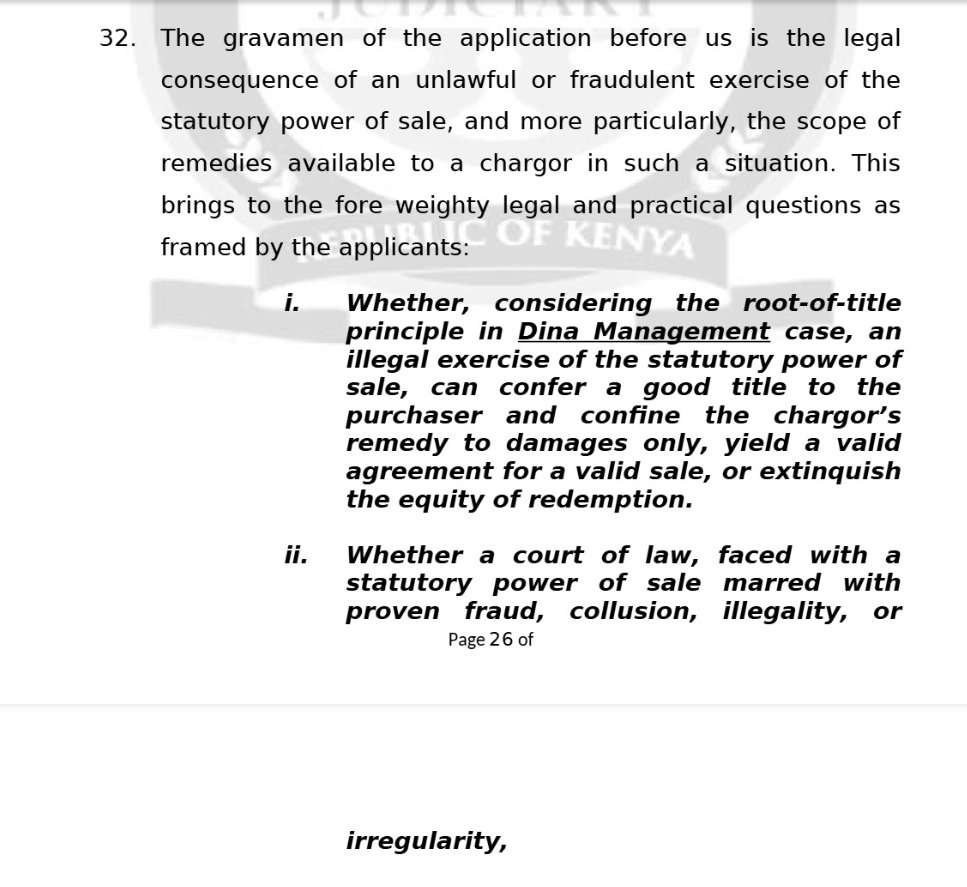
CoA grants Nyanja Holdings Ltd leave to appeal to the
Supreme Court under article 163(4) (b) (matters of general public importance) to clarify on the issue of illegal exercise of the statutory power of sale, borrower rights, and protection of property titles.
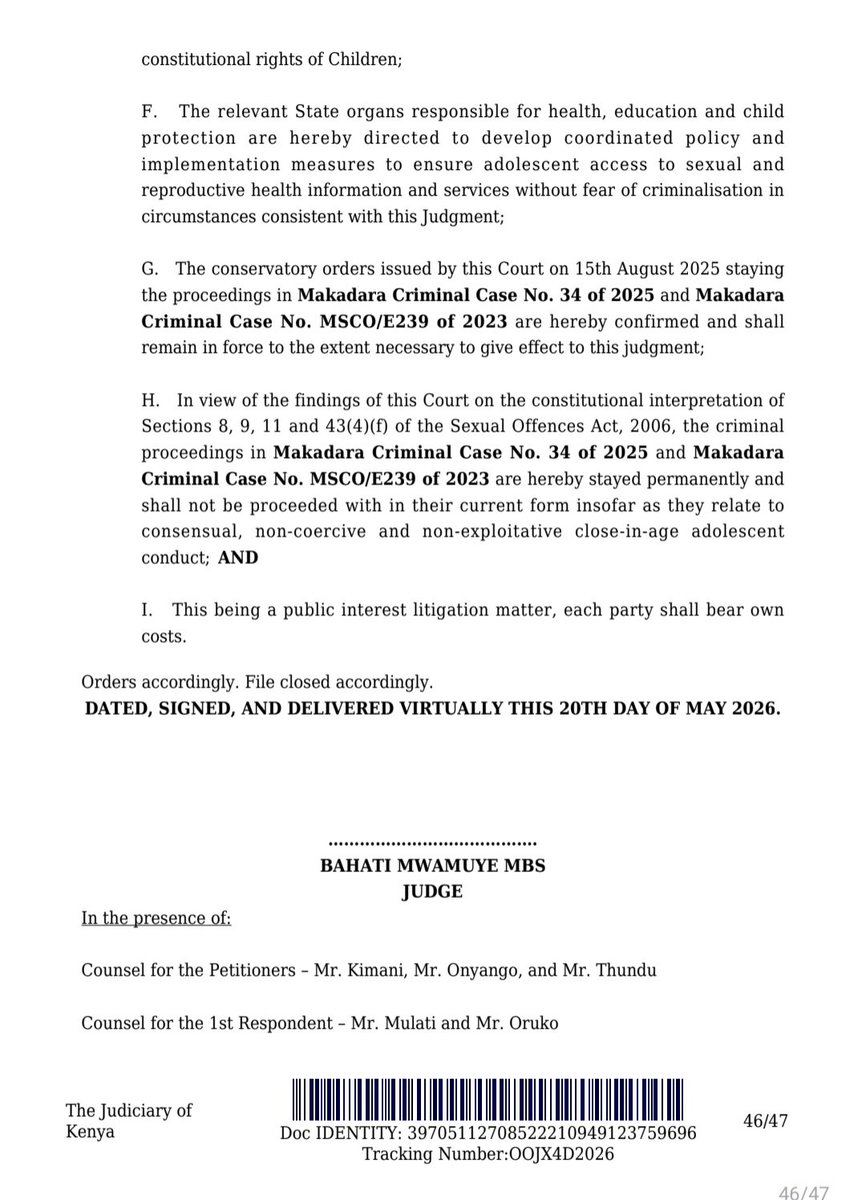
Yesterday, the High Court delivered a significant judgment in Petition E490/2025 (HSO & 3 Others v. ODPP & 4 Others) that will reshape Kenya's approach to adolescent sexuality and criminal law. The Court ruled that the misapplication of the Sexual Offences Act to prosecute adolescents engaged in consensual, non-coercive peer relationships violates their constitutional rights to equality, dignity, privacy, health, education and the best interest of the child.
This judgment addresses a documented tension in our legal framework. While the Sexual Offences Act was enacted to shield children from sexual abuse and exploitation, it has been applied broadly against adolescents in consensual peer relationships while ignoring their evolving capacities and driving them where they cannot access sexual and reproductive health services out of fear of prosecution. The Court's directives are clear. The ODPP must publish prosecutorial guidelines distinguishing consensual peer relationships from exploitative conduct, the National Police Service must review arrest protocols and State organs must develop coordinated policies ensuring adolescents can access SRH information without fear.
But we must ask the difficult questions. Against the backdrop of Kenya's escalating GBV and femicide crisis will this judgment inadvertently create loopholes that perpetrators exploit? The ODPP has previously employed diversion mechanisms in cases involving teenagers yet concerns persist about weaponization of these alternatives. The criminal justice system has failed women and girls through inadequate investigations, delayed prosecutions and impunity for perpetrators. Distinguishing consensual peer relationships from exploitation becomes so subjective that predatory conduct escapes accountability under the guise of consent.
Without precise legislative safeguards, we risk creating interpretive gaps that undermine hard-won protections for children particularly girls who bear the burden of sexual violence. Who determines genuine consent among adolescents of varying maturity levels? How do we prevent this progressive protection from eroding gains in combating child sexual abuse in a country grappling with what many have called a national GBV and femicide crisis?
Reform of the Sexual Offences Act remains urgent but it must be survivor-centered and grounded in the realities of GBV in Kenya. We need legislative amendments that protect juveniles from sexual violation without victimizing them for age-appropriate peer relationships while tightening enforcement against exploitation and abuse. The judgment's legacy will depend entirely on its implementation and future interpretation by courts and prosecutors. Only time will tell whether the promised guidelines will include safeguards that prevent manipulation by those who seek to exploit power imbalances. As we monitor this decision closely, one principle must remain non-negotiable, justice must protect the vulnerable not create new vulnerabilities.
Because Matatu operators are the ones who have called off the strike, Kenyans MUST REFUSE to pay hiked fares. Since they are the ones in dialogue with the government, they should not pass on the cost of their dialogue to innocent, underpaid and overtaxed Kenyans!