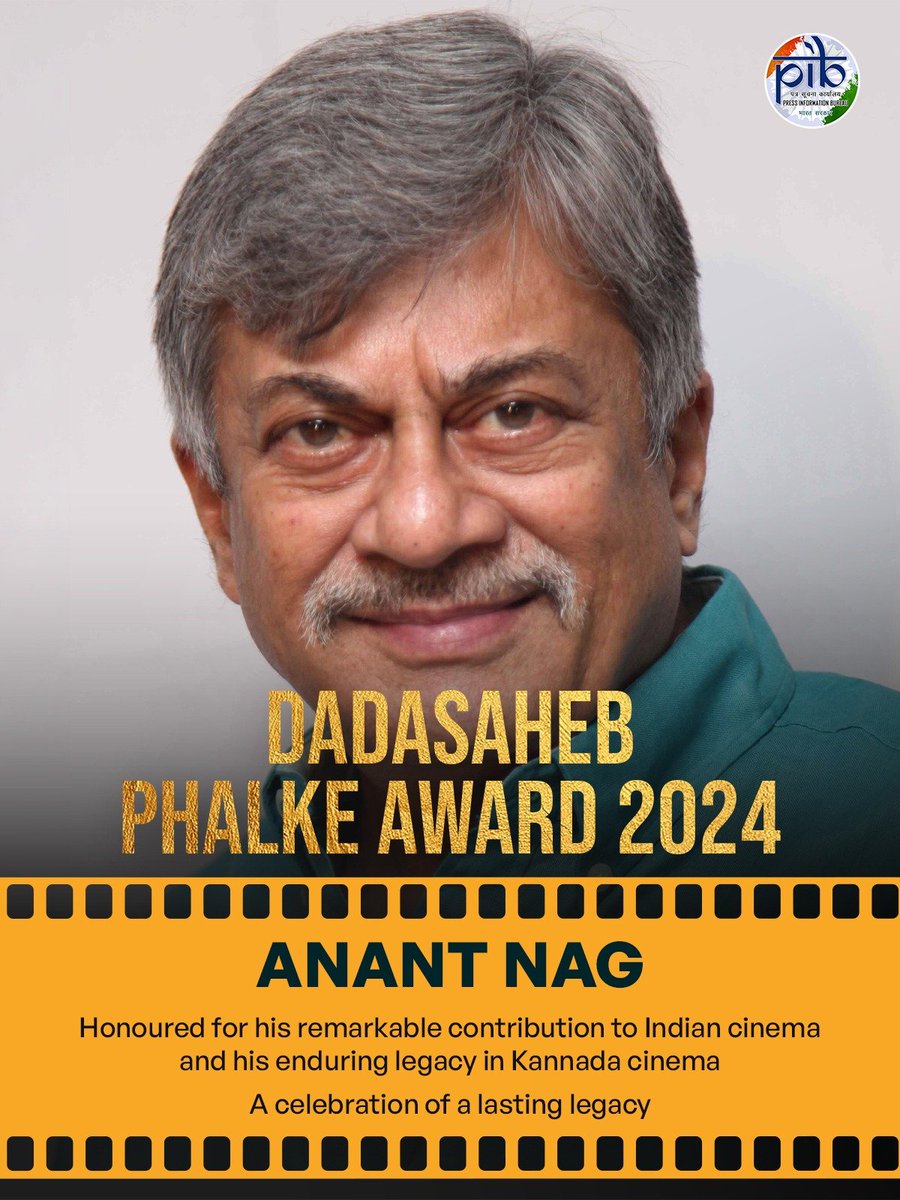
🎬THE DADASAHEB PHALKE AWARD 2024 GOES TO…
Shri ANANT NAG
On the recommendation of the Dadasaheb Phalke Award Selection Committee, the Government of India is pleased to announce that the Actor will be conferred the prestigious Dadasaheb Phalke Award 2024 for his contribution to Indian cinema and an illustrious cinematic journey that has inspired generations.
🗓️ The award will be presented at the 72nd National Film Awards ceremony on Sept 22, 2026.
📍Kevadia, Gujarat
#NationalFilmAwards #DadasahebPhalkeAward
@airtelindia No proper signal for Airtel AirFiber at Parkala, Udupi District, Karnataka – 576107, for more than a month. Despite repeated complaints, there has been no proper response or resolution from your office. Please address this issue urgently and restore reliable service.
English itself has many accents—even among native English-speaking countries. British, American, Australian, Canadian, Irish English…… all sound different. Indian English is simply another legitimate variety. Respect every accent; don’t make fun of Indian English. #GenZ
The Himalayan Saint Who Built Andhra University’s Nuclear Physics Department
India has produced people whose lives cannot be understood through career categories.
Swami Jnanananda was one such being.
Born as Bhupathiraju Lakshminarasimha Raju in Andhra Pradesh, he left ordinary life in his youth and went into tapasya. Mount Abu. Rishikesh. Himalayas. Long years of sadhana, silence, meditation, austerity, and inner discipline.
This inner work shaped the rest of his life.
His sadhana gave him stillness, attention, and one-pointedness. The same intensity with which he looked within, he later brought to the study of matter, energy, radiation, and the atom.
Then life took a remarkable turn.
His Guru asked him to study physics.
He entered the laboratories of Europe. Dresden. Prague. Liverpool. Michigan. He studied physics with the intensity of a seeker. For him, science became another way of approaching creation with precision.
He worked in X-ray spectroscopy. He earned a D. Sc. from Charles University, Prague. He worked under Sir James Chadwick’s scientific environment at Liverpool and earned a Ph.D. for research on beta radiation.
Then he returned to India.
A newly independent nation needed institutions. It needed people who could build capability. Swami Jnanananda brought the discipline of a yogi and the rigor of a scientist to Andhra University.
In 1954, he joined Andhra University. The Nuclear Physics Department was established under his leadership. Laboratories were built. Equipment was brought. Students were trained. Research culture was created.
This is leadership.
A leader takes responsibility for what does not yet exist and makes it possible for others to grow.
Swami Jnanananda did this with an entire generation of Indian scientists.
He trained over 20 doctoral students. His department published more than 100 research papers. Andhra University became one of the most active nuclear physics laboratories in India outside the direct control of the Department of Atomic Energy.
What made this possible was the quality of the human being.
Scientific work needs steadiness. It needs attention. It needs patience with detail. It needs the ability to observe without agitation. His sadhana had prepared him for this level of work.
Swami Jnanananda’s life shows what education can become when inner clarity, intellectual fire, and national responsibility come together.
He wrote on Nuclear Physics. He wrote on High Vacuum. He wrote on Vedanta, Yoga, Science and Religion. His life did not divide knowledge into compartments. He moved from tapasya to theory, from samadhi to spectroscopy, from Himalayas to high-voltage laboratories.
For young entrepreneurs and leaders, this is the lesson.
Do not build only a career. Build yourself into a possibility.
When your inner life is intense, your work gains a different quality. When your mind is sharp, your action becomes precise. When your life is offered to something larger than personal ambition, institutions get created.
Swami Jnanananda created a field, built a department, trained people, and left behind a culture of scientific pursuit rooted in a deeper reverence for truth.
This is the kind of education Bharat needs.
Education that creates capability.
Leadership that takes responsibility.
Science pursued with humility.
Spirituality expressed through service.
@PriyankKharge Yes, the Centre faced criticism over the handling of the first NEET exam. But does that justify creating fresh difficulties for students? Politics can wait. Competitive exams cannot. @RahulGandhi@KpccSocialMedia
@PriyankKharge A genuine question to @INCIndia and @KpccSocialMedia :
Why was a mega rally scheduled on the day of the NEET exam? With thousands of students appearing for the important exam, was the impact on traffic considered?
Could this event not have been held on another day?
📦 Ordered an item on 23rd September, but it’s still not delivered! 😞
@amazonIN please look into this — delay is way beyond expected timeline. Order stuck without any update. #AmazonIndia#CustomerService
@NHAI_Official@FASTag_NETC
FASTag amount deducted without crossing toll gate — and now being asked to replace FASTag for ₹100?! @HDFCBank_Cares
This is unfair. Why should I pay for a new FASTag when the deduction error is not my fault?
#FASTag#HDFCBank#NHAI
Illegal parking observed near MIT-Babbuswamy Temple area. Often vehicles are moving from wrong side between MIT Junction & KMC OPD Road, causing traffic hazards. Requesting @udupipolice to take necessary action for road safety. #Manipal#TrafficViolation@YashpalBJP@dcudupi