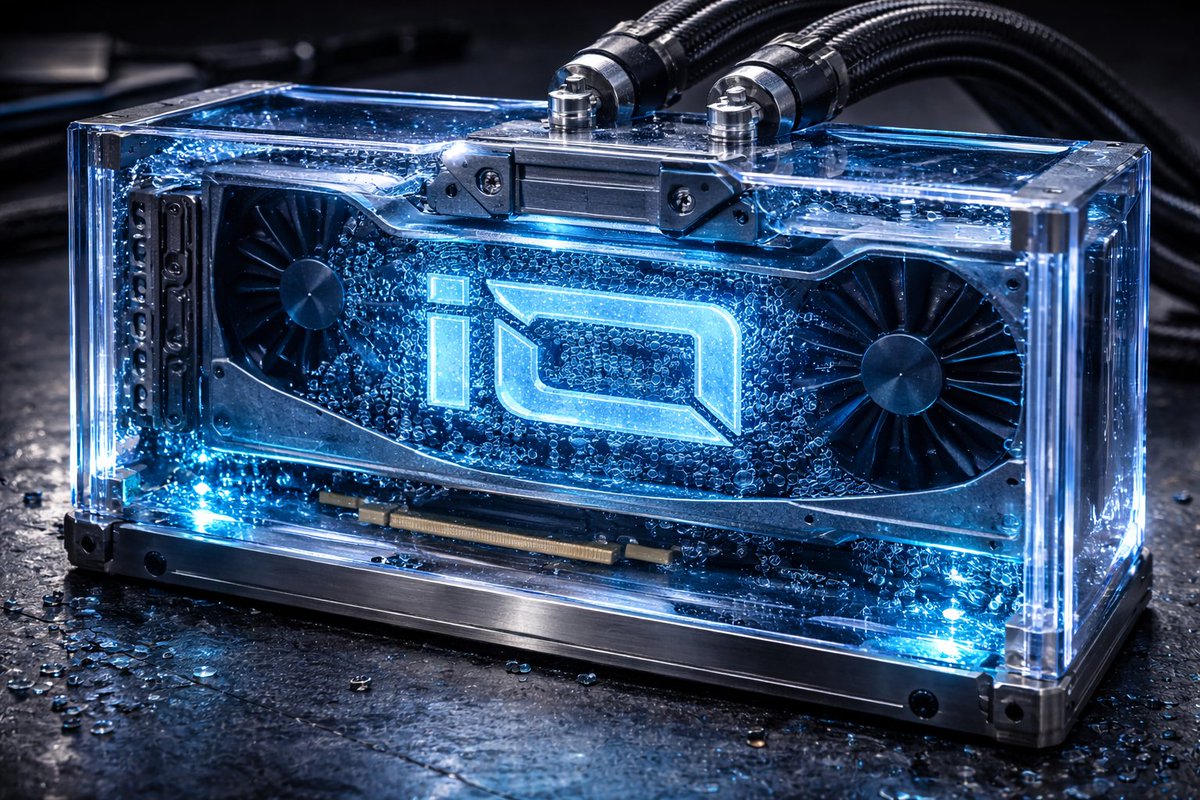
THE MOST BULLISH TECH YOU HAVEN'T HEARD OF
https://t.co/aVWqdCAvtP introduces the Incentive Dynamic Engine (IDE) -- the world’s first demand-driven token economy for sustainable DePIN growth.
IDE replaces inflationary emissions with a self-regulating model that ties $IO supply directly to real GPU usage and network revenue, stabilizing supplier income while driving long-term token scarcity.
Key highlights:
- USD-stable rewards for GPU providers, independent of $IO price volatility
- Dynamic emissions that expand or contract based on real demand
- 50%+ revenue burn, reducing circulating $IO over time
- Two-vault system (Reward Vault + Fee Vault) to balance downturns and demand surges
- Target to remove 50% of legacy token supply, strengthening sustainability
- Built to attract enterprise-grade suppliers, not speculative miners
By aligning suppliers, token holders, and users around real utility, IDE positions https://t.co/aVWqdCAvtP as a credible decentralized alternative to AWS-style compute, designed for long-term stability and scalable AI infrastructure.
The future of AI compute doesn't run on hype.
It runs on real utility, real burns, and a network that gets stronger every time it's used.
The Incentive Dynamic Engine (IDE) is now live!
https://t.co/ggOg5dBdZw
Season 2 is officially live for the @ionet community.
A new month-long XP campaign for the community, with roles, competition and a 10,000 solana:BZLbGTNCSFfoth2GYDtwr7e4imWzpR5jqcUuGEwr646K reward pool on the line.
Join events, complete activities, earn XP and climb the ranks.
350 XP ➞ 🌠 IO Comet
650 XP ➞ ☄️ IO Meteoroid
850 XP ➞ ⭐ IO Star
Show up. Stack XP. Prove your rank.
The build-vs-rent math gets real faster than most teams think.
Renting 32 A100s can cost around $900K/year on-demand, while buying the same setup with nodes, InfiniBand, and storage lands around $900K–$1.1M.
Once usage stays high enough, the economics flip.
That is where @ionet becomes compelling: cluster-scale GPU access without the upfront capex, power planning, cooling burden, or long procurement cycle that usually comes with building for serious AI workloads
A lot of teams still price GPU clusters off the headline rate and miss where the real burn starts.
An A100 may be listed at $2.48/hour, but once you add VPC traffic, NAT, cross-AZ transfers, storage and idle autoscaling, the true per-GPU-hour cost can run 40–60% higher.
That is why @ionet stands out.
Instead of swallowing the usual cloud waste, teams get a decentralized path to cluster-scale compute that is built for training, inference and data-heavy workloads without the same hardware overhead.
The real ROI question is whether owning the full infrastructure stack around GPU compute makes financial sense.
A modern GPU rack can demand 60kW+, and once power, cooling, storage and network fabric enter the picture, the cost model gets ugly fast.
@ionet changes that by giving teams a way to tap high-performance GPU compute with up to 90% lower costs, no contracts and no waitlists.
That is a much cleaner path for teams that want raw output.
The economics of GPU infra are changing faster than most teams admit.
AWS p4d.24xlarge can run to roughly $288K over 12 months, while the break-even for moving beyond hourly cloud leasing starts to show up once usage becomes sustained.
@ionet gives teams a way to skip long procurement cycles and cut GPU costs by up to 90%, while tapping a global supply of 300K+ verified GPUs for training, batch inference and scale-heavy AI workloads.
Legacy GPU infrastructure breaks fast when AI demand gets real.
A standard CPU rack pulls around 7–15kW. Modern GPU deployments can push 60kW+ per rack, with some setups crossing 100kW. That is where costs, cooling, and rack design start becoming the real bottleneck.
@ionet takes a different route: access 300K+ GPUs across 138+ countries, deploy H100s in under 2 minutes, and scale heavy training or inference workloads without waiting on centralized capacity to catch up.
A lot of teams still assume decentralized compute means weaker reliability or less control.
But the model is getting much more mature.
@ionet shows how decentralized infrastructure can still support real workload scheduling, cluster deployment and performance monitoring without forcing teams into the usual centralized bottlenecks.
That is a big reason this category is starting to feel production-ready.
The @ionet Community Season Event is live.
Earn XP, unlock exclusive roles, and compete for a 10,000 $IO prize pool.
300 XP ➞ IO Comet
600 XP ➞ IO Meteoroid
800 XP ➞ IO Star
Season runs from 17 March – 17 April.
More info below 🔽
The biggest mistake is thinking decentralized compute means rebuilding everything from scratch.
With @ionet, teams can start small, move the right workloads first and use decentralized GPU supply where it makes the most financial and operational sense.
That makes the model far more practical than most people think.