TPLF Rejects EU Delegation's Statement on #Tigray, Calls for Genuine Political Dialogue
----
Mekelle, June 29, 2026— Tigray People's Liberation Front (TPLF) has rejected allegations made in a recent statement by the European Union Delegation to Ethiopia, describing them as inaccurate and not reflective of the realities on the ground in Tigray.
In a statement issued, the TPLF denied claims that it had established a "parallel regional council," asserting that Tigray has only one elected Regional Council, which recently resumed its functions following consultations across the region.
The party accused Ethiopia's federal government of failing to implement key provisions of the Cessation of Hostilities Agreement (CoHA), alleging continued political and economic restrictions, military mobilization around Tigray, and repeated drone strikes that it said have heightened tensions and worsened humanitarian conditions in Tigray.
TPLF also dismissed allegations that it is pursuing unilateral military conscription, stating that any measures taken are aimed at protecting civilians amid what it described as growing security threats.
Reaffirming its commitment to peace, TPLF called for immediate and meaningful political dialogue and urged the European Union and other international partners to encourage the Ethiopian federal government to engage in genuine negotiations. It said renewed conflict remains avoidable and expressed confidence that a credible and lasting peace can still be achieved.
#Ethiopian journalists win #US’ democracy award for courage
One of the last remaining independent media outlets in Ethiopia, #Addis_Standard, has won the US' National Endowment for Democracy award for its journalists' resilience and courage working under a repressive media landscape.
Addis Standard will travel to #Washington DC in September to accept the award. Ethiopia is the country that jails the most journalists in Sub-Saharan #Africa only after #Eritrea.
Topics like armed conflict and human rights abuses have led local journalists to be imprisoned and international correspondents to be expelled from the country.
France 24 correspondent in Ethiopia Tom Canetti sat down with the editor-in-chief of Addis Standard Yonas Kedir.
Watch
https://t.co/OHUaRLvxWu
Looks we have a wise man in the room.
Thank you @BradSherman for this wise statement!
Indeed, the one sided and biased statement can only make the situation worse.
👇🏿
https://t.co/2218G6PqiA
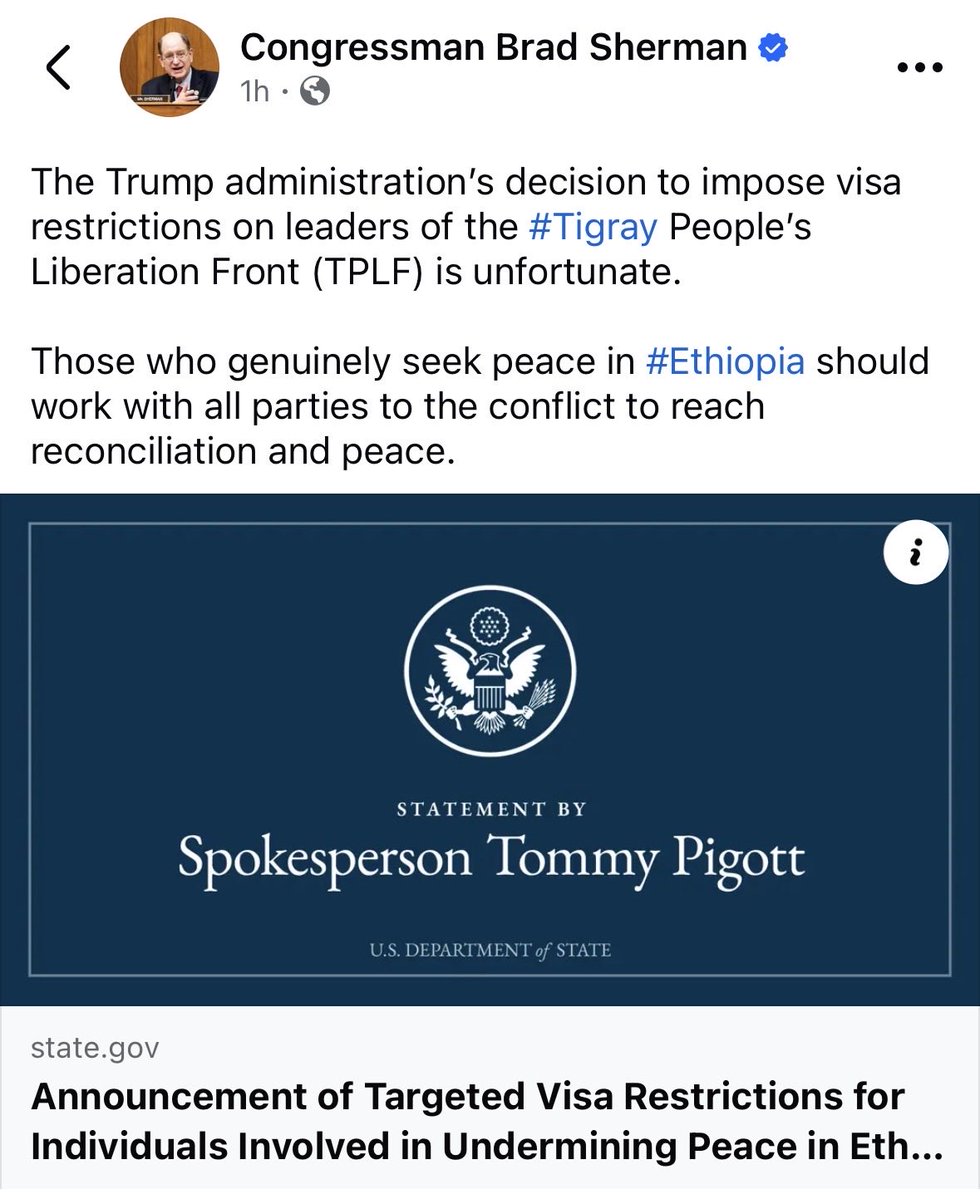
News: #US Congressman criticizes visa restrictions on #TPLF leaders, calls for inclusive peace efforts in #Ethiopia
In a statement shared on X, #Sherman said, "The Trump administration's decision to impose visa restrictions on leaders of the #Tigray People's Liberation Front (TPLF) is unfortunate."
"Those who genuinely seek peace in Ethiopia should work with all parties to the conflict to reach reconciliation and peace," he added.
https://t.co/Dvsif7CM8k
What Tsadkan is saying right here is let’s save the genocidal maniac @AbiyAhmedAli from his enemies,so that his survival will be a good project for Tigray’s future and survival.
This the most ignorant and corrupt attempt to bleach the stains of the regime in public.
@USEmbassyAddis@reda_getachew If only the US ambassdor Massinga gave this speech before the US imposed a biased one sided sanctions. When we know the fed govt is mainly the one undermining the pretoria agreement incl cutting buget, refusing return of territory n IDP to tig. the Amb has lost his credibility!
This is a strong statement from the US Ambassador on the deteriorating situation in Tigray and the need to restart peace talks. I wonder if it would have been more effective if it had been delivered before the US used Abiy's language of "Tigrayan hardliners" and sanctioned only one side for undermining the peace process? I wonder if the Tigrayans had purchased several billion $$ worth of Boeing airplanes if we would view them any differently today... https://t.co/2gr6M6PfZr
@US_SrAdvisorAF@POTUS No it doesn't promote regional peace or security. The fed govt of eth. has been displaced millions of its own people in different parts of eth. It has failed to implement the Pretoria agreement. The US should push both parties towards the full implementation of pretoria agreement
Washington’s new sanctions on TPLF may accelerate conflict rather than prevent it. Here is my take.
The United States has announced visa restrictions on selected TPLF leaders and their families, hoping to deter them from pushing Tigray back into war with the federal government. Will this sanction achieve its intended objective? I doubt it. In fact, I fear it may have the opposite effect.
At this stage, the TPLF faces only two choices: fight or surrender. Externally, the federal government has steadily tightened the screws through budget cuts and severe restrictions on essential goods and services entering Tigray. Internally, the party is grappling with deep factional divisions and growing public frustration. Faced with these twin pressures, TPLF leaders seem to have concluded that war offers a better chance of political survival than capitulation. Their calculation is straightforward: a renewed conflict could restore internal discipline, rebuild cohesion, and rally a frustrated population around collective defense rather than socio-economic grievances.
Will a US visa ban force them to reconsider? Unlikely. If anything, it may convince them that the diplomatic path has effectively closed, making the battlefield appear to be their only remaining option. The sanction itself is largely symbolic. Most of the targeted officials are already unable to travel freely outside Tigray, save for limited access to neighboring countries such as Eritrea and Sudan. For political actors who increasingly view their situation in existential terms, a travel restriction is hardly a meaningful deterrent. Some may argue that extending the sanction to family members increases pressure. Having observed, studied and campaigned against TPLF leaders for years, I am skeptical that concern for their children’s travel prospects will alter decisions they perceive as matters of political survival.
There is also a broader problem. TPLF is not the only actor involved in the emerging confrontation. It has built relationships and understandings with other forces that view conflict with the federal government as increasingly likely. Unless those actors are similarly incentivized to step back from the brink, it would be extraordinarily risky for TPLF to de-escalate unilaterally. Doing so could leave it isolated and vulnerable against a far stronger federal state. Under such circumstances, the sanction offers little incentive short of outright surrender.
More fundamentally, what guarantee is Washington offering in return? The US, the AU, and much of the international community were guarantors of the Pretoria Agreement, yet they largely walked away from enforcing its implementation when disputes emerged. Why should TPLF believe that diplomacy will protect its interests now? A small stick without any accompanying carrot is unlikely to inspire confidence, particularly when it comes from an administration whose positions are often perceived as shifting with changing realities on the ground.
There is another glaring omission. The sanctions focus exclusively on TPLF leaders, yet the actual military deployment toward Tigray is being carried out by the federal government. Equally concerning is the increasingly belligerent rhetoric coming from senior military commanders and federal officials over the past several days. Their statements and saber-rattling suggest a level of preparedness and willingness to wage war that, at least for now, appears greater than that of the Tigrayan side. If the objective is genuinely to prevent conflict, why is this aspect being ignored? Why is the pressure being applied only to one side while the other side’s military preparations and escalation signals escape scrutiny?
For these reasons, I fear the sanctions may produce precisely the opposite outcome from what Washington intends: accelerating the path to war by convincing TPLF that diplomacy is exhausted, while simultaneously emboldening Abiy Ahmed’s government to act more aggressively.
I sincerely hope I am proven wrong.
An important question also comes to mind: what, exactly, did Abiy promise or offer Donald Trump in exchange for this sanction? Given the remarks Trump made during his meeting yesterday with Egypt’s President Abdel Fattah el-Sisi, Ethiopians would do well to keep a close eye on GERD.
Statement from #TPLF
A fundamental question remains unanswered:
Who is:
- preventing the return of displaced Tigrayans,
- Restrict access to basic services,
- Failing to implement the humanitarian provisions of the Pretoria Agreement…..
👇🏿
2/2
Collectively, these dynamics constitute a grand strategic failure, wherein the objectives, instruments, and outcomes of the United States are fundamentally misaligned. The United States aimed for stability, accountability, and regional security. Instead, Ethiopia is experiencing widespread internal conflict, the Pretoria Agreement remains largely unimplemented, and the Red Sea-Horn of Africa region is facing escalating cross-border tensions. The U.S. has not only failed to achieve its goals but has also lost credibility with key regional actors.
The lesson is evident: without recalibrating its approach to include enforceable commitments, consistent messaging, and a willingness to apply meaningful leverage, the United States risks further diminishing its influence in one of the world’s most strategically significant regions, the Red Sea-Horn of Africa.
To achieve peace and stability in this strategically significant region, U.S. policymakers should consider the following measures: reassess U.S. support for the Ethiopian federal government, considering governance failures and regional destabilization; enhance enforcement mechanisms for the Pretoria Agreement by incorporating conditions related to humanitarian access and territorial withdrawal; advance regional diplomacy to address Ethiopia’s external conflicts and avert escalation; restore credibility with affected communities through consistent communication and targeted humanitarian initiatives; and formulate contingency plans for potential Ethiopian state fragmentation and cross-border spillover.
@SecRubio@StateDept@SenateForeign@SenatorShaheen@SenatorCardin@SenatorRisch@SenateGOP@SenateDems
U.S. Diplomatic Performance in Ethiopia and Emerging Regional Risks
The United States' engagement in Ethiopia since the outbreak of the Tigray War exemplifies a strategic failure, characterized by a notable gap between declared American objectives and actual outcomes. Washington entered the Tigray crisis with clear goals: to avert mass atrocities, stabilize Ethiopia as a regional anchor, and contain the conflict’s expansion across the Red Sea-Horn of Africa. Nevertheless, despite having early access to substantial evidence of atrocities, including internal evaluations by the U.S. State Department and other agencies as early as May 2021, the United States refrained from issuing a genocide determination. This reluctance diminished its influence at a crucial juncture and conveyed to all parties that U.S. red lines were flexible. In policy terms, this constitutes a strategic failure: the inability to synchronize tools, timing, and political resolve with the magnitude of the crisis.
The U.S. role as a guarantor of the 2022 Pretoria Cessation of Hostilities Agreement further exemplifies a diplomatic failure. Although the agreement formally ended active hostilities, its core provisions remain unimplemented. Tigray continues to be encircled by Ethiopian federal forces and militias, with significant portions of its territory still under occupation. Furthermore, essential services, including banking, fuel, and budget, remain restricted. Millions of Tigrayans are either internally displaced or have been compelled to seek refuge in Sudan. As a guarantor, the United States possessed both the responsibility and the diplomatic capacity to ensure compliance, yet it has not fulfilled this role. Consequently, the peace agreement that exists predominantly on paper, with minimal practical impact on the humanitarian or security realities in Tigray and the region and the surrounding region.
At the national level, Ethiopia is experiencing systemic instability that directly contradicts U.S. objectives. The Ethiopian federal government is actively engaged in armed conflicts across multiple regions, including Amhara, Oromia, Gambella, and Afar, while simultaneously facing economic collapse, governance breakdown, and widespread public distrust. Despite U.S. policy efforts to support the Ethiopian federal government with the aim of preserving national unity, this strategy has not resulted in stability. Instead, Ethiopia’s internal fragmentation has intensified, and the government’s capacity for effective governance has diminished. This discrepancy between U.S. intentions and actual outcomes constitutes a clear failure in foreign policy failure.
In the regional context, Ethiopia has become a driver of instability rather than a stabilizing force. Its involvement in Sudan, particularly its alignment with the Rapid Support Forces (RSF), its confrontational posture towards Eritrea, and the escalating tensions with Somalia over maritime access, have collectively deteriorating the security environment in the Red Sea-Horn of Africa. These developments compromise U.S. regional priorities, including Red Sea security, counterterrorism cooperation, and safeguarding critical maritime corridors. The inability of U.S. diplomacy to restrain Ethiopia’s increasingly assertive regional behavior reflects a broader erosion of American influence.
The challenges are exacerbated by the growing credibility gap. Washington’s simultaneous support for the Ethiopian federal government and the imposition of visa sanctions on Tigrayan leaders have strained its trust with various constituencies. The Ethiopian government perceives U.S. pressure as inconsistent and politically motivated, while Tigrayans perceive U.S. actions as punitive and misaligned with the realities of their humanitarian crisis. This dual loss of trust constrains the U.S.'s capacity to influence outcomes, mediate disputes, or enforce agreements. 1/2
@SecRubio@SenateForeign@SenatorShaheen@SenatorCardin
News: #Tigray Teachers' Association says unpaid salaries pushing teachers into severe hardship, urges national body to intervene
In a letter addressed to the #Ethiopian Teachers’ Association, the association said the prolonged non-payment of salaries has exposed teachers and their families to illness, extreme economic difficulties, and, in some cases, death due to hunger.
The association condemned the withholding of teachers’ salaries, which it attributed to political and ideological disagreements, describing the situation as “an act of extreme injustice” that would be “condemned by history.”
#Nigisti_Gared, President of the Tigray Teachers’ Association , says teachers in the region have repeatedly appealed for the payment of their salaries through written requests and peaceful demonstrations. However, the association said no responsible body has responded adequately to address their grievances.
https://t.co/MAGn1BNBSu
The question is, was the Tigray crisis on its way to resolution before the TPLF took its recent actions? Certainly hasn't looked that way in the past year, and escalatory moves have been taken by both sides.
Wonder to know what Abiy has to offer for the State department to come up with this biased, if not perverse statement.GERD? Want peace in the HoA? Watch Abiy! Ensure accountability for the >600k perished lives mentioned in your statement @statedeptspox https://t.co/jXJVKgUwpp
Tigray Accuses Ethiopia of Preparing for Renewed War
The #TPLF says the federal government is gearing up for a renewed military offensive in #Tigray, citing drone strikes, troop mobilization, and the continued blockade. It also called on Tigrayans to strengthen their resistance.
US also stated that it “will continue to stand with the Ethiopian people, inc the people of #Tigray, who want to live in peace and dignity.” Meanwhile, nearly a million Tigrayan IDPs remain in makeshift camps, without peace or dignity, due to Ethiopia’s genocidal machinations. 2/