Socks are the #1 most requested item at homeless shelters. Dave Heath turned that single fact into @BOMBAS . The brand has donated over 200 million items of clothing and built a billion-dollar business along the way. What makes Dave a builder worth studying isn't just the scale. It's the discipline behind it. He reverse-engineered an exceptional product from a mission. He learned to test before betting. And he protected the brand as it grew.
In this episode, I sit down with Dave to break down:
• How he reverse-engineered an "exceptional product" from a donation mission and brought athletic-sock innovation to the mass market.
• The Shark Tank effect, going from $800K to $2M in revenue in the six weeks after airing.
• The expensive lesson of expanding into adjacent products too fast and the MVP-testing discipline that replaced it.
• Radical-ish transparency.
• The self-awareness to evolve his own role as the company scaled and how he screened his successor for humility
• How Bombas is approaching AI.
Big thanks to Dave for coming on the pod and sharing the playbook (and the mindset) behind Bombas.
It might be an understatement to say that time heals all wounds. We instinctively reduce stories of old to fantasy - a part of some other reality. Objectively this isn't true, it's just a fallacy of the human mind.
250 years ago people endured awful tragedy to deliver this holiday to the Americans reading this. People ran directly into gunfire, were impaled, starved and burned alive. People lived the rest of their lives without husbands and sons. It was an ugly business, but the people of the time valued their freedom so greatly that they died willingly.
In doing this they started a global movement. Before this revolution - roughly zero humans lived in a democracy. Today close to half of all humans live in a version of one.
Americans - imagine what it would take for you to opt in for that now, risking your life and your family. Enjoy your BBQ, laugh and be happy, but privately, in the back of your mind, marvel at what they did. And then think about the folks in other countries who are still fighting this battle.
The LBO market has had a private capital liquidity option for years. LBO firms would just sell to other LBO firms. In my view this is the VC market catching up.
For the first time on record, more US venture capital money came back to investors through private share sales than through IPOs. In Q1 2026, those private sales ran at an annualized $112.2 billion. IPOs ran at about $105 billion.
The instinct is to read this as another symptom of a quiet IPO market. It isn't. Private share sales have grown ~30% a year since 2022 while IPO proceeds stayed flat. PitchBook calls 2026 the year these private sales graduate from a temporary fix into a permanent piece of the market. The pool of money set aside to buy these shares hit $11.8 billion in June 2025 — nearly 3x what it was in 2022.
This is a structural change. Three things worth sitting with:
- Fund managers: Returning cash used to mean waiting for an IPO or sale. Private share sales let you do it years earlier — but every sale prints a real price, so wins and losses both arrive while the fund is still active.
- Institutional investors: The "value" line on a quarterly report used to be an estimate. Now it's a real price someone just paid. The numbers are more trustworthy — and they can also swing 30% in a quarter without the company doing anything new.
- Founders: Tender offers used to be a rare treat for the most senior people. Now they're regular events. That resets hiring expectations, founder concentration, and the question of whether you ever need to go public when $112 billion a year already moves quietly in the private market.
The IPO class coming for SpaceX, OpenAI, and Anthropic will reset this picture. It won't undo it. The plumbing is built. The new exit — secondaries — has quietly become the exit that might just matter the most.
Read more here: https://t.co/E9s5Yhm4eA
#venturecapital #privatemarkets #ipo #liquidity
America just stopped building offices for people. In April 2026, US data-center construction ran at a $50.7 billion annualized rate, passing general office construction at $43.8 billion for the first time on record.
This is the cleanest single-chart refutation of the "services-led growth" narrative we have seen. The next investment dollar is no longer funding a software-company office in Austin. It's funding a hyperscale data-center campus (the giant cloud-compute halls run by Amazon, Microsoft, Google, and Meta) in northern Virginia, Phoenix, or central Texas — and the entire industrial supply chain underneath: electrical switchgear, transformers, liquid cooling, specialized cleanroom build-outs, concrete, copper, steel.
Two things are converging. Raw computing power is now the binding constraint on every frontier tech company. And the office category itself is shrinking in real terms after a generation of remote/hybrid work and a wave of conversions of mid-tier ("Class-B") offices into apartments. The compute curve is doubling every five years; the office curve has flatlined.
The opportunity for industrial and AI-infrastructure founders is wider than the headline. Anything that touches the data-center supply chain — grid interconnection, electrical equipment, liquid cooling, prefab construction, on-site power, fiber, security, system commissioning — sits on a multi-decade tailwind that does not depend on AI models continuing to get better. Even if the AI software layer becomes a commodity, the compute infrastructure has been built and someone has to run it.
The $50.7B number being quoted is in the spotlight, but the real insight is the crossover.
Read more here: https://t.co/lTrZuOUZAy
#industrialAI #datacenter #venturecapital #infrastructure
The Semiconductor Industry Association (SIA) reports March 2026 chip sales hit $99.5B — up 79.2% YoY. Q1 totaled $298.5B. The industry is on track for the first $1T year in semiconductor history, ~2 years ahead of the most aggressive 2024 forecasts.
The number matters less than the shape of the curve. For 40 years, semis were textbook cyclical: 18–24 month up-cycles (PCs, mobile, cloud), then 12–18 month corrections. Investors learned to underwrite the cycle, not the trend.
The 2024–2026 data shows the cycle didn't correct. It accelerated. March's +79% follows a +28% comp in March 2025 — this isn't a base-effect bounce. One end-market explains nearly all of it: AI infrastructure. HBM is sold out through 2027. The constraint is no longer demand — it's fab capacity, packaging, and power.
For VC, the takeaway isn't about chip companies themselves. It's that the cost of running AI — training and inference — is falling faster than any prior compute shift, because the underlying chip supply is compounding at 70%+ annually. That cost decline flows downstream to every company building on top of it. In the cloud era, infrastructure costs flattened within a few years; here, they're still dropping. Anything built on this base inherits that.
The first trillion-dollar year isn't the story. The story is that it no longer looks cyclical.
https://t.co/GN2PO4iogd
PitchBook-NVCA's Q1'26 data confirms what every seed investor has felt for six months: the seed round is no longer a category. It's two.
The headline — a $3M median — looks unremarkable. The distribution under it isn't. It's bimodal.
Peak 1: the classic $2–4M seed. Capital-efficient, team-and-thesis, 18–24 months of runway. Nothing new there.
Peak 2: the $20M+ mega-seed. AI-native, pedigreed founders, functionally a Series A wearing a seed label. Different game.
The valley in between — the old $7–12M "priced seed" — is where the worst 2026 rounds live. Too big to be scrappy. Too small to fund the AI play. In my experience, that's where down rounds incubate.
So the right question for a founder raising now isn't how big the seed should be. It's which seed market they're in. There is no longer a default answer.
Full piece: https://t.co/tgiwFB1iUV
Anduril: $5B raise, $61B valuation. The same week was the largest defense-tech VC week on record. Silicon Valley is re-enlisting — and it's worth remembering the Valley was born defense (Fairchild → Minuteman, Apollo → ~60% of all ICs, DARPA → ARPANET).
Then it drifted. Cold War wound down in '91, the web arrived in '93, and by the late 2000s the dominant Valley archetype — Google, Facebook, Twitter — had near-zero federal exposure. The near-divorce hardened in 2018, when 3,000+ Googlers signed the letter that killed Project Maven.
The reversal came quietly: Palantir (In-Q-Tel → 2020 IPO → $300B+), Anduril (founded 2017 to rebuild a prime the Valley way), SpaceX (the Pentagon's biggest launch provider). Today's Stanford/MIT grads compete for the offers that were career suicide in 2018.
What changed? A hot geopolitical backdrop, DoD on-ramps (Replicator, OTAs) that fit startup timelines, and a founder generation that decided ceding the frontier was the bigger ethical risk.
The $5B isn't the story. The story is there's no longer a contradiction.
Full piece: https://t.co/ROQL18gX8q
Most law firms are already using AI, but agentic AI is a whole different level.
It doesn't just generate content. It qualifies leads, routes inquiries, triggers follow-ups, and flags bottlenecks automatically.
See how it fits into your intake workflow: https://t.co/uFCOV0o2y3
Huge thanks to @smallsforcats for building one of the most thoughtful cat-first brands out there. Worth a listen for anyone interested in overlooked markets.
Cats are 40% of the pet market, but are somehow still chronically overlooked. Every innovation goes to dogs first. Even your vet's office is built for dogs first. Matt Michaelson, cofounder and CEO of Smalls, and his team have built an incredible cat-first brand precisely because of that blind spot.
In this episode, I sit down with Matt to break down:
• Why the cat industry is structurally underinvested (which includes VCs simply saying "I don't really like cats")
• What "human-grade" actually means for pet food — and the sustainability trade-offs nobody talks about
• Ingredient splitting: the regulatory hack that lets pet brands disguise what's actually in the bag
• "Wrestling in the mud": a feedback culture where every hire is expected to disagree
• Founders Pledge, and why committing 5% early changes the giving conversation later
Big thanks to Matt for coming on the pod and sharing the playbook behind Smalls.
US manufacturing output is rising. Headcount is not. Q1 2026 BLS: factory productivity +3.6% — 5x the rest of the economy. Output up, hours down. That's the AI/automation story showing up in government data.
https://t.co/m0d2Vk82Pm
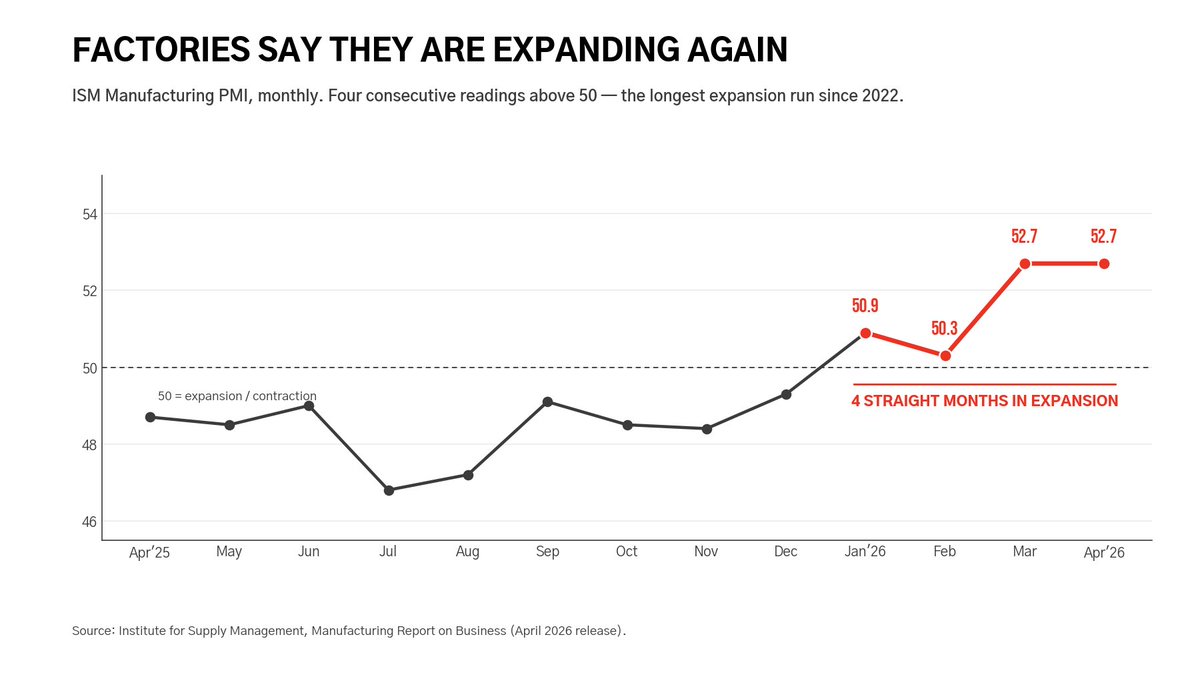
US manufacturing PMI: 52.7 in April — 4 straight months in expansion.
Factory construction: $189B SAAR — 2.5x the pre-CHIPS baseline.
Soft and hard data agree. That is rare. https://t.co/szrCVIZsZI
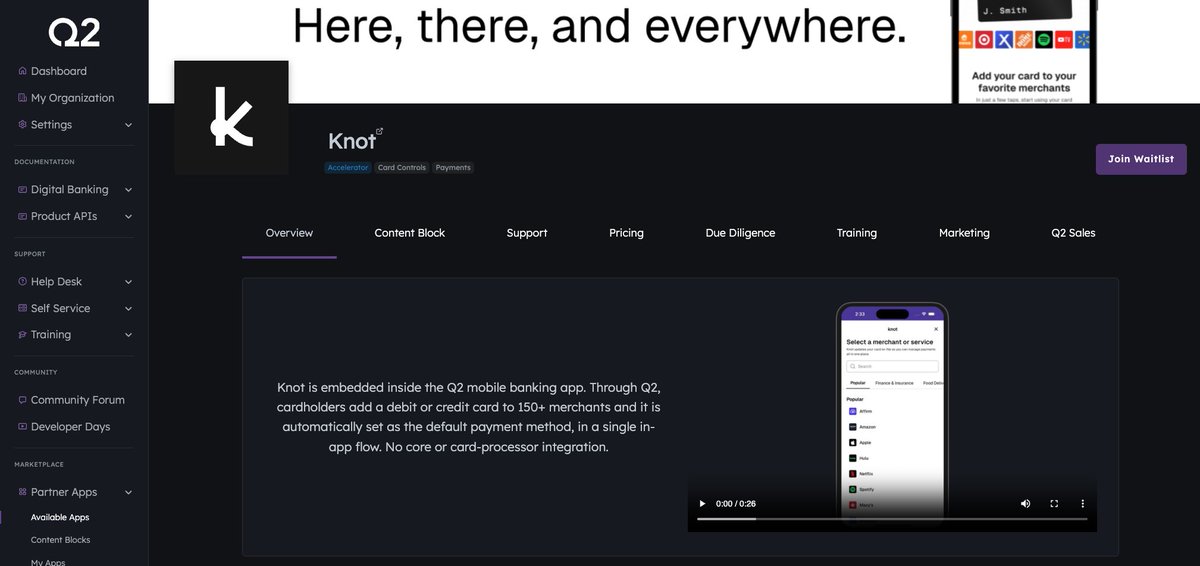
We’re excited to announce that @KnotAPIs is now available within @Q2_Software.
For years, credit unions and community banks have faced the same challenge: delivering the modern experiences customers expect without the engineering resources of the largest institutions. That gap has made it increasingly difficult to compete for top-of-wallet.
Today, that changes.
The 1,000+ credit unions and community banks running on Q2 can now enable Knot’s CardSwitcher™ with just a few clicks. Cardholders can seamlessly set their card as the default payment method across Amazon, Netflix, DoorDash, Uber, and many of the merchants that drive recurring and everyday spend.
Huge thank you to the team at Q2 for partnering with us. We believe the future of banking belongs to the institutions that make it effortless for customers to choose them, and we’re proud to help bring those capabilities to financial institutions of every size.
The elevator pitch is dead.
For years, founders have been coached to cram their entire business into a 60-second monologue, in case they corner a VC in an elevator. That's not how real conversations work — and it's not how investors decide what to look at next.
When I meet a founder and ask what they're working on, I want a normal answer. One sentence. "We're helping people do X by offering a service that does Y." If I'm interested, I'll ask questions. If I'm not, I'll say so and we both move on.
A canned, rapid-fire pitch doesn't make me lean in. It makes me wonder why you're talking at me instead of with me. The founders who actually raise well speak plainly about their business, answer questions directly, and send a clean executive summary afterward. The pitch isn't a performance. It's the start of a conversation.
If you're prepping to fundraise, throw out the script. Be able to explain what you do in plain English, and trust the investor to ask for the rest.
From The Fundraising Rules — the chapter on getting the meeting.
Venture studios are quietly becoming one of the most effective models for company creation, but most people still don't understand what happens inside one.
For this podcast episode I sat down with @AndyBilinsky, Partner at Interplay leading our Studio, to break down exactly how we build companies from the ground up.
During our conversation, we covered:
- What a venture studio actually is and how it differs from traditional VC
- Why we research industries deeply before ever writing a business plan
- The role of operating partners as true co-founders
- Why second- and third-time founders are choosing to build with a studio instead of going solo
- How Interplay went from 3 new companies in Q4 2025 to targeting 10+ in 2026
Big thanks to Andy for pulling back the curtain on how we build. Grateful to have him here at Interplay.
"VC is back" is a misread. Q1 2026 hit an all-time record — and 43% of it was one round (OpenAI, $122B). Strip out four AI labs and the other 5,996 startups split what was left. There are two venture markets right now. Most founders live in one of them. https://t.co/SCii6noWeN
B2B procurement is getting a complete overhaul.
Not incremental improvement. A full rebuild of the stack, from the agents executing purchases to the ERPs integrating them to the payment rails settling transactions.
@navya_prab breaks down where the opportunity is for investors and builders: https://t.co/4CeJb5UnRt
Most founders treat fundraising like a finish line. It isn't. It's a pit stop.
You stop racing for a few weeks. Fresh tires, souped-up engine, the right advisors on board.
If the raise doesn't make you faster after, you ran the wrong play.