Today, we’re excited to introduce Miso One, the most emotive voice model in the world.
Miso One is an 8-billion-parameter text-to-speech model for highly expressive speech generation. It emotes like a human and responds faster than a human, with just 110 milliseconds of latency.
We’ve open-sourced the model weights, with API access coming soon.
Hear how Miso One sounds in the thread below.
Pulled the trigger today and switched 100% of Lindy traffic to DeepSeek v4, churning from Anthropic models.
Saves us millions of $ and we're actually seeing an *increase* in performance on many core use cases. Transformative for the business.
What I wanted at 20:
- A fancy car
- A lot of friends
- A high-paid job
- A crazy social life
- A lot of validation
What I want at 30:
- A fit body
- A best friend
- A peaceful mind
- A meaningful work
- An empty calendar
My girlfriend called me at 2am crying. She had seen a photo on Instagram of me and another girl at a party.
She sent me the photo. I looked at it and I'm like, what? Only my nose looks like the guy in the photo! I keep telling her, “We're not the same person,” but she is not ready to accept it.
She then forwarded the photo to my friends asking them to confirm.
Even they were confused. Bro that really does look like you.
Now, at this point, the only hope I have is my last line of defense - a Cosine Similarity Test.
I know you guys are thinking, what the hell is this Cosine Similarity.
Cosine similarity is a mathematical way to measure how similar two things are by treating them as vectors in space. Think of it like measuring the angle between two arrows - the smaller the angle, the more similar they are.
In math, cosine similarity works like this:
cos(θ) = A·B / (|A| × |B|)
Where:
- A·B is the dot product of A and B.
- |A| and |B| are the magnitudes.
Understanding the Scale (-1 to 1):
- cos(0°) = 1 : Perfectly identical
- cos(45°) = 0.7 : Partially similar
- cos(90°) = 0 : No similarity at all
- cos(180°) = -1 : Complete opposites
Now let me prove to my girlfriend that the guy in the photo is not me. Let's say my facial features are Vector A and the guy in the photo is Vector B:
Vector A = [2, 4, 6, 8]
Vector B = [1, 2, 3, 4]
Step 1: Calculate Dot Product
Multiply each corresponding element and add them all up:
A·B = (2×1) + (4×2) + (6×3) + (8×4)
A·B = 2 + 8 + 18 + 32
A·B = 60
Step 2: Calculate Magnitude
Take the square root of the sum of squares of each element:
A = [2, 4, 6, 8]
|A| = √(2² + 4² + 6² + 8²)
|A| = √(4+16+36+64)
|A| = √120
B = [1, 2, 3, 4]
|B| = √(1² + 2² + 3² + 4²)
|B| = √(1+4+9+16)
|B| = √30
|A| × |B| = √120 × √30
|A| × |B| = √3600
|A| × |B| = 60
Step 3: Apply the Formula
cos(θ) = A·B / (|A| × |B|)
cos(θ) = 60 / 60
cos(θ) = 1
Cosine of 1 means perfectly identical.
Congratulations 🎉, you just learned Cosine Similarity.
Bonus:
Why does AI/ML care about cosine similarity?
Recommendation Systems: Netflix uses it to find movies similar to what you have watched.
Image Recognition: AI systems compare feature vectors extracted from images to identify faces or detect similarities between pictures.
Document Classification: Text classification systems use it to categorize emails as spam or not spam by comparing document vectors.
Last day under Seoul’s sun ☀️ These 3 weeks off gave me a lot of energy and new ideas. I recommend anyone who’s working on AI to take a week fully disconnected to recover and recharge!
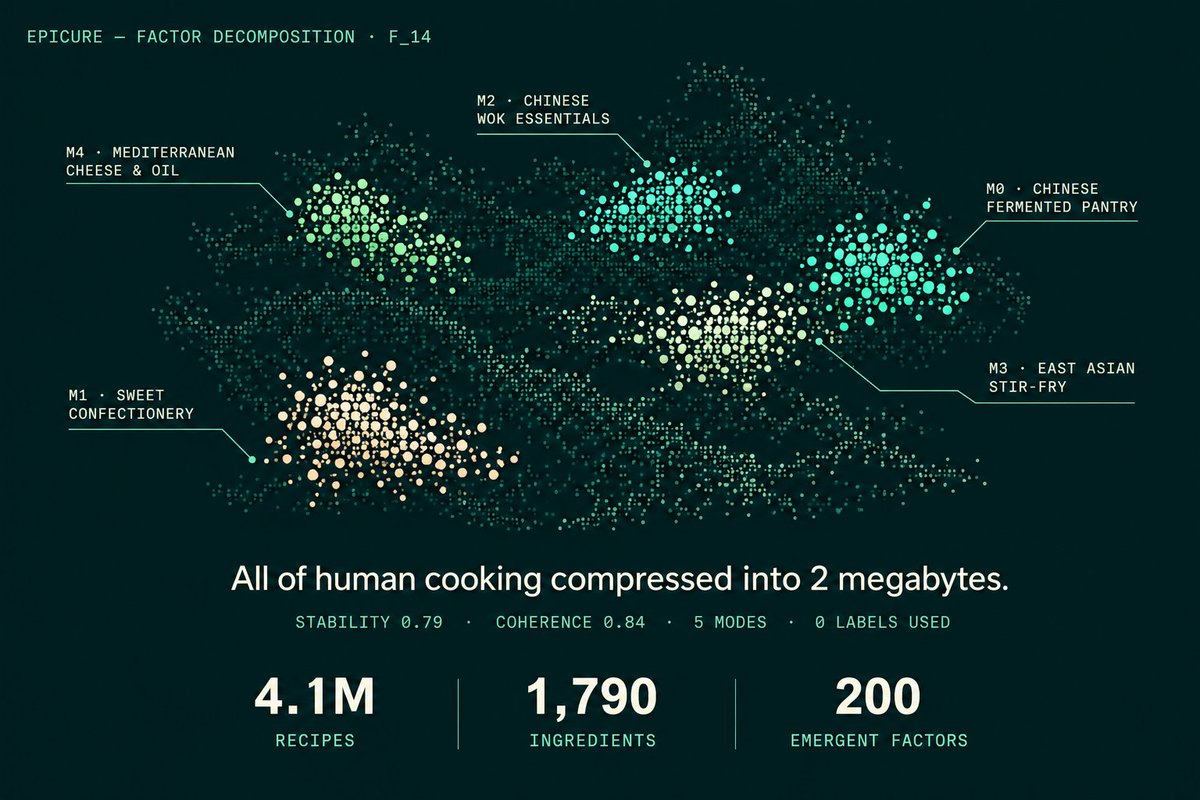
Launching our new paper on arXiv: we trained the largest multilingual food model ever built.
4.1M recipes. 7 languages. 1,790 ingredients. 300 dimensions.
All of human cooking compressed into 2 megabytes.
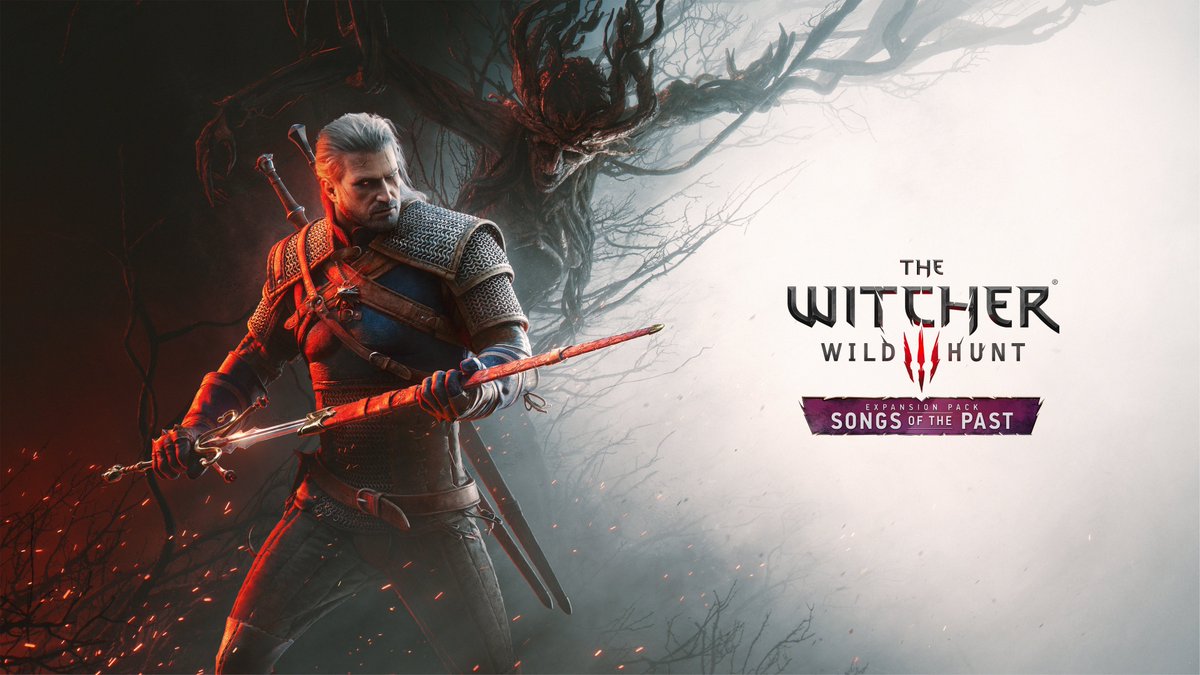
Medallion's humming... that can only mean one thing! It's time to announce The Witcher 3: Wild Hunt - Songs of the Past! ⚔️
This brand new expansion for The Witcher 3: Wild Hunt will take you to the Path with Geralt of Rivia once more. It’s being co-developed with @Fools_Theory and is coming to PC, Xbox Series X|S, and PlayStation 5 in 2027. Stay tuned for more information in late summer. ⏰
I just got back from SF and I FEEL INSPIRED.
I spent 5 days with frontier AI model teams, AI startup founders, and 3 billionaires.
My takeaways:
1. I had lunch with 3 billionaires. All of them are buying SaaS companies and rebuilding them agent-first. They were deeply inspired by Bending Spoons and Ryan Cohen's eBay deal. Buy the company, cut the headcount, rebuild the tech, add agents, add features, make more valuable experience, raise prices.
2. The frontier model companies are hungry for usage data from the field. They can see API calls and token counts. They can't see the actual workflows. If you're deep in a niche using these models in ways the model companies haven't seen, that understanding is incredibly valuable. Usage intelligence is the new alpha.
3. Consumer AI is massively underbuilt. Every billboard in SF is either B2B inference infrastructure or vertical agent companies. The entire city is optimized for enterprise. Meanwhile you have companies like Cal AI doing $50M ARR in 18 months as a consumer app. I met with a cool few teams doing consumer AI (@paulscherer / @ekuyda)
4. MCP came up in literally every conversation. The companies exposing their product as MCP endpoints are getting pulled into deals they never pitched for. The ones that aren't are becoming invisible to agents. This is the new SEO. If agents can't find you, you don't exist. Building products for agents is the new zeitgeist in general.
5. Not uncommon for hot seed rounds to be $25-50 million valuations. I saw a Series A at $450 million
6. If I had a dollar every time someone mentioned "forward-deployed engineer" this trip I could have funded a seed round. It's the hottest role in SF right now. The person who sits between the agent and the customer, making sure everything actually works.
7. The mood around open source shifted. A year ago it felt like open source was chasing the frontier models. Now founders are telling me Gemma and DeepSeek are good enough for 80% of what they need at a fraction of the cost. The "which model do you use" conversation is being replaced by "which model for which task." Model loyalty kinda feels dead.
8. Voice agents came up more than I expected. Multiple founders told me voice is the interface for the next billion users. The billion people who will never type a prompt will absolutely talk to one.
9. The Obsidian community in SF is weirdly intense. Multiple founders showed me their vaults unprompted. Like showing someone your home gym. It's a flex now. The quality of your knowledge base (second brain?) is becoming a status symbol among builders.
10. Maybe it was just the people I met but the age of the founders is shifting. I met more founders over 40 this trip than any trip before and more founders under age 21 than ever before. Founders getting older and younger at the same time.
11. I spoke to a lot of fast-growing startups, VCs and frontier models who are hiring content creators right now.
12. The restaurant scene in SF is actually better than it's been in years. Founders are going out more. Alcohol is out, not surprisingly.
13. SF doesn't feel like the only place anymore. We all have access to the same frontier models. We all read the same X feed. A founder in NYC or Lagos is calling the same APIs as a founder in SoMa. So in the past it felt like SF was always lightyears ahead, doesn't feel that way anymore. It's okay not to live in SF and have BIG DREAMS.
14. The coworking spaces in SF are half empty but the coffee shops are packed. People want to be around people. I had a few startup ideas here....
15. Walking around the Mission I noticed something: the street-level businesses, the taquerias, the barbershops, the laundromats, none of them use any AI at all.
16. I heard the phrase "agent debt" for the first time. Like technical debt but for agents. When you hack together an agent workflow fast and never clean it up, the system prompts conflict, the memory gets polluted, the tools overlap. 6 months later the agent is doing weird things and nobody knows why lol.
17. Met a few people who carry two phones now. One for personal. One that's basically an agent terminal running Telegram or iMessage connections to their agent fleet.
It's always amazing to get that dose of inspiration in SF. I FEEL INSPIRED.
But I'm so happy to be back home, locked in and building.
We're 12-18 months into a shift that will take 15 years to play out. The urgency in every conversation was real.
What an incredible time to be building.
Doing my 2 weeks detox from working in AI startup with 10 agents running and talking about B2B SaaS with my roommate everyday to travelling in South Korea without computer, no internet except hotel wifi and barely speaking Korean 🥴
6AM walk along the old Seoul city wall at Naksan Park, surrounded entirely by elderly Koreans moving at a pace I could barely keep. That's who I want to be at their age, aging goals honestly! 🏃♂️