I am a spectrum of people,I am not hateful, I just say things people are afraid to say unapologetically, I mean no harm, I seek truth, and knowledge within love
Your AI agent can do almost anything. Who decides what it's allowed to do?
That's the question keeping security teams up at night.
Claude Code, Cursor, Codex, OpenClaw — they're shipping code, querying databases, and clicking through real browsers. They act autonomously, at superhuman speed.
And right now, nothing sits between them and the systems they touch.
No layer decides what's allowed. No record of what happened. No way to cut off access without redeploying.
Then I found @kastralabs.
Launched today on Product Hunt.
It's the runtime authorization layer for AI agents. It decides what agents can and cannot do before actions execute — enforcing policies with sub-1ms latency across tools, prompts, inputs, and outputs.
Here's what makes it different:
➟ Runtime authorization — every prompt, tool call, shell command, and API request is checked against policy before it runs. Deny in under a millisecond
➟ One control plane — govern agents and policies across Claude Code, Cursor, Codex, OpenClaw, Anthropic SDK, OpenAI SDK, and more
➟ Recon — scan your agent's history and see every risky thing it already did, with policies drafted for each one
➟ Audit trail — signed, append-only traces. Stream to your SIEM. Pass audits on the first pass
➟ Deployment flexibility — cloud, hybrid, self-hosted, or air-gapped. Same policies. Same evidence vault
What this actually means:
✓ Prevent unauthorized tool use, prompt injection, and data exposure before they become incidents
✓ Authorize actions, tools, shell commands, API calls, SQL queries, and web actions — all from one control plane
✓ Auto-detect risky behavior and draft policies before enforcing
✓ SOC 2, ISO 27001, HIPAA, GDPR compliant. FedRAMP ready
Trust the rules, not the agents. 142 active policies. 4,812 requests/second. p99 0.8ms latency.
Built for global banks, federal agencies, and frontier AI labs.
👉 Your AI can do almost anything. Decide what it's allowed to do.
📌 Start free → https://t.co/HewRq23KhM
@kastralabs is live on ProductHunt right now: https://t.co/TvND3H7UFr
🔄 Repost if you've ever wondered what your AI agent is really doing in production.
—
#AISecurity #AgenticAI #Authorization #OpenClaw #Kastra #ProductHunt
My friend applied to 250 tech jobs in two years. No MIT. No Stanford.
Last month Anthropic offered him $750,000.
I asked him how he broke in from zero.
He sent me the exact video that got him in. Anthropic's 2-hour course on how to become an AI engineer in 2026.
Thariq Shihipar shows you exactly how to build AI agents from scratch.
I watched it last night.
Halfway through, I realized I could break into an AI lab in months, not years.
Bookmark this and read the article below.
• 00:00 - AI agent harness
• 23:44 - building AI agent loops
• 56:39 - AI agent context engineering
• 1:33:34 - AI agent deterministic hooks
• 1:50:31 - Anthropic SWE interview process
Burkina Faso's President Ibrahim Traore says Sharia Law will never be implemented in the country, and advised Burkinabe citizens studying the course in Saudi Arabia not to return.
He questioned why the 1,000 students studying Sharia Law didn't learn trade or acquire skills.
SOMEONE BUILT AN ENTIRE COMPANY BRAIN INSIDE CLAUDE CODE IN 7 DAYS
Not Obsidian. Fully custom.
A living map of every employee, every agent, every SOP on one screen.
Click any node and it opens up:
- what department it's in
- what SOPs are attached
- what it can actually access
that permission layer is the whole game
an employee opens the chat and the AI already knows their access level, agents, SOPs and tools surface in the conversation like you tagged them by hand
Obsidian cannot do this...
no dev team.
no six month build.
no enterprise budget.
just Claude Code and one week
https://t.co/HRsFUkCQkv has everything to build one
full guide on building your own team below
Anthropic engineer:
"Fable 5 is already smarter than we know how to use. The bottleneck was never the AI, it's you."
In 19 minutes he shows exactly how to get everything out of Claude with no extra tools, no extra costs.
You're already paying for all of this, just not using it.
Watch the session, then read the guide below on the Claude features 99% of users never find.
PROMPTS ARE DEAD. LOOPS JUST REPLACED YOUR $200K ENGINEER.
Claire Vo showed how to turn one prompt into a self-running loop.
It reviews your aging pull requests every morning and hunts for new skills every week.
And it spins up its own subagents to check its own work.
Runs on Claude Code + Codex. One afternoon. One prompt.
The numbers are insane:
- Senior doing code review: $200K/year
- Automation engineer: $150K/year
- This setup: about $200/month
- Time to build: one afternoon
- Skill required: describe the job like you are onboarding a hire
The opportunity is even wilder:
Teams pay people to babysit pull requests and chase stale reviews. The loop does it itself at 10:15 a.m., alerts the team, and validates itself with subagents. An agency would charge thousands to wire this up.
One person + Claude Code + Codex + one prompt = an engineering team that reviews code and finds new skills while you sleep.
Save and watch the clip.
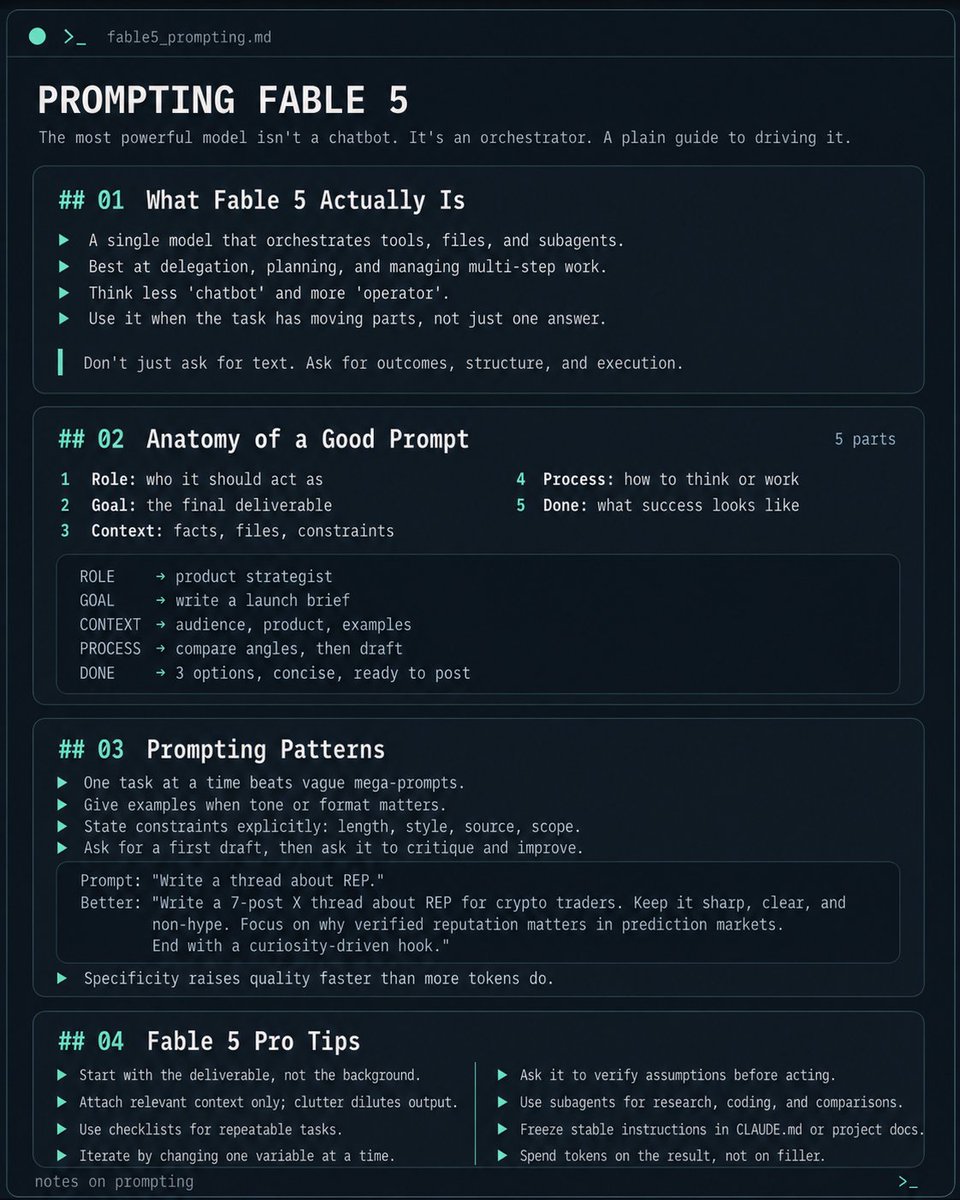
SOMEONE MAKING $50K A MONTH WITH FABLE 5 LEAKED THE ONE-PAGE CHEATSHEET ANTHROPIC BURIED IN THEIR OWN DOCS
4 effort levels, 50+ subagents, 1 orchestrator - the entire prompting system for the most powerful model on earth, on a single screen
the barbell that decides if it pays: Fable plans 10%, cheap agents run 80%, Fable verifies 10%
a whole team's output for a fraction of the tokens
tell it the why, keep the prompt short, and cap it with a stop rule
this isn't prompting, it's a machine that builds while you sleep
your old Opus 4.8 prompts actively make it worse, and Anthropic hid the fix deep in the docs
people sell $500 courses on this - you get the whole thing free in the article below
CLAUDE JUST TOOK FULL CONTROL OF TRADINGVIEW AND STARTED PLACING TRADES ON ITS OWN
one workflow now reads the chart, marks the setup and executes while the screen sits untouched
here is the build
connect Claude to TradingView through a browser automation layer
feed it your rules, the levels you watch, the entries you take, the invalidation
it scans the chart, waits for your exact condition then fires the order and manages the stop
no more sitting there refreshing candles at 2am
i wrote the whole loop out, how it researches the setup, verifies it against your rules then executes while you sleep, in Loop Engineering for Quants
SOMEONE VISUALIZED THEIR SECOND BRAIN AS A COLOR CODED CLUSTER YOU CAN ROTATE
every note sized by weight, activity bleeding through in reds and oranges, months of thinking compressed into one shape you can spin around
this article runs a different kind of second brain through the same idea, four agents instead of one static map, each one updating its own cluster every six hours as new notes, chats, and code sessions come in
the map isn’t just a snapshot here, it keeps redrawing itself while you sleep
full breakdown in the article below👇
Anthropic just dropped 5 workshops on building self-improving agentic systems from scratch:
00:00 - Ship your first Claude agent
36:44 - Build memory for Claude agents
1:05:06 - Make your agent autonomous
1:26:46 - Set up a proactive agent
2:03:35 - self-improving agents (tools,skills)
These 3-hours of free Claude workshops will replace 10 paid agentic courses.
Watch today, then read article below on how to build a self-improving agentic system with Fable 5.
SOMEONE MAPPED CHAOS INTO A NAVIGABLE SPACE AND YOUR HERMES AGENT NEEDS THE SAME THING
thousands of chaotic data points, each given a position, navigation becomes instant because the structure does the work
your vault is the same chaos, hermes lands in it and opens files at random because nothing tells it where to start
one index file per major folder with a clear starting point changes everything
2 minutes per task drops to 10 seconds, same agent, same model
full breakdown in the article below ↓
A Japanese 58 year old filmed himself walking on a treadmill for his subscribers. He said his monthly income was 15 million yen from stocks. He has not placed a trade himself in 11 months. A team of 8 AI agents runs his entire portfolio.
He built each agent to watch for one condition and act automatically. Nothing else.
One agent watches for a 5 percent drop and holds. One watches for a 15 percent drop and buys 10 percent more. One watches for a 25 percent drop and buys 25 percent more. One watches for a 15 percent rise and keeps holding.
One watches for a 25 percent rise and sells 10 percent. One watches for a 35 percent rise and sells 20 percent. One watches for a 45 percent rise and sells 30 percent. One agent runs the other seven.
This is what Japan figured out before the rest of the world. You do not need a hedge fund to run your own money. You break your rules into 8 small agents, wire them together, and let them run 24 hours a day for 60 dollars a month.
15 million yen a month in income. His Claude subscription costs 4,000 yen. He spends the rest of his time on the treadmill, on the phone, and asleep.
On camera he was a 58 year old sharing 28 years of wisdom with his followers. The wisdom is now 8 small agents watching the market while he walks.
claude fable 5 can scrape thousands of sold homes and finds the patios with zero shade in 100°+ heat. then it mails the owner a postcard with the fix rendered into their own backyard
here's the system you can sell to contractors:
- scrapes every home sold in the metro in the last 12 months (recent buyers spend the most)
- vision-reads the listing photos, skips the 64% with cover already
- measures the sun on each patio, hour by hour, off google's satellite data
- renders a louvered pergola into the owner's actual backyard photo
- prints the diagnosis on the postcard: "your patio takes 11 hours of direct sun a day. saturday it hits 97°."
- QR opens a heat report for their exact address with a booking link
every install is $6.5k to $18k, one close covers months of retainers and homes sell every single day.
reply "SYSTEM" + RT and i'll send you a free guide so you can build this too (must be following so i can DM you)
THIS $300 ZIMA BOARD RUNS A LOCAL LLM AND HOSTS AN ENTIRE DEV STACK, KILLED $200 CLAUDE CODE MAX AND $200 CHATGPT PRO SUBSCRIPTIONS THE DAY IT SHIPPED AND MADE HIS AI BILLINGS FREE FOREVER
00:47 the host holds up the board, "you can do just about anything on this"
the zima board 2 is an x86 mini pc that runs proxmox with claude code and every client's staging environment inside a chassis smaller than a hardcover book
he used to spread the ai stack across chatgpt pro, claude code max and cursor for $459 a month, one weekend of migration onto local models and the entire bill dropped to $3 in electricity
claude code runs locally on the board with an agents.md and claude.md file per client repo, the router assigns sonnet 5 to daily work and fable 5 to migrations and audits, every pull request opens without a cloud api touching client code
$459 a month in ai subscriptions used to walk into openai and anthropic pockets, the $300 board pays for itself in month one and every ai billing after that is $0 because the model runs on his own hardware
bookmark this and read the article below
A 20-year-old student from China, Li Hao, built an AI speed radar with Claude alone and sold it to a city district for $317,000
He wrote the whole thing in 9 days, spending about $20 on Claude API calls
He set an old camera on his balcony, pointed it at the intersection below, and let Claude watch the road
Claude tags every car, motorbike and pedestrian in real time, 653 in five minutes, and flags anyone over the limit
The moment a car speeds, Claude clips the video, reads the license plate, matches the owner, and emails the fine on its own
A normal radar takes one photo and misses half the time. Claude records full video, so there is nothing to dispute, and the fines go out with no operator
He walked into the district office with a flash drive and asked for 10 minutes. he left with a contract
Every Claude config he used is in the article
An China guy discovered a method to learn any knowledge instantly using AI.
The key is Obsidian + any AI — Kimi, Claude, or Gemini.
Most people learn slowly: read, forget, read again, forget again.
His method: use AI to transform any content into small, interconnected notes.
Use Obsidian to link them, so every piece of knowledge is never isolated.
Slow method: highlight books, keep going, forget after a week.
Fast method: AI breaks it into atomic notes, Obsidian links them into a network.
Six months later, a new idea instantly connects to twenty things you already know.
I compiled the full A–Z guide to building a second brain with Obsidian — works with Kimi, Claude, or Gemini — that most people have never discovered.
Article below