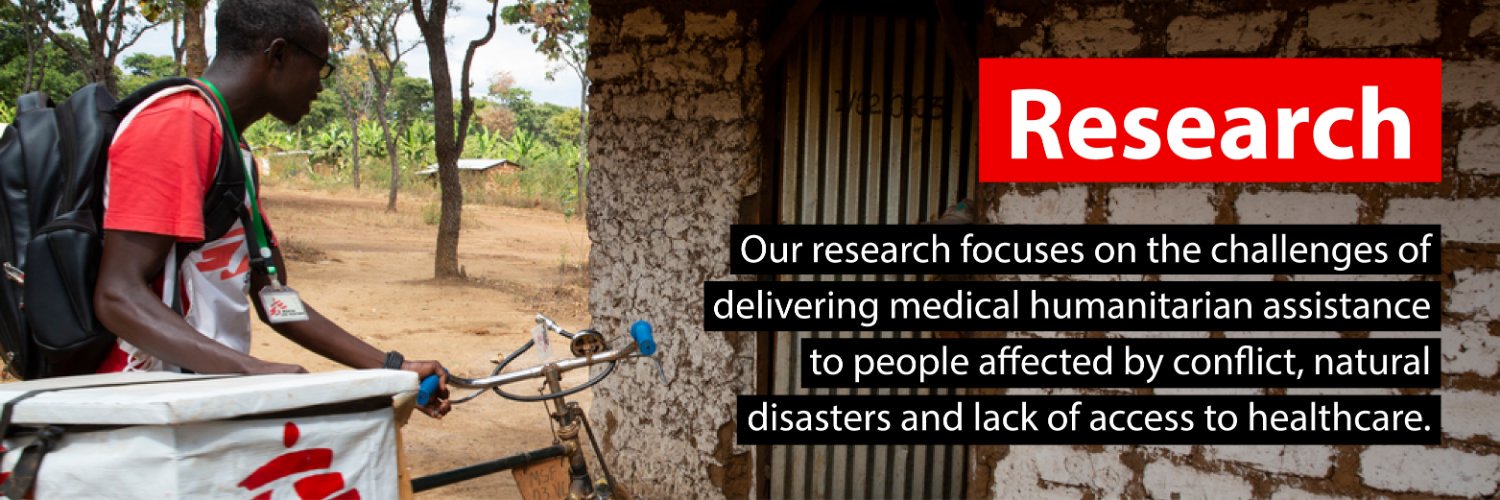
Research @ Médecins Sans Frontières. Global health research and innovation for humanitarian action. Home of the MSF Scientific Days and MSF Science Portal.
“In many humanitarian emergencies - including those where MSF works - acute mortality rates for children may exceed WHO-recommended thresholds for considering mass drug administration (MDA)" shares Dr.@AulaAb, MSF Infectious Diseases specialist advisor.
“Azithromycin MDA has shown the potential to reduce childhood mortality in stable, high-mortality settings... As such, it could provide an additional practical intervention, particularly when integrated with other lifesaving activities such as vaccination campaigns."
"Its use must be guided by evidence and accompanied by careful AMR monitoring."
In humanitarian crises, children face a high risk of dying from infections that are both preventable and treatable, especially before emergency services are set up.
A new review from @LSHTM , @LSHTM_AMR, @UNICEF and MSF explores how providing a commonly used antibiotic to all children under five during acute emergencies, whether they are ill or not, could complement existing child health interventions and reduce excess mortality. The authors call for humanitarian guidelines to consider mass administration of antibiotics as a potential additional tool.
Read the full article: https://t.co/ghtqIYSwqW
In humanitarian crises, children face a high risk of dying from infections that are both preventable and treatable, especially before emergency services are set up.
A new review from @LSHTM , @LSHTM_AMR, @UNICEF and MSF explores how providing a commonly used antibiotic to all children under five during acute emergencies, whether they are ill or not, could complement existing child health interventions and reduce excess mortality. The authors call for humanitarian guidelines to consider mass administration of antibiotics as a potential additional tool.
Read the full article: https://t.co/ghtqIYSwqW
Some publications are measured by citations, others are measured by the lives, dedication and memories they carry.
Today we share research on burn rehabilitation in Gaza, documenting improvements in pain, function and scar outcomes among patients treated in MSF outpatient clinics between 2018 and 2020.
This publication honours colleague, Abed El Hamid Qaradaya, who dedicated his career to improving care for burn survivors in Gaza.
Read the full article here: https://t.co/lh3oJEvnW7
On International Day of Play Dr. Louisa Baxter, MSF Medical Director, discusses the importance of preserving play in humanitarian interventions with
Watch it here: https://t.co/bqV9iLdC7m
Conflict-related deaths nearly doubled between 2021 and 2024, and an estimated 239 million people require humanitarian assistance in 2026. Health in a World of Crises and Impunity, the CHH-Lancet Commission’s report starts an important conversation
Following on from Scientific Days we are excited about the launch of the CHH-Lancet commission on Health, Conflict and Forced Displacement. An important discussion on health systems in crises. Read more here: The Report - https://t.co/OGz9zA7llb
@HumanitarianJH · @TheLancet
#MSFSci #msfscidays #CHHLancetCommission #HumanitarianHealth #GlobalHealth
239 million people need humanitarian aid in 2026. Only 87 million will receive it. Health in a World of Crises and Impunity, the CHH–Lancet Commission’s report starts an important conversation.
#MSFSci#CHHLancetCommission#HumanitarianHealth#GlobalHealth
📢🏁Last presentation of the day integrated newborn care kit to improve outcomes in Gilgit Baltistan, Pakistan — results from a cluster randomised trial by Daniel Farrar @SickKidsGlobal#MSFScidays
Director of the MSF Manson Unit, Matt Coldiron, shares #MSFscidays closing remarks: “We don’t want to make patients fit the tools, we want to make tools fit the patients”
Study team think that neonatal mortality may have been under reported in the study areas during study period, as was clearly higher in pre-study survey results. Challenging uncertainties.
#msfscidays
« Knowledge and action looks different, depending on where you stand » Fantastic ethnographic study by seeking to integrate operational intentions with local understanding and priorities to design climate responsive humanitarian programming #MSFScidays
For our final session, Daniel Farrar from @SickKidsGlobal presents findings from Gilgit Baltistan, Pakistan.
A simple newborn care kit delivered by community health workers reduced umbilical cord infections and dangerous post birth bleeding, demonstrating the strong potential of low-cost community based care for hard to reach populations. #globalchildhealth #MSFscidays
Integrated newborn care kit (iNCK) - cluster randomised trial of use in Pakistan to estimate effect on neonatal mortality and other related outcomes.
#MSFSciDays
“Knowledge and action look different depending on where you stand.” Nell Gray calls for better integration of community experiences of climate change into humanitarian response in eastern Chad. #MSFscidays
@ViiVHC do better! We want pricing transparency and accountability to drive access to vital preventative tools! Our science shows how much #PrEP is needed and wanted in key populations. #HIV thrives in silence so why ask for silence in your procurement policies? #MSFscidays
Research on improving access to healthcare for adolescent populations in Mombasa, Kenya shows that involving young people in programme development improves health seeking behaviour.
Presenter Denton Callander calls for greater engagement with key adolescent populations to maximise impact. #MSFscidays
HIV thrives in silence: Marginalised people need access to long-acting injectable HIV prevention the most, with a peer-delivery model proving most effective.
What happens when HIV prevention is designed around community preferences? Early findings from Beira, Mozambique suggest that many participants prefer long acting injectable HIV prevention delivered by peers over daily oral medication. #MSFscidays
What happens when HIV prevention is designed around community preferences? Early findings from Beira, Mozambique suggest that many participants prefer long acting injectable HIV prevention delivered by peers over daily oral medication. #MSFscidays
Next up: Final results from the Mombasa Youth and Key Pop Study — advancing population health research for better interventions by Denton Callander #MSFScidays