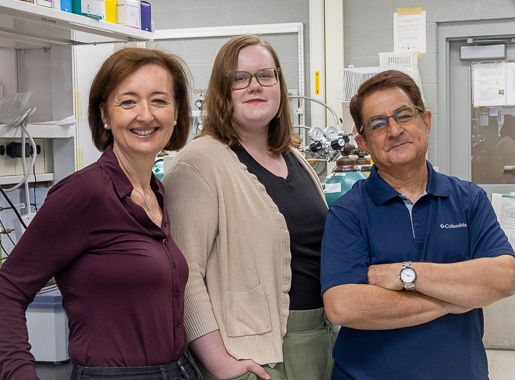
Congratulations to MGI Professor Chris Waters on winning the Michigan State University College of Natural Science Meritorious Faculty Award! Well done!
One way these immune cells defend the lungs is by engulfing, or "eating," bacteria through a process called phagocytosis.
Jared uses a laboratory model of alveolar macrophages to study these responses. Here, fluorescently labeled bacteria appear green in a microscopy image.
Student spotlight: MGI graduate student Jared Godfrey studies alveolar macrophages, immune cells that help protect our lungs from infection and regulate immune responses.
His research explores how these cells respond to potential threats and help maintain healthy lung function.
MGI's Asst Prof Aretha Fiebig & PhD student Maddy Quinlan headed down to the MSU ag fields to take soil samples last Friday. They will conduct greenhouse experiments later this winter to explore the ways in which the soil microbiome affects the growth of soybean plants.
The podcast is live!
Recorded during MSU's ASM Milestones in Microbiology celebration, this special episode of This Week in Microbiology features MGI's Vic DiRita, Elizabeth Heath-Heckman, Rich Lenski, and Jim Tiedje.
Listen here: https://t.co/UdqCJRLalH
New research from the @Abramovitch Lab! First author Adam Kibiloski and colleagues found that lactate and phosphate together increase acidity inside tuberculosis bacteria, contributing to growth arrest under acidic conditions.
Read in PLOS Genetics: https://t.co/pVAsALJRfM
Congratulations to MGI Associate Professor Kirstin Parkin who was honored with two awards from the College of Human Medicine! She received the Outstanding Curriculum Contribution Award and was inducted into the Gold Humanism Society.
Read more: https://t.co/N9UjsWHGya
Recently, she returned to her high school to speak with students in her former AP Biology teacher's classroom. She shared her experiences conducting infectious disease research, discussed grad school as a possible path, and answered students' questions.
Great work, Madison!
Meet Madison Enviya, an MGI grad student in the DiRita Lab studying how the gut pathogen Campylobacter jejuni senses and responds to changes in oxygen & how these changes support its growth during infection.
New research from Drs. Hong, Fiebig, O’Halloran, Crosson, and colleagues in mSystems shows that two closely related genes in the gut bacterium B. fragilis play distinct roles in shaping its cell membrane and helping it withstand stress.
.@michiganstateu earned top global honors across multiple science-related fields in the latest 2026 @ShanghaiRanking Global Ranking of Academic Subjects.
These university-wide achievements highlight the incredible work of Spartans across campus, including from the @msunatsci.
Growth media long considered interchangeable in Geobacter research can actually cause the bacteria to behave very differently.
New research from the Reguera Lab reveals why that matters for studying how these bacteria transform metals.
Read more: https://t.co/3Fu1TnekU0
We are absolutely thrilled to have been designated an ASM Milestones in Microbiology Site! This honor recognizes the university's lasting contributions to the field of microbiology, particularly in the fields of microbial ecology & evolution.
Read more: https://t.co/8JOyQAZkZN
How did a bacterium responsible for deadly botulism become a producer of valuable pharmaceuticals?
MGI Prof. Richard Lenski helped investigate its evolution in a collaboration featured in @ScienceMagazine .
https://t.co/aIdn2K2Jxe
New research from MGI Asst. Prof. Elizabeth Heath-Heckman's lab with first author Alice Walker sheds new light on the peripheral nervous system of the Hawaiian bobtail squid.
Read more here: https://t.co/61Nmo8V3aA
Leah is pictured examining switchgrass, a potential biofuel crop, growing in an experimental setup called a gnotocosm.
The second image shows fluorescence from coumarins, a class of chemical compounds Leah studies, in the roots of Arabidopsis plants.
🌱 Meet MGI grad student Leah Knoor from the Lebeis Lab! She studies how chemicals released by plant roots shape the microbial communities around them, especially under stressful conditions. Her research could help scientists find new ways to improve plant health.
Leah is pictured examining switchgrass, a potential biofuel crop, growing in an experimental setup called a gnotocosm.
The second image shows fluorescence from coumarins, a class of chemical compounds Leah studies, in the roots of Arabidopsis plants.