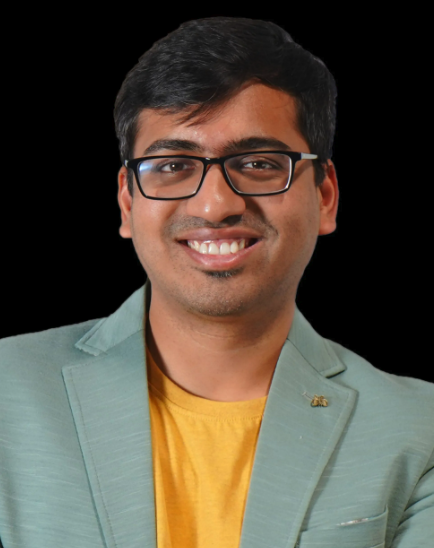
Meet Pawan Kumar Chandana, the man who scored 51 marks in maths as a schoolboy and went on to build India's first private rocket.
Born in 1991 and raised in Visakhapatnam, Chandana grew up in a middle class household. Maths was a weak spot until entrance exam prep turned it into an obsession, and that push got him into IIT Kharagpur in 2007 for a dual degree in Mechanical Engineering.
He joined ISRO in 2012, working on the GSLV Mk3 heavy lift vehicle. But he wanted to build a private rocket industry in a country where that barely existed.
In 2018, along with fellow ISRO engineer Naga Bharath Daka, he founded Skyroot Aerospace in Hyderabad. By 2020 they had tested India's first privately built rocket engine. Skyroot went on to launch Vikram-S, India's first private rocket, and the company is now valued at over 1 billion dollars.
Once defeated by numbers, now he counts stars - leading India toward the cosmos.
Charlie Munger:
“A wonderful life lesson for you...There's a whole lot of things that aren't going to work for you...Avoid the crooks, crazies, egomaniacs, people full of resentment, people full of self-pity, and people who feel like victims...Avoid them like the plague.”
Warren Buffett: "You have to understand accounting. It's the language [of business]. It's like being in a foreign country without knowing the language if you're in business and you don't understand accounting."
"You want to get as comfortable with [accounting] as you are with the English language."
Warren Buffett: "No matter how wonderful a business is, there's always a risk that you will pay [too high] a price [and] it will take a few years for the business to catch up with the stock. The stock can get ahead of the business."
(Berkshire Hathaway AGM || 1997)
Wonderful times are coming for humanity, because machines will handle memory better than human beings. For the first time, we can focus on what truly matters – becoming a profound life and raising human consciousness.
#SadhguruWisdom
El gran abuelo Charlie
“El mundo no se mueve por la codicia. Se mueve por la envidia.”
“El hecho de que todo el mundo viva cinco veces mejor que antes se da por hecho. Solo piensan en que otro tiene más, y en que no es justo que él lo tenga y ellos no.”
“Hay mucha gente que sigue sintiéndose infeliz y maltratada, aunque la calidad de vida haya mejorado muchísimo con el tiempo, simplemente porque siempre ven a alguien que tiene más.”
Today, one of my office friends told me something about his wife that really stayed in my mind.
He said that yesterday he came home completely exhausted after a long and stressful day at work. He was expecting to have dinner and relax, but when he entered the kitchen, he realized that no food had been prepared.
He asked his wife, "Why isn't dinner ready?"
She calmly replied, "I wasn't feeling well today, and honestly, my mood wasn't good either, so I couldn't cook."
My friend admitted that he became upset. After a tiring day, he felt disappointed and spoke to her in an irritated tone.
What surprised him was that instead of arguing back or getting angry, she simply smiled and remained calm.
Confused, he asked, "I'm clearly upset. Aren't you angry at me? Why aren't you arguing back?"
His wife smiled and said,
"My mother taught me that a marriage is not a competition where someone has to win. Not every situation needs an angry response. If one person is upset, sometimes the other should stay calm. Otherwise, a small issue can turn into a big fight."
My friend said those words instantly made him realize his mistake. His anger disappeared, and instead of continuing the argument, they went into the kitchen together, prepared a simple meal, and spent the evening peacefully.
Before finishing the story, he looked at me and said,
"Beauty may impress someone for a few years, but a kind, understanding, and patient life partner can make an entire lifetime beautiful. If someone gets a spouse like that, home truly feels like heaven.
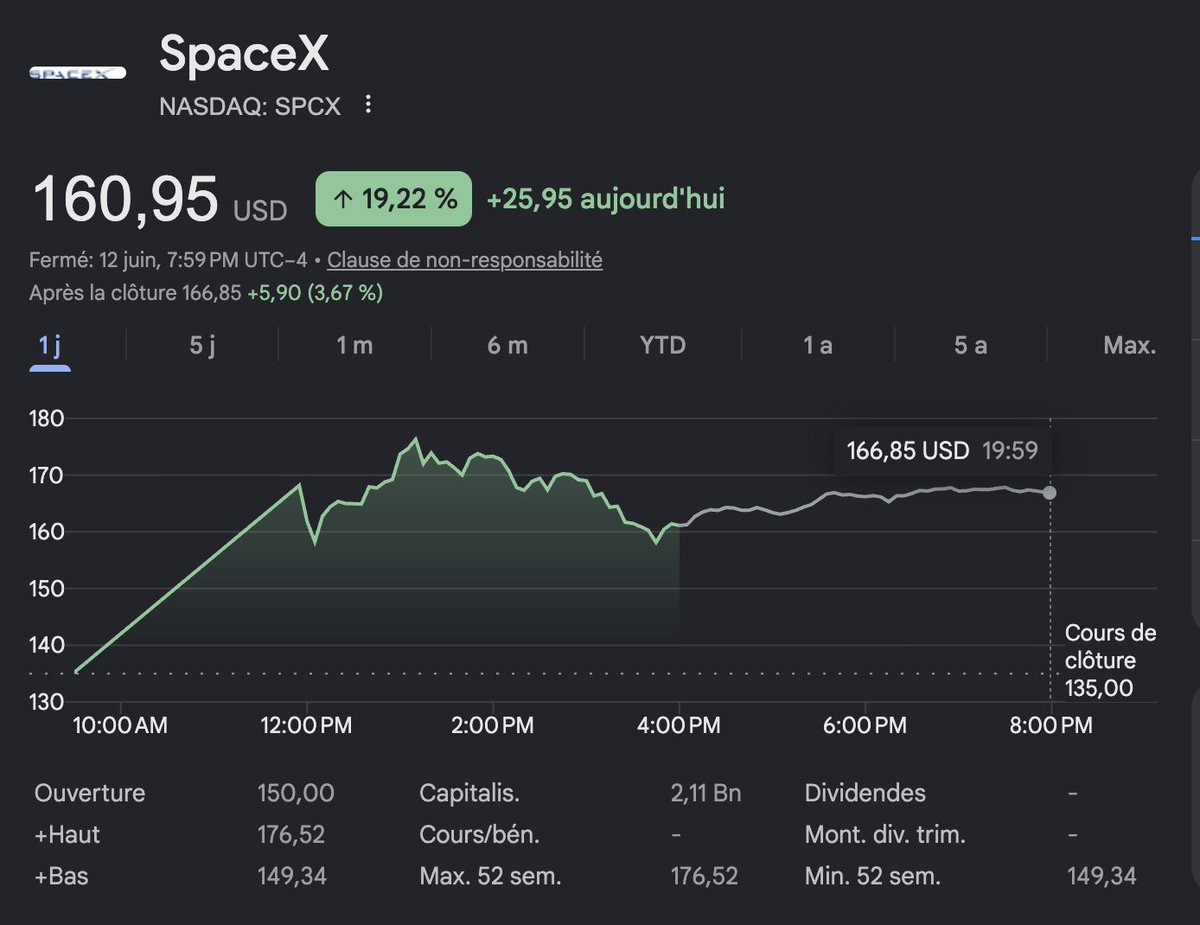
SpaceX a clôturé son premier jour de cotation à 2 100 milliards de dollars, +19%. Tout le monde regarde le chiffre. Personne ne regarde ce qu'il price réellement.
Laissez-moi vous dire ce que le marché vient d'acheter, et pourquoi je pense que cette boîte vaudra 30 à 50 trillions d'ici 5 ans.
D'abord, le symbole. Cette IPO est un référendum. D'un côté, 20 ans de discours sur la décroissance, la sobriété, la redistribution, la fin de l'histoire gérée par des comités. De l'autre, un homme qui a dit "je vais rendre l'humanité multiplanétaire", que tout le monde a traité de clown, et qui vient de créer la plus grosse entreprise cotée de l'histoire en partant d'un entrepôt à El Segundo. Le marché a voté. Le wokisme avait des départements RH, SpaceX avait des fusées. Les fusées ont gagné.
Ensuite, la mécanique économique, parce que c'est là que tout le monde se trompe. Les analystes valorisent SpaceX comme une entreprise de lancement plus Starlink. C'est comme valoriser Internet en 1995 sur le marché du fax. Starship ne réduit pas le coût du kilo en orbite de 20%, il le divise par 100. Et chaque fois dans l'histoire qu'un coût d'infrastructure est divisé par 100, ce n'est pas le marché existant qui grossit, ce sont des industries entières qui naissent. Le coût du calcul divisé par 100 a donné Internet, le smartphone, l'IA. Le coût de l'orbite divisé par 100 va donner une économie spatiale complète.
Faisons la liste de ce qui devient rentable quand le kilo en orbite coûte le prix d'un billet d'avion. Les data centers orbitaux, avec énergie solaire continue et refroidissement gratuit, au moment exact où l'IA fait exploser la demande énergétique terrestre. La fabrication en microgravité de semi-conducteurs, de fibres optiques, d'organes imprimés impossibles à produire sous gravité. Le tourisme orbital de masse, puis les hôtels lunaires, qui passeront du fantasme au business plan exactement comme la croisière de luxe au 20ème siècle. Le transport point à point terrestre, Paris-Tokyo en 40 minutes. L'industrie minière des astéroïdes, dont un seul corps de classe M contient plus de métaux que tout ce que l'humanité a extrait depuis le néolithique. Et Mars en ligne de mire, pas comme destination touristique, mais comme le plus grand projet d'infrastructure jamais entrepris, avec tout ce que ça implique de demande en énergie, matériaux, robotique, IA.
SpaceX ne participera pas à ces marchés. SpaceX possède le péage d'entrée de tous ces marchés. C'est AWS, mais pour la civilisation. Apple vaut 3 500 milliards en vendant des rectangles de verre sur une seule planète. Le premier monopole d'accès à une frontière infinie à 30 ou 50 trillions dans 5 ans, ce n'est pas de l'exubérance, c'est une simple règle de trois sur l'expansion du marché adressable.
Et maintenant, la partie que je préfère. Ce futur n'a pas besoin de bureaucrates. Il n'y a pas de comité consultatif en orbite. Pas de commission Théodule sur Mars. Chaque dollar de cette nouvelle économie sera créé par des ingénieurs, des techniciens, des soudeurs, des pilotes, des entrepreneurs. Les diplômés en gestion de la norme vont devoir apprendre un métier utile, et franchement, c'est une excellente nouvelle pour eux aussi : construire est infiniment plus fun que contrôler.
Parce que c'est ça, le vrai signal d'aujourd'hui. Pendant 50 ans on nous a vendu un futur rétréci : moins d'énergie, moins d'enfants, moins d'ambition, gérer le déclin proprement. Et là, d'un coup, le plus gros actif financier du monde est un pari sur l'abondance, l'expansion et l'aventure. Le pessimisme vient de passer en position vendeuse sur lui-même.
Le futur sera méga fun. Il y aura des hôtels avec vue sur la Terre, des honeymoons en orbite, des gamins qui diront "papa, c'était comment avant les fusées réutilisables" comme on dit "c'était comment avant Internet". Et quelque part dans les années 2030, un humain marchera sur Mars en livestream devant 5 milliards de personnes, et ce jour-là plus personne ne se souviendra du nom d'un seul de ses détracteurs.
Achetez de l'optimisme. C'est encore sous-valorisé.
Charlie Munger: "There will never be any shortage of good people in the world. All you've got to do is seek them out and get as many of them as possible into your life — and keep the rest the hell out."
A 25-year-old housewife in Chennai earns ₹250/hour ($3) just by doing her normal housework.
She wears a phone on her head and records herself making coffee, cutting fruit, folding laundry.
These first-person videos get sent to AI companies training humanoid robots to handle real-world tasks. She shoots 90+ clips a day.
Her quote: "Who else will pay you ₹250/hour ($3) an hour just for doing housework?"
She's part of a growing gig economy in India where thousands are doing the same thing, filming everyday life to train the robots of tomorrow.
Elon Musk just explained why artificial intelligence cannot physically survive on Earth.
In a conversation with Jamie Dimon, Musk bypassed the romance of space exploration entirely.
He answered with physics.
Musk: “I think we can do probably somewhere around 1 terawatt per year of AI space compute from Earth, but we can do 1,000 terawatts or more from the Moon.”
One terawatt. That is the thermodynamic ceiling of this entire planet.
Every nuclear plant. Every solar farm. Every grid upgrade humanity can possibly build. All of it maxes out at one terawatt of AI compute.
Earth is no longer a canvas. It is a bottleneck.
So Musk is looking at the Moon.
Not for flags. Not for footprints. For leverage.
Musk: “Because the Moon has no atmosphere and about one-sixth Earth’s gravity, you can use an electromagnetic accelerator… You don’t need to use rockets to do AI data centers into deep space from the Moon. You can literally just shoot them like a railgun type of thing.”
He is not describing a research outpost. He is describing a frictionless manufacturing hub on a celestial body.
Mine the lunar surface for raw material. Build solar arrays and thermal radiators on-site. Construct an electromagnetic railgun. And fire AI superclusters directly into the vacuum of deep space.
No supply chain from Earth. No atmosphere to fight. No fuel to burn on exit.
A thousand terawatts. A 1,000x multiplier on the physical limit of human intelligence.
And the Moon isn’t even the endgame.
Musk: “We can build a self-growing city on the Moon faster than we could do so on Mars.”
The Moon is the factory floor. Mars is the civilization.
Musk: “If you warm up Mars, you could one day make Mars like Earth, meaning with liquid oceans and life and where you could walk outside without a spacesuit type of thing.”
Musk: “I call Mars a fixer-upper of a planet, but it’s got a lot of potential.”
A fixer-upper. That is how the richest man on Earth talks about an entire planet. Like a house with good bones and a bad roof.
The rest of the industry is fighting over zoning permits and year-long environmental reviews to plug in a single server farm.
Musk is building a magnetic launcher on the Moon to fire compute into the cosmos.
For ten thousand years, humanity looked up at the stars and saw mythology.
Musk looks up and sees bandwidth.
We thought the ultimate purpose of spaceflight was exploration.
It was always infrastructure.
Earth was never the destination. It was the incubator.
Nobel Prize winner Demis Hassabis just accidentally revealed who survives the next 5 years and who doesn't.
"One person who understands AI will outperform an entire startup team"
Most founders heard that and thought: "Oh no, I need to learn prompt engineering"
Wrong.
That's not what "understands AI" means anymore.
It means: building workflows. Chaining systems. Automating entire departments.
Not typing better questions into ChatGPT.
The split is brutal:
> 90% of people = still using AI like a calculator
> 10% of people = treating it like infrastructure
In 5 years, the 10% will run everything with half the headcount.
The 90%? Replaceable.
Which group are you in?
Watch the full breakdown. This is the only skill gap that actually matters right now.
Bookmark this. You'll want to reference it.
🔴 وارن بافيت يقول :
أهم قرار في حياتك هو اختيار شريك حياتك والزواج..
تجاهل باقي الأمور ..
إذا اخترت الشخص المناسب وتزوجت الشخص الصحيح فأنت تقريبًا حققت 90% من نجاحك في حياتك ..
أتفق معه 👍
In Chinese schools, artificial intelligence now reviews homework by scanning notebooks, grading assignments automatically, and printing feedback that highlights errors.
Jensen Huang just dismantled the entire “AI is coming for your job” narrative in under two minutes.
Huang: “If you apply that to me, you would come to the conclusion what Jensen does for a living is tap on phones and talk. And therefore my job should be gone. But I’m busier than ever.”
The entire panic is built on a category error.
People look at a job and see the task.
They never see the purpose.
The task is typing.
The purpose is solving.
They were never the same thing.
Huang: “There’s a fundamental difference between the purpose of the job and the task of the job.”
Every doomsday prediction about AI makes the exact same mistake.
It watches a programmer type and concludes the job is typing.
It watches a designer move pixels and concludes the job is moving pixels.
It watches a writer arrange words and concludes the job is arranging words.
The job was never the motion.
It was the judgment behind it.
Huang: “It is a fundamental flaw that we only need a billion lines of code written. We need a trillion lines of code written.”
The doomsday model assumes demand is fixed.
That there’s a set number of problems in the world and AI is about to solve your share and leave you with nothing.
Demand was never fixed.
It was capped.
Capped by the speed of human fingers on a keyboard.
Hospitals still running on software from 2003. Small businesses still doing invoices by hand. Not because nobody imagined better. Because there weren’t enough humans to build it.
The backlog of unsolved problems on this planet isn’t shrinking.
It’s infinite.
AI didn’t show up to take your seat.
It kicked open a door to a room full of problems nobody had the bandwidth to touch.
Huang: “We have lots and lots of imaginations of all the things that we can do. If we just didn’t have to type anymore, we could go and do those things.”
This is what 50 years of keyboards did to us.
We didn’t build a tool and stay in control.
We built a tool and rearranged our entire lives around serving it.
Huang: “This one little device with a keyboard on it consumed all of our lives to the point where we just can’t imagine living without typing anymore.”
An entire generation measured its worth by how fast it could press buttons on a rectangle.
We called it skill.
We called it career.
We called it identity.
Nobody stopped long enough to ask whether the thing eating 8 hours of every day was the work itself or just the friction standing between us and the work.
Huang: “50 years before that people didn’t do that. And so in the future we’re gonna do less of that, we’re gonna do more of something else.”
The people most terrified of AI aren’t afraid of losing their purpose.
They’re afraid of losing their routine.
Because somewhere along the way routine became identity.
And when the routine disappears, they don’t know who they are without it.
The farmer didn’t stop feeding people when the tractor arrived.
The surgeon didn’t stop saving lives when the robot entered the operating room.
The task changed.
The purpose never did.
AI isn’t coming for your job.
It’s coming for the part of your job you mistook for the whole thing.
Fifty years from now, people will look back at this era the same way we look at scribes copying manuscripts by candlelight.
And they’ll ask the same question we always ask.
Why did it take so long to let go.