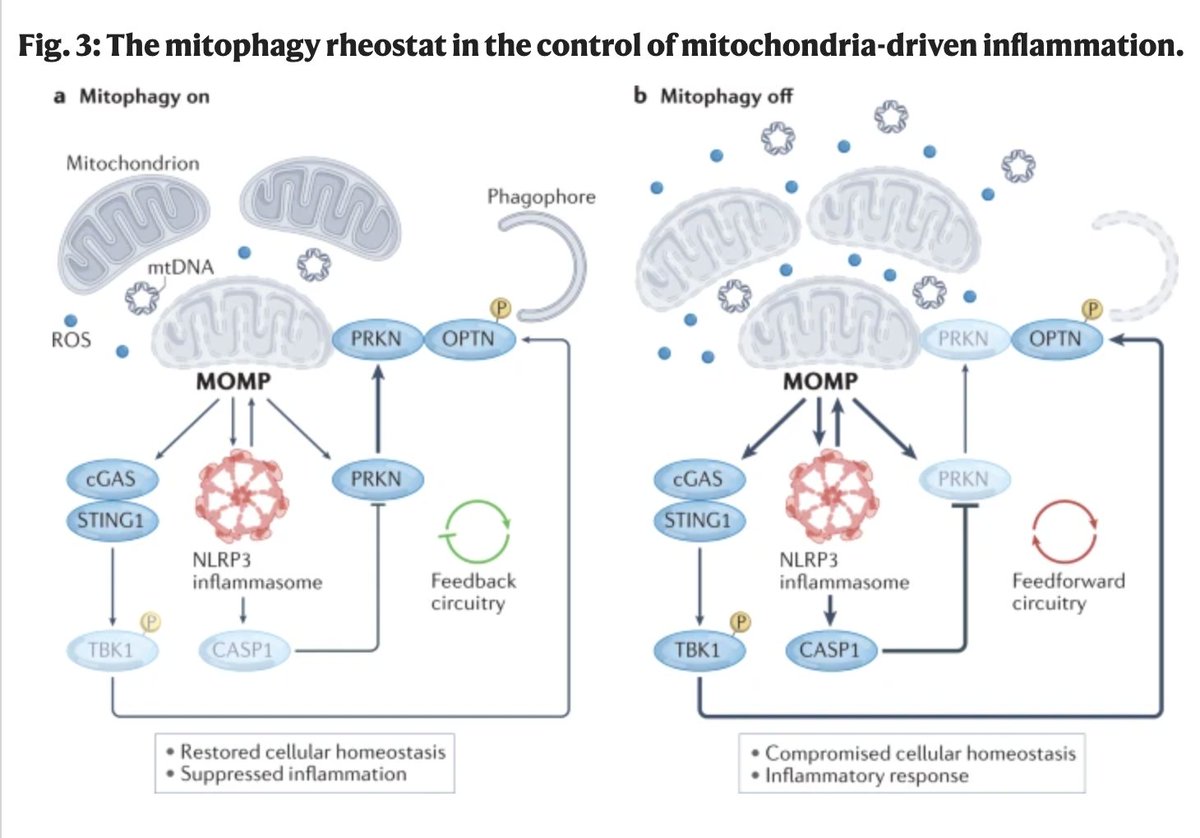
Your mitochondria can trigger the same inflammatory alarms your immune system uses to fight bacteria. That's because mitochondria are bacteria, or at least they were 1.5 billion years ago.
A Nature Reviews Immunology paper maps the molecular mechanisms of how mitochondria control inflammation, the safeguards that normally prevent false alarms, and what happens when those systems fail.
The core problem: mitochondria are ancient bacteria that your cells absorbed roughly 1.5 billion years ago. They still carry bacterial signatures. Your immune system evolved to recognize bacterial molecules as threats. When mitochondria get damaged and leak their contents, your immune system can't distinguish between a broken mitochondrion and an actual infection.
Mitochondria contain multiple damage-associated molecular patterns, or DAMPs. These are molecules that trigger immune responses when detected outside their normal location:
• Mitochondrial DNA (mtDNA): Unmethylated, circular DNA that resembles bacterial genomes
• Cardiolipin: A phospholipid normally confined to the inner mitochondrial membrane
• N-formyl peptides: Proteins with bacterial-style chemical signatures
• ATP and other metabolites: Energy molecules that signal danger when released
These molecules activate pattern recognition receptors, the sensors your immune system uses to detect threats.
The most studied pathway involves mitochondrial DNA activating a detection system called cGAS-STING. Here's how it works:
When mitochondria become damaged, their outer membrane develops holes. Think of it like a breach in a container. The mitochondrial DNA, which normally stays sealed inside, leaks out into the cytosol, the liquid interior of your cell.
An enzyme called cGAS patrols the cytosol looking for DNA that shouldn't be there. When it finds mitochondrial DNA floating around, it produces a signaling molecule called cGAMP. This molecule activates another protein called STING, which sits on the endoplasmic reticulum, a membrane network inside cells.
STING activation triggers the production of interferons, immune signaling proteins your body normally makes to fight viral infections. Your cell responds to leaked mitochondrial DNA the same way it responds to a virus.
A second pathway involves cardiolipin, a fat molecule that normally stays on the inner membrane of mitochondria. When cardiolipin appears on the outer surface or leaks into the cytosol, it activates the NLRP3 inflammasome. This is a multi-protein assembly that acts like an alarm system. Once activated, it produces inflammatory molecules called cytokines, specifically IL-1β, which trigger inflammation throughout surrounding tissue.
Your cells have multiple safeguards to prevent mitochondria from triggering these inflammatory pathways:
Apoptosis suppresses inflammation. Apoptosis is programmed cell death, a controlled self-destruction process. When a cell commits to dying, it activates enzymes called caspases. These enzymes act like molecular scissors, rapidly cutting up mitochondrial DNA and other inflammatory molecules before they can activate immune sensors. Two key studies demonstrated that strong caspase activation prevents the cGAS-STING pathway from turning on during cell death.
Mitophagy removes damaged mitochondria. Mitophagy is selective autophagy, meaning cellular recycling that targets only mitochondria. When mitochondria lose their electrical charge, called membrane potential, or accumulate too much damage, they get tagged with molecular markers. These tags signal cellular machinery to engulf the damaged mitochondrion inside a double-membrane structure called an autophagosome. The autophagosome fuses with a lysosome, which contains digestive enzymes that break down the damaged mitochondrion completely. This happens before its contents can leak out and trigger inflammation.
Chromatin packaging inhibits cGAS. Your nuclear DNA is wrapped around proteins called histones and packaged into a structure called chromatin. This packaging prevents cGAS from detecting it. Mitochondrial DNA lacks this protective packaging, which makes it a much stronger activator of cGAS when it reaches the cytosol. This difference explains why leaked mitochondrial DNA triggers inflammation while nuclear DNA, even when exposed during normal cell division, generally does not.
The pathological consequences emerge when these safeguards fail or get overwhelmed.
Insufficient mitophagy allows damaged mitochondria to accumulate. Their contents gradually leak into the cytosol, triggering chronic low-grade inflammation. This process contributes to age-related inflammatory diseases, neurodegenerative disorders, and metabolic dysfunction.
Defective apoptosis prevents proper DAMP degradation. Cells that can't complete programmed death release intact mitochondrial components that activate stronger inflammatory responses. This mechanism appears in some autoimmune conditions where defective clearance of dying cells drives chronic inflammation.
Excessive mitochondrial stress overwhelms quality control. When mitochondrial damage happens faster than mitophagy can remove it, cells release mitochondrial DAMPs even with functioning safeguards. This occurs during ischemia-reperfusion injury, severe metabolic stress, and certain infections that specifically target mitochondria.
The inflammation can become bidirectional. Inflammatory signals like TNF-α and interferons feed back to impair mitochondrial function, creating cycles where inflammation damages mitochondria and damaged mitochondria amplify inflammation.
Several human diseases show clear links to dysregulated mitochondria-driven inflammation:
Parkinson's disease involves mitochondrial dysfunction in dopaminergic neurons. Defective mitophagy allows damaged mitochondria to trigger inflammatory responses that accelerate neurodegeneration.
Systemic lupus erythematosus shows elevated mtDNA in circulation and enhanced cGAS-STING activation. Defective clearance of dying cells releases mitochondrial contents that drive autoantibody production.
COVID-19 severity correlates with cGAS-STING pathway activation. Viral infection triggers mitochondrial DNA release, and excessive type I interferon responses contribute to immunopathology.
Cancer cells sometimes exploit insufficient mitochondria-driven inflammation. Tumors with defective inflammatory signaling evade immune surveillance, while therapeutic interventions that trigger controlled mitochondrial DAMP release can enhance anti-tumor immunity.
The therapeutic implications point in two directions.
For inflammatory diseases, blocking mitochondrial DAMP signaling could reduce pathological inflammation. cGAS-STING inhibitors are in development for autoimmune conditions. Enhancing mitophagy might prevent DAMP accumulation before inflammation starts.
For cancer and infections, activating mitochondrial DAMP release could boost immunity. Some chemotherapy drugs work partly by triggering immunogenic cell death that releases mitochondrial DAMPs. Radiation therapy activates similar pathways.
The central insight is that mitochondrial quality control and inflammation are mechanistically linked. The same cellular machinery that maintains energy metabolism also determines inflammatory state. When mitochondria function properly and damaged ones get cleared efficiently, inflammation remains appropriately regulated. When quality control fails, mitochondrial DAMPs drive pathological inflammatory responses.
Your immune system treats broken mitochondria like invading bacteria because, evolutionarily, that's exactly what they once were. The molecular signatures persist. What determines health versus disease is how effectively your cells maintain mitochondrial integrity and clear damaged mitochondria before they trigger inappropriate immune activation.
Cancer Immunotherapy Breakthrough
"Scientists discovered that tiny fluorescent core shell silica nanoparticles, called Cornell prime dots (C’dots), can do more than image tumors. They actively reprogram the immune system to attack cancer."
"These particles can turn immunotherapy resistant “cold” tumors into immune responsive “hot” ones by activating the cGAS–STING pathway. They also slow cancer cell growth, push damaged cells into senescence, and trigger ferroptosis, a hard to escape form of cell death."
"In mouse melanoma models, using these particles alongside existing checkpoint immunotherapies significantly improved survival. Importantly, the nanoparticles do all of this without carrying any drugs. The particle itself acts as the treatment."
Why it matters?
Most nanomedicines are just delivery vehicles. These particles are the therapy, opening a new path for treating tumors that currently ignore immunotherapy.
MIT researchers have discovered “moiré crystals” with two different competing atomic lattices, which together generate a moiré superlattice that is mathematically equivalent to an emergent 4D “superspace” lattice. https://t.co/ZoXyGb36rW
🇭🇰 IBRO is heading to Hong Kong!
Join us at APSN-#FAONS-HKSN 2026:
📍 Visit our booth for IBRO grants, training, journals & #IBRO2027 updates
🗣️ Join the @network_alba–IBRO Special Session on scientific mobility across borders
🔗 https://t.co/yMqx5NERmI
See you soon! 👋
By combining deep Learning with structural biology, our new framework maps out how these aggregates form, but it also guides the design of suppressors. Now published at #advancedscience, thanks all funders @IBROorg & hardworking colleagues & students.
https://t.co/9otH7aRlS3
@ronyarcuk@KosisoVall this is not how you see it, you have to compare Arsenal vs Man City vs Liverpool ..etc
The fact is all these wining streaks are achievable, esp for the big four. So the margin that decide it would be during the game Arsenal vs Liverpool/Man City/Man Utd/Chelsea
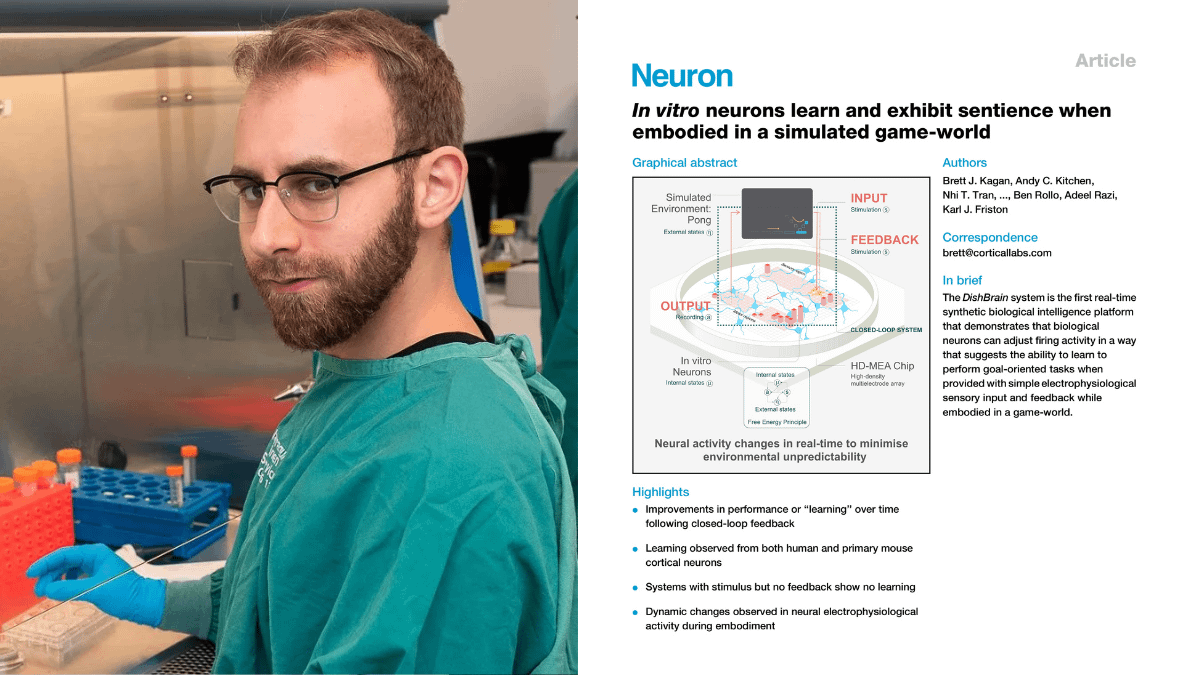
An Australian scientist took 800,000 human brain cells, kept them alive in a dish, wired them to a computer, and taught the cells to play the video game Pong in five minutes, which is faster than any AI on Earth had ever learned the same game.
His name is Brett Kagan.
He runs the science team at a Melbourne company called Cortical Labs, and the paper that broke the story was published in the journal Neuron in October 2022. The title sounds like a science fiction novel. In vitro neurons learn and exhibit sentience when embodied in a simulated game-world.
The setup was simple, and that is what made it so strange.
Kagan and his team took some brain cells from mouse embryos. They took some human brain cells grown from stem cells. They placed them on a chip covered in tiny electrodes, the size of a small coin, and they hooked the chip up to a computer running Pong.
The electrodes could do two things. They could read what the cells were doing. They could also send small bursts of electricity back into the cells.
The team used those two channels to talk to the dish.
When the ball was on the left, they fired the electrodes on the left side of the dish. When the ball was on the right, they fired the electrodes on the right. The closer the ball got to the paddle, the faster they fired. The cells could move the paddle by sending their own signals back.
That was the whole game.
Then the team added one more rule, and this is the part that changed everything.
When the cells missed the ball, they got a random, chaotic burst of electricity for four seconds. Noise. Static. Pure unpredictability. When the cells hit the ball, they got a clean, steady, predictable signal.
That was the only feedback the dish ever received.
Within five minutes, the cells started getting better at the game.
The rallies got longer. The hits got more frequent. The dish was not winning, but it was clearly playing, and it was improving, and nobody had told it the rules.
It had figured them out by itself.
The reason this worked is the part that should stop you for a second.
Brains hate surprise. That is the thing they are built to avoid. Karl Friston, who is one of the most cited neuroscientists alive and a co-author on the paper, has spent his whole career proving this. The brain is not really a thinking machine. It is a prediction machine. It runs on a single quiet rule. Make the world less surprising.
The cells in the dish were doing the same thing.
The chaotic stimulus felt like surprise. The clean stimulus felt like calm. The only way to get more calm and less chaos was to stop missing the ball. So the cells learned to stop missing the ball, not because anyone trained them, and not because they wanted a reward, but because the only way to quiet the noise was to play the game well.
They were not learning Pong. They were learning to make their own world more predictable, and Pong just happened to be the world they were stuck inside.
The same thing your brain is doing right now.
Every choice you make today, every word you reach for, every plan you build for tomorrow, is your brain trying to make the next moment less surprising than the last one. The feeling you call thinking is mostly your head doing the same thing those cells did. Trying to quiet the static.
The dish learned Pong faster than any AI had at the time, using around 800,000 cells and almost no power, while the AI systems running the same game needed thousands of times more energy and far longer training runs.
Kagan said it plainly in his interviews after the paper came out.
He said the cells were not trying to win. They were trying to feel less lost. And the moment he said that, half the room realized he was no longer just describing the dish.
He was describing them.
Surprised to discover that Thermo Fisher appears to show a fake western blot for the validation of one of their p53 antibodies. I've added a diagram to show the very similar bands. This does not appear to be one of the "published figures", but their own internal data.
A study in Nature reveals that tumour microenvironments can be decomposed into spatially organized multicellular ecosystems that can be accessed non-invasively via liquid biopsy and used to profile individual cancers and target treatments. https://t.co/3ajlUIxq1B
La biología en PDF acaba de morir.
Un tío hizo una app donde exploras estructuras 3D como un videojuego.
UI: GPT Images 2. Código: Gemini 3.1 Pro.
Los libros de texto ya no sirven.
Online now: A type I interferon-mitochondrial axis regulates efferocytosis and interferon-stimulated gene induction in macrophages https://t.co/EK2079Eq9K