Dear bacterial transformation community,
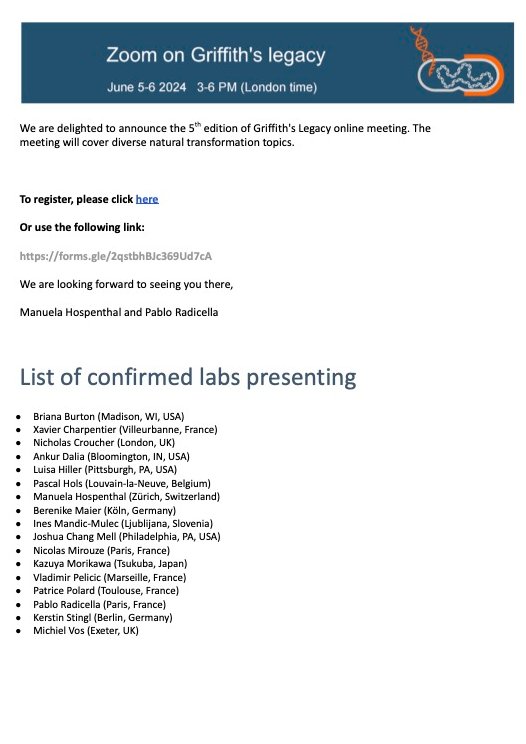
This is a reminder to register for the upcoming Griffith's Legacy meeting, which will take place as a Zoom webinar on 5-6th of June. Use this link to register: https://t.co/aTfR4hD7At
Please also spread the word🙂
Dear bacterial transformation community 🧪🧫🦠
We are delighted to announce this year's Griffith's Legacy meeting, which will take place as a Zoom webinar on 5-6 June. To register, click here: https://t.co/aTfR4hD7At.
Please also spread the word
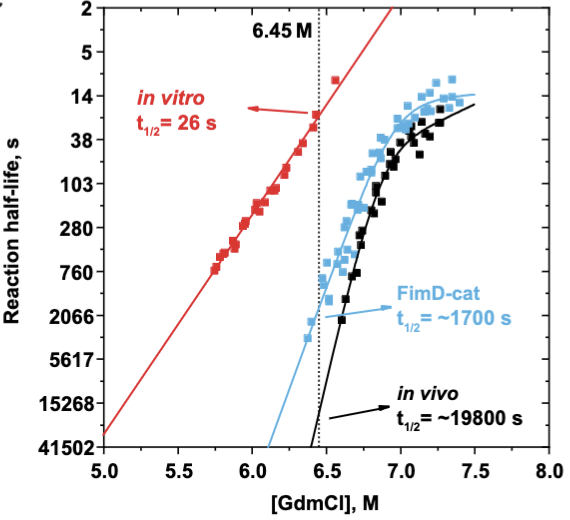
Check out https://t.co/qL9UTkzYQ3. FimD is needed for type 1 pili to assemble to their most stable quaternary structure. Thanks to all who were involved @DawidZyla, Thomas Wiegand, Paul Bachmann, @Rafal_Zdanowicz, Christoph Giese, Beat Meier, @GabrielWaksman & @Glockshuber_lab
1/9 Our manuscript on type 1 pilus stability is finally out in @naturecomms! Our study reveals how bacteria assemble their highly stable type 1 pili. We show pili formed in vivo via the chaperone-usher pathway are up to 1000x more stable than those assembled in vitro.
Check out our new paper on a previously unknown function of the type 1 pilus assembly platform FimD! Many thanks to everybody involved in this terrific collaboration with the labs of Gabriel Waksman, Manuela Hospenthal, Beat Meier and Thomas Wiegand.
https://t.co/KwbJll4AFb
9/9 This work was completed through excellent collaboration with @M_Hospenthal, @GabrielWaksman, Thomas Wiegand, and Beat Meier, with support from Paul Bachmann, Rafal Zdanowicz, and Christoph Giese. The manuscript is available in open access here: https://t.co/xaBhtVNjNt
🎉 Welcome our 24 new Young Investigators joining the @EMBO_YIP network! The new YIPs will receive financial and practical support for a period of four years, starting in January 2023 – congratulations!
➡️ Read more in the press release here: https://t.co/9ot0mynvsE
Congratulations to the Waksman lab and collaborators for the beautiful work on the T4SS! I know how hard you worked on this and it's an amazing achievement. https://t.co/TvmiBq4nkx
Sometimes we must create artificial things to understand nature. Kathrin Lang @klanglab, new professor of #ChemicalBiology#LOC, develops special tools and enables deep insights into complex biological systems. Learn more on June 1 #inaugurallecture & on https://t.co/TPZS7TWEkN
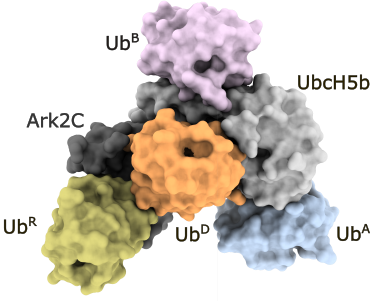
Cool science alert! Otago biochemists led by Prof Day have just published in @NatureComms. They reveal the exact mechanism of how ubiquitin regulates the activity of an E3 ligase. https://t.co/vwgu1YnHmb
Though small, #ubiquitin is profoundly important to multi-cellular life.1/4
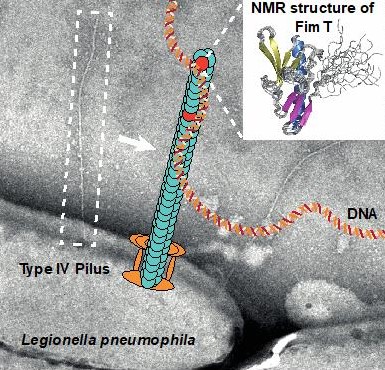
Our paper just came out in @NatureComms😀! We identified FimT, a DNA-binding minor pilin, to play a major role in natural transformation🦠🧬. Thanks again to our fantastic collaborators @DrFranShort and Alvar Gossert!
https://t.co/2L0CiGaEaF
FimT is a novel DNA receptor. A study by the @M_Hospenthal group in collaboration with the Gossert (ETH) and @DrFranShort (Monash, Australia) groups shows how FimT’s ability to bind DNA is crucial for bacterial natural transformation. More: https://t.co/7wCUpwhjiF
Very excited to share that we've been awarded an ERC Starting Grant to study the mechanisms of natural transformation😀👩🔬🧬! Thanks a lot to my team and the ERC/SERI for their support and congratulations to all other awardees!
https://t.co/H3OvrTtcSx