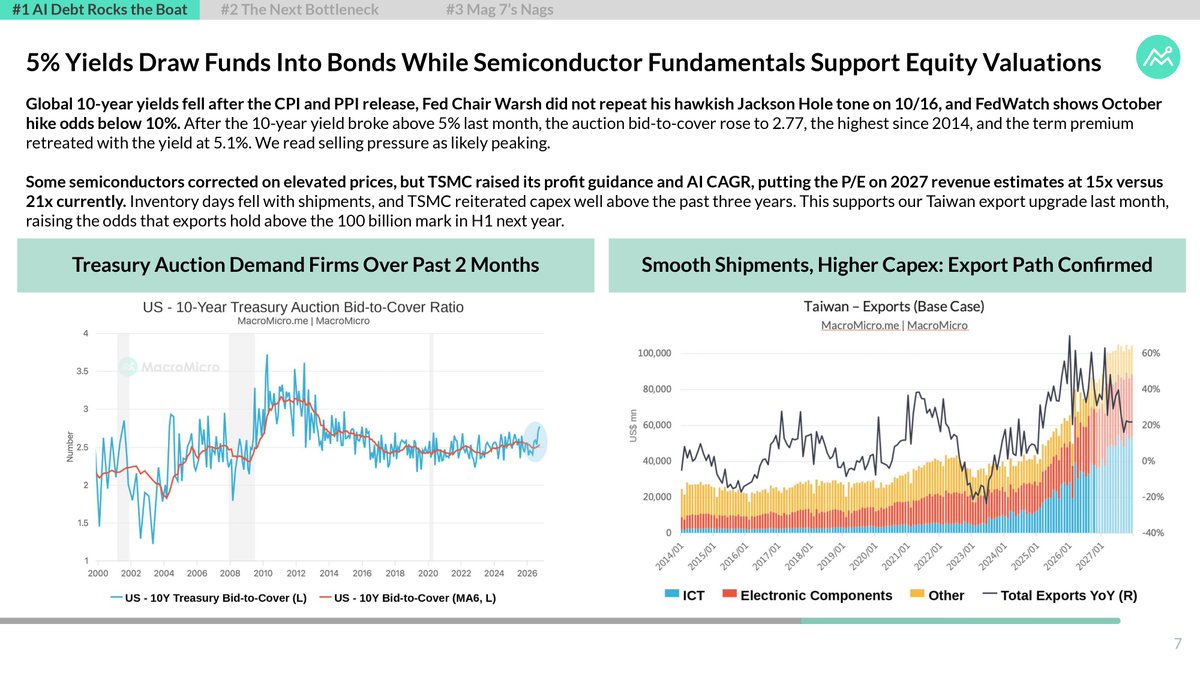
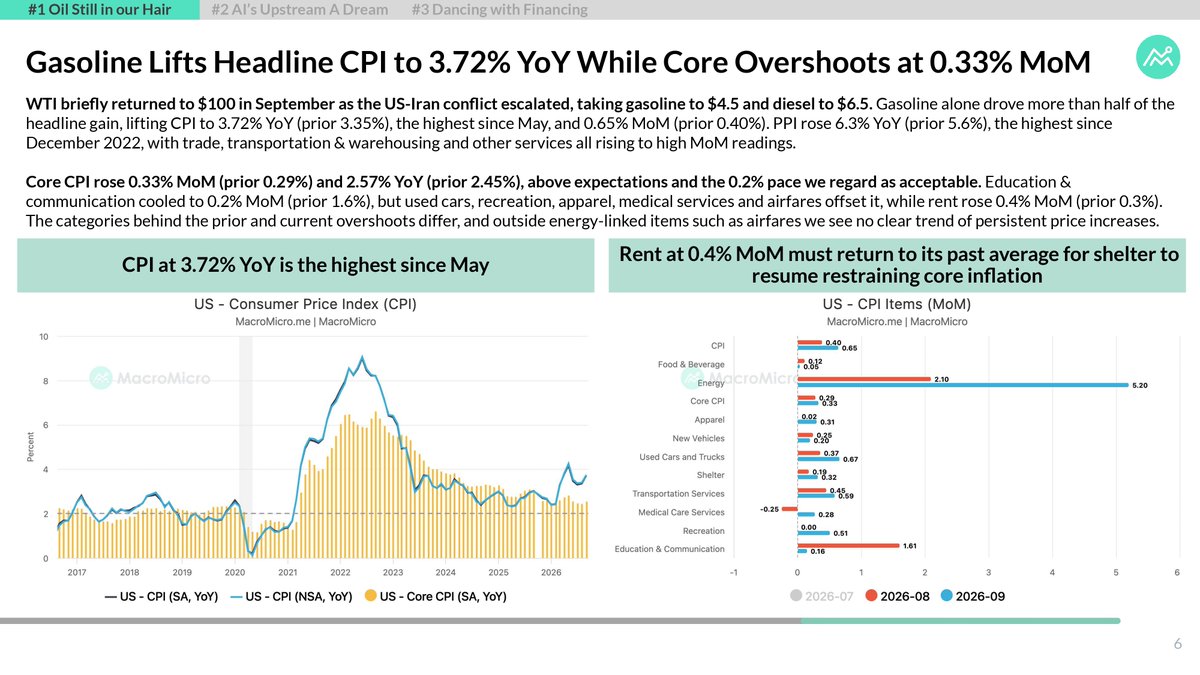
🔮 The SOX fell eight straight sessions last week, its longest losing streak since 2008, and sank more than 15% from its October 6 high through Friday. Hotter inflation started it, with September CPI at 3.7% and PPI at 6.4% YoY, but the move accelerated when CoreWeave’s 5-year CDS went above 1,100 bp, which implies a default probability above 60%, and Anthropic’s QoQ revenue growth slowed to 45% from 145%.
CoreWeave’s first half explains why credit investors are nervous. Operating cash flow of $3.66 billion ran against $14.1 billion of cash capex, which required $11.53 billion of net borrowing, and the CCC high-yield spread has broken above 12%, close to its October 2022 high.
At the same time, TSMC raised its 2026 revenue growth guidance to about 44%, and the companies supplying chips, packaging and power equipment are posting cash flow that looks nothing like the operators’. Our four-stage dot-com framework places the cycle between stages two and three, and it treats upstream cash flow as the test of whether stage three arrives.
This week's commentary compares 18 companies across five layers of the AI chain through eight financial metrics, then follows the cash into TSMC’s depreciation schedule and Meta’s and Tesla’s Q3 results.
🔗 Full report 👉 https://t.co/OUbgNL9CCX
📢 MacroMicro | Website Maintenance Notice (EDT, GMT−4)
Our website will be unavailable for a system update starting at 11:00 PM on 10/22 (Thu), with service expected to resume before 5:00 AM on 10/23 (Fri).
Thank you for your patience and understanding.
⏰ LAST 24 HOURS! Get the Global ETF AI Assistant FREE with Max AI.
Bring MacroMicro’s ETF research framework and market views to ChatGPT, Claude, Gemini, and more.
Subscribe Max AI and download from My Rewards by 10/23.
Once installed, keep using it after the offer ends. Claim yours before time runs out!
👉 https://t.co/C5k5A8ldfA
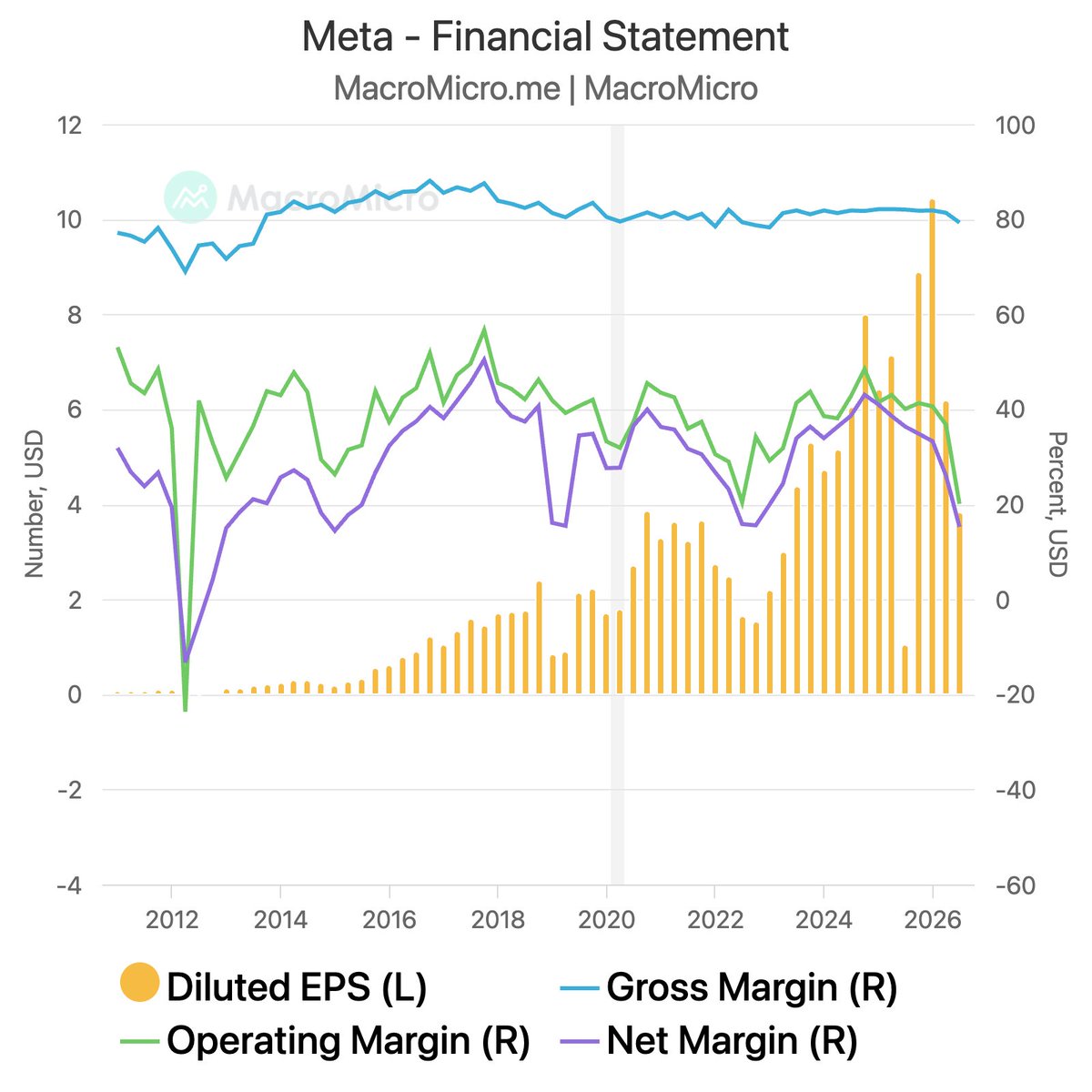
$META Q3: AI Is Paying Off in Ads. Can Muse Do the Same?
Meta’s revenue rose 26% YoY to $64.6 billion, beating expectations, as AI-driven ad improvements lifted monetization. Ad prices climbed 14% and impressions grew 10%, while nearly 10 million advertisers used at least one generative AI creative tool. AI is already improving the core business, not just promising future growth.
Now Meta wants to turn that advantage into a new business. Its Muse personal AI agent attracted more than 10 million sign-ups in the US and Canada in roughly six weeks, with shopping emerging as a key use case. Transaction fees, subscriptions and enterprise services could open new revenue streams, but user adoption is only the first step toward proving the model.
The challenge is cost, with free cash flow swinging to negative $2.12 billion. Meta raised its 2026 capex outlook to $135 billion to $145 billion as AI infrastructure spending continues to climb. Management is targeting more than a tenfold improvement in compute cost efficiency over the next year, a key condition for scaling Muse beyond its initial user base.
Meta has shown that AI can improve the performance of its advertising business, but turning that advantage into a profitable consumer and enterprise AI platform is a much larger undertaking. With infrastructure spending still climbing and a 2027 budget not yet finalized, the key question is whether Muse can generate enough revenue to justify the cost of building it.
$TSLA Q3 results showed improving margins and a return to positive free cash flow, although its next growth drivers remain years away from full commercialization, leaving the company balancing better near-term financials against substantial investment needs.
Revenue fell 0.2% YoY to $28.05 billion, slightly below expectations, while GAAP gross margin rose to 19.6% from 16.8% last quarter and non-GAAP EPS of $0.48 beat forecasts. Free cash flow also turned positive at $1.53 billion, helped by lower capital expenditure, but operating income fell 56% YoY to $718 million and automotive revenue declined 3%, showing that stronger margins have yet to translate into broad-based earnings growth.
Energy storage offered a brighter spot, with deployments reaching 13.7 GWh and gross margin rising to 33.1%, although the improvement partly reflected one-off benefits from tariff refunds and battery warranty cost adjustments. Tesla also sees AI data center demand supporting further growth, with 2027 Megapack capacity nearly sold out.
In the automotive business, FSD adoption continues to expand, with active paid subscribers reaching 1.74 million, up 67% YoY. Meanwhile, Tesla expects Robotaxi to make a more meaningful revenue contribution from Q2 2027 and begin external Optimus deliveries by the end of 2027, while its in-house semiconductor program is targeting useful chip production from 2028. All three plans remain dependent on technical progress, regulatory approval and the ability to scale production.
Tesla lowered its 2026 capital expenditure guidance to around $20 billion from more than $25 billion, partly due to delays in new product timelines, but expects spending to accelerate again from 2027. Planned investments span Robotaxi fleets, humanoid robots, AI computing and semiconductor manufacturing, with Musk outlining potential long-term investment of more than $100 billion in chipmaking infrastructure.
The central question is whether these new businesses can generate returns that justify the investment required to bring them to scale. For now, Tesla’s core financials are showing signs of improvement, but much of its longer-term growth case rests on businesses that have yet to prove their economics at scale.
🌡️ CoreWeave $CRWV grew Q2 revenue 113% year over year to $2.58 billion, and after $640 million of net interest expense, only $130 million of operating profit remained.
Over the first half of 2026, operating cash flow of $3.66 billion covered about a quarter of its $14.1 billion in cash capex, and $11.53 billion of net new borrowing filled the gap. By October 16 the shares had fallen 25% in a week, and five-year CDS above 1,100 basis points was pricing a default probability over 60%. That was enough to drag Oracle and other leveraged technology names down with it.
Markets took this as the beginning of a broad retreat from AI financing. Credit spreads on the other AI data center bonds we track barely moved over the same period, which disagrees with that reading.
Our latest report compares neocloud providers with the large cloud providers on capex-to-revenue and free cash flow, goes through 24 US high-yield data center bonds backing more than 4.5 GW of computing capacity, and places the AI buildout on a four-stage framework drawn from the dot-com cycle. It also covers September’s inflation surprise and the slowdown in Anthropic’s revenue growth.
📥 Download the full PDF to see where we think the cycle stands and which segment of the supply chain would have to crack before the risk turns systemic 👇
🔗 https://t.co/rZlX3eLciH
🚀 SpaceX revenue surged 161%. Here’s what stood out on its earnings call.
What’s next for Starlink and AI? How much will SpaceX spend to keep growing?
Get the highlights from SpaceX’s Q3 earnings call—from management’s outlook to analyst Q&A — with our AI summary and full transcript.
🔗 Read the earnings call highlights: https://t.co/QxanwTKTYs
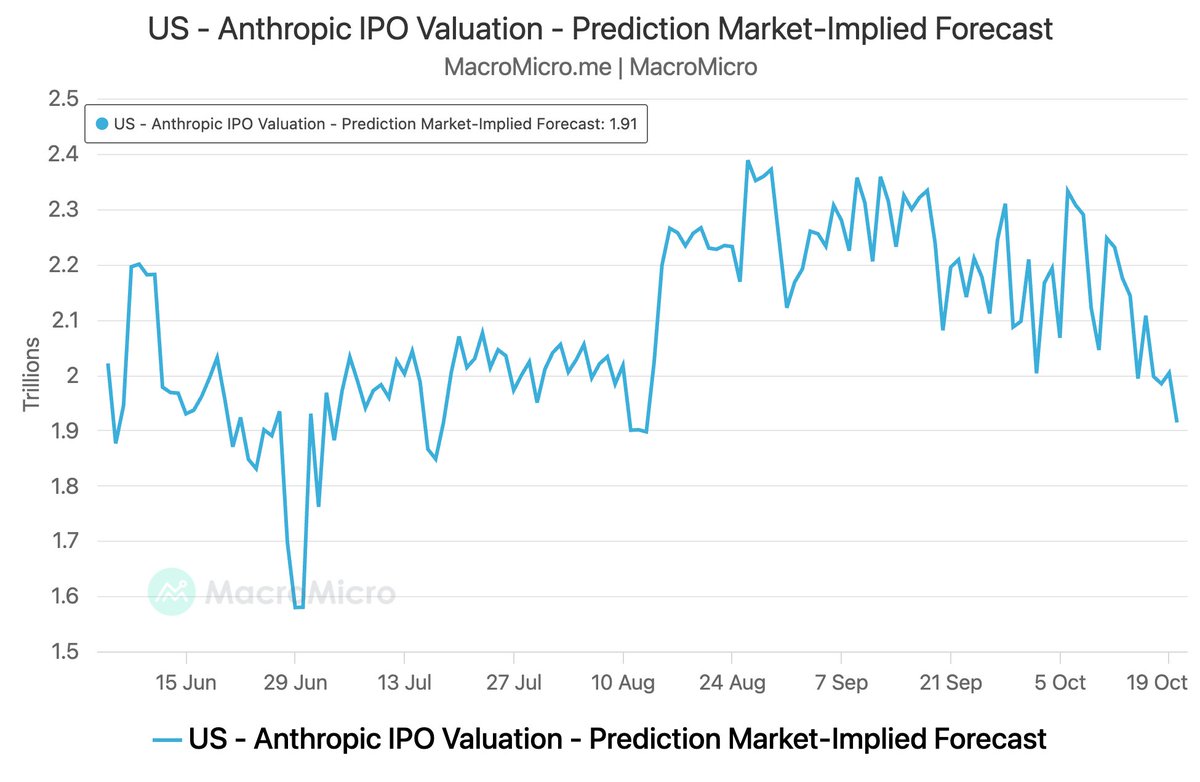
Anthropic’s IPO valuation, as implied by prediction markets, slipped to $1.91T after its pre-IPO meeting. That’s well off the ~$2.4T peak in late August.
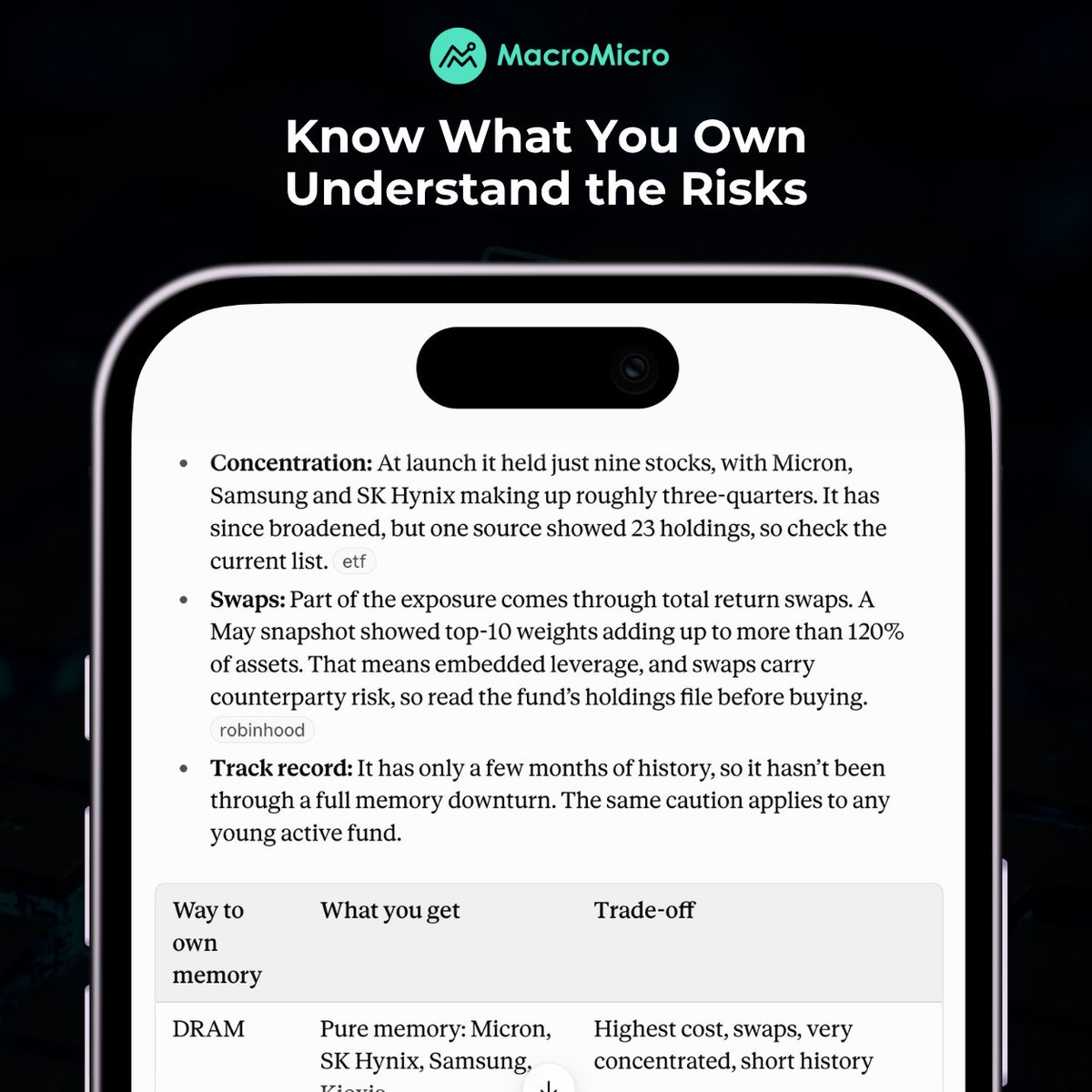
📈 AI memory chips are in the spotlight. Does buying a memory ETF mean you’re getting in on the opportunity or taking on too much concentration risk?
"AI memory is booming. Is DRAM worth buying now?"
We asked AI enhanced with our Global ETF AI Assistant. Swipe to see how it explains daily leverage, holding risks, alternative ETFs, and the broader market picture.
AI is powerful, but needs guidance to truly take it to the next level of expertise. Bring MacroMicro's ETF framework and 2026 market views to ChatGPT, Claude, Gemini, and more.
Last Call! Subscribe to Max AI. Claim it free by 10/23.
👉 See how to claim and set it up: https://t.co/C5k5A8ldfA
🚨BREAKING: 12-month forward WTI hits $83.4, the highest since 2022, as markets price in prolonged Middle East tensions.
Forward prices are a better gauge of longer-term inflation expectations than spot, and they’re a key input in central bank inflation forecasts.
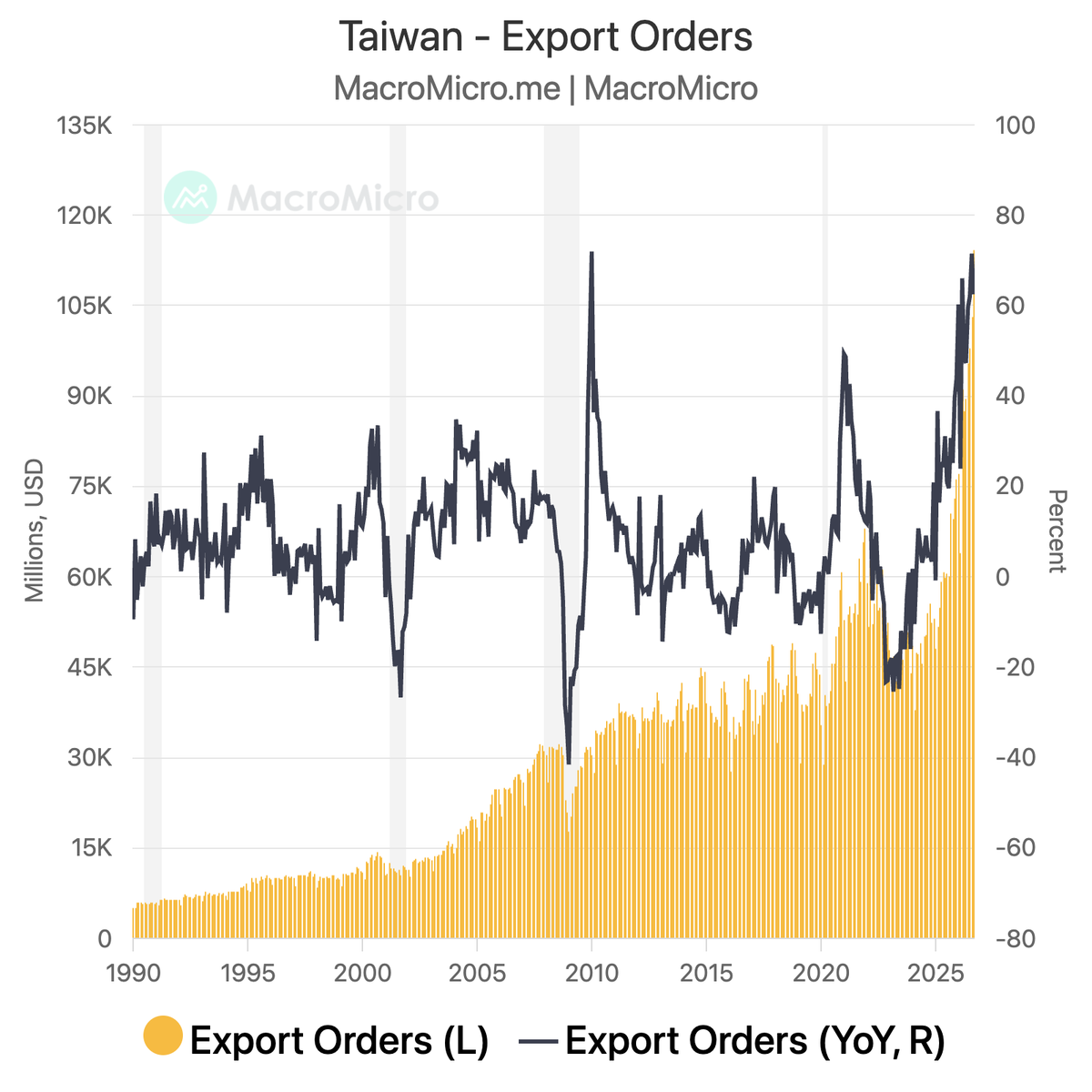
🚨BREAKING: 🇹🇼 Taiwan Export Orders Hit a Record $114.2B in September, Up 62.4% YoY!
AI demand continues to drive Taiwan’s export orders, with electronics and ICT products accounting for nearly 80% of the total. US orders rose 79.4% YoY, while demand remained strong across Europe and Asia.
The spillover is spreading to adjacent industries. Basic metals grew 29.7% YoY on AI server-related materials demand, while machinery orders rose 21.5% on semiconductor equipment investment. Traditional end-market demand, however, remains uneven, with optical equipment orders down 5.6%.
A key improvement: the gap between export-order growth and actual export growth narrowed from 30.4 percentage points in August to 1.5 points in September, suggesting supply-chain bottlenecks are easing and shipments are catching up.
With AI server shipments expected to ramp up in Q4, Taiwan’s export momentum remains strong.
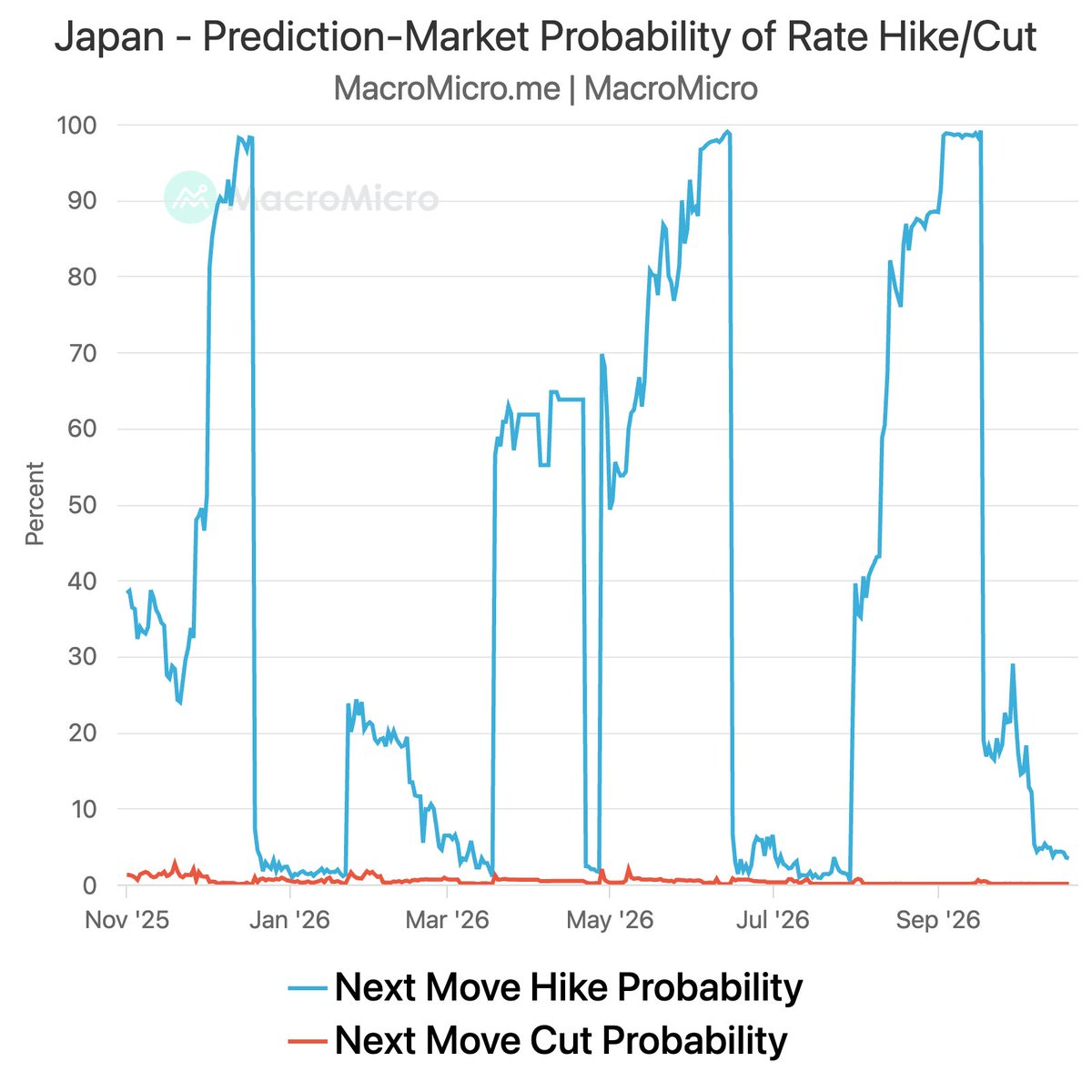
🇯🇵 The Bank of Japan may raise its inflation forecast for the next fiscal year in its October projections, as higher oil prices threaten to keep consumer price increases elevated for longer than expected.
Markets expect rates to hold at the October 29-30 meeting following last month’s hike. But the BOJ could signal rising inflation risks, keeping a December hike in play, particularly if yen depreciation raises import costs.
Even with little change in underlying inflation, persistent energy-driven price pressure could bring the next rate hike closer.
📍https://t.co/U4uMB9xmgK
🪢 CoreWeave’s five-year CDS spreads topped 1,100 basis points last week after its shares fell more than 15% on October 14 and its unsecured bond yields briefly exceeded 15%. That is pricing normally reserved for distressed credits, and it arrived while investment-grade spreads sat near 0.8% and Google-backed developer bonds traded 27 to 76 basis points over.
The market reacted this sharply because of how the buildout is paid for. In the first half, CoreWeave generated about $3.66 billion of operating cash flow against $14.12 billion of capex, and debt markets covered the difference. A borrower funded this way depends on refinancing windows staying open, and AI-related investment-grade deals above $3 billion fell to zero between September and mid-October.
Meanwhile the banks arranging that financing are collecting the rewards. AI transactions generated more than half of year-to-date investment-banking fee growth, so intermediaries get paid well before the weakest borrower in the chain is tested.
📥 This week’s WEFC works through CoreWeave’s implied default probability under several recovery-rate assumptions and what past funding cycles in telecom and shale suggest about how fast refinancing windows close. It also covers the oil-driven CPI rebound behind our call for a December Fed hike, and what TSMC and ASML guidance implies for chip capacity through 2028.
🔗 Download the full report: https://t.co/bsvFvAEgDi