One thing I find deeply troubling is how Nigerian politicians, despite their glaring intellectual shortcomings, manage to manipulate so many people, including the supposedly educated ones.
When Northern politicians need a convenient enemy, they make the Igbo the scapegoat, dragging out 1966 as justification. And it has worked for decades. The South West appears to be adopting the same playbook.
For 60 years, you have refused to move beyond the mistakes of a few young military officers in 1966, yet the damage you have collectively done to this country far exceeds the consequences of that single episode.
Negro, for 66 years, you have failed to provide something as basic as electricity. Common electricity! Yet you have endless energy to cry over Sardauna, a man who would have been dead by now even if he had survived 1966.
Israel became a nation in 1948. Today, Israel is a technological and economic powerhouse. Nigeria, meanwhile, cannot provide reliable electricity, your presidential villa doesn’t even have drinking water. Shameless breeds!
You all disgust me. Keep crying over the killing of Sardauna while ignoring the bigger issues. Nigeria is supposed to be a home and a source of pride for the average Black person across the world, yet a bunch of brain dead leaders and their loyalists have turned it into a pit of shit
And then we wonder why Black people are treated with such contempt around the world.
The real tragedy is that 60 years later, you are still more interested in weaponising history and tribal grievances than confronting the failures that have kept an entire country in darkness.
Dear young man, running away from your problems may give you temporary relief, but it will never fix the problem. I understand the frustration. I understand the desire to live in a country where hard work pays, where basic things work, and where you can build a future without struggling for survival every day.
But think about this,immigration policies are tightening across the world. You may feel settled today, but one stroke of a pen, one change in government policy, and everything you have built abroad could be thrown into uncertainty. You could find yourself being sent back to the very country you desperately wanted to escape.
We cannot keep abandoning our country and expect someone else to come and fix it. No nation will truly respect us if our only response to a broken system is to run away from it.
I am not saying you shouldn't seek better opportunities abroad. You deserve a good life. But we must never lose sight of the responsibility we share to make Nigeria a country where the next generation will not have to leave home just to have a decent chance at life.
A few months ago, my grammar was not particularly great, especially here on X.
Then, one beautiful morning, I received a call from Dr. Oby Ezekwesili ( @obyezeks ) that changed that aspect of my life forever.
She advised me to go back to Primary 3 and rebuild my foundation in English.
She said something profound: Once you fix the foundation, everything else begins to fall into place.
I took her advice wholeheartedly. I went back to study Primary 3 Grammar and Comprehension, and that simple decision transformed my command of English.
I remain deeply grateful to @obyezeks for that invaluable piece of advice. Its impact on my life has been remarkable.
But this experience taught me something much bigger about education.
Many of us are struggling today, not because we lack intelligence, but because we are building on weak educational foundations.
We keep trying to fix problems at the top when the real problems are at the bottom.
Sometimes, the greatest form of progress is having the humility to go back to the basics and rebuild properly.
You cannot build excellence on a foundation you have refused to repair.
Good People, across Africa, many young people amplified our message on ContiSX Phones, making us a brand even before we started. Thank you for believing in our mission!
Today, I have two exciting updates.
First: On November 10, 2026, we will push an operating system update to ContiSX Phones, activating access to our non-exchange products. Exchange-related services will follow once regulatory licensing is concluded.
Second: We will open our development environment with SDKs, APIs, ContiSX Codex and other tools, enabling young innovators to build on our blockchain infrastructure once the OS push is concluded.
Within Nigeria, core ContiSX services, including voice calls, messaging and video calls, are zero-metered because we have prepaid for connectivity. If you build something remarkable, we could make your application zero-metered too!
Imagine building an application that digitally registers goats, cows and other livestock in your village, validates ownership through local authorities, and connects farmers to urban buyers. Working with microfinance institutions and SEC-registered operators, those records could become pathways to financing, wealth creation and eventually capital market participation through ContiSX Exchange.
You do not need to build for Silicon Valley, London or Paris. Build for your village, your community and Africa! ContiSX is providing the infrastructure to unlock opportunities from the grassroots. That is why our devices understand Igbo, Hausa, Yoruba, Pidgin, and English. We will add Swahili and French later in the quarter to cover more African markets.
We are in the business of “exchanging prosperity”, fulfilling that Igbo axiom of “uwa bu ahia” [literally, the world is a marketplace]. Make the market, including your village, accessible by all and for all. Get ready to build: https://t.co/TKt2hczybc
Image: some apps in ContiSX phones.
I met a little boy named Chijindu who was struggling academically. I decided to focus on helping him achieve mastery in just one subject: Mathematics.
What happened afterwards completely changed how I think about education.
As Chijindu began solving mathematical problems he previously considered impossible, something remarkable happened.
He became excited about learning. His confidence grew. His performance in other subjects improved dramatically.
Eventually, Chijindu took first position in his class.
But here is what fascinates me.
I didn’t just teach Chijindu mathematics. I may have changed what he believed about his own intelligence.
There is a concept in psychology called self-efficacy, developed by Albert Bandura. When people experience genuine success, their belief in their ability to overcome challenges can grow.
Think about a child who has repeatedly failed academically.
Eventually, that child may stop believing, “I don’t understand this subject,” and start believing, “I am not intelligent.”
The first is a learning problem. The second is an identity problem.
And our education systems often respond to both by giving children more examinations, more pressure, and more opportunities to fail.
But what if we reversed the process?
What if, instead of trying to fix everything a struggling child cannot do, we first helped that child become exceptionally good at one thing?
What if one experience of genuine mastery could rebuild the confidence needed to approach other subjects differently?
I am not suggesting that mastering mathematics automatically improves performance in other subjects. But confidence can increase effort, effort can produce success, and success can make learning exciting again.
Perhaps millions of children we consider academically weak are not incapable of learning. Perhaps many have simply never experienced the confidence that comes from truly mastering something.
We spend so much time measuring what children cannot do.
Maybe we should spend more time helping them discover what they are capable of achieving.
Chijindu has made me question something fundamental:
What if the first step to transforming a struggling child’s education is not teaching them more, but helping them believe, through genuine achievement, that they can learn?
"This is one of the most unpatriotic statements I have ever heard in my life. If you understand what this man said here, then you will understand how disturbing it is to have people with this type of mindset run our government.
What he said outrightly here is that they at ACN (now APC) knew that Jonathan's government was doing well. They knew that the policy he was trying to implement was very good for Nigeria and Nigerians but because they didn't want him to succeed they lied to Nigerians about the policy. We knew that Jonathan was right but because we wanted to take power, we found a way to condemn what he was doing and even deceived Nigerians to come out and protest against it. Simply put, what this man is saying here is that they knew Nigeria was heading to a good direction but they disrupted it for their own selfish reasons. What it means is that these guys don't mind putting Nigeria in a bad condition just so they can get power.
This is so serious and so disturbing. He is actually saying that all the protests they organised against Jonathan were fake and NEVER about the interest of Nigeria or Nigerians but just for them to grab power. Now I understand why Peter Obi would always say, that he won't be in any coalition just for the sake of grabbing power.
This statement from this man shows you that the people in power right now don't give a damn about Nigerians. Now you understand why they implement these harsh policies since 2015. Now you understand why they live in plenty while Nigerians are becoming poorer by the day.
Now you understand why APC has thrown over hundred million Nigerians into poverty. It's simple. They don't care. Everything is politics for them. They play politics with people's lives. Very dangerous and very pathetic. God forbid.
Dear Nigerians, this man has told us plainly that APC is not in power for you but for themselves.
We must do something about it in 2027."
- @governance_101 10-26-2025
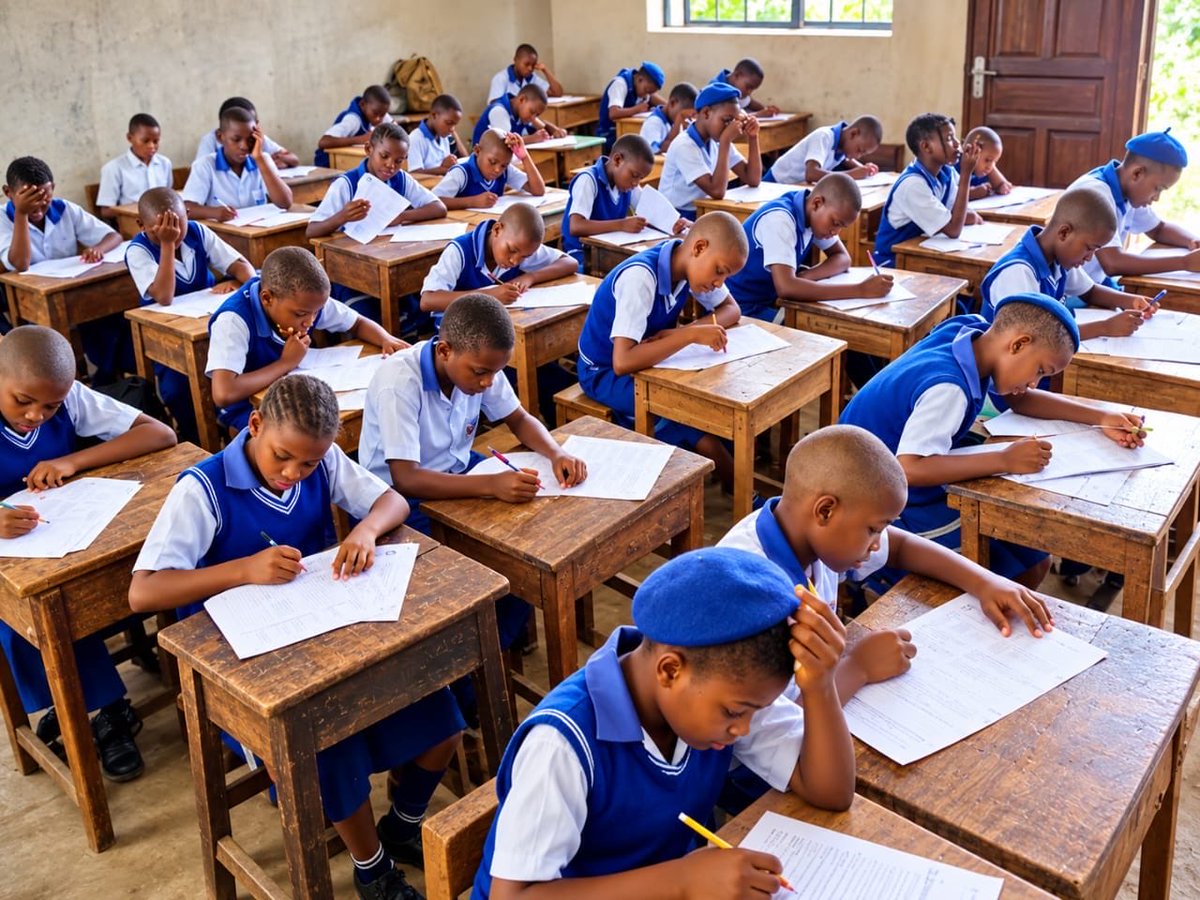
This is how we are transforming the lives of children in Ebonyi State.
No child will be left behind in the South East.
We are laying the foundation to build Africa’s greatest workforce within the next 10 years.
The future of Africa will be shaped by the quality of education we give our children today.
Watch closely how we are building the future of our children in the South East.
None of these children will grow up to become a nuisance to society.
They will achieve greatness and do extraordinary things.
Good People, I have been away from posting because I was helping to set up a new structure to address the logistical challenges we encountered while delivering ContiSX Phones across Nigeria and beyond.
Let me share one lesson from that experience: Nigeria needs the old NIPOST back! Whatever it takes, we need a functional, reliable and efficient postal system nationwide. Nations cannot build modern economies without the infrastructure to move goods seamlessly. Yes, we need to fix this critical friction in our economy.
As our customers begin using their ContiSX Phones, Africa's pioneering blockchain phones, I am happy to announce that next week, ContiSX will unveil three new products: ContiSX Watch, ContiSX Ring and ContiSX EarPod.
You may want to hold off on ordering your ContiSX Phone here https://t.co/0BRvR8It1J so that you can order these devices together. After all, Christmas and holiday shopping will not be complete without some of the finest devices coming out of Africa!
Good People, there is something fundamentally different about these products. We are not building devices merely for entertainment. We are building intelligent tools for commerce, productivity, investing and wealth creation. A native African operating system for commerce; no Android, no Apple iOS, just ContiSX!
Your ContiSX Watch, Ring and EarPod will bring native intelligence into everyday life, empowering you to interact, conduct business and access investment opportunities in Igbo, Hausa, Yoruba, Pidgin and English.
Imagine speaking to ContiSX Sage through your Watch and requesting market briefings, financial insights, investment information or reminders. Imagine interacting with the capital market in your native language!
And as we prepare to open the doors of ContiSX Securities Exchange, our mission remains clear: Investment Inclusion. Plan for next week and let's make it big. Thanks for the support.
One of Nigeria’s greatest tragedies is not just that millions live in poverty, but that many have been conditioned to defend the very system that keeps them poor.
In the next couple of months, we will have Dutch experts visit the South East to train our children in high-precision masonry, plumbing, welding, and carpentry.
We will start with these core skills and gradually expand into other relevant areas.
The first cohort will then pass on their training and knowledge to others as we scale the programme.
This is the generation that will build our society.
One major difference between life in Nigeria and life in developed economies is something we don’t talk about enough:
ACCESS TO AFFORDABLE CREDIT.
In Canada, car loans can be around 6–7% per annum. Mortgages can be around 4–6%.
In the UK, new mortgages are around 4–5%.
Across the Eurozone, new housing loans are around 3–4%.
In the United States, even with today’s relatively high rates, a 30-year mortgage is around 7%.
Now come to Nigeria.
Our Central Bank policy rate is 23%, while commercial lending rates can run above 30% and, depending on the lender and borrower, considerably higher.
Then there are short-term digital lenders and informal loan sharks whose effective borrowing costs can be brutal.
Think about what this does to a society.
In developed economies, a hardworking person does not necessarily need the entire cash to buy a car, own a home, acquire equipment or build a business.
The financial system allows you to bring tomorrow’s income into today’s productivity.
You buy the house and repay over 15, 20 or 30 years.
You buy the car and repay over several years.
A business buys equipment today and pays for it from the income that equipment generates tomorrow.
That is one of the hidden infrastructures of prosperity: AFFORDABLE, LONG-TERM CREDIT.
In Nigeria, we have almost criminalised not having cash.
If you don’t have ₦50 million today, you may simply not be able to buy the ₦50 million asset, even if you have a stable income capable of paying for it over several years.
And when credit is available, the cost can be so high that the loan itself becomes the problem.
This affects everything.
Home ownership.
Transportation.
Manufacturing.
Agriculture.
Small businesses.
Education.
Technology.
Job creation.
We cannot build a productive middle class entirely on CASH AND CARRY.
A modern economy must allow responsible people to use their FUTURE INCOME to build their PRESENT PRODUCTIVITY.
Nigeria doesn’t only need more jobs.
We need a financial system that makes the income from those jobs actually capable of building wealth.
Affordable credit is not a luxury.
It is economic infrastructure.
SOUTH EAST NIGERIA, THIS IS FOR YOU! 🚨 @Delyorkgroup@ReSkillAfrica
If you’re between 18–35 and you’ve been looking for an opportunity to learn practical skills, improve your chances of getting a job, or gain the knowledge to start and grow your own business, don’t let this opportunity pass you by.
The iDICE South East Skills to Jobs Programme, delivered by Del-York Group, is giving young people across Abia, Anambra, Ebonyi, Enugu and Imo States access to FREE training designed to connect skills to real economic opportunities.
This isn’t just about getting a certificate. It’s about learning skills you can actually use, positioning yourself for employment, and opening new possibilities for your future.
Applications close October 5th. That’s just TWO DAYS AWAY. ⏰
If you qualify, register now. Don’t wait until the deadline.
👉 Register: https://t.co/OVHYjtn7AK
👉 Or visit @delyorkgroup and @reskill.africa for the registration link.
And please share this with someone who needs an opportunity. One share could genuinely put this information in front of the right person.
Your next opportunity could start with this application. Apply today.
#iDICESouthEast #SkillsToJobs #FreeTraining #iDICE #SouthEastNigeria #YouthEmpowerment #SkillsDevelopment #DelYorkGroup #ReskillAfrica
Burkina Faso inaugurated its first-ever gold refinery, with President Ibrahim Traore saying the country wanted to process its mineral resources locally and take control of the entire value chain