Saylor has no long term impact on the growth of AI or of 24/7 trading and the perpification of finance. $VVV $GRASS $HYPE remain my highest conviction tokens in these categories and when the current chaos is all said and done in my opinion these will be the tokens likely to bounce back the strongest. They are anchored in real fundamentals, are growing insanely fast, have huge addressable markets, and are category leaders in massive secular growth areas
Four ideologies shape the Bitcoin community. Maximalists bring conviction. Capitalists bring integration. Technologists bring innovation. Fundamentalists bring preservation. Bitcoin reaches its full potential when these four forces work in harmony.
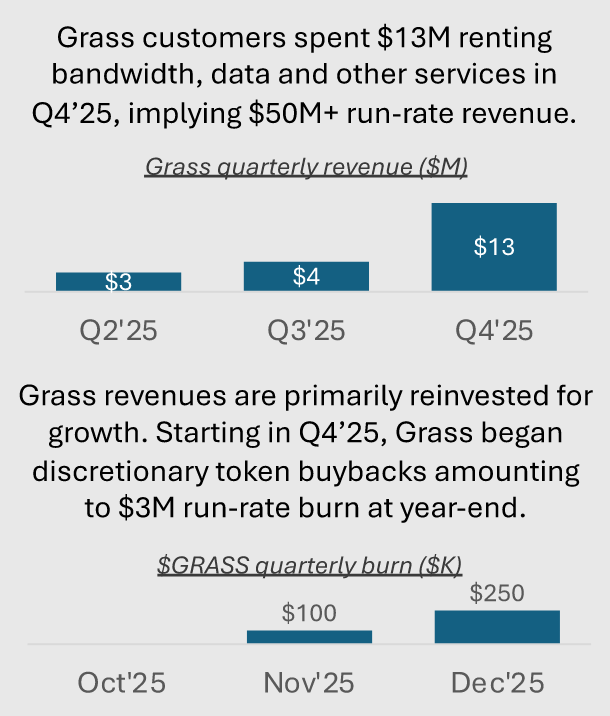
. $grass scaled rev's from 2.75M in Q2->12.8M in Q4. That's a growth rate of 365%. No other DePIN has added +$10M of Q rev in a year, ever
They have also funded the business' growth by revenue. They aren't raising 100M+$ like other protocol
I bet big rev #'s come July 7 on THC
Imagine telling someone in 2024 that not over-relying on synthetic data is a good thing.
The reality is LLM outputs are biased towards the high-density regions of the training distribution.
Synthetic data is a lossy reconstruction of reality. That's great for augmentation and distillation. But if models increasingly train on the outputs of other models, we're effectively recompressing a compression. The first thing that disappears is the long tail (rare observations and genuinely novel information), and much of what we call intelligence is the ability to reason about those exact things.
the Grass Foundation is an ownerless foundation that is governed by independent directors (including former securities regulators) and faces all of Grass’s customers, including mag 7 companies and frontier AI labs. it also owns all of the business’s intellectual property, and it owns the millions of dollars of hardware being used to provision frontier data.
we are very lucky that for the last few quarters, the business’s growth has been funded by revenue! unlike a lot of other startups in the space that need to raise $50-100 million a year to fund their operations.
as far as value accrual, we are all extremely token aligned. I will give you the benefit of the doubt and assume your original post was uninformed and not engagement bait. happy to discuss further, but these are all things we’ve already announced and communicated in the past.
Crypto is not Web3 - but it can save it. Why AI is the next iteration of the internet and crypto is a critical part of keeping it free.
The internet began as a place of total freedom, where web 1.0 users existed completely outside of society’s restrictions. Anyone could post a website, and there was virtually no oversight of what got posted. It was a place where you could look for anything. Now it’s a place where things look for you.
What happened? Two things: smartphones and social media.
As billions of people rushed in over the past ten years, they’ve joined a fundamentally different internet. Today, the web no longer takes place on unique URLs. It takes place on centralized platforms, and it takes place on apps. This happened over the course of several years, but if you blinked you would’ve missed it.
So far, the consequences have been dismal. Despite its early promises, more users spending more hours on fewer platforms has ultimately meant one thing: much more data in much fewer places. This data translated into an unprecedented amount of power, and the platforms that promised to fix the world began abusing it.
What followed was a small group of digital actors getting wholesale access to our digital lives. They use our data for profit while maintaining a system of total surveillance and programmed content. Centralized companies now control what we see and observe what we do, and the egalitarian utopia that was promised to us has turned into a digital feudal state.
So ask yourself:
If Web 2.0 happened when the internet became more closed off, when free apps were offered to users whose data was then captured and sold – what is the next evolution of these trends?
It’s not crypto. It’s AI.
AI in its current state is the ultimate example of a closed internet built on extracted data. And whether we like it or not, Web3 began the moment AI had its iPhone moment two years ago. It began with the release of ChatGPT.
The difference is, the apps of Web 2.0 controlled our view of the internet. Web3 is on track to control our perception of reality itself.
There are less than five companies in the world right now who can achieve an internet scale web crawl. These companies basically control the internet, and by transitivity, the future of AI development.
Today, Grass has over 2 million users. At its current scale, Grass can scrape enough data for fine-tuning specific AI models or informing certain types of real-time inference. When it reaches 25 million users, it will be able to scrape a pre-training corpus large enough to train ChatGPT from scratch on a weekly basis.
Grass's vision extends beyond merely scraping data for model training; we want to fundamentally transform the internet. With 100 million users, Grass will be large enough to achieve an internet-scale web crawl, owned and controlled by its users.
If we can give users control of the rails by which data itself is acquired for AI, we can begin to seize power back from the small handful of companies who took over during Web 2.0.
We stand at a pivotal time in history. Web2 did not need (or necessarily want) to become evil; we just didn’t have the tools to prevent it. The system at the time fell victim of the market incentives that compelled it to act nefariously. Before the advent of blockchain coordination mechanisms, it was impossible to include users in the equation.
We have a chance to do things properly this time.
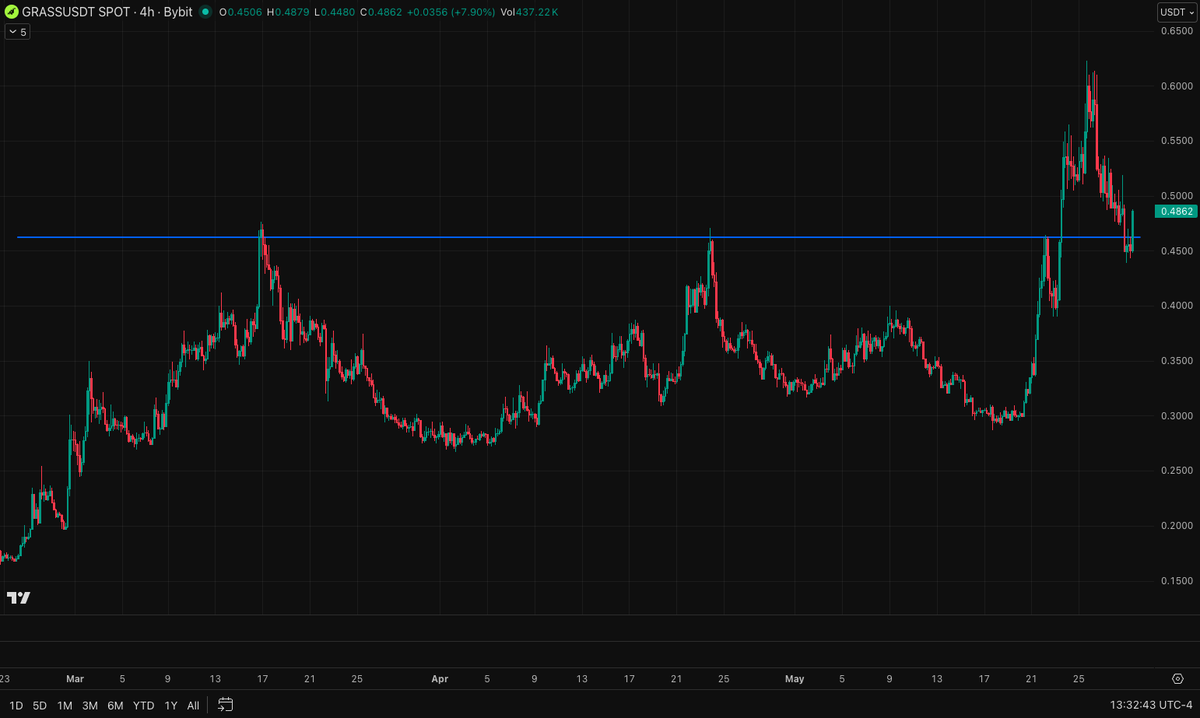
Strong bounce in $GRASS off of prior resistance levels around $0.46.
Great setup going into the upcoming tokenholder call. Likely we see very strong growth in 2026 revs as data demand for model training from leading AI labs continues to accelerate
Yan Liberman (@YanLiberman) explains why @grass is the most underappreciated AI infrastructure play in the market:
"GRASS made it. $12M in quarterly revenue as of November 2025. Sparse updates, that's why it's been overlooked."
"Residential opt-in bandwidth network. Users contribute unused bandwidth through a browser extension. GRASS scrapes the internet with it."