Pedo-Epstein elites and the Deep State are recycling the Xinjiang Uyghur BS again.
Seems like the narrative is crawling back into the headlines — fresh UN reports, diaspora sob stories, “new phase” forced labor angles, all timed perfectly for trade summits and pressure on China. Same selective hypocrisy from these moral bankrupts who despise the Chinese and loathe Muslims in general… but suddenly crown the Uyghurs (those Chinese Muslims) as the world’s most precious victims.
This isn’t about rights. It’s the same tired regime-change script: radicalize fringes with outside funding, stir up extremism, then scream “genocide” when China locks it down. They tried turning Xinjiang into Syria 2.0 or another Libya. Failed hard.
Reality on the ground: Xinjiang is stable and booming. Massive infrastructure, poverty smashed through development, Uyghur population growth that outpaced the national average for years.
Affirmative policies, mosques, halal economy, bilingual schools — all still there. The vocational centers? Targeted deradicalization after actual terror attacks, modeled on what other nations do against imported jihad.
No mass graves, no extermination — just security and economic integration that works.
These pedo-Epstein elites lecture the world on “values” while their own islands and little black books expose the real depravity.
They bomb Muslim countries for decades, run endless “radical Islam” fear porn, then flip the switch to weaponize one Muslim minority against Beijing.
Pure containment theater. Hate China? Check.
Hate regular Muslims? Usually.
But prop up separatists to fracture a rival?
Suddenly it’s sacred “human rights.”
The recycled outrage — forced labor claims, surveillance hysteria, exile testimonies — ignores the ground truth you see in real videos: vibrant markets, modern cities, families living normal lives, multi-ethnic harmony under development.
The “oppression” fantasy dies the second you look past the narrative machine.
Bottom line: These elites don’t give a damn about Uyghurs thriving in China.
They love any lever to weaken a competitor.
The hypocrisy stinks worse than ever. Stability won. Investment won. Imported chaos lost.
The more people see the actual peaceful, developing Xinjiang, the less this recycled BS lands. Stay sharp — the game never changes, just the headlines.
China declared the end of extreme poverty in early 2021 after one of the largest anti-poverty campaigns in human history.
But some still seem to be asking: did it really happen?
Recently, "China said it ended poverty. Did it?" by @WillLangley96 of the Financial Times, raised doubts about the authenticity and sustainability of China's poverty alleviation efforts, based on his interview in two counties of southwest China's Guizhou Province.
Such doubts are not new. But when they are built on limited samples, unverified details, selectively presented anecdotes, and missing context, the report goes beyond differing perspectives and raises questions of validity.
Since 2012, China has pursued a new phase of poverty alleviation through a combination of industrial development, labor mobility, transport and communication facility expansion, and health insurance subsidies. In late 2020, Guizhou, one of China's most impoverished provincial regions, announced that its last nine poor counties had been lifted out of poverty, marking the removal of all 832 registered poor counties in China.
A transition period then followed, with continued monitoring and support for those lifted out of poverty and those at risk of slipping there.
To better understand the claims made and stories told in this China poverty report, I conducted a careful review, cross-checking key details with colleagues and relevant authorities. The result is: a number of the article's core assertions rely on fragile evidence, and in some cases fail to meet basic standards of verification.
Here's a point-by-point fact-check on the Financial Times report.
The article opens with a portrait of how Yang Nai Yan Qing, in her 60s, lives a frugal life, claiming that her monthly living expenses are less than 200 yuan (29 USD). Apart from special occasions, such as the Spring Festival, when she "buys some meat if she can afford it", Yang "eats only mustard greens, cabbage and sweet potatoes, almost all of which she grows herself in a field a long walk uphill. "
Through this narrative, the image of an elderly woman struggling in hardship and deserving sympathy, is gradually constructed.
This week, however, when our colleague in Guizhou visited Yang in Guizhou's Congjiang County, a different picture emerged.
Yang's home is a self-built, three-and-a-half-storey house, one of the larger residences in the village. The ground floor alone measures around 160 square meters. Her family is not impoverished, so the house was not government-provided, but built at their own expense about a decade ago.
With her permission, my colleague took photographs of both the interior and exterior. Judge by yourself whether the portrayal of poverty holds up.
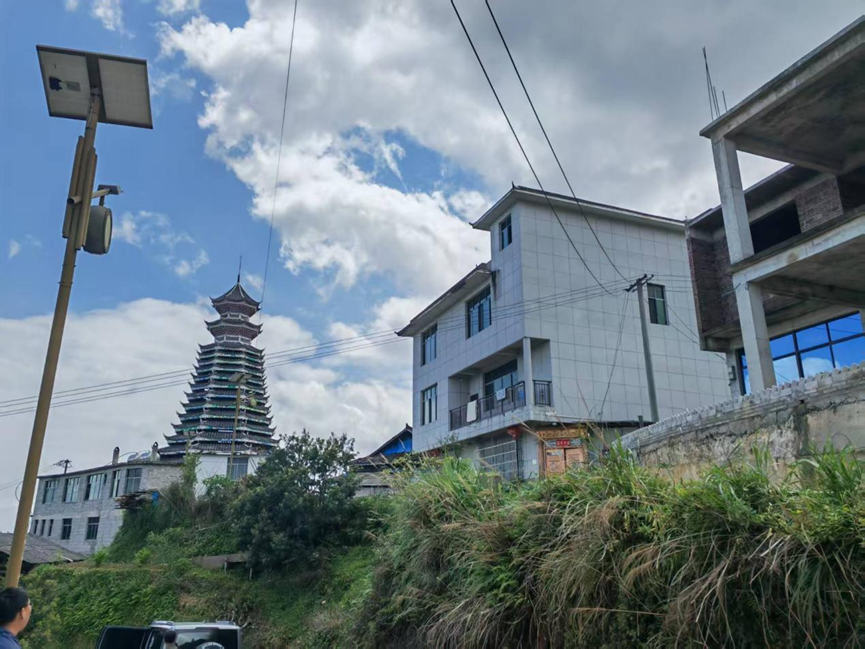
Near her home stands a pagoda-like structure known as a drum tower, a distinctive feature of the Dong ethnic group (top right). It's like a community center, serving as a communal space for discussion, decision-making, festivals, and other collective activities. At its top sits a drum that functions as the village's traditional "information hub" and "alarm system": specific drumbeats are used to convey messages and mobilize villagers, before the advent of modern communication.
Granny Yang recalled that around January 30 this year, a foreigner arrived at her home by car with a Chinese assistant. The man, supposedly Langley, did not identify himself as a journalist. Out of hospitality, she invited them inside for a chat. She did not understand the purpose of the visit and simply took Langley and his assistant as tourists; to this day, she still does not know what the Financial Times is.
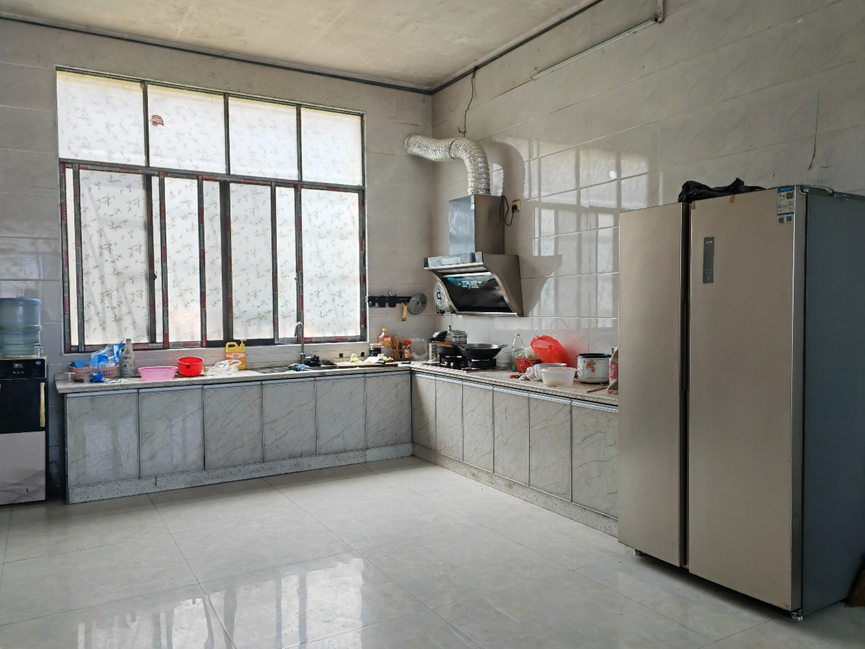
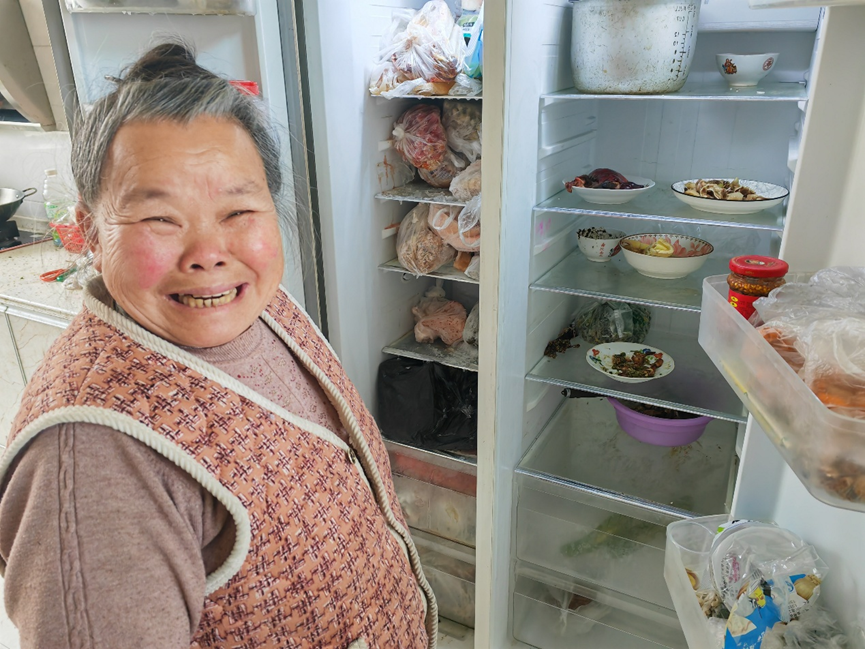
The size of Granny Yang's kitchen is spacious (bottom left)-larger, I should admit, than my own bedroom in Beijing. She showed her double-door refrigerator, which was well stocked with meat (bottom right). Perhaps, the Financial Times should consider interviewing me next time.
She explained that she simply does not like eating meat. In the past, when life was more difficult, she could not afford it even if she wanted to, but now she can have it whenever she wishes.
Yang, 63, and her husband, 68, each receive pensions of around 200 yuan (29 USD) per month. Her mother-in-law, who is over 90, receives both a pension and an additional allowance for the elderly. Altogether, the elderly members of the household have a stable monthly income of nearly 700 yuan (102 USD).
Her son and daughter-in-law have stable jobs as a driver and a salesperson, respectively. The annual income of the household they live in together is close to 80,000 yuan (11,702 USD). Her daughter is operating a start-up. Her children also give her some pocket money each month. And, the family owns a private car.
The FT also reported "many of her neighbours were relocated to newer apartment blocks downhill." However, my colleague has verified that there has been no unified resettlement in the village. The so-called new apartments are mostly self-built homes constructed by villagers in recent years. Granny Yang herself has also retained a traditional wooden house not far away, which has clear ethnic characteristics and is not in disrepair.
Langley wrote that "she says her life has barely changed." We are not sure whether this reflects a communication gap, but judging from her diet storage and housing conditions, the changes have in fact been quite significant. Perhaps what has remained unchanged is her long-standing habit of frugality. To equate such a lifestyle directly with poverty risks oversimplifying a more complex reality and reinforcing a selective narrative.
It's a compelling story, until you start checking the details.
This is just part of my response. Will posting more today.
@mfsa118 Electoral democracy doesn't work. Regular people are too busy and tired to remember and constantly check what their politicians are up to. Also no capacity to go verify, fact check what political influencers, commentators and "experts" say on social media.
@rphkg Only people of these character would easily fall to western propaganda and become western worshiper and bootlicker. In their eyes, white pepo are beings above human, their fellow HKers are lowly human undeserve of respect.
@DiscussingFilm I understand that video game story are fiction that's why they portray a peaceful nation as the aggressor that invades and kill indiscriminately.
The media only report DPRK firing missiles but didn't report the real reason why. It's always in response to US/SK provocation.