#Reformation2.0
THE SECOND REFORMATION: STATE vs CORPORATION
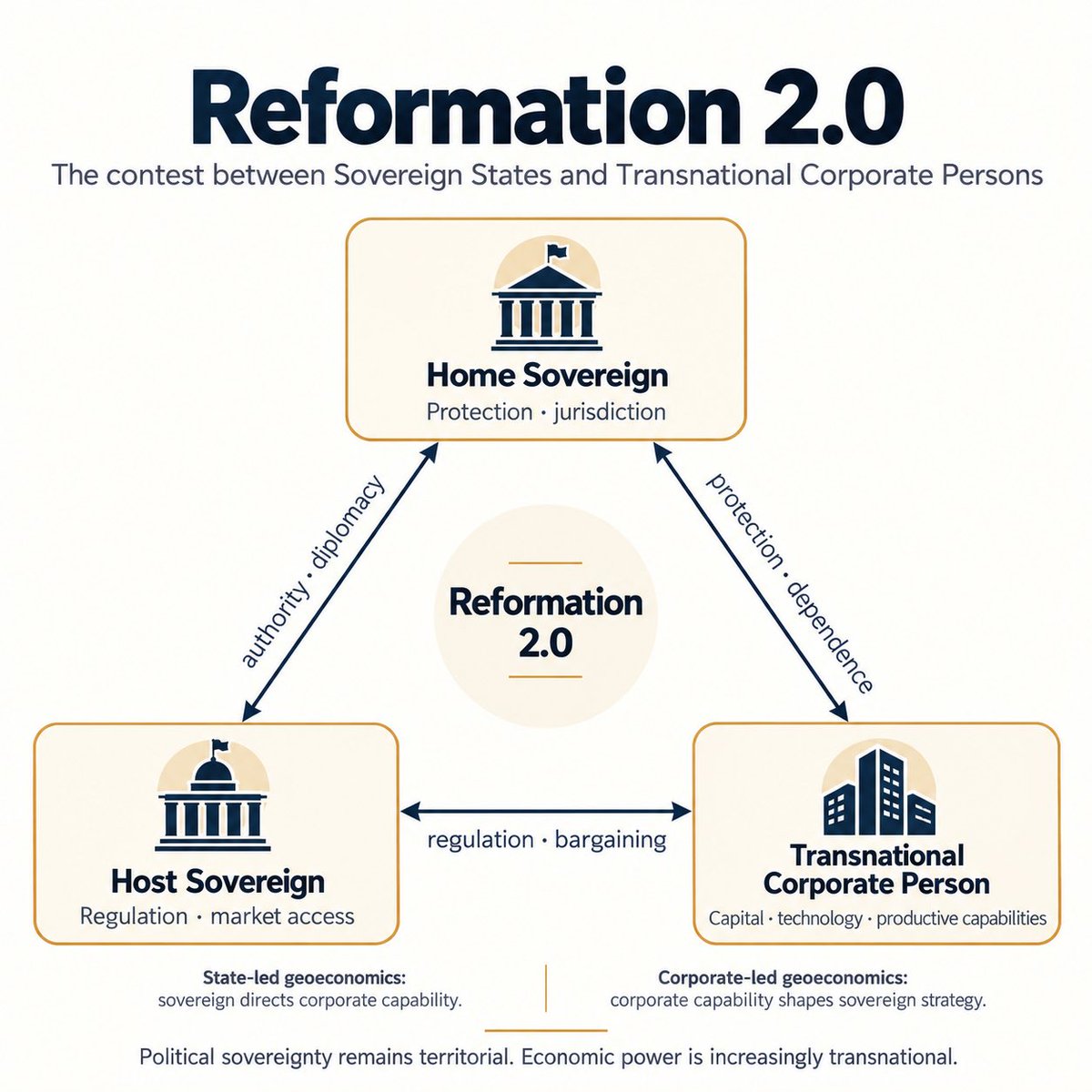
The contest between sovereign states and transnational corporate persons.
The First Reformation challenged the authority of a transnational Church and contributed to the reordering of its relationship with territorial sovereigns.
It was not merely a religious dispute. It transformed the distribution of institutional authority, political legitimacy, property and power.
The Second Reformation concerns the emerging contest between sovereign states and transnational corporate persons over who governs the economic and technological foundations of society.
The corporation is a legal person constituted under sovereign law, capable of owning property, accumulating capital, contracting, borrowing and exercising rights across jurisdictions.
Yet the modern transnational corporation can accumulate financial, technological and productive capabilities upon which sovereign states themselves become dependent.
The constitutional paradox: the sovereign creates the corporate person, but the corporate person may acquire the capabilities upon which the sovereign depends to exercise its authority.
This produces two competing, increasingly intertwined configurations of geoeconomic power.
STATE-LED GEOECONOMICS
Political authority establishes strategic objectives and mobilises corporate capital, technology and productive capabilities in pursuit of national development and security.
The sovereign directs corporate capabilities.
CORPORATE-LED GEOECONOMICS
Corporations control critical productive, financial and technological capabilities, increasingly conditioning the strategic objectives, policy choices and economic possibilities available to sovereign governments.
Corporate capabilities shape sovereign strategy.
Neither configuration is absolute. States and corporations remain simultaneously collaborators, competitors and mutually dependent institutions.
The contest becomes more complex across borders.
A transnational corporate person may be constituted by one sovereign, operate within another, and depend upon the financial, technological and legal systems of several others.
Its home sovereign may mobilise it as an instrument of national strategy, while its host sovereign may depend on its investment, infrastructure and technology.
What makes this a Reformation is not the growing size of corporations, but the potential reordering of the institutional settlement governing the exercise of economic power.
Three fundamental questions define that settlement:
1. Who sets strategic objectives?
The sovereign or the corporation?
2. Who controls productive capabilities?
States, shareholders or an increasingly inseparable combination?
3. Who absorbs losses and captures gains?
Taxpayers, investors, workers or foreign customers?
The First Reformation transformed the relationship between Church and State.
The Second Reformation may transform the relationship between State and Corporation.
Political sovereignty remains territorial. Corporate economic power is increasingly transnational.
And the central contest is whether political authority directs economic capability, or economic capability increasingly determines the choices available to political authority.
#Reformation2.0 #SecondReformation #Geoeconomics
@michele_geraci There is no need
EU policies will simply and slowly ensure inflation rises and bond yields follow.
To do it all at once would be a quick death. Politicians prefer slow.
In 1913, China issued a £25 million gold loan through a consortium of British, German, French, Russian and Japanese banks.
Within a year, several of those powers were at war. Yet the eventual beneficiary of Britain’s declining monetary supremacy was America.
There is an instructive analogy for today.
Between 1913 and 1945, Britain was the incumbent monetary hegemon, America the ascendant industrial power, and Germany the geopolitical challenger.
Germany challenged Britain’s security order. America inherited its monetary position.
War accelerated an economic transition already under way, converting American industrial strength into creditor power and eventually monetary dominance.
Today, America is the monetary incumbent, China the industrial challenger, while Russia and Iran disrupt the European and Persian Gulf security orders.
But there is an additional complication: America is also undermining some of its own monetary advantages.
By weaponising the dollar through sanctions, reserve immobilisation and financial exclusion, Washington is encouraging other sovereigns to reduce their dependence on American monetary infrastructure.
Meanwhile, prolonged military commitments impose fiscal and strategic costs, while geopolitical disruptions threaten the trade and energy flows supporting China’s industrial economy.
The consequences are contradictory.
Financial coercion encourages alternative payment arrangements, while geopolitical crises can reinforce demand for dollar liquidity. China’s industrial ascendancy does not automatically translate into monetary succession.
For Africa and the Global South, this distinction is critical . Trade settlement, international financing and reserve accumulation need not remain anchored to the same currency. More options beat less.
The emerging hegemonic transition is a two-power economic competition unfolding within a multipower geopolitical conflict.
Its outcome may depend less on China’s industrial ascendancy alone than on whether geopolitical conflict and monetary coercion erode America’s financial advantages faster than they damage China’s productive advantages.
The greatest beneficiary of a hegemonic conflict need not be the power that starts it, fights it or wins it.
Those that study monetary history know the sequence:
•Physical hegemony change - Energy, Industry, Trade
•Bond yields cross
•Financial hegemony change - Financial, Monetary
We need not cross to RMB as the reserve asset. Maybe the gold bugs are right. Maybe it will be collateralised bilateral central bank swaps. The UST is no longer the trusted Global Reserve/ Settlement/ Collateral Asset.
Scotland as 21st Century Hong Kong for Arctic access. 🫣
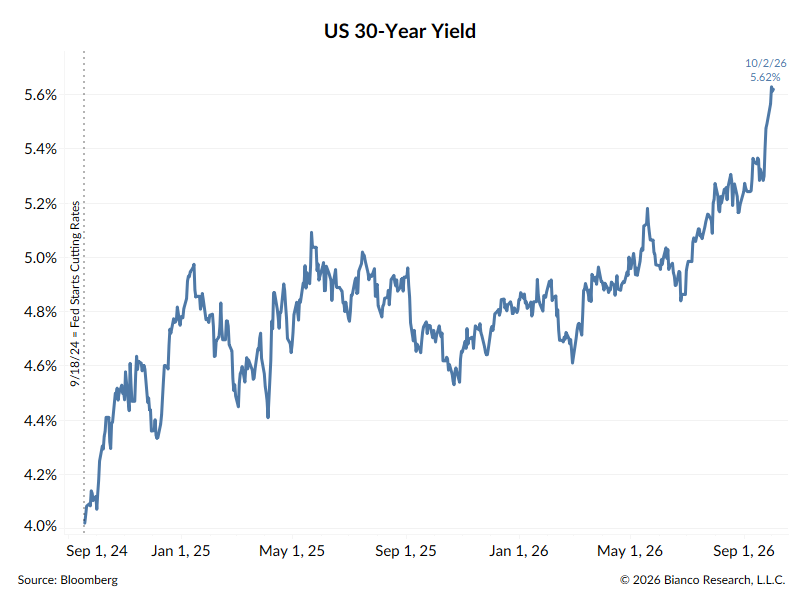
IS THE BOND MARKET PRICING IN A NEW GLOBAL HEGEMON?
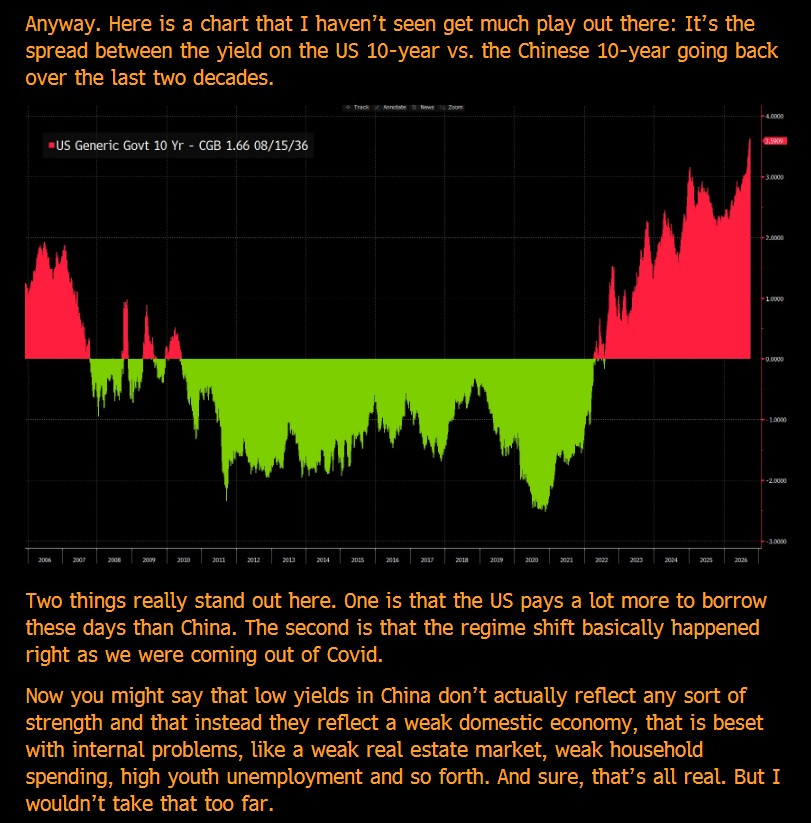
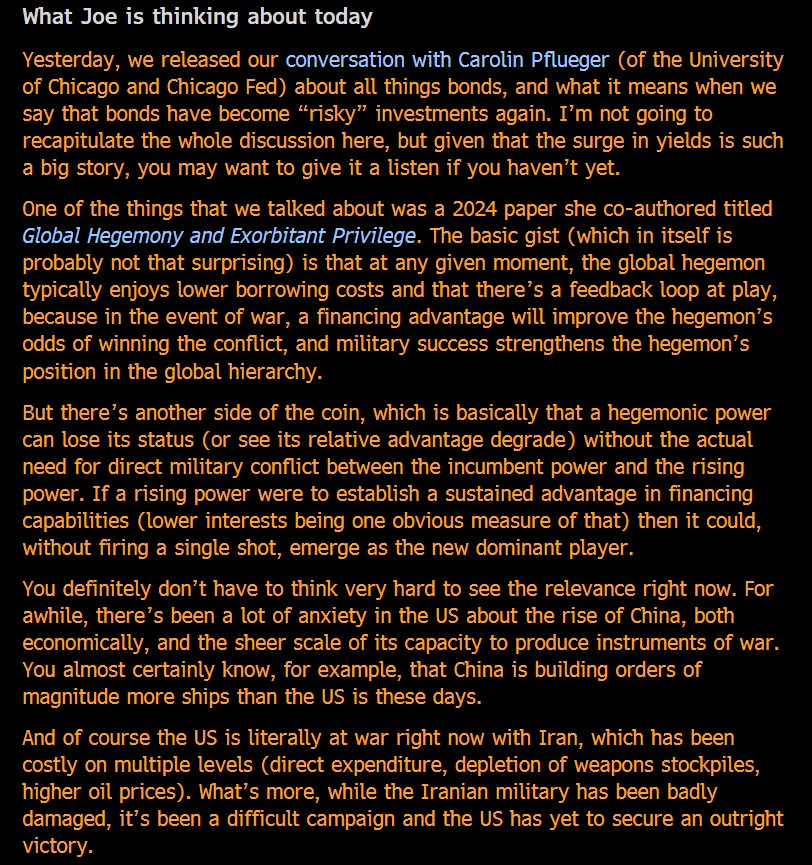
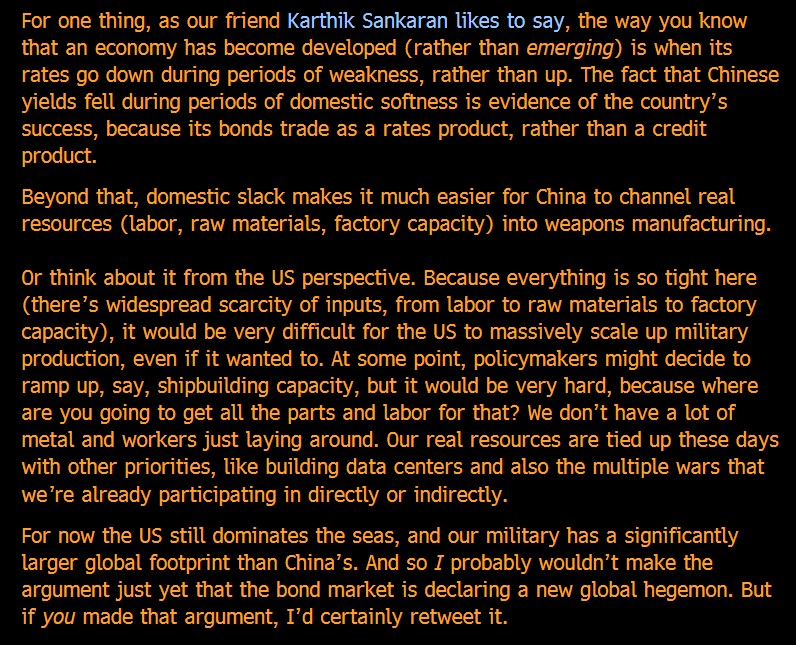
In the newsletter (inspired by our conversation with @CarolinPflueger) I wrote about the huge spread between US and Chinese sovereign borrowing costs, and what it might imply about a shifting balance of geopolitical power.
This is a sovereign debt crisis and not a private debt crisis. This crisis is inflationary and a private debt crisis is deflationary.
It’s government debt service ratios not debt to gdp
- Debt Payments/ Income
- Debt Issuance/ Expenditure
Ask any EMDE trader — G7 governments are becoming banana republics as debt servicing requirements take up an increasing proportion of income and expenditure against the fact that G7 governments neither want to tax citizens or reduce programs.
The dynamics are self reinforcing for now.
1/8
Is Too Much Debt the Reason Bond Yields are Heading Higher?
--
My argument for why this case is overstated.
(It's a problem, but a secondary one.)
🧵
The Hegemonic Yield Spread Widens.
US10Y - CN10Y = 357bppa
This has just exploded in the past month and China CUTS rates!!
Who is Superman, who is Buzarro?
America pays more for capital; China pays less to turn capital into capacity.
In a CAPEX-intensive technological transition, that difference compounds through every power plant, grid, battery factory, EV plant and data centre.
America may offer investors the higher return on capital. China may offer industry the lower cost of capital. For building the next technological system, those are very different advantages.
#CAPEXTransition
#DollarCitizenship
#YuanCarryTrade
https://t.co/oWutv2Clng
The West still seems not to understand that the transition from combustion heat engines to electrical machines is fundamentally a materials-science transition.
It is rather like entering the Industrial Revolution without noticing that civilisation was moving from eating carbohydrates to burning hydrocarbons.