My assessment that Kerch Strait north ship anchorage (Crimea logistics) is done for now, stands.
After incessant hammering by Ukraine drone forces the latest sat imagery (July 13th) show only 6 ships left, from about 50-90 normally.
Ukraine has claimed 116 ships hit.
The multinational naval coalition that suppressed Somali piracy took years and billions to build. Reassembling it in 2026 is a fantasy. https://t.co/eXvRyFZ6co
(Reuters) - U.S. President Donald Trump on Monday said that the U.S. would take out Pickaxe Mountain in Iran, as he warned that Washington would continue to hit the country hard.
"We're going to take out Pickaxe Mountain. Tell the Iranians to be ready," Trump said in an interview on the Hugh Hewitt Show.
"We're watching (Pickaxe Mountain) closely. We see no activity there. They're not doing well with their nuclear situation. Every time we hear about it, we blow it up. So they don't like talking about it. But we'll probably give Pickaxe a shot relatively soon," Trump said.
Pickaxe Mountain, located near Iran's heavily damaged Natanz uranium enrichment facility, is a heavily fortified site that hosts two deeply buried tunnel complexes that experts assess as beyond the reach of the most powerful bunker buster bombs in the U.S. arsenal.
Trump earlier on Monday said the United States was reinstating its blockade of Iranian shipping in the Gulf and would ensure the Strait of Hormuz stays open — for a fee — after the two sides exchanged more missile and drone attacks.
"We're going to hit them very hard tonight and we're going to hit them hard tomorrow. And there's not a damn thing they can do about it," he said on the Hugh Hewitt Show.
Iran Update Special Report, July 13, 2026: The US-Iran ceasefire has effectively ended with relatively more intense and consistent exchanges of fire in the Persian Gulf. The present fighting is relatively less widespread in geographic scope and smaller in terms of total strikes compared to March and April 2026, but the increase in strikes and reimposition of the blockade nonetheless mark the end of the ceasefire.
More Key Takeaways:
The US naval blockade had a limited but notable effect on Iranian willingness to continue fighting in Spring 2026 and was critical to securing the memorandum of understanding (MoU). Iranian President Masoud Pezeshkian, reportedly fearful of the US blockade and the deteriorating economic situation in Iran, implored Supreme Leader Mojtaba Khamenei to accept the June 18 MoU despite the supreme leader’s concerns and desire to retain control over the Strait of Hormuz. Pezeshkian’s efforts to secure the MoU do not imply that other elements of the Iranian regime were seriously affected by the blockade, however.
The recent MoU breakdown and the reimposition of the US naval blockade can cause negative political effects within Iran that are not immediately related to a breakdown in the regime’s willingness to continue the fight. The regime’s decision to continue firing into the Strait of Hormuz ultimately reignited the war, and the regime will need to argue the case to its own people and among itself as to why continuing the conflict is necessary. This situation will likely revive the intra-regime debate over how to handle the strait, economy, and negotiations with the United States.
The United States and Iran are in a new phase in the war, and both sides have had time to internalize lessons and reconstitute after the initial round of conflict. (1/2)
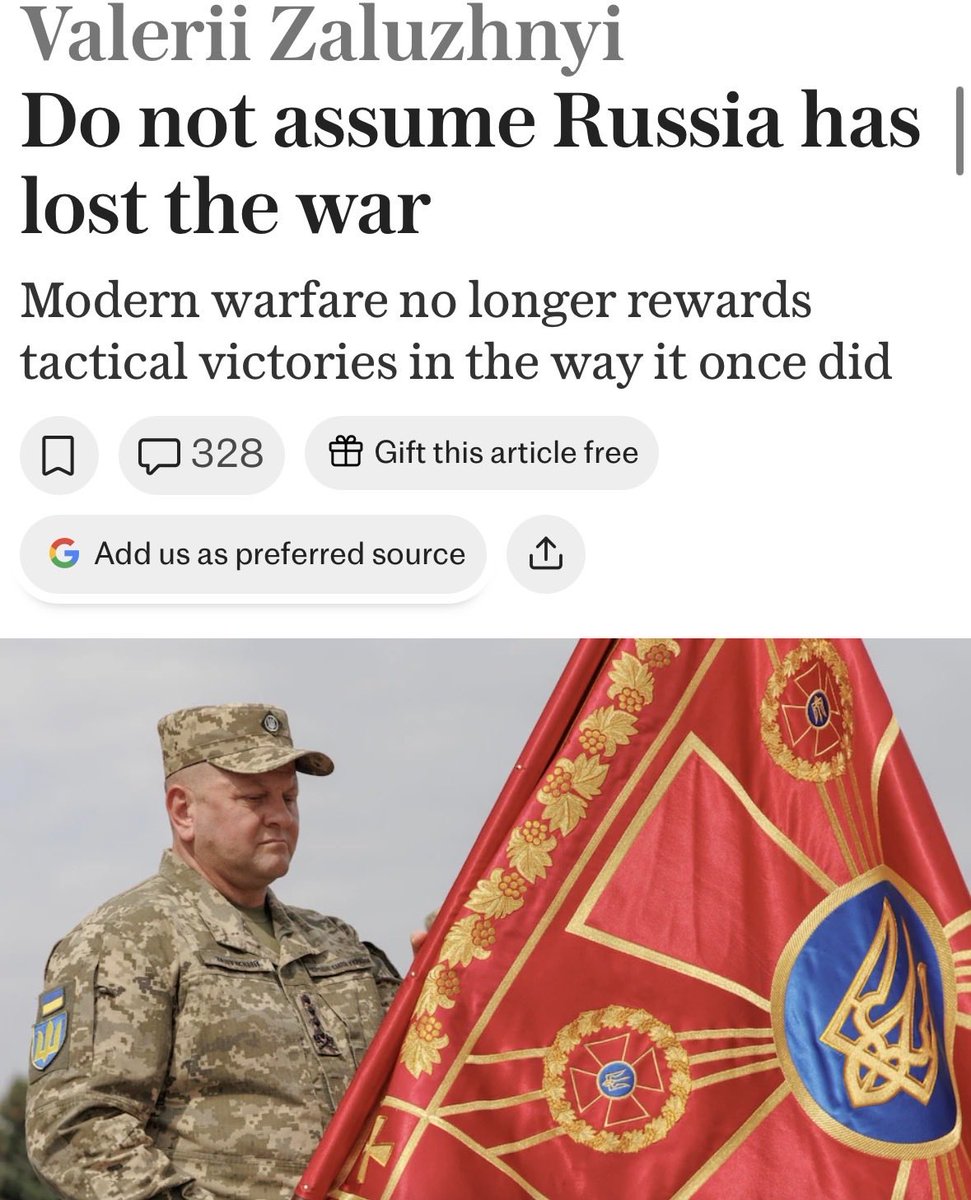
Interesting piece by Valerii Zaluzhnyi:
He notes that Russia has “effectively lost” the war are a dangerous misreading. The front has reached rough equilibrium: Russia can’t conquer Ukraine, but Ukraine can’t fully liberate occupied land by force alone. More mutual denial rather than decisive victory. On mid/long-range strikes:
“Ukraine’s increasingly effective strikes against Russian logistics and critical infrastructure have imposed real costs on Moscow. But these attacks are expensive, technologically demanding and ultimately reciprocal. Russia retains the ability to strike back with equal or greater force. Neither side can rely on this form of warfare to produce a decisive strategic outcome.”
I try to take a balanced look at the question of Russian military reconstitution after this war, the problems and enduring weaknesses in the force, but also how it has evolved and expanded in ways that we need to consider in future contingencies. https://t.co/J0jaZ9ViCW
@auonsson looks to me like a Claude generated HTML dashboard. I made one recently and it looks very similar in terms of color palette and general style
Likely to resume major air strikes. Likely more shock and awe kind of deal this time I would imagine. Power and oil production targets would be my guess. Moving on the Strait and going for islands is possible, but very risky.
But lots to maintenance will be required since the ceasefire, as well. Gulf states will have to suck up another round. Diplomatically it will be tougher than the first go.
Interceptor stockpiles a major concern, especially mid course and THAAD. This affects Israel most.
What do you think the target sets will be?
1526 - 2026: Beretta turns 500
Introducing the Titan – not just a rifle, but a statement: https://t.co/RDTb3smrUJ.
Born from Beretta’s advanced engineering and inspired by the rigorous demands of the tactical world, the Titan is a fusion of performance and ceremonial elegance. This one-off bridges the gap between your sporting and tactical needs and the collector's cabinet with seamless grace. The Titan project introduces groundbreaking applications for Beretta, blending aesthetics with advanced engineering. built with magnesium, titanium, and carbon fiber, the Beretta Titan redefines modularity, versatility, and accuracy. Rigorous testing confirms its superior performance, marking a milestone for the rifles of tomorrow.
#Beretta500 #LegacyForgesTomorrow
Everyone is covering the force majeure. Everyone is covering the 13 million tonnes. Everyone is covering the gas prices and the geopolitics and the five-year timeline.
My good friend Veron Wickramasinghe just asked the question nobody else is asking: how do you rebuild when the machines that make the molecules take three to four years to manufacture, ship through a closed strait, and commission in a war zone?
Read what he found.
Every LNG train at Ras Laffan requires high-purity nitrogen from Air Separation Units: cryogenic plants cooling air to minus 190 degrees to distil it into component gases. Pearl GTL needs 30,000 tonnes per day of pure oxygen from eight Linde-built ASUs. Each cold box: 470 tonnes, 60 metres tall. Lead time from contract to commissioning: three to four years. If destroyed, replacement arrives no earlier than 2029.
But here is the choke point that Veron identified that nobody else has. The heart of every cryogenic ASU is a brazed aluminium plate-fin heat exchanger called a BAHX. These exchangers operate with temperature differentials of one to two Kelvin and require precision brazing in vacuum furnaces. Only five companies on Earth are qualified to manufacture them. Five. For every cryogenic heat exchanger in every air separation unit, every LNG train, every industrial gas facility, and every hydrogen plant on the planet. Fives Cryo in France. Kobelco in Japan. Linde in Germany. Sumitomo in Japan. Chart Industries in La Crosse, Wisconsin. Current lead times: 12 to 18 months or more. And their order books are already full.
Veron was honest about what is confirmed and what is not. QatarEnergy CEO al-Kaabi confirmed LNG Trains 4 and 6 are damaged: 12.8 Mtpa offline, 3 to 5 year repairs, $20 billion annual revenue loss, force majeure up to 5 years. Shell confirmed Pearl GTL Unit 2 needs roughly one year of repair. What has NOT been confirmed is whether the ASUs themselves were destroyed. Shell’s one-year timeline is inconsistent with total ASU loss, which would require four to five years. Veron flagged this honestly and gave you the analysis both ways.
And then he showed you the cascade nobody else sees.
Qatar produces one-third of the world’s helium from the same facility. Helium is irreplaceable in semiconductor fabrication: cooling wafers, purging chambers, detecting leaks. Samsung and SK Hynix import 64.7 percent of their helium from Qatar. Spot prices have doubled. Liquid helium vaporises within 35 to 48 days. Fourteen percent of capacity is permanently damaged.
The LNG trains, the ASUs, and the helium plants all sit on the same rock, fed by the same gas field, accessed through the same strait. One set of missile strikes on March 18 to 19 took out 17 percent of global LNG, threatened one-third of global helium, and exposed a supply chain that runs through five workshops in Germany, France, Japan, Italy, and Wisconsin with three-year lead times and full order books.
This is what Veron understood that the headline analysts missed: the recovery is not constrained by money or political will. It is constrained by vacuum furnaces, aluminium metallurgy, and the physics of brazing at tolerances measured in single-digit Kelvin. You cannot accelerate physics. You cannot surge-produce a 470-tonne cold box. You cannot commission cryogenic equipment in a war zone.
Five companies. Five workshops. Three-year lead times. Full order books. A closed strait. An active war.
That is not a recovery timeline. That is a sentence. Read Veron’s full analysis. It is the most important thing written about this war that does not involve a missile.
@TBrit90@gepardtatze The counterattack in Zaporizhzhia starting last month showed that you can conduct offensive operations if you can locate and suppress UAV positions. New countermeasures + proper planning and preparation can set the conditions for successful mechanized assaults.
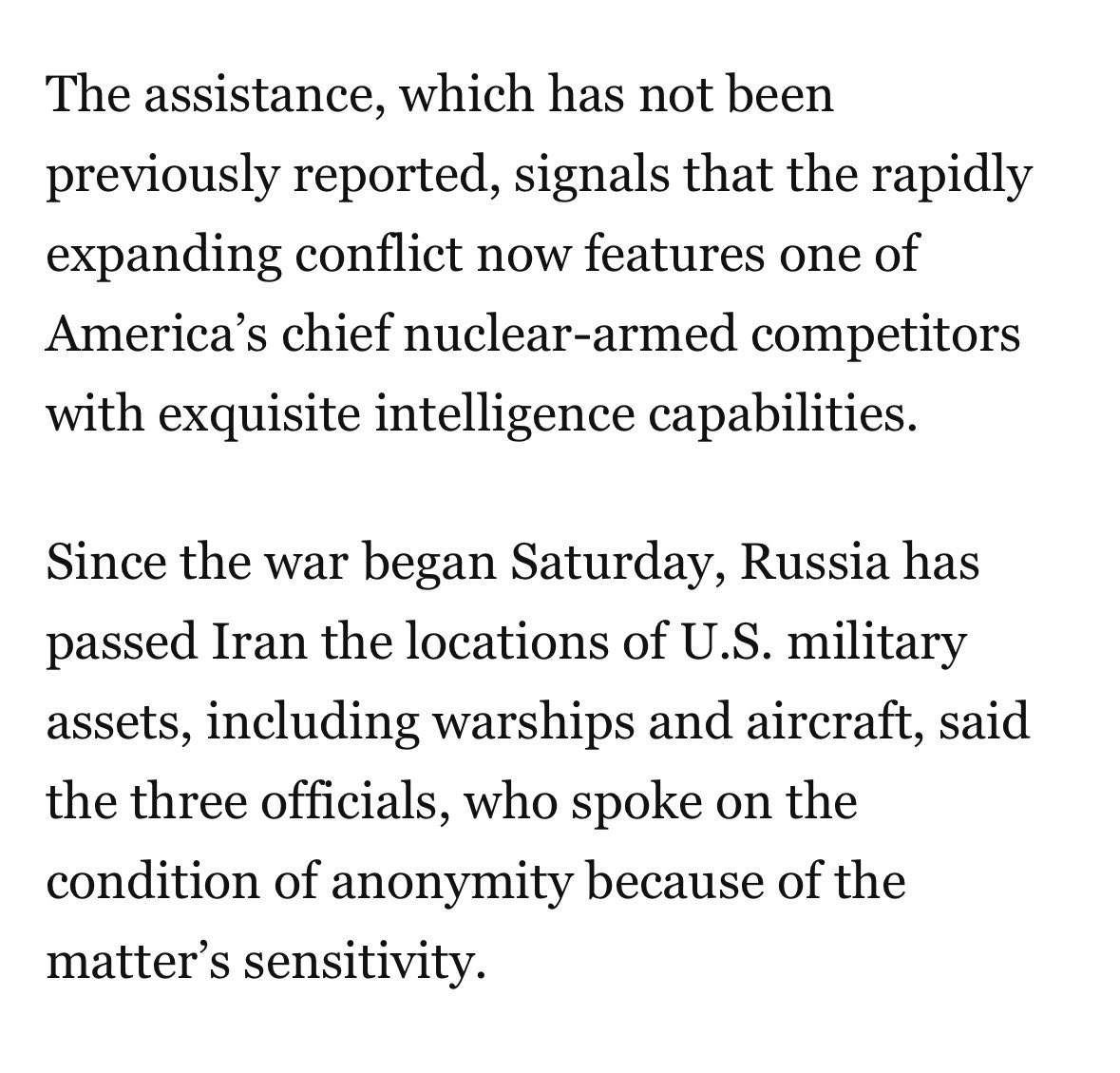
“Russia is providing Iran with targeting information to attack American forces in the Middle East, the first indication that another major U.S. adversary is participating — even indirectly — in the war, according to three officials familiar with the intelligence.
The assistance, which has not been previously reported, signals that the rapidly expanding conflict now features one of America’s chief nuclear-armed competitors with exquisite intelligence capabilities.
Since the war began Saturday, Russia has passed Iran the locations of U.S. military assets, including warships and aircraft, said the three officials, who spoke on the condition of anonymity because of the matter’s sensitivity.”
@nakashimae@wstrobel@noahjrobertson
https://t.co/NGOURoUUEC
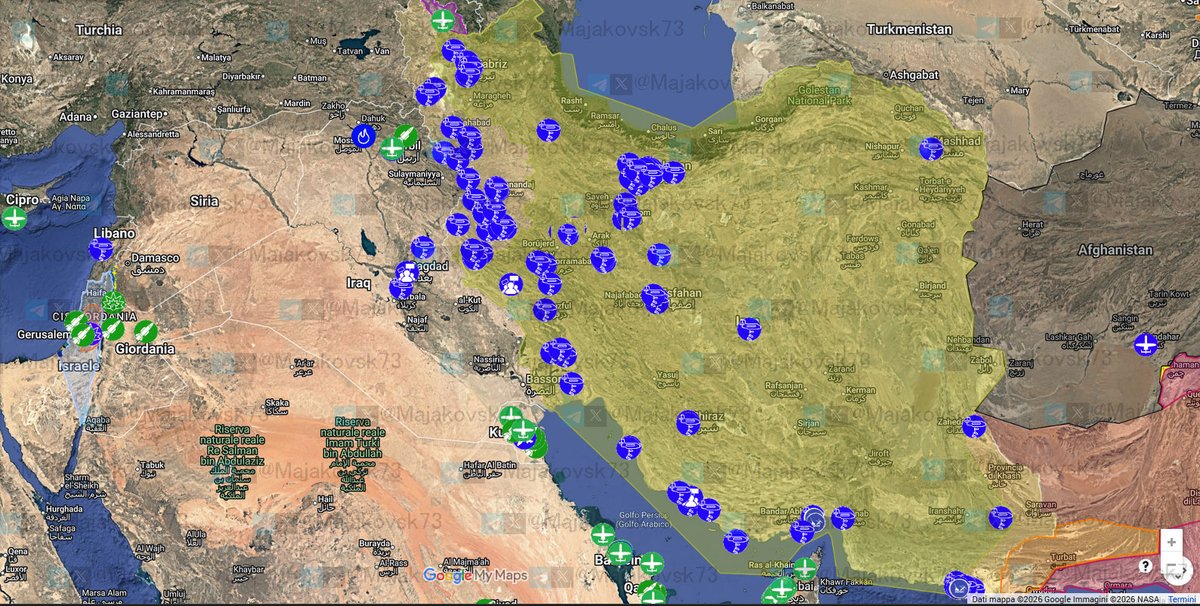
#iran#Usa#Mo consueto aggiornamento mappa. Alcune cose da notare:
1) Le notizie sull’entrata dei curdi ad ovest sono risultate completamente false. La notizia è stata smentita dallo stesso governo curdo iracheno.
Ho già spiegato ampiamente perché non mi aspetto boots on the ground, in particolare nel caso dei curdi.
Resteranno attivi, ovviamente, i movimenti insurrezionali beluci e curdi già esistenti, che cercheranno di sfruttare l’occasione. Ma ricordiamoci che sono numericamente decisamente piccoli.
2) Interessante come gli strike stiano sistematicamente colpendo non solo infrastrutture e mezzi militari, ma anche commissariati di polizia e palazzi governativi. Soprattutto per i commissariati il numero è impressionante. Si vuole cercare di eliminare il più possibile le forze di sicurezza e di primo contrasto per eventuali insurrezioni.
Altro punto: gli strike si stanno “allargando” anche in aree periferiche, soprattutto nelle zone curde, ma anche altrove. L’impressione è che nei primi giorni ci si sia concentrati su obiettivi più grossi e su Teheran, per poi andare ad allargare progressivamente l’azione.
Quanto alle navi, da registrare il primo siluramento di una nave dalla WWII: a largo di Ceylon è stato affondato un destroyer iraniano. Ormai si parla di 20 navi iraniane affondate ed anche stamani il porto di Bandar Abbas era in fiamme per gli airstrike della notte. Probabile che la marina iraniana di grossa stazza sia stata completamente azzerata.
3) L’Iran ha diminuito il numero di lanci di missili e droni. La curva dei lanci si è abbassata, ma ovviamente il problema è che difficilmente tenderà a zero.
Va tenuto conto che anche le munizioni d’intercetto tendono a diminuire drasticamente, soprattutto perché i sistemi PAC (Patriot) tendono a un consumo massivo di munizioni. L’utilizzo contro i droni tende quindi a far esaurire le scorte di intercettori.
Gli USA stanno già pensando di spostare batterie da altri paesi; intanto sono stati schierati solo ieri sistemi C-RAM in Iraq, più adatti al contrasto dei droni. I paesi del Golfo si stanno rivolgendo all’Ucraina per l’acquisto di droni intercettori (che producono in serie), ma non vedo tempistiche rapide. Francesi, greci e stamani pare anche italiani si stanno muovendo per spostare navi in difesa dell’area del Golfo e di Cipro con funzioni di intercetto dei droni.
4) Stamani due droni hanno colpito l’aeroporto dell’enclave azera di Nakhchivan: è la prima volta che viene colpito l’Azerbaigian.
Ieri un missile è stato intercettato sopra territorio turco (in questo caso gli iraniani hanno parlato di deviazione e sostenuto che il lancio fosse diretto su Cipro, ma ho molti dubbi). Nuovi lanci sull’Oman sono stati registrati ed intercettati.
Abbattuti altri due aerei iraniani in direzione del Golfo. La cosa incredibile è che ci siano ancora aerei iraniani in volo.
5) La situazione rimane complessa e non c’è nessun accenno a proteste o a un crollo del regime, che si appresta a scegliere il successore di Khamenei e la nuova Guida Suprema.
La strategia del terrore è piuttosto chiara: bloccare e paralizzare il Medio Oriente, colpendo traffici marittimi e aerei e soprattutto quelli navali, in modo da paralizzare produzione e trasporto di greggio, facendo pagare al mondo intero il costo di questa guerra (ed aumentando le pressioni sugli USA per la fine del conflitto).
Altro punto interessante: dopo i primi 2 giorni non sono state annunciate altre perdite di rilievo del regime. Il che fa pensare che gran parte delle strutture di "potere" siano stati evacuate, e che i principali papaveri siano stati messi al sicuro in bunker sotterranei.
6) Intanto l’IDF continua a bombardare il Libano. L’esercito è entrato oltre il confine ma ancora non sono registrate avanzate in profondità; da capire se si spingeranno più avanti in direzione del fiume Litani.
Per Israele l’attacco all’Iran ha molte opzioni strategicamente positive:
colpire il nemico di sempre e metterlo almeno militarmente fuori dalla possibilità di nuocere per un bel pezzo;
eliminare quel che resta di Hezbollah in Libano;
“costringere” i paesi arabi a schierarsi con Israele, cosa che sarebbe un unicum e che creerebbe non pochi mal di testa alle opinioni pubbliche arabe.
Motivo per cui i paesi del Golfo non hanno ancora iniziato operazioni offensive verso l’Iran, limitandosi a quelle difensive.
(Reuters) - The assassination of Iran's Supreme Leader Ayatollah Ali Khamenei has plunged the Islamic Republic into its most perilous crisis since the 1979 revolution - confronting it with war on its own territory, an unresolved succession, and mounting internal strain.
Despite the shock of Khamenei's killing, five regional officials and analysts cautioned against assuming rapid collapse. Iran's political order, they said, was deliberately constructed to avoid reliance on a single leader, dispersing authority across clerical institutions, the security apparatus and power networks.
"The Iranian system is bigger than one man - removing Khamenei could harden the regime rather than weaken it," said Danny Citrinowicz of the Atlantic Council.
"Iran was built to survive the loss of a leader," added Ali Hashem, a research affiliate at Royal Holloway, University of London. "The danger is not a vacuum. It's whether war and pressure push the system past the point where that resilience holds."
At the centre of that resilience is the elite Islamic Revolutionary Guards Corps (IRGC), long regarded as Iran's true centre of gravity. The balance of power now hinges on whether the Guards emerge weakened by battlefield losses and internal frictions - or more entrenched, closing ranks around a harder, more security-driven approach to governance.
"The real question is whether Khamenei's death takes the air out of the IRGC - the force that actually runs Iran - or whether they close ranks and harden," said Alex Vatanka, a senior fellow at the Middle East Institute. "If rank-and-file officials decide there is no future here, I'm not sure even the Guards can keep the regime together."
Regional officials say the Guards are unlikely to transform ideologically because their identity and mandate are rooted in protecting the revolution. But they are capable of tactical evolution if the system requires it.
"They may evolve into a less hardline force...there are pragmatic mid-level members open to reducing tensions with the United States if necessary for the system's survival," said one regional official. That conditional pragmatism makes the IRGC both the system's shield and its key barometer.
REGIME CHANGE?
Jonathan Panikoff, a former U.S. deputy national intelligence officer for the Near East, said Washington and Israel appear to be pursuing a strategy aimed not only at degrading Iran's military response capabilities, but at destabilising the regime itself by removing its senior leadership and testing the loyalty of the rank and file.
The success of that approach, he said, would ultimately depend on whether security forces stand aside or defect if public unrest resurfaces.
In the immediate aftermath, officials say Tehran's overriding priority is to project continuity. Operationally, Iran's command structure continues to function, though under heavy pressure. Missile forces, air defences and top commanders have been hit, but the system has so far absorbed the blows.
Iran now faces three intersecting tests, officials say: whether its security state can hold under fire; whether its embattled elite can agree on a successor or pivot to a new governing formula; and whether a shaken public pushes the crisis toward a deeper political rupture.
Veteran Iranian politician Ali Larijani, secretary of Iran's Supreme National Security Council, announced on Sunday that a temporary leadership council would oversee the transitional period after Khamenei's death.
Figures such as Larijani and Mohammad Baqer Qalibaf, the parliament speaker, are seen as potential bridge figures in such a phase, reflecting a security-oriented but pragmatic balancing approach.
Politically, Iran faces a succession process it has navigated only once before - and then under far more stable conditions. The constitution assigns the task to the Assembly of Experts, an 88-member clerical body, but analysts say wartime pressures could push the process toward a more improvised outcome - either a quickly appointed successor or a temporary collective leadership centered on the security establishment.
They said Khamenei has sought to shape that outcome before his death. Following a 12-day war with Israel in June last year that targeted him and his inner circle, he nominated preferred successors and ensured key military posts were filled with backup commanders.
The candidates he favoured included judiciary chief Gholam-Hossein Mohseni-Eje'i and Hassan Khomeini, a moderate cleric and grandson of the Islamic Republic's late founder.
But officials say the clerical body may delay the selection of a successor to Khamenei for fear he will be killed.
FAR FROM OVER?
Externally, Israel is signaling the campaign is far from over. Two sources briefed on the operation said Israel intends to keep striking political and security institutions linked to Iran's ruling establishment, as well as ballistic missile and launcher systems, in an effort to weaken the state and create conditions for regime change.
One source said Israel wants the campaign to continue at least until Iran's missile capabilities are destroyed, but fears it could be cut short if Washington reaches an agreement with Tehran.
"The objective is very clear: to remove an existential threat to the State of Israel," Israeli Foreign Ministry spokesperson Oren Marmorstein told Reuters in Tel Aviv. "That threat is the Iranian regime. We have no quarrel with the Iranian people."
A senior official with direct knowledge of joint Israeli-U.S. military planning said it was too early to predict what political order might emerge in Iran, noting that the campaign was still in its early stages and outcomes would depend on developments on the ground.
Iranians must take their destiny into their own hands, the official said, adding that this might be easier once the U.S. and Israel have achieved "air supremacy" over Iran.
Maintaining the tempo and intensity of strikes was seen as critical to exploiting fissures inside Iran and the IRGC following the killing of senior leaders, the official added, declining to elaborate on what a breakdown in command could look like.
The conflict has also opened new risks.
With foreign militaries operating over Iranian airspace and the state's coercive capacity under strain, analysts say unrest could intensify if large-scale anti-government protests re-emerge, raising the prospect of defections within the security forces and giving prominence to civilian figures calling for change.
To everyone wondering why ships are holding up outside the Strait of #Hormuz right now, the reason is WAR RISK INSURANCE!
Right now, every major Protection and Indemnity (P&I) Club is notifying their clients of the need for additional protection (AP).
You see, the shipping companies are not worried about incurring damage from the Iranians.
They are worried about incurring damage that is not INSURED! The ships will sail once they garner the additional protection or they will seek out another port to load, but 20% of global crude comes out of the Persian Gulf and through the Strait of Hormuz.
Welcome to the world of Global Shipping!
https://t.co/lphhe3iyqt
(Reuters) - The United States unleashed an array of weaponry against Iranian targets on Saturday, including Tomahawk cruise missiles, stealth fighters, and for the first time in combat, low-cost one-way attack drones modeled after Iranian designs.
U.S. Central Command released photographs showing Tomahawk missiles, F-18 and F-35 fighter jets alongside details of the strikes on Iran as part of Operation Epic Fury.
DRONES
The U.S. military said it used suicide drones that appear identical, based on photos released by the Pentagon, to the new LUCAS (Low-Cost Unmanned Combat Attack System) manufactured by Phoenix, Arizona-based Spektreworks. The company did not respond to requests for comment.
In a first, CENTCOM used one-way attack drones modeled after Iran's Shahed drones, the Pentagon said.
Kamikaze drones are inexpensive and are meant to be produced by several manufacturers, the Pentagon has said.
The price of the LUCAS is around $35,000 each. Drones have become an increasingly important part of warfare as Russia's invasion of Ukraine has pushed U.S. and other countries towards a new strategy known as "affordable mass" - having plenty of relatively cheap weapons at the ready.
TOMAHAWKS
The Tomahawk Land Attack Missile is a long-range cruise missile typically launched from sea to attack targets in deep-strike missions. The precision-guided Tomahawk cruise missile can strike targets from 1,000 miles (1,600 km) away, even in heavily defended airspace. The missile measures 20 feet (6.1 meters) long with an 8.5-foot wingspan and weighs about 3,330 pounds (1,510 kg).
RTX's RTX.N Raytheon unit makes the Tomahawk missile - which are not nuclear-armed - which can be launched from land or sea. According to Pentagon budget data, the U.S. plans to buy 57 such missiles in 2026. They have an average cost of $1.3 million each. There is also an ongoing effort to spend millions to modify and upgrade the weapons including the guidance systems.
A recent agreement between Raytheon and the Pentagon aims to increase production of Tomahawk cruise missiles eventually to 1,000 units annually.
U.S. and allied militaries have flight tested the GPS-enabled Tomahawk and used it in an operational environment including when the U.S. and UK Navies launched Tomahawk missiles at Houthi rebel sites in Yemen.
FIGHTER JETS
U.S. Central Command released photographs and video footage showing F/A-18 and F-35 fighter jets being used in the strikes on Iran.
The F-35 is a fifth-generation stealth fighter capable of evading radar detection and carrying precision-guided munitions.
The United States has deployed F-35s extensively across the Middle East. The F-18, made by Boeing BA.N, is a multi-role fighter that can conduct both air-to-air and air-to-ground missions, carrying a variety of bombs and missiles.
The F-35s can carry a wide array of missiles such as those which can seek out and destroy radar installations to blind the enemy. The jets are also in use by the Israeli Air Force.
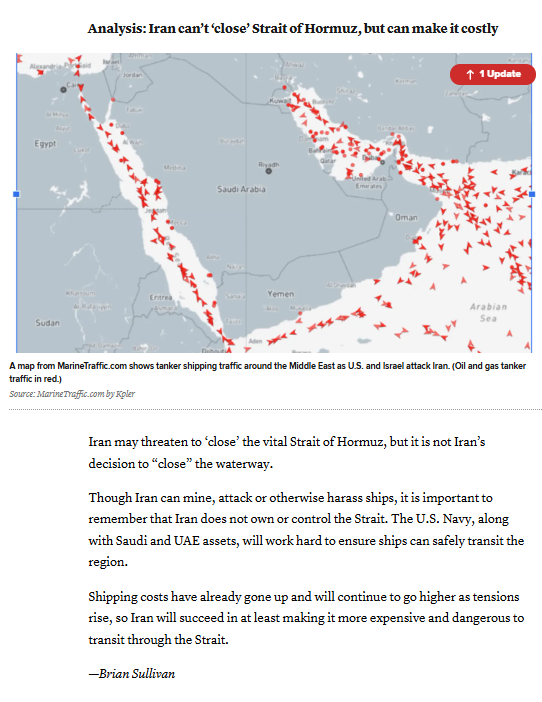
You may hear about Iran "closing" the Straight of Hormuz.
Let's be clear: Iran cannot "close" the waterway. It can threaten, harass, mine or whatever .. but it doesn't own or control the Straight.
#oil#OTT#Iran
My comments on the https://t.co/WPx9K7iweS live blog right now
@Majakovsk73 Penso sia l'unica cosa che possono fare, visto che gli è rimasto solo l'arsenale missilistico. E comunque tra catena di c2 decapitata e jamming nella regione, non stanno riuscendo a montare sbarramenti o colpire obiettivi importanti.