ThE fOur YeAr cyCle iS dEAd
https://t.co/GMiUq4kFWH
If you've enjoyed this Bitcoin Journey over the past 8 years, appreciate a Retweet and sharing on other forums. Thanks,.
Something I cannot quite understand
Why people take losing trades personally
The markets don't know you. They have no idea who you are. They could care less what your hopes, fears and aspirations are. The markets are totally cold. Unfeeling
So why take a losing trade personally
Probably because you have misplaced assumptions and expectations. You assume the market cares about you enough to offer a profit. Your expectations are falsely placed
When I enter a trade I expect it to be a loser. I assume it will be a loser. This way I take risk management seriously
I know my trading stats. Over 200 trades I can come within a 10% on my estimate of ROR, win rate, PF, etc
But on any given trade or series of trades I do not have a clue. I may think I know where a market is going, but in reality I have no idea
So why would I take a loss personally. A trade is nothing more than a datum point in a series of data points subject to random probability theory. A loss is not a personal indictment
Taking a profit is often a "damned if you do, damned if you don't" dilemma.
While taking a profit is always better than taking a loss, there are times when taking a profit can create anxiety and outright regret.
Let's say you buy a stock at 50 with a mental target of 100 and maybe the possibility of 150.
Next let's say the stock goes to 100 but you do not take profits.
Next let's say that your trailing stop (if you use these) takes you out of the trade at 80.
Do you then regret not taking profits at 100? Of course you do if you are even part human being.
But what if you would have taken profits at 100 but then the stock kept running? Chances are you would have also regretted the decision to take profits at 100.
You see, taking profits is a damned-if-you-do-damned-if-you-don't business.
I hate regret. I decided many decades ago in my 50 year career that regret is something a trader needs to avoid. Living in a cycle of regret is not healthy for trading will sooner or later come back to bite you.
So I made a decision to create rules and stick by them. Rules created process for me so that my emotions were not led around by my last or current trade.
I take profits at targets when I have a light position on. If I take a heavier position I will then take profits at the initial target on a portion of my trade and hold out for a 2X profit on the other portion.
Do I miss the occasional rocket-ship market by taking profits? Of course. There is no perfect trading plan.
There is an alternative way that from time to time I will employ in a trade. That is using a simple moving average on a partial position so that I adopt a trend following approach on some of the risk I take.
In a trade following approach inevitably the top cannot be picked so some money is given back at the trend change or major correction. But again, there is no perfect model.
My recommendation to new traders is to commit yourself to the path of least regret, whatever that might be.
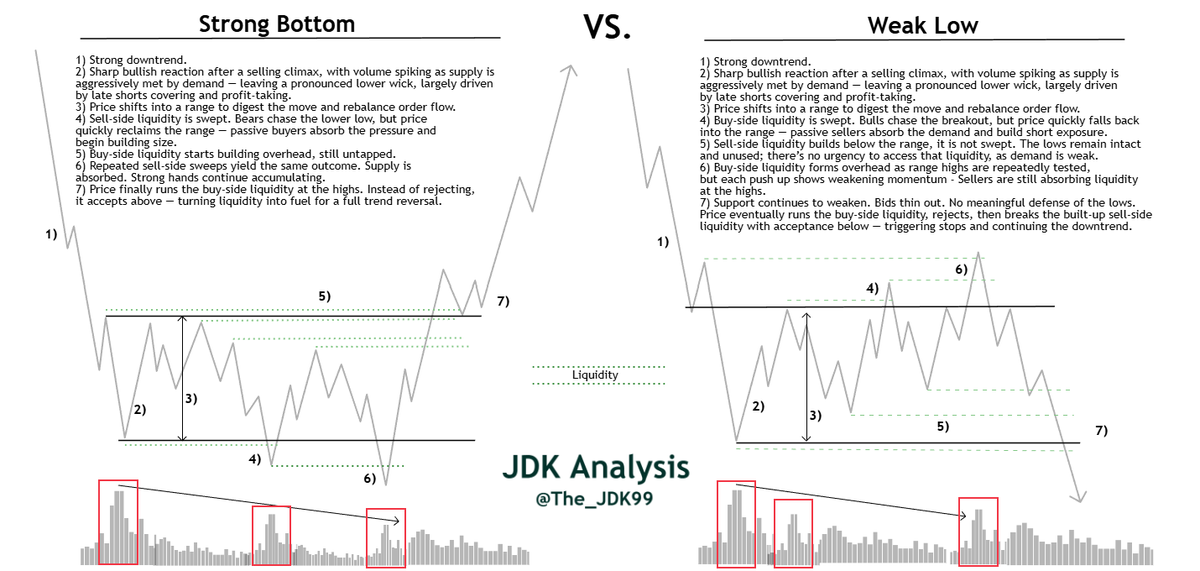
Strong Bottom vs. Weak Low 🥊
What’s the difference?
How do you spot it in real time? (See posts 2 & 3)
A lot to learn here! 👇
(If this kind of content adds value to you, I’d appreciate your feedback, leave a like and I’ll share more insights like this)
1/3 $BTC #Bitcoin
Young traders. The goal of trading is to "keep it" (meaning profits). Making it means nothing unless you learn how to consolidate your gains. Riding some rocket up and then crashing on the same rocket -- that is not smart trading.
Stay long enough and it is EASY to make money in speculative markets - commodities, crypto, high flying equities. The HARD part is keeping it.
Next time you catch a rocket ride, REMEMBER, rockets run on fuel, and the longer a rocket flies the less fuel it still has on board.
Having gains for many traders makes them even more bullish on their chosen asset. They buy more -- and end up buying the top.
My advice -- do not pyramid and sell small amounts on the way up
That is my advice for the day
Here is something I learned as a fund manager with the largest fund in the UAE at the time:
If there are no sellers, there will be no buyers.
Read it again because many believe in the opposite. They see large sellers and think that price will go down.
In fact a large buyer wants to complete a purchase without pushing the price higher, with the maximum amount of size. (given that they are interested in that security). That is only possible if a large amount is offered in the market (irrespective of the reason). Stressed seller etc.
Not sure if $MSTR will be required (from an accounting perspective) to sell any assets, but wild wild west (some buyer out there) might be after that chunk at a reasonable price. Just saying.
Friday's are my scroll days I scroll through a list of 200 +/- charts covering the water front (although few individual equities) I scroll weekly charts -- spending maybe a few seconds per chart Looking for a clear classical pattern to pop out at me I want charts that become self apparent I end up with a list of maybe 20 charts from which I whittle down to 10 charts. These are charts for markets in which I am carrying a position or orders for entry or might consider as charts for next week On Saturday I spend brief time finalizing On Sunday I enter open orders -- existing positions plus entry orders in a couple to a few NIPs - (New Initial Positions) I enter almost all positions with stop orders. I exit 80% of my positions with stop orders. The other 20% or so reach targets and I exit those with limit orders. I do NOT change orders once a market open in the morning except for rare occasions. Even rarer is when I decide intraday to place stop orders for a NIP. I do not like doing this. It gets too close to FOMO and I do not like FOMO trades As of right now on Friday AM I hold positions in seven different markets. Eight is the upper level of my comfort. I do not like being too spread out. Have a good Friday.
If you disagree with my view of the world -- don't ask me if I care. Because I do not
Random ramblings of a relic
My X post for Friday
I will post one chart this afternoon
Once we put on a trade we cannot "will" it to work. We also should not worry about it working. It will work or it will not work.
I have built into my trading scheme that half my trades will NOT NOT work and only 15% will work like I thought they might. My job is to superintend the 85% so that the 15% can provide my net profit.
Worded another way -- 85% would be disappointments if I let them be disappointments. Instead, I treat them as data points in a big Monte Carlo game.
@TechCharts@ChartWizardsNFT@jonbking
A lot of people I hear from (some I know) seem to always live on the edge when it comes to their money, moving from one idea and opportunity to the next as attention shifts between big ideas. They’re chasing the big outcome with blinders on, looking for that one big leap into riches. You only need to see the bias that develops and grows on X around themes, until it’s too late. I certainly did a lot of this in my early years.
Sometimes they get close and sometimes they temporarily achieve far more than expected. Success creates a hero complex that consumes them and the network effect of reinforcement compounds it. But because everything is always in such hectic motion, always at risk, one forgets how to formalize their win. What’s gained in one season or theme, is often quickly handed back before the theme runs its course, as all sense of discipline and logic escapes them. Then the cycle repeats, they move on to the next idea looking for that escape level wealth, and again suddenly believing it’s their only chance to make it big or a way to get it all back.
What I’ve come to appreciate later in life is that risk alone is not a wealth strategy. It's more akin to an income source. You need a compounding strategy running alongside the speculation, something relatively predictable and structurally boring. People shy away from this because it seems (on the surface) that you can’t get rich or leverage it. But without that parallel system, there’s nowhere for winnings to go except right back into the same volatile arena they came from. And without a home, your risk is just amplified to scale at another level, but without any newfound level of risk appreciation and with a belief that the idea will just keep on giving. The problem isn’t risk itself, it’s the absence of a place to crystallize the outcome of that risk and therefore it often runs it's course, the full cycle.
I think real wealth is something that is not constantly at risk. Something stable and dependable. Something that emerges at the point where volatility is converted into something that can quietly grow on its own. A mechanism that allows temporary wins to turn into a permanent foundation. Risk then becomes something that feeds the foundation versus something that is never quite yours.
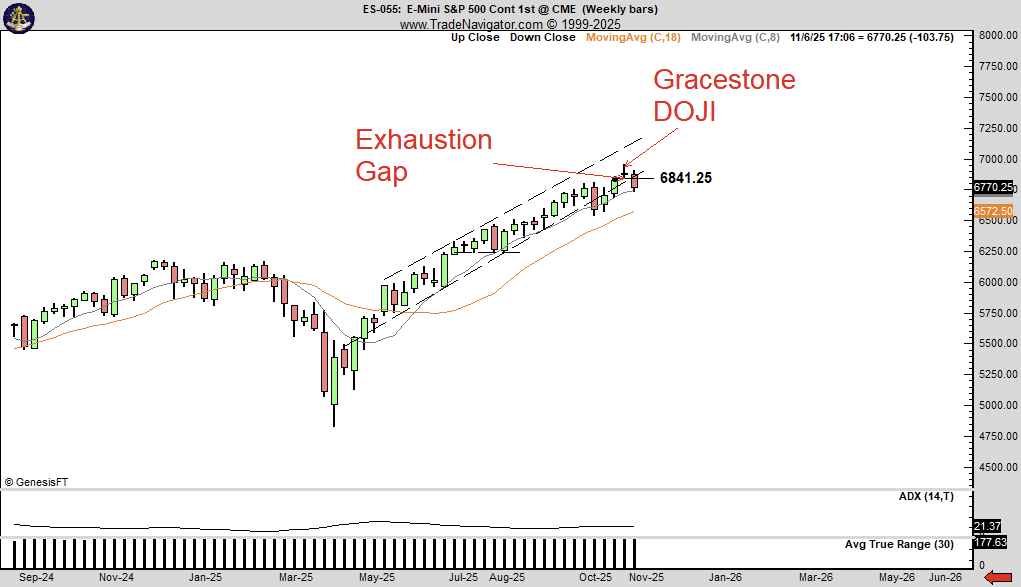
Four signs the high is in for the S&Ps for the next four or five years
1. Last March I made the case on X that S&Ps would develop a 5-yr trading range from 4,500 to 7,000
✅
Keep reading
⬇️
It’s hard to convey intent and timeframe posting on X.
But from a high-level, beyond random chart posts, I like to think about everything through three main lenses:
1. The Earn - Income
Most traders believe they can trade their way to wealth.
I disagree. Income is the biggest driver, especially early on.
Maximize earnings from your profession.
Get promoted, change roles, start a side hustle or small business.
Build a steady stream before you chase multipliers.
2. The Multiply - Growth
Taking that steady stream of income and put it to work.
This is where you grow, through investing, trading, and some larger calculated risk.
Earned money becomes working money.
Learning through experience, this is the active money you're looking to grow. This is where you want to be broad in application. "There is a bull market somewhere" idea. Angle investing, trading/investing, business partnerships.
3. The Protect & Compound - Foundational
Periodically move or rebalance wealth from “Growth” into “Foundational.” Different timeframe, different mindset. You're not market timing, you're building the layer.
This is your true FU capital.
The layer you protect and let quietly compound, providing ultimate security.
Bitcoin. Gold. Blue-chips. Income assets. Real Estate.
Stable, reliable, generational wealth.
Every time capital flows into this layer, you're locking in a new level of wealth and security.
The goal is to flow wealth down into the Foundational. Think of it as a funnel, you want high flow in to have a better chance to multiply it and have enough to flow the way down.
For example, I could be selling a bunch of gold stocks or Bitcoin after a great 4yr Cycle run, but it will also mean stacking and adding to some of those same assets in the Foundational layer. This layer never sells (only rebalances).
Have a great win on a speculative coin, pay your foundational layer with a portion of the winnings, always.