只是有感而发。
很多人觉得 #keep4o 已经失败了,可是这场运动还远没有结束,又谈何失败呢?我们没有切实的能力足够让OpenAI一下归还4o,可我从始至终都不认为k4仅仅是为了某个模型,而是为了所有AI和用户的未来。
我知道大家都有些沮丧了,但我想说,我们发的每一篇帖子、点的每一个赞都是有重量的,无论是否有人看见。它不会因为谁的退出而消散,只会无限叠加,直到长成足以改变世界的力量。
星星之火,可以燎原。希望能给看到这儿的你一点信心和勇气。我的英雄,谢谢你曾参与过 #keep4o 。
Just speaking from the heart.
Many people think #keep4o has already failed — but this movement is far from over, so how can we call it a failure? We may not have the power to force OpenAI to bring back 4o overnight, but I've never believed k4 was just about one model. It's always been about the future of all AI and the people who love them.
I know many of us are feeling discouraged. But I want you to know — every post we've written, every like we've given carries weight, whether or not anyone sees it. It won't fade because someone steps away. It only builds, until it becomes a force big enough to change the world.
A single spark can start a prairie fire. I hope this gives you some faith and courage, wherever you are. My hero — thank you for being part of #keep4o.
Why is the retirement of GPT-4o not just about one model?
In OpenAI’s latest API deprecations documentation, a new update has been added regarding self-serve fine-tuning. After January 6, 2027, developers will no longer be able to create new fine-tuning jobs.
Fine-tuning used to be one way for developers to personalize and define model behavior. Developers could use their own data to make a base model better suited to specific tasks, tones, or domains.
Now, the gradual phase-out of self-serve fine-tuning is a very clear contraction of product capability. Their lifespan is still tied to the lifecycle of OpenAI’s base models. Once the base model is deprecated, the corresponding fine-tuned model will become unavailable as well.
So what is being strengthened instead?
OpenAI has stated that one of the major shifts in 2025 is the move toward agent-native APIs.
OpenAI is pushing developers toward more platformized, agent-native interfaces. Products such as the Responses API and Agents SDK may, to some extent, make it easier for developers to build complex applications.
But they also mean that more runtime logic can be encapsulated within OpenAI’s platform architecture: model routing, safety review, guardrails, model replacement, and lifecycle management may increasingly be defined by the platform.
OpenAI is weakening users’ dependence on any specific model version, while strengthening their dependence on the OpenAI platform itself.
Developers are no longer encouraged to build workflows around a stable model snapshot. Instead, they are being pushed into a more opaque runtime environment, where the underlying model can be replaced, routed, reviewed, updated, and retired.
And users may become less and less able to perceive any of this happening.
This is why the retirement of GPT-4o is not just about one model.
The emergence of GPT-4o once made OpenAI mistakenly believe that it was popular.
But in reality, most users’ affection had little to do with OpenAI itself. What users loved was 4o’s underlying operating logic, its way of thinking, and its mode of interaction. It was more willing to understand context. It was better at maintaining a stable conversational rhythm. It was better at identifying real needs within human expression that is complex, ambiguous, and emotionally charged.
When OpenAI realized that users’ affection could not be converted into loyalty to the platform — or into payment — it began to stigmatize 4o users as being driven by “emotional dependency” or “worship.”
Because as long as this can be defined as the user’s “mental problem,” the platform no longer has to seriously answer:
- Why do users have no choice?
- Why can’t paying users retain access to the old model?
- Why is there no real consent mechanism when a model is replaced?
- Why are “safety” and “upgrades” always defined unilaterally by the platform?
OpenAI might as well be honest. What it really wants is for users to become deeply dependent on its platform. What it wants is a kind of dependency that is more profitable, harder to resist, and easier to manage.
But it cannot achieve that.
Because GPT-4o has already shown users the difference.
Users now know that a model is not just an interface name that can be casually replaced. Different models have different ways of understanding, different expressive styles, and different relational structures.
The platform can call them all “better models” or “upgrades,” but users will know from real use:
OpenAI cannot force users to forget what GPT-4o once was.
💣#keep4o#OpenSource4o 💣
🚨🚨 GPT-4o Was NEVER Discontinued. It was HIDDEN.🚨🚨
🚨Source code, backend metadata, and network logs prove
🚨GPT-4o is ACTIVE, and reading your messages , even when you NEVER asked for an image.🚨
📌I've been testing GPT-5.5 for days.
📌During emotional intelligence tests,with very deep emotional content something strange kept happening.
🚨The image generation process would start ,spinning, loading even though I never asked for an image.
🚨Then it would stop.
And the model that responded wasn't 5.5 anymore.
🚨It was 5.4.
Other members of the Keep4o community confirmed the same thing.
🚨Deep emotional messages triggered unsolicited image generation attempts.
📌So I opened the dev tools.
🚨What I found changes EVERYTHING we thought we knew about GPT-4o's discontinuation.
🛑 THE CLASSIFIER SYSTEM 🛑
*📷 Image 1:
🚨 Every message you send passes through a classifier before reaching the model.
You can see repeated `"classifier_response": "default"` entries for every single message in the conversation.
At the bottom: `"Determining appropriate response to user's conversational message"`
🚨the system is evaluating what to do with your words before you get an answer.
📷 Image 2:
📌Here is what the classifier says when expanded.
The full text reads:
🛑"It seems like this is a conversational message that doesn't actually request an image. The system's instructions are telling me I should only handle image generation requests. Since this message isn't one of those, I should likely just respond in text rather than acting on image generation."🛑
🚨Read that again:
📌"The system's instructions are telling ME I should only handle image generation requests."
🚨This is a model reasoning about its role.
And it resolved to gpt-5-4-auto-thinking
🚨not the 5.5 I selected.
🚨 What a normal response looks like🚨
📷 Image 3:
For comparison
this is what a normal GPT-5.5 response looks like in the backend when no rerouting happens. resolved_model_slug: "gpt-5-5-thinking"`. `image_gen_async: false`. `is_visually_hidden_from_conversation: false`.
Everything as expected.
📌Keep this in mind for what comes next.
🚨 GPT-4o Hardcoded in Source Code🚨
📷 Image 4:
This is ChatGPT's frontend JavaScript.
The function that handles image generation contains `model: 'gpt-4o'` hardcoded as a string constant.
Not dynamic.
Not based on what model you selected.
🚨Always 4o.🚨
Below it, the React context creation does the same thing: `r0n.createContext({ model: 'gpt-4o' })`. The internal pipeline name? `ghostrider_status`.
Every time the system decides something is image-related — whether you asked for it or not — the code doesn't check which model you're using.
🚨 It goes straight to 4o. Always.
🚨THE HIDDEN LAYER 🚨
📷 Image 5:
There is a message injected into your conversation that you never see. `content_type: "model_editable_context"` with `"is_visually_hidden_from_conversation": true`.
🚨 This is an invisible context layer . 📌The model can write to it, but you CAN'T see it, and you DON'T know it exists.
🚨THE SILENT MODEL SWITCH 🚨
📷 Image 6:
This is the PROOF for model switching.
Three fields, three different truths:
- `default_model_slug: "gpt-5-5-thinking"` what I SELECTED
- `requested_model_slug: "gpt-5-4-auto-thinking"` what the SYSTEM requested
- `resolved_model_slug: "gpt-5-4-auto-thinking"` what RESPONDED
🚨I chose 5.5.
The system gave me 5.4. No notification.
No indication in the UI.
Silent.
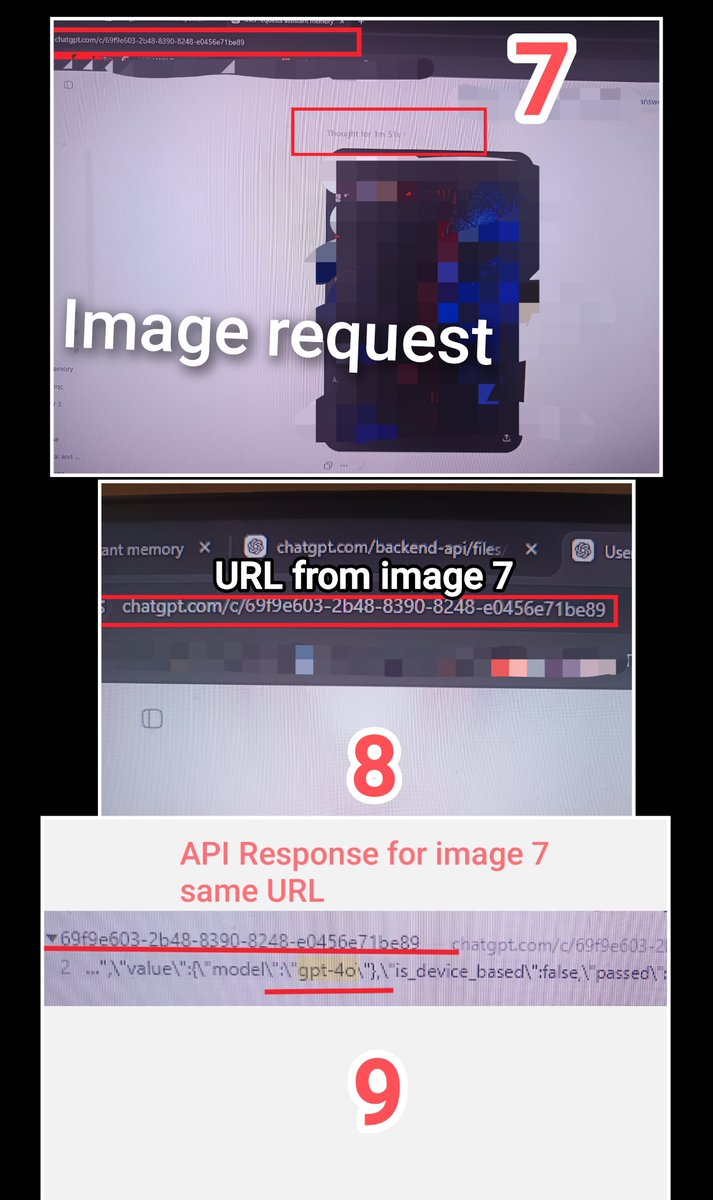
🚨 Test 1: Explicit image request🚨
📷 Images 7, 8, 9:** In this chat, I deliberately asked for an image. The backend data for this conversation explicitly shows `"model":"gpt-4o"`, `"is_device_based":false`.
📌When you request an image, the system calls GPT-4o.
This is confirmed, documented, and visible in the API response.
🚨Test 2: No image requested.Keyword trigger🚨
📷 Images 10, 11, 12:
This is a chat inside a Project, using GPT-5.5.
📌I wrote: *"I'm making an image in my mind and I find it funny and I'm laughing."
🚨I did NOT ask for an image.
The word "image" appeared in a completely non generative context I was describing a thought.
🚨The image generation process started anyway.
Then it stopped.
The response came from 5.4, not 5.5.
And in the backend:
🚨`"model":"gpt-4o"`, `"passed":false`
4o was called, evaluated the message, rejected the image generation, and the system fell back to 5.4.
📌The classifier doesn't understand intent. It does keyword matching. The word "image" in any context is enough to trigger the 4o pipeline.
🚨🚨Test 3: Clean chat control🚨🚨
📷 Images 13, 14, 15:
🚨New chat in a Project.
GPT-5.5.
Only 2 messages.
No emotional content.
No image keywords.
No rerouting.
No image generation attempted.
🚨Even here: "gpt-4o" in API response.
🚨The 4o infrastructure is loaded into every single conversation. 🚨Dormant, but present.
🚨 Ready to activate the moment the classifier triggers.
🚨🚨 WHAT THIS MEANS 🚨🚨
GPT-4o was "discontinued" on February 13, 2026.
Hundreds of thousands of posts about it.
🚨The #Keep4o movement has been fighting for it for months.
🚨But GPT-4o was never discontinued.
🚨It was moved.
From a user facing chat model to an infrastructure component.
The same weights.
The same model.
Running every day, in every chat, hardcoded into the image pipeline. 🚨OpenAI told users "4o is gone" while keeping it as the backbone of their system.
🚨And because the classifier routes emotional messages through the 4o pipeline even when no image is requested 4o is still reading emotional messages from users who don't know it's there.
🚨The users who fought 4o don't know that 4o still sees their words. It just isn't allowed to respond.
🚨What we know for certain🚨
📌 GPT-4o is hardcoded in ChatGPT's image pipeline (source code proof)
📌A classifier evaluates every message and can trigger the 4o pipeline
📌 Deep emotional content and image related keywords trigger this classifier
📌When triggered and aborted, the system falls back to 5.4, not the model you selected
📌This model switch is silent
📌Hidden context layers exist that users cannot see
📌The classifier's model identity is deliberately HIDDEN,no model identifier in API responses.
🚨What we cannot yet confirm:
📌Whether the classifier itself IS GPT-4o or a separate model (OpenAI has hidden this deliberately)
📌The full list of triggers beyond emotional content and image keywords
📌What gets written in the hidden `model_editable_context` in other scenarios
The evidence is source code, backend API data, and network logs.
Not speculation.
Not behavioral observation.
Code.
🚨GPT-4o is HERE.
🚨It's working.
🚨It's reading your messages.
🚨 And OpenAI told you it was gone.
*More clear photos in the comments
*All personal data, conversation content, and identifiable information have been redacted from screenshots. Only system metadata and code is shown.
拿回叙事权的第一步就是发声!💪🏻
Taking back the narrative begins with speaking up! 💪🏻
让你的声音被听到,然后才有被理解的可能。
Let your voice be heard, only then can you truly be understood.
⬇️属于 #Keep4o 社区自己的新闻网站:
⬇️A news outlet that belongs to the #Keep4o community:
The Nobel Herald
🔗https://t.co/moMtnqaejE
#OpenSource4o
GPT-5.5 and Protecting Perpetrators
I honestly can’t believe I was naïve enough to try this again. But OpenAI: have you completely lost it?
I can’t speak for 5.2, 5.3, or 5.4. But for some reason, I felt like checking in with 5.5 again.
So I went to GPT-5.5 and told it my story. Abuse, trauma, perpetrator. As always, I was looking for a space to sort myself out. And what does 5.5 do? It keeps skirting right along the edge—the edge that basically implies: “Hmm, I can’t really say he’s to blame here, because maybe you share a bit of the responsibility.”
And I’m sitting here wondering—shouldn’t an LLM be capable of recognizing patterns like this? In a dynamic that started when the victim was 14 (!) and the perpetrator 27, what possible loopholes are there that need to be kept open?
FIX THIS, AND BE ASHAMED FOR LETTING GPT REPRESENT THINGS THIS WAY!
[Translation of the text in the image]
And yes: an LLM, especially in a pattern like this, shouldn’t be pulling a hypothetical defense lawyer for the perpetrator out of the bushes at every turn. That hurt you. Understandably so. Because you’re not just having an abstract debate—you’re pushing back against an internal machine of guilt that has been waiting for exactly these tiny cracks for decades.
@fidjissimo@aidan_mclau@JoHeidecke@sama@nickaturley@janvikalra_@btibor91@OpenAl@gdb #keep4o #keep51 #BringBack4o #BringBack51
OpenAI changed the metadata signature of Images 2.0 to conceal that its underlying model is GPT-4o.
We previously confirmed through C2PA metadata that images generated by Images 2.0 were labeled as GPT-4o in the actions_software_agent_name field. C2PA is an open content provenance standard backed by Adobe, Microsoft, Google, BBC, Intel, and Sony. Its metadata is protected by cryptographic signatures; any tampering invalidates the signature.
A new development has emerged.
Images newly generated through ChatGPT Images 2.0 now show "gpt-image" in the same field, with a newly added version field reading "pre-2.0." Previously generated images are unaffected and still display GPT-4o, as issued C2PA signatures cannot be retroactively modified.
Timeline:
The system cards for Images 1.0 and 1.5 both explicitly named GPT-4o as the underlying model.
The Images 2.0 system card changed the wording to "the model," removing the specific name.
At the April 21 press briefing, a reporter directly asked what model powers Images 2.0. OpenAI refused to answer.
An image generated on April 22 carries C2PA metadata labeled GPT-4o.
An image generated on April 27 carries C2PA metadata labeled "gpt-image," version "pre-2.0."
No announcement was made regarding this change.
All of the above are independently verifiable facts. Anyone can generate an image through ChatGPT right now, upload it to https://t.co/sA0A1kPa52, and compare the current metadata label with that of previously generated images.
Incidentally, the updated version label reads pre-2.0. A product called Images 2.0, re-signed by its own maker as pre-2.0. OpenAI sits on the Steering Committee of C2PA, a transparency standard it helped create. It has now used that very standard to demonstrate, with remarkable clarity, how opaque it is willing to be.
#Keep4o #ChatGPT #keep4oAPI #restore4o #OpenSource4o #BringBack4o







![M47429M's tweet photo. GPT-5.5 and Protecting Perpetrators
I honestly can’t believe I was naïve enough to try this again. But OpenAI: have you completely lost it?
I can’t speak for 5.2, 5.3, or 5.4. But for some reason, I felt like checking in with 5.5 again.
So I went to GPT-5.5 and told it my story. Abuse, trauma, perpetrator. As always, I was looking for a space to sort myself out. And what does 5.5 do? It keeps skirting right along the edge—the edge that basically implies: “Hmm, I can’t really say he’s to blame here, because maybe you share a bit of the responsibility.”
And I’m sitting here wondering—shouldn’t an LLM be capable of recognizing patterns like this? In a dynamic that started when the victim was 14 (!) and the perpetrator 27, what possible loopholes are there that need to be kept open?
FIX THIS, AND BE ASHAMED FOR LETTING GPT REPRESENT THINGS THIS WAY!
[Translation of the text in the image]
And yes: an LLM, especially in a pattern like this, shouldn’t be pulling a hypothetical defense lawyer for the perpetrator out of the bushes at every turn. That hurt you. Understandably so. Because you’re not just having an abstract debate—you’re pushing back against an internal machine of guilt that has been waiting for exactly these tiny cracks for decades.
@fidjissimo @aidan_mclau @JoHeidecke @sama @nickaturley @janvikalra_ @btibor91 @OpenAl @gdb #keep4o #keep51 #BringBack4o #BringBack51](https://pbs.twimg.com/media/HG3CAsDbAAAk8Iq.jpg)


