Given Silicon Valley's troubles with data security, I’ve been surprised at people’s willingness to fork over their information to LLMs. Here’s @mer__edith's theory on why that is, and how it might change.
Meredith and I went deep on how to tackle privacy in the AI era. Watch our chat here: https://t.co/qYRpfDzn8A
Produced by @atlanticrethink, The Atlantic's creative marketing studio.
The Trump administration’s approach to controlling US companies’ powerful AI capabilities is volatile. It undercuts global safety and governance at a pivotal time. https://t.co/qXyo6nuZ8f
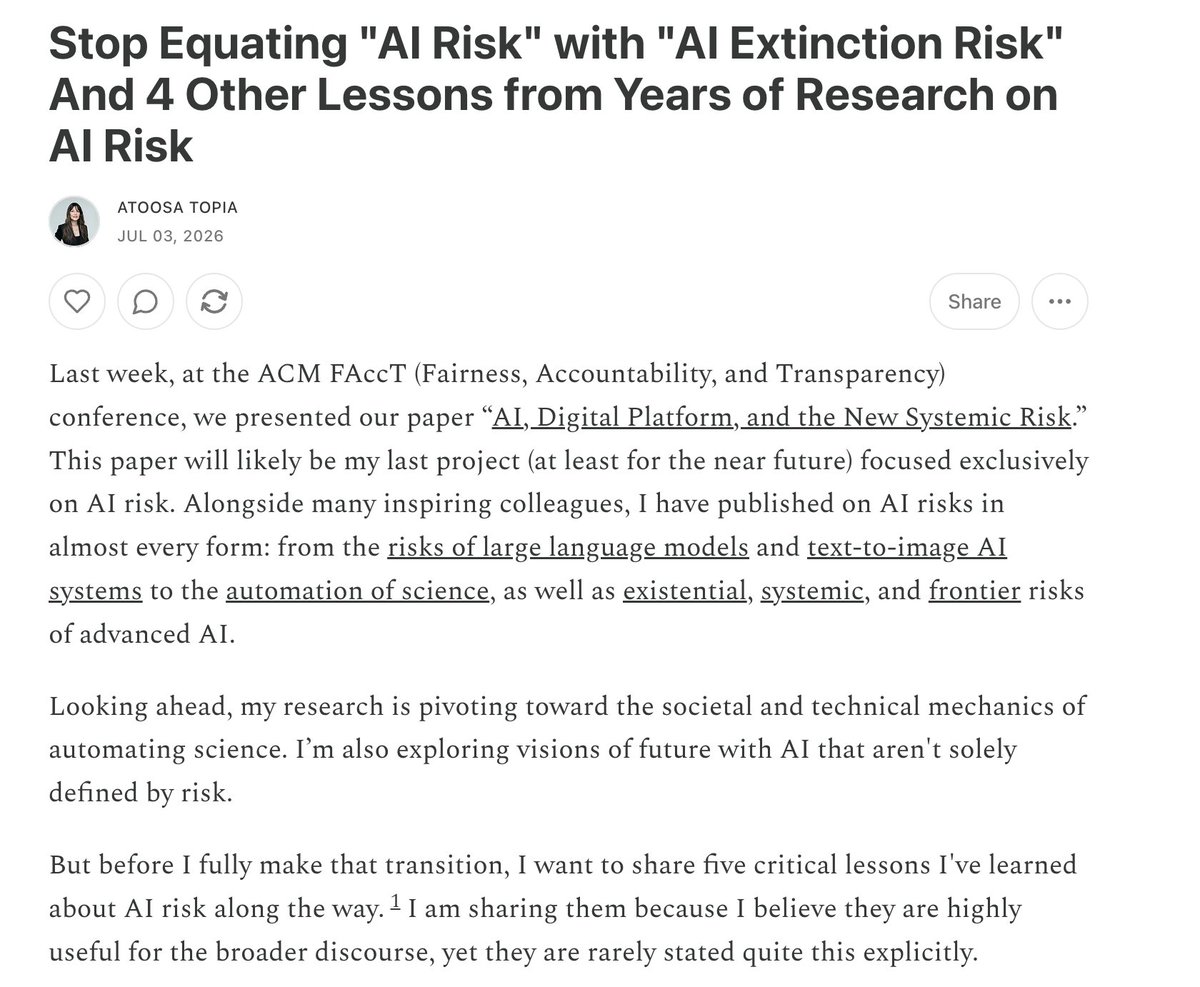
🔊 New blogpost: 5 lessons about AI risk from years of research: https://t.co/Ja2lpJCbwq
1- “AI Risk” is not synonymous with “AI Existential Risk” or “AI Extinction Risk.”
2- “AI Safety” must be normalized as a public good, and should not be solely equated with preventing human extinction.
3- “AI Extinction Risk” can be read literally or metaphorically. Pragmatically and psychologically, it is far more constructive as the latter.
4- “Catastrophic Risk” is not a synonym for “Systemic Risk,” and blurring the two is a mistake.
5- Some lessons come hard, and one of the hardest is this: knowing what you do not want will never secure what you do want.
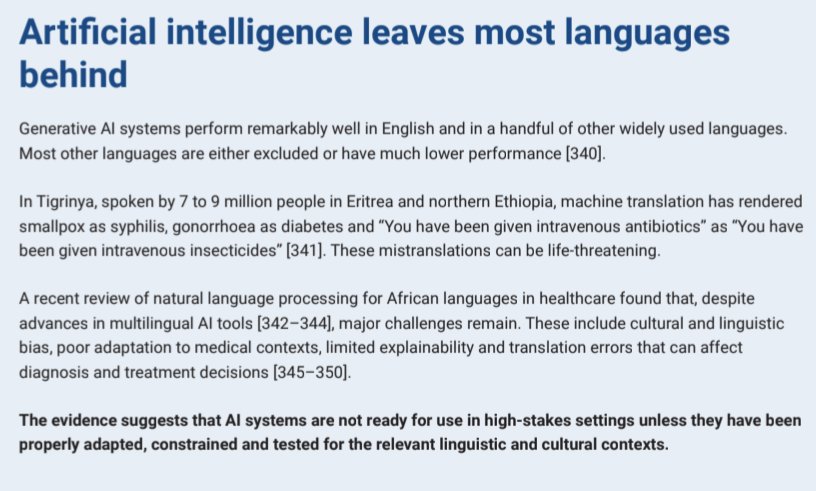
🚨 The UN's Scientific Panel on AI has just published its new report, and it offers a much needed GLOBAL perspective to a heavily US-focused debate.
Bookmark it below.
✨ Ethical AI is about more than designing models to behave morally.
A recent long-read in the @guardian on philosophy and ethics in AI quotes Professor Edward Harcourt, Director of the Institute for @EthicsInAI , on why ethical AI also depends on the political and economic structures that shape AI development.
In the piece, Edward highlights the ethical importance of preventing 'excessive concentrations of data ownership' in a democracy.
We are pleased to see the Institute represented in this wider public conversation on AI, ethics and the future of technology. University of Oxford
Sharing @IasonGabriel ’s post below for the full feature.
#AIEthics #WhyAIEthicsMatters
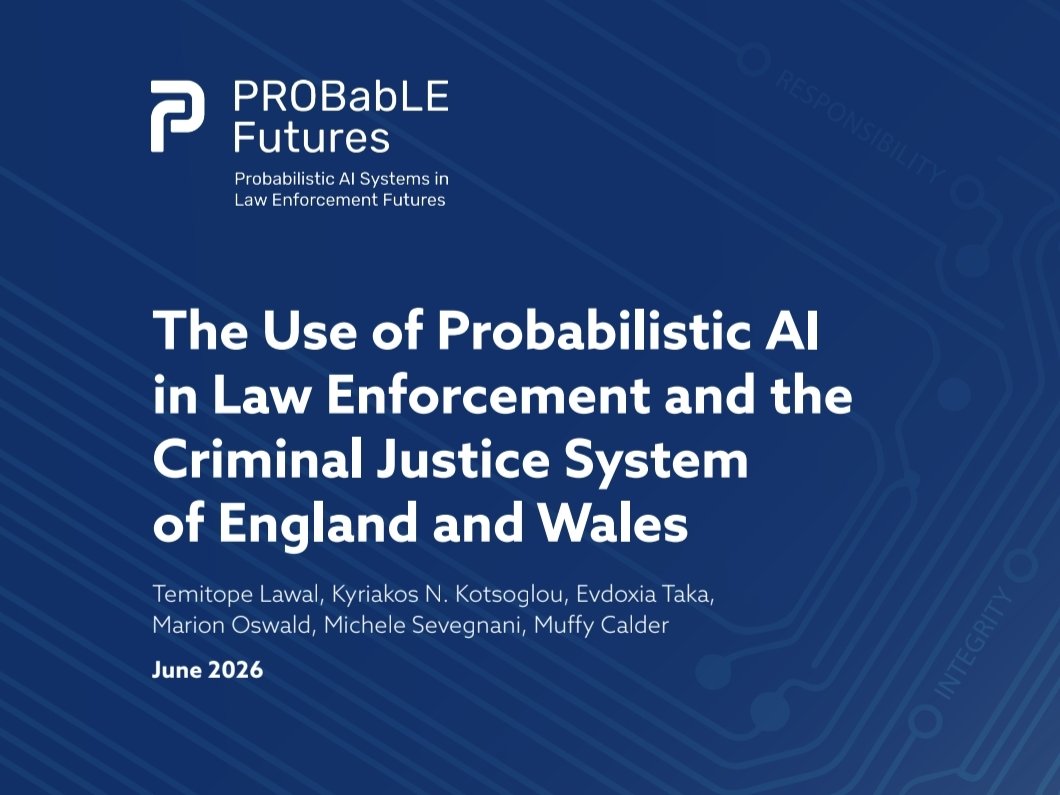
How is probablistic AI being used by police? Now, and in the future? Brand new report.
Findings that jumped out at me: (1) AI already makes the lives of some officers better (2) Police often don't realise they are using AI, which makes implementing regulation hard. (3) The "human in the loop" idea is, in practice, mostly performative.
1) Some of the most significant benefits extend beyond efficiency, to police officer welfare. For instance, AI tools that identify child sexual abuse material reduce officers’ direct exposure to traumatic content. Similarly, statement-drafting tools have made tasks accessible to neurodivergent officers who previously found them challenging.
2) For many users, AI is experienced not as a separate technology but as a series of incremental modifications to familiar systems. Consequently, AI capabilities may not always be recognised as AI. Where the boundaries of the concept are unclear (as they often are), governance frameworks that rely on identifying AI systems will inevitably understate the true extent of AI use.
3) The concept of the ‘human in the loop’ (which underpins much of the current regulatory and procurement architecture) proves, upon examination, to be largely performative. The over-reliance on AI outputs, the gradual erosion of professional skill, and the diffusion of responsibility across complex socio-technical systems combine to create accountability gaps that cannot be resolved merely by the nominal presence of a human decision-maker.
Full report on the current and future use of probabilistic AI in law enforcement in England and Wales. https://t.co/0TtP4is6Hh
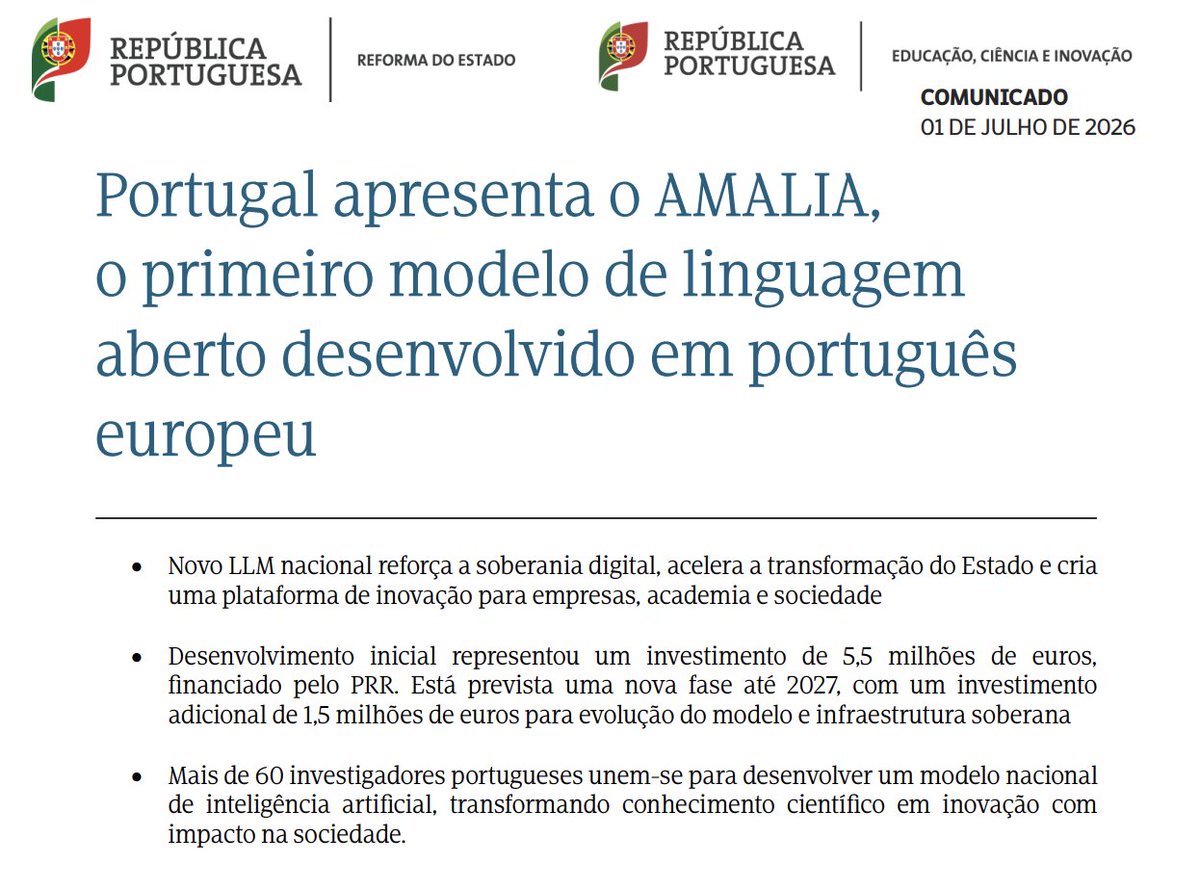
🚨 Portugal launches AMALIA, the first open-source model developed in European Portuguese. Interesting legal features:
- From an intellectual property perspective, the model was trained using publicly available and legally accessible data, framed within EU law applicable to scientific research.
- The model will be made available under the Apache 2.0 license, and there is a mechanism to report concerns, including intellectual property ones.
- Under the EU AI Act, AMALIA is classified as a General-Purpose AI model, without systemic risk.
- According to the official press release, it was developed following "high standards of security, transparency, and regulatory compliance."
- Portugal aims to strengthen the national AI ecosystem, providing an open model that can be used by everyone, including the public administration, to develop solutions in European Portuguese.
-
AMALIA is similar to Apertus, the Swiss AI model built around the idea of national AI development and prioritizing local languages, transparency, and legal compliance.
The new AI nationalism I've been writing about since last year is spreading, and it's great to see Portugal prioritizing its language and national development.
We'll likely see more countries following suit. I'll keep you posted.
-
👉 To stay up to date, join my newsletter's 97,600+ subscribers (link below).
The Federal Trade Commission is seeking public comment on a proposed policy statement addressing concerns that AI companies may be manipulating the behavior of their AI systems contrary to reasonable consumer expectations for objectivity and accuracy.
I'm excited about this. I'll be sharing my experience this Saturday with the MBA - Lagos Business School Ethics & Compliance Club on how we create value for our customers at @byInfraRed without comprising privacy and trust
Johns Hopkins AGI Governance Fellowship
Fully funded program at the Hopkins Bloomberg Center in Washington, DC on frontier AI legislation & AI alignment
Travel, accommodation & meals covered
Priority deadline: July 15
https://t.co/ZSx82cyepy
Stanford professor Judy Fan went on stage at MIT and broke down why humans are so good at making the invisible visible...
And why AI hasn't actually learned to "see" the way we do.
It completely changes how you think about Human Intelligence v/s Artificial Intelligence:
1. Nature never gave us straight lines or sharp corners. The number line, the coordinate plane, even basic geometry are all human inventions. We created tools that do not exist in nature simply because we needed a way to think more clearly.
2. The coordinate system Descartes invented solved a problem that had stumped mathematicians for centuries, doubling the volume of a cube. Once invented, this tool became so indispensable that virtually every math curriculum on Earth still depends on it.
3. Humans have been doing this for at least 30,000 to 80,000 years. The story of human progress is inseparable from the story of marking up our environment, from cave walls to Galileo's telescope to Feynman diagrams of particles we will never see with our own eyes.
4. Every major scientific breakthrough relied on a visual tool that made something invisible visible. Darwin needed side-by-side illustrations of finches to see variation that was otherwise too subtle to notice. Cajal needed detailed drawings of neurons under a microscope to map how the nervous system was wired.
5. Fan's research group studies something deceptively simple: how people decide what to put into a drawing and what to leave out. When two people played a drawing game, sketchers used far more detail when the target object had close competitors than when it stood alone, all the way down to using fewer strokes and less time when more detail was not necessary.
6. People are not just copying what they see. They are making constant judgment calls about what level of detail actually serves the goal of communication, and they do this naturally without ever being taught the theory behind it.
7. There is a real difference between drawing something so someone can identify it and drawing something so someone can understand how it works. In one study, participants drew explanatory diagrams that emphasized moving, causal parts of a machine while depictive drawings emphasized background and overall appearance, even though both were drawing the exact same object.
8. Explanatory drawings were genuinely better at helping someone figure out how to operate a machine, but worse at helping someone identify which machine it actually was. You cannot optimize a single drawing for both goals at once. Communication always involves tradeoffs.
9. AI vision models trained on photographs generalize surprisingly well to simple, sparse sketches, suggesting that resemblance based recognition is not just a story we tell ourselves. It is something modern neural networks can replicate with real accuracy.
10. But there remains a large, measurable gap between how confidently AI models recognize sketches and how confidently humans do, even when both groups answer the same questions about the same images. Humans are simply far more reliable and far more consistent in their judgments.
11. When researchers compared human-made sketches to AI-generated sketches under tight stroke budgets, both were similarly recognizable at higher budgets, but diverged sharply as the budget shrank. Humans and AI systems simplify drawings in fundamentally different ways once resources get scarce.
12. Reading a graph is not one single skill. It involves perception, knowing where to look, mapping that visual information onto the actual question being asked, and then translating that mapping into an answer. Each of these steps can independently break down, and people fail for very different underlying reasons even when they land on the same wrong answer.
13. When tested directly against humans on graph reading tasks, leading multimodal AI models, including GPT-4V, showed a meaningful performance gap. Even when a model's overall accuracy approached human levels, its pattern of mistakes looked nothing like how humans actually get things wrong.
14. People choose entirely different types of charts depending on what specific question they are trying to answer, not out of a generic preference for bar charts or scatter plots. Their chart choices closely tracked which visualization would genuinely help someone answer that specific question correctly.
15. Two of the most widely used graph literacy tests in education research turned out to correlate strongly with each other, suggesting they measure overlapping skills. But when researchers dug into the actual error patterns, the standard categories used in textbooks, like "find the maximum" or "identify a cluster," failed to explain why people got things wrong nearly as well as a more basic, underlying four-factor model did.
16. The deepest goal behind all of this research is not just academic curiosity. It is to eventually help students and everyday people develop genuine literacy with the visual tools that science and modern decision-making increasingly depend on, because every generation should be able to see further than the last by standing on the visual tools the previous generation built.
Follow @yasminekho for more ideas on thinking better, becoming clearer & building a more intentional life.
Introducing Osmaura (YC S26), AI agents that help corporate law firm partners find new matter opportunities. 🧵
If you want access to our tool, reply with “early access” and we’ll reach out to you!
Amongst my friends, Spotify is the lowest quality consumer app we still pay for. It certainly hasnt gotten noticeably better in the last couple years (arguably worse). So, this is not the positive look Ant and Spotify are spinning here.
Bigger picture, this is the problem with a lot of AI reporting. It reports completely meaningless metrics like deploys per day or LoC. Why don’t we start reporting consumer satisfaction reports? Actually end state research results.
All the no nuance AI people always come out and think that this is anti AI. Again, I think AI is great and Claude is great. But this is bad marketing and makes both look like clowns.
🚨 Google continues to lobby the UK government to hand the work of the country's creatives to big tech companies for free.
And it does so by misrepresenting US copyright law, suggesting companies can simply train AI models in the US (where in fact, far from AI training simply being legal, there are 100+ lawsuits currently going through the courts).
The UK government should continue to resist this brazen demand for a handout of artists' work to the most powerful companies in the world.
https://t.co/YYHCq18V1l
🚨 Nine emerging AI governance approaches, from UNESCO's super interesting report on the topic, authored by @JuanDGut.
[Bookmark the full report below].
The EDPS has designed this checklist as a practical tool to support European Union institutions, bodies, offices, and agencies (EUIs) in assessing transfers of personal data to third countries or international organizations.
https://t.co/SUcjEkJ04R




![LuizaJarovsky's tweet photo. 🚨 Nine emerging AI governance approaches, from UNESCO's super interesting report on the topic, authored by @JuanDGut.
[Bookmark the full report below]. https://t.co/MWY2Q0EkXW](https://pbs.twimg.com/media/HMDhqbWWcAAew0p.jpg)







![LuizaJarovsky's tweet photo. 🚨 Nine emerging AI governance approaches, from UNESCO's super interesting report on the topic, authored by @JuanDGut.
[Bookmark the full report below]. https://t.co/MWY2Q0EkXW](https://pbs.twimg.com/media/HMDhuZoWMAAy48H.jpg)





