"I am actually getting out of Odin all the good and all the fun that Odin can supply, while the Nazi Odinists are getting none of it."
- C.S. Lewis, First and Second Things
I’m loving having the World Cup here in America because it’s like we’re having a wild sleepover party with the rest of the world while they go on adventures here
It’s been a terrific week of Europeans experiencing and opining on all the great things in America. I’ve been talking up hot American breakfast and black coffee for a while. But this gentleman absolutely nails why we’re doing temperature right
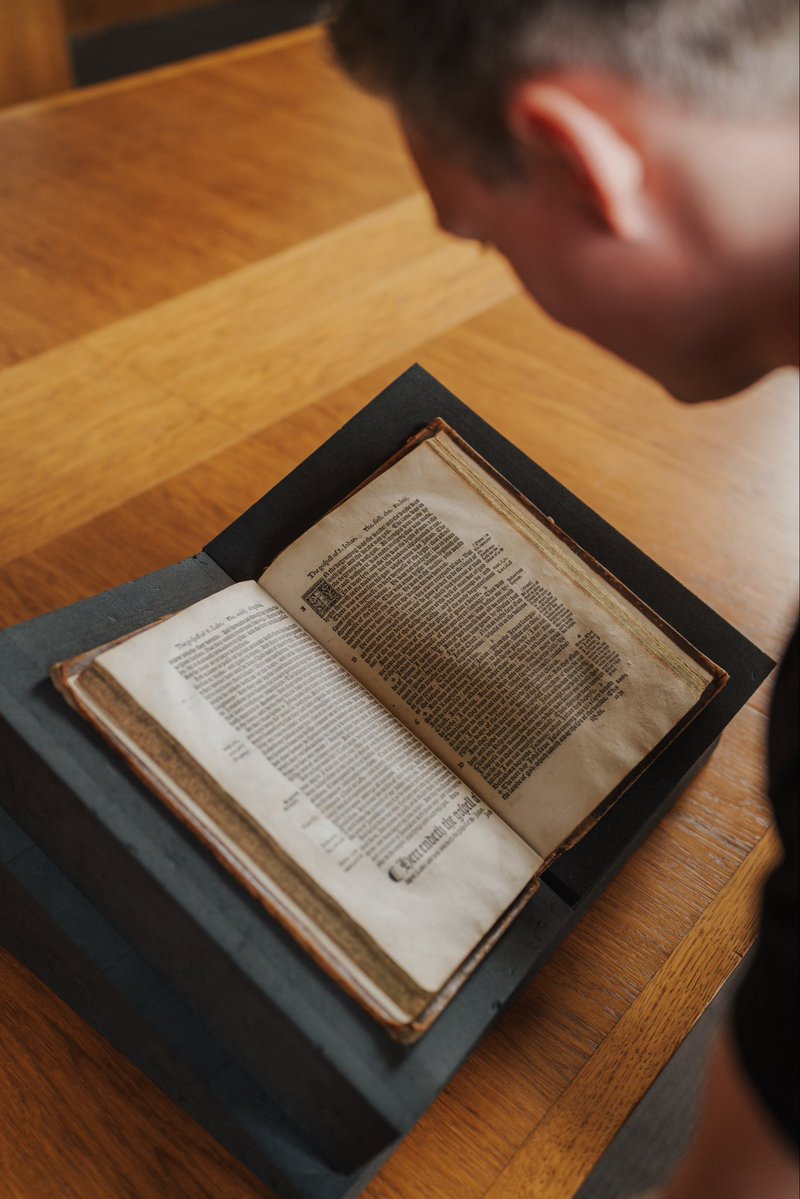
Pretty special day today getting the opportunity to spend some time with a 1536 Tyndale New Testament. This spectacularly preserved copy was printed the very year William Tyndale was burned at the stake.
Tyndale is usually credited with coining or first popularizing a small but highly influential set of English biblical terms. One of which you can see on the very page Im looking at: atonement.
Tyndale’s motivation was basically translation + theology: he wanted an English word that could carry the biblical idea of estranged parties being made “at one” again, especially God and sinners through Christ.
The word “atonement” appears to have existed just before Tyndale; Thomas More is often cited as an early user around 1513, meaning “reconciliation” or settlement after conflict. But Tyndale seems to have been the one who gave it its powerful biblical-theological career in English Bible translation, especially from 1526 onward.
The word literally expressed “at-one-ment.” In early English, “atonement” meant something like being at one, concord, agreement, reconciliation. That made it useful for rendering biblical concepts of reconciliation between God and humanity.
Tyndale used “atonement” because “reconciliation” alone did not fully capture, in earthy English, the biblical idea that Christ’s saving work makes God and sinners “at one.” It was a translator’s solution, but also a Reformation theological choice.
This reminds me of the part in That Hideous Strength when Mark is comparing himself to Dimble and Denniston, describing them as having elbow room in their lives. I sort of didn’t believe someone would really notice that difference. But Steven seems to. It’s a beautiful clip.
Man, this is beautiful. A life adorning the gospel.
Listen to what @StevenBartlett—host of one of the world’s most popular podcasts—says to Christian apologist John Lennox.
Around 1,950 years ago in Pompeii, a weaver named Successus fell in love with a barmaid named Iris.
She did not love him back.
We know this because his rival, a man named Severus, decided to humiliate him publicly. He grabbed something sharp and carved this into a wall for the whole city to read:
"Successus the weaver loves the innkeeper's slave girl named Iris. She does not care about him at all. But he begs her to have pity on him. His rival wrote this. Goodbye."
Imagine walking to work and seeing that with your name on it.
Successus found it. And instead of letting it go, he carved his reply directly underneath:
"Envious one, why do you get in the way? Yield to a man who is better looking and being treated very unfairly."
Severus came back one more time to end it:
"I have spoken. I have written. You love Iris, but she does not love you."
Then, in 79 AD, Vesuvius erupted and buried the wall, the tavern, and the entire argument under 20 feet of ash. The thread was frozen mid-beef for almost two millennia until archaeologists dug it up and translated it.
We will never know who got the girl. We do not even know if any of the three survived.
Pompeii has over 11,000 of these inscriptions. Bar reviews. Bragging. Bad poetry. A bakery wall that says "Welcome, hungry people." Two guys fighting over a girl in the comments.
The technology changes. We do not.