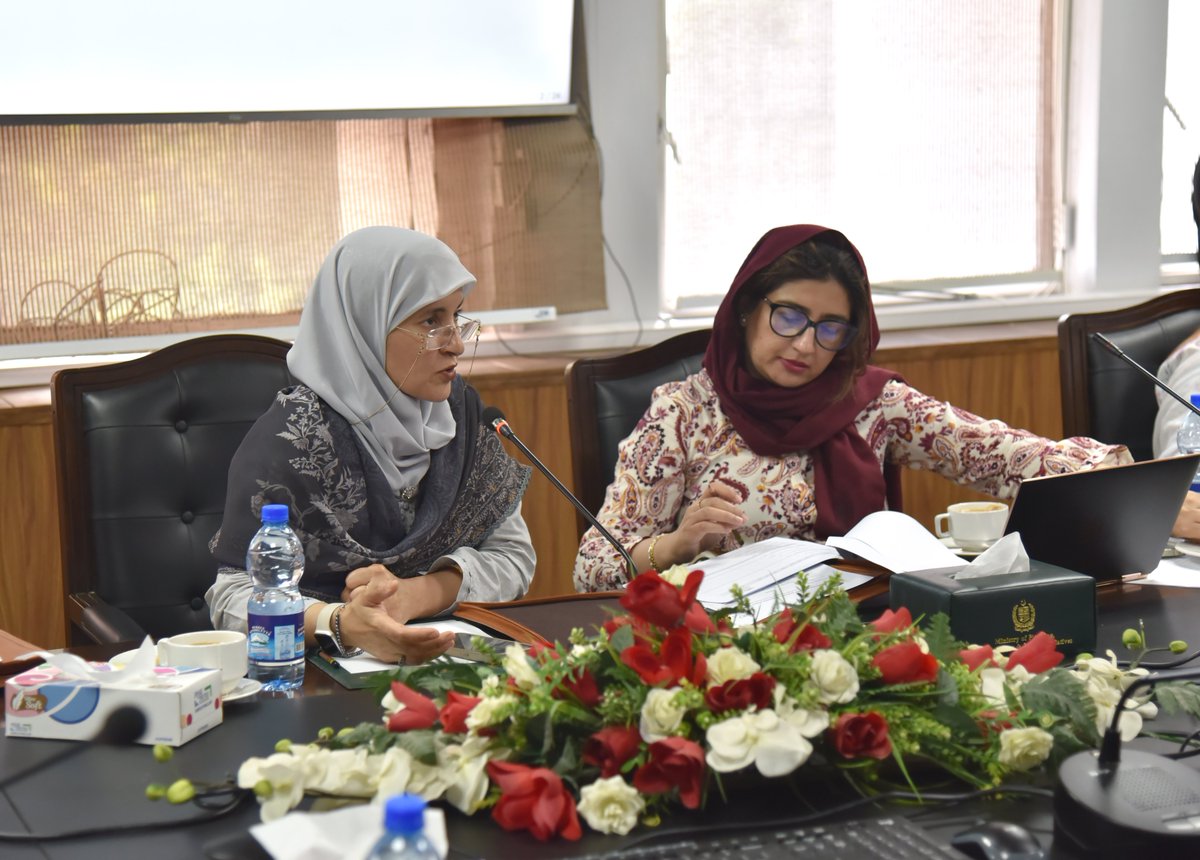
In partnership with @WHO,
@PlanComPakistan held the first meeting of the Technical Expert Group to initiate the formulation of the Women's Health & Development Index in Pakistan.
Our common objective: strengthening evidence-based policy to build a healthier Pakistan for all.
This looks like a must-read!
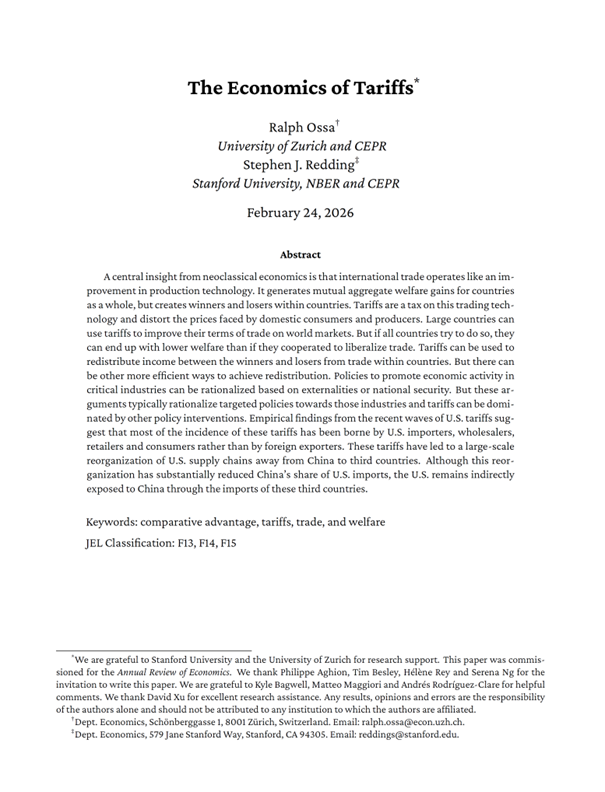
"The Economics of Tariffs" by Ralph Ossa and Stephen J. Redding.
"A central insight from neoclassical economics is that international trade operates like an improvement in production technology. It generates mutual aggregate welfare gains for countries as a whole, but creates winners and losers within countries. Tariffs are a tax on this trading technology and distort the prices faced by domestic consumers and producers. Large countries can use tariffs to improve their terms of trade on world markets. But if all countries try to do so, they can end up with lower welfare than if they cooperated to liberalize trade. ...Empirical findings from the recent waves of U.S. tariffs suggest that most of the incidence of these tariffs has been borne by U.S. importers, wholesalers, retailers and consumers rather than by foreign exporters. These tariffs have led to a large-scale reorganization of U.S. supply chains away from China to third countries. Although this reorganization has substantially reduced China’s share of U.S. imports, the U.S. remains indirectly exposed to China through the imports of these third countries."
https://t.co/J9vW8Rtwpn
Anthropic's own researchers just proved that using AI to learn new skills makes you 17% worse at them.
and the part nobody's reading is more important than the headline.
the paper is called "How AI Impacts Skill Formation." randomized experiment. 52 professional developers. real coding tasks with a Python library none of them had used before. half got an AI assistant. half didn't.
the AI group scored 17% lower on the skills evaluation.
Cohen's d of 0.738, p=0.010.
that's a real effect.
and here's what makes it sting: the AI group wasn't even faster.
no significant speed improvement. they learned less AND didn't save time.
but the viral framing of "AI bad for learning" misses what actually matters in this paper.
the researchers watched screen recordings of every single participant.
they identified 6 distinct patterns of how people use AI when learning something new.
3 of those patterns preserved learning. 3 destroyed it.
the gap between them is enormous. participants who only asked AI conceptual questions scored 86% on the evaluation.
participants who delegated everything to AI scored 24%.
same tool. same task. same time limit.
the difference was cognitive engagement.
the highest-scoring AI users actually outperformed some of the no-AI group. they asked "why does this work" instead of "write this for me."
they generated code then asked follow-up questions to understand it. they used AI as a thinking partner, not a replacement for thinking.
the lowest-scoring group did what most people do under deadline pressure: pasted the prompt, copied the output, moved on. they finished fastest.
they learned almost nothing.
and here's the finding that should concern every engineering manager alive: the biggest score gap was on debugging questions.
the skill you need most when supervising AI-generated code is the exact skill that atrophies fastest when you let AI do the work.
the control group made more errors during the task. they hit bugs.
they struggled with async concepts. they got frustrated. and that struggle is precisely what built their understanding.
errors aren't obstacles to learning.
they ARE learning.
removing them with AI removes the mechanism that creates competence.
participants in the AI group literally said afterward they wished they'd "paid more attention" and felt "lazy."
one wrote "there are still a lot of gaps in my understanding."
they could feel the hollowness of having completed something without understanding it.
that's not a productivity win. that's debt.
this paper isn't an argument against using AI. it's an argument against using AI unconsciously.
Anthropic publishing research showing their own product can inhibit skill formation is the kind of intellectual honesty the industry needs more of.
the practical takeaway is simple: if you're learning something new, use AI to ask questions, not to skip the work.
the struggle is the product.
Holy shit... Tencent researchers just killed fine-tuning AND reinforcement learning in one shot 😳
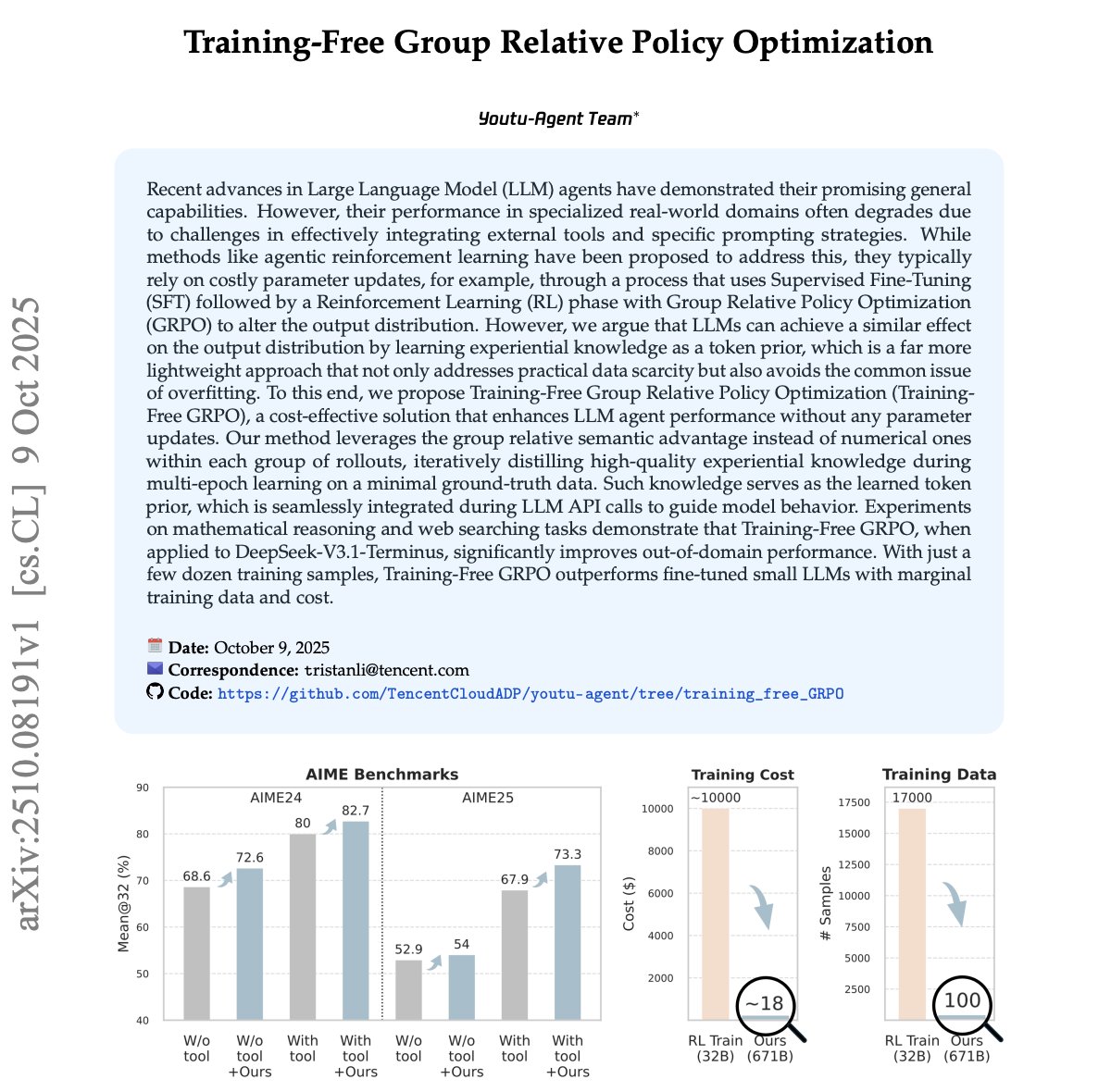
They call it Training-Free GRPO (Group Relative Policy Optimization).
Instead of updating weights, the model literally learns from 'its own experiences' like an evolving memory that refines how it thinks without ever touching parameters.
Here’s what’s wild:
- No fine-tuning. No gradients.
- Uses only 100 examples.
- Outperforms $10,000+ RL setups.
- Total cost? $18.
It introspects its own rollouts, extracts what worked, and stores that as “semantic advantage” a natural language form of reinforcement.
LLMs are basically teaching themselves 'how' to think, not just 'what' to output.
This could make traditional RL and fine-tuning obsolete.
We’re entering the “training-free” era of AI optimization.
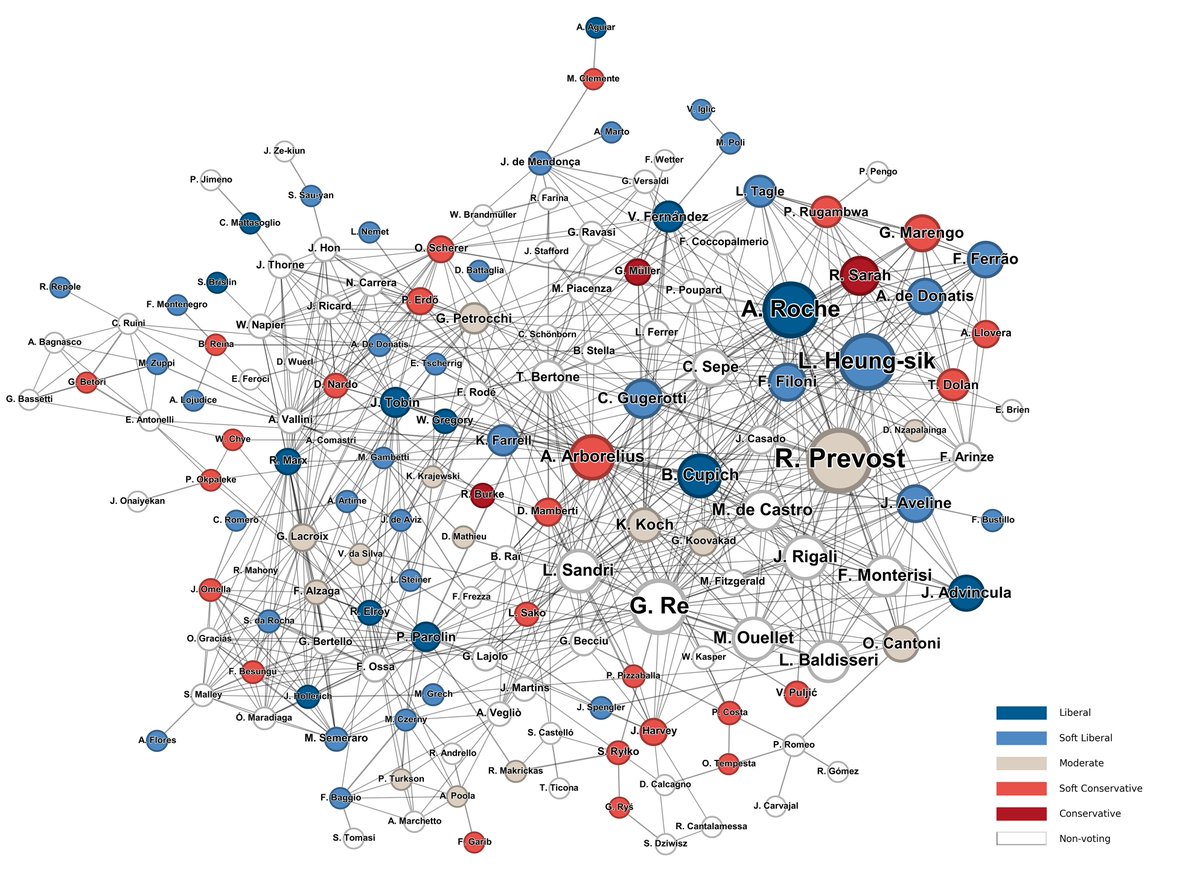
How we "guessed" the Pope using network science: inside the cardinal network. A study by me, Beppe Soda and Alessandro Iorio. Article: https://t.co/xQ0fTmpVxb @Unibocconi
To finish off my Econ principles class, we covered game theory and oligopoly. I pointed out that studying for the final was a prisoner's dilemma. Even more so if no one (meaning not a single person took the final) I'd have to curve it so they all got an A. 1/12 #econforeveryone
The Economist: "China has become a scientific superpower"
Rare for me - maybe even unprecedented - to praise the Economist but this might be the seminal article on the current status of China's scientific might.
Let's take a look 🧵
https://t.co/LufhWQGJBh
Long-term impacts of Brazil's #cashtransfer program:
years of schooling ⬆️
completing primary school ⬆️
completing secondary school ⬆️
monthly labor income ⬆️
still in the transfer program ⬇️
https://t.co/f1MXAEsZfH
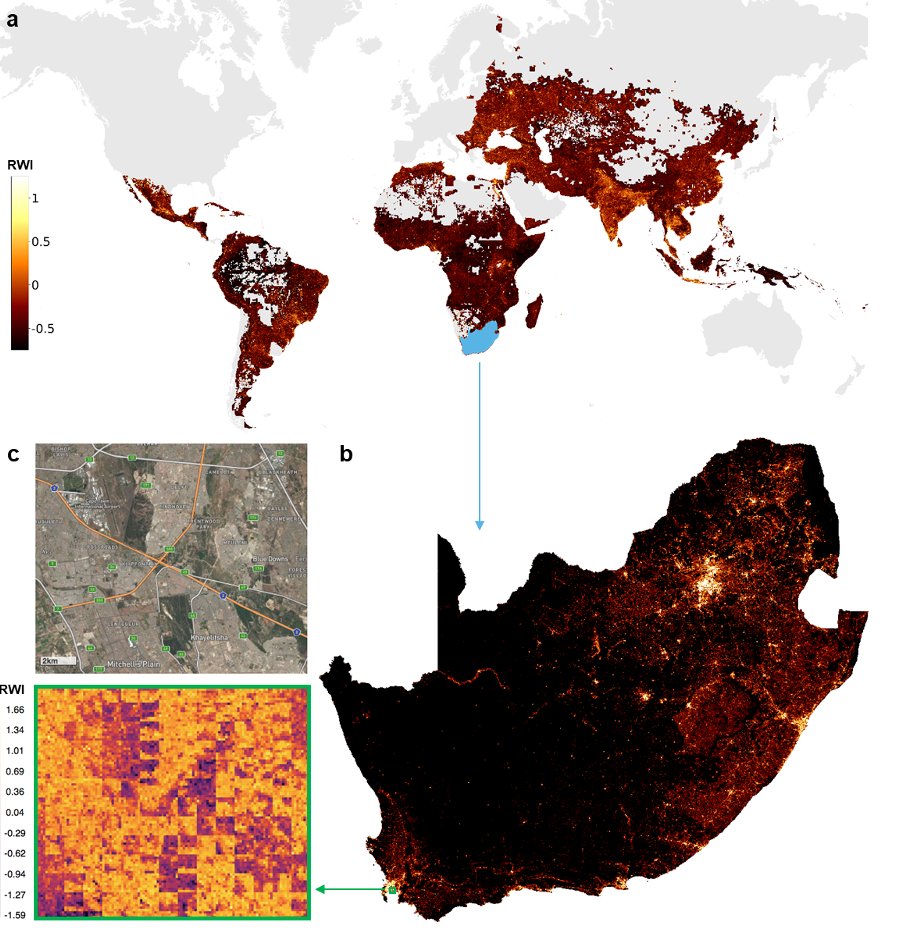
Meta is using Facebook and mobile phone data to produce super-granular household wealth estimates.
Here’s what you need to know about the Relative Wealth Index:
@leightjessica Another interesting thing would be to conduct a cost-benefit analysis, i.e. do RCTs improve society well-being and standards of living (in addition to generating evidence), given their massive costs?
Seeing what’s happening with post-docs on the econ job market & pre-docs among grad school applicants truly leaves me sad for our profession.
We are screening out people who can’t/won’t spend 10 years preparing for a job as a PhD economist!
[ Important Thread ]
PML N issued tickets to notable sardars and nawabs in Balochistan. Ridiculously, Sardar Khetran will be contesting from PB 4, (NA 252), who was in headlines for months for allegedly murdering & torturing servants. Saleem Khoso, (1/4)
بولتے کیوں نہیں مرے حق میں
آبلے پڑ گئے زبان میں کیا
میرا بیٹا پڑھائی اور تعلم کی وجہ سے مصیبت کا شکار ہوگیا
اے اللہ میرا بیٹا ایک بار مل جائے پھر اس کو سکول کے قریب بھٹکنے نہیں دوں گا
میرا بیٹا بکریاں چراتا تو اج لاپتہ نہیں ہوتا
ایک بزدگ بلوچ باپ
#MarchAgainstBalochGenocide
4 things Israeli leaders said today:
–We’re collectively punishing Gaza citizens
–We will indefinitely occupy Gaza
–We’re “rolling out the Gaza Nakba”
–"When we say Hamas must be eliminated, we mean leaders, supporters, and even those who distribute candy—they’re all terrorists”
Israel’s Defense Minister Yoav Gallant openly says what some American politicians have denied: Israel is collectively punishing civilians in Gaza.
Says “all the citizens of Lebanon” will “pay the price” if Hezbollah escalates.
“What we do in Gaza we know how to do in Beirut.”


![WaqasAalam's tweet photo. [ Important Thread ]
PML N issued tickets to notable sardars and nawabs in Balochistan. Ridiculously, Sardar Khetran will be contesting from PB 4, (NA 252), who was in headlines for months for allegedly murdering & torturing servants. Saleem Khoso, (1/4) https://t.co/LupVErniQ1](https://pbs.twimg.com/media/GC8xId6aAAATA54.jpg)








![WaqasAalam's tweet photo. [ Important Thread ]
PML N issued tickets to notable sardars and nawabs in Balochistan. Ridiculously, Sardar Khetran will be contesting from PB 4, (NA 252), who was in headlines for months for allegedly murdering & torturing servants. Saleem Khoso, (1/4) https://t.co/LupVErniQ1](https://pbs.twimg.com/media/GC8xIpOaoAAZ42Q.jpg)


