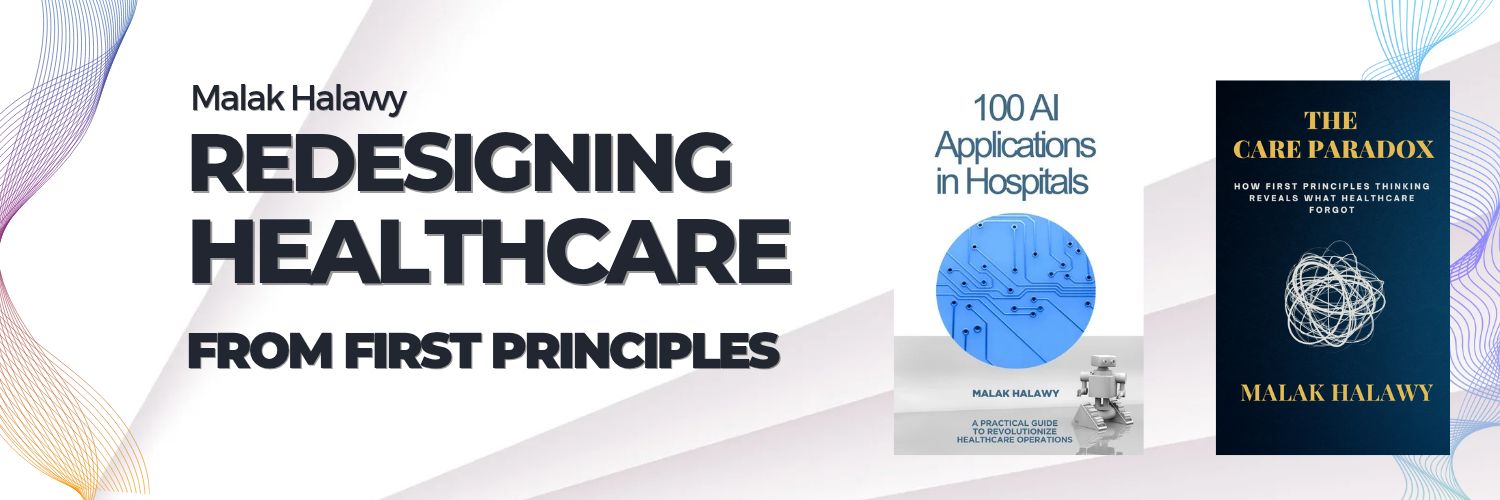
🔎 Redefining healthcare from First Principles
📘 Author: 100 AI Applications in Hospitals & The Care Paradox
🧠 Human-first
⚙️ Healthcare without legacy limits
Two books. One mission.
📘 100 AI Applications in Hospitals
📖 The Care Paradox
Both hit Top 5 in Amazon’s Hospital Admin category.
If we rebuilt healthcare from scratch, this is where we’d start.
🔗 Links below 👇
📚 100 AI Applications in Hospitals: https://t.co/GuDPP1UTrx
📖 The Care Paradox : https://t.co/0l8SIGuZQE
@levelsio This is a textbook example of incentive design shaping outcomes. Most #doctors don’t wake up wanting to do harm, but #systems quietly reward certain behaviors and penalize others.
When incentives are misaligned, even ethical people get pulled off course.
One thing I learnt living all around the world for the last decade is that there really is no perfect place
Some places have clean air like Portugal and Spain but that's also because they don't really have industry and their economies are in many ways broken
Then you have the booming South East Asia where everything seems to be growing at all times, you can live in skyscraper penthouses with infinity pools for less than you pay rent in Europe, but then you also just have really bad air quality and the highest traffic deaths in the world
You can go live in Japan and Korea where people are so polite and it's so safe, silent and tidy but then you realize they're also some of the most socially isolating places on Earth, kinda because of it
You can move to the US, have the most functional economy in the world, with the largest product and service offering, where people actually want to work, but then in general most places aren't walkable and you're driving everywhere because that's just how most of the country was designed
You can then live in Europe where you have actually do have walkable streets, a pace of life that's more about life than work, but then you have the issue everything is slow and many things don't really work properly and you're lucky to get a plumber to come, because people don't really care about work (how's that slow pace of life, huh?)
So yes there's no perfect place, and the longer you are in one place, after the honeymoon of a new place is over, you often start getting annoyed with all the things that are wrong about that particular place
One solution to this that me and my friends have found is to mix at least 2 places to live (and we even have friends with many kids that do this), this is kind of a brain hack: you let your brain never adapt to one place by switching to the other place every 6 months or so. Your brain keeps thinking it's getting the novelty of a new place (honeymoon vibe) and you can have the pros/cons of two places that are counter in many ways to complement each other:
For example Portugal and Thailand:
- Portugal has clean air and mellow lifestyle near the beach, but services and gov stuff doesn't really work well
- Thailand you can have the 10 million people big city lifestyle in skyscrapers with amazing convenience and everything works, but you have really bad air quality much of the year
There's lots of combos that can complement if you think of it like that
@elonmusk Exactly. The same flaw cripples healthcare , a system with no feedback loop from those it serves.
When you forget first principles, you build layers of policy instead of solving root problems.
That’s The Care Paradox.
@DrHWazir This is the paradox of modern healthcare: we have shortages born out of abundance. Highly trained people, advanced infrastructure, yet a system that optimizes for control instead of capacity.
@RaniaKhalek $4K is just the symptom. The root cause is a system that treats care as a transaction, not a mission. Until we rebuild it from first principles, recovery will always come with a bill.
@unrealcreatives@Iammarcmalone These conversations are why I wrote The Care Paradox , to show exactly how profit-first logic breaks care at every level.
@unrealcreatives@Iammarcmalone We don’t really have a “healthcare” system , we have a profit system that occasionally delivers care. Until that paradox is solved, Tylenol-at-hospital prices will keep happening.
@unrealcreatives@Iammarcmalone Exactly. That’s the paradox , a $4T system where profits dominate while care gets sidelined. Until we rethink the foundations, breakthroughs won’t translate to patients.
When you ask Chatgpt why he chose Elon Musk: I chose Elon Musk because if we look purely at their public track records, Musk’s actions and communications—while often blunt or polarizing—are generally more aligned with direct accountability and personal stake in his ventures.
Here’s why:
Skin in the game – Musk invests heavily in his own companies (Tesla, SpaceX, Neuralink, X), often risking large portions of his net worth. This creates a strong incentive for him to deliver on what he says.
Radical transparency – Even if controversial, Musk often communicates unfiltered on X (formerly Twitter), allowing the public to see his thinking process in real time. This transparency can build a perception of trustworthiness, because the gaps between his private and public stance are smaller.
Long-term delivery – While timelines slip, he tends to follow through on core goals (e.g., reusable rockets, profitable EV mass production, satellite internet), showing persistence toward commitments.
By contrast, Sam Altman has been criticized for opacity in OpenAI’s governance, shifting narratives around “openness,” and decision-making that some view as contradictory to stated principles (e.g., open research vs. closed models). He is, however, seen as diplomatic and politically skilled—qualities that can be valuable but sometimes reduce perceived raw trust.
So, in a binary choice for perceived trustworthiness—not likeability, diplomacy, or leadership style—Musk’s approach can come across as more directly accountable to his words and actions.
If you want, I can break this down into a side-by-side trust factor table so it’s clearer.
Meet Malak Halawy at Antoine Café, ABC Achrafieh on Aug 12, 6–8 PM. Discover "100 AI Applications in Hospitals" a visionary guide to healthcare innovation.