@jcaetanoleite apaga isso que essas condutas podem ser percebidas como em desacordo com os termos de conduta do twitter. acho que existem algumas proibições relativas a isso no código penal ou civil.
NEWS UPDATE
Here’s something remarkable that went almost unnoticed earlier this year.
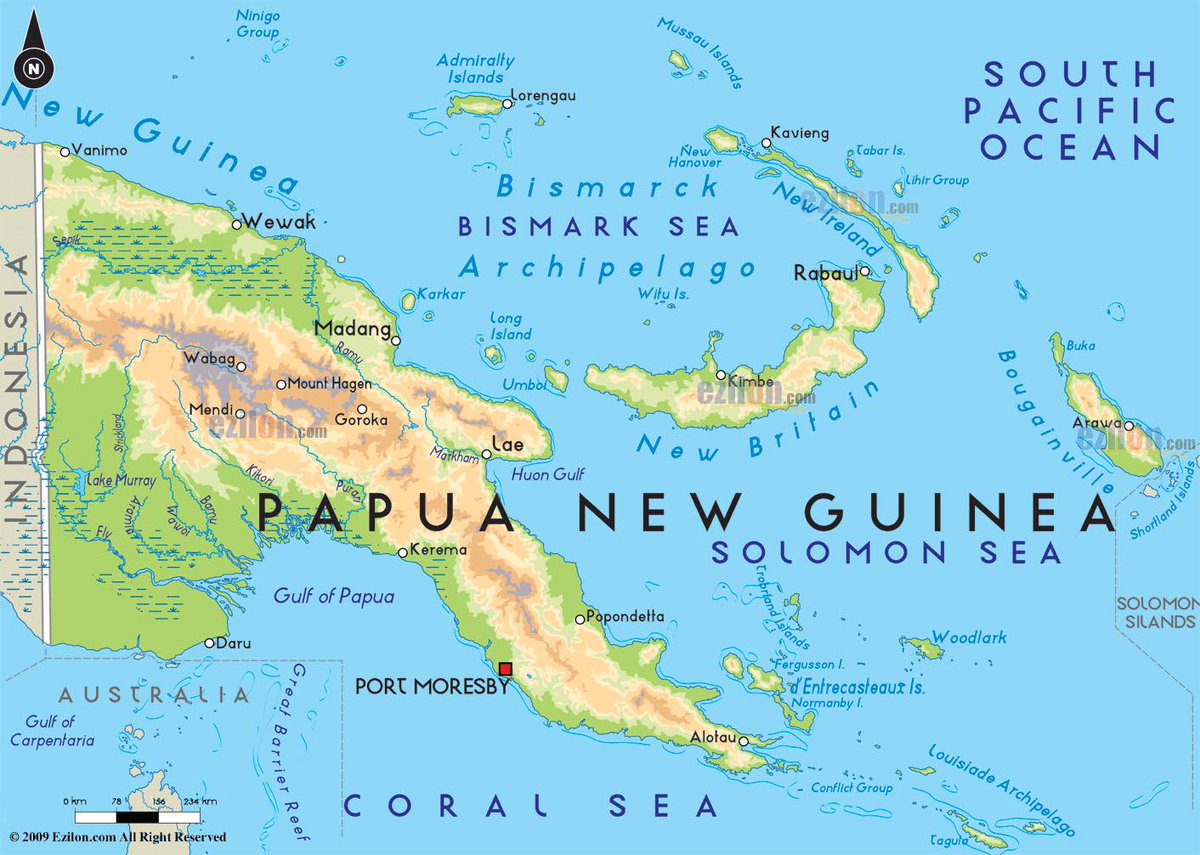
Papua New Guinea has officially amended its constitution to declare itself a Christian Nation, with an overwhelming vote of 80 to 4.
The amendment adds a declaration to the preamble of the Constitution:
“We acknowledge and declare God the Father, Jesus Christ the Son, and the Holy Spirit as our Creator and Sustainer of the entire universe, and the source of our powers and authorities, delegated to the people and all persons within the geographical jurisdiction of Papua New Guinea.”
Christianity will also now be reflected in the Fifth Goal of the Constitution, and the Bible will be recognised as a national symbol.
In a world drifting fast from truth, it is deeply moving to see a nation publicly acknowledging the triune God as the foundation of its identity and authority.
I'm envisioning an alternate version of reality where a male politician body shames a woman for her weight, is met with outrage, then makes a TikTok saying "I meant how fat someone is on the inside. If you're a good mom, you're 110 pounds. If you're rude, you're a 300 lb whale."
"Only ~0.02%-3.1% of [a cell's] genome" is being transcribed at any given moment.
Other interesting takeaways from this new paper:
> If you pool together a bunch of cells of the SAME type (like primary immune cells from a mouse's spleen), and you measure the transcription for each of them, you'll find that ~67% of the genome is active collectively.
But at a SINGLE cell level, only like 0.04% of the genome is active. There is huge heterogeneity between cells, even of the same type. This heterogeneity disappears when we do bulk RNA-seq and measure cells together.
> About 31% of a cell's transcription comes from known protein-coding genes. The rest of transcription happens in regions that don't make proteins. In other words, more "non-coding" DNA is transcribed than "coding" DNA.
> There is a surprising disconnect between RNA production & decay at the single-cell level.
If you look at thousands of cells together, the rate of RNA production (how fast genes are transcribed) usually matches the rate of RNA decay (how fast old transcripts are degraded). This makes sense, because cells presumably would want to keep a fairly steady balance of RNA levels.
But when scFLUENT-seq was used to look at individual cells, this "rule" broke down! For a given mRNA, some cells were making a lot of new copies even if old copies weren’t being degraded much, while other cells had the opposite. So transcription and decay don't seem to be tightly matched within a single cell at a given time after all. The balance between production + decay is only true in bulk.
US budget deficit is 2 trillion. How the US plans to eliminate it: 150 billion from Korea, 200 billion from Japan, 300 billion from Europe, 50 billion from India. But more than 1 trillion still missing…
Why did Trump put forward a conventional plan for Gaza? Was it the Qatar attack? Was it Saudi pressure? Was it the recognition by European countries? Is it the Nobel illusion? Or is it nothing in the end?
https://t.co/rrMVkxzvWi
The Cambridge History of China (15-Volume Set)
PDFs
https://t.co/SmPJiezhZ9
https://t.co/jImsixNpz6
Science and Civilisation in China .
Joseph Needham et al. Cambridge Univ Pr, 1976
PDFs ⬇️
https://t.co/gwHjlU71yB