One of the new, buzzy jobs in Silicon Valley is the AI Forward Deployed Engineer (FDE), an engineer who is embedded within a client organization to help customize solutions, such as building and tuning agentic workflows that suit the client’s particular needs. I’ve heard from people who are wondering anew about the FDE career path since OpenAI and Anthropic started building new teams to place FDEs within client organizations.
The rise of FDEs for AI workloads is one way AI is creating new jobs (and why the jobpolcalypse narrative of upcoming job market collapse is false -- there will be many AI and non-AI jobs). However, I believe there will be far more AI Engineer jobs than FDEs, as I explain below.
The FDE role was pioneered about two decades ago by Palantir, which sent engineers to government locations to work on secure, air-gapped networks. In addition to having good technical skills, FDEs need communication skills and sometimes business skills. For example, they may need to speak with clients to understand their needs, formulate a strategy to prioritize projects, explain complex technology, and respectfully push back if a client asks for something unrealistic. They’re enjoying a resurgence because of the amount of work involved in taking an off-the-shelf LLM and building it into a custom agentic workflow that fits particular business needs.
However, I believe the number of AI Engineer jobs will be far larger. A company might accept a few FDEs to be embedded within its organization. But most companies will want far more of their own employees working on their projects. While my organizations do hire FDEs, we hire far more AI Engineers! Also, a common client concern is that it is hard to find vendor-neutral FDEs — they are, after all, there to deeply integrate a particular vendor’s product into a company. In this moment when it’s hard to predict which AI service will be the best one in a year’s time, optionality (the ability to pick whatever vendor turns out to fit best in the future) is very valuable. In contrast, letting FDEs tightly bind a company’s processes significantly reduces optionality.
Right now, I see surging demand for AI Engineers who can build software applications using AI software components (like LLM prompting, agentic frameworks, evals, etc.) and effectively use AI coding agents (like Claude Code, Codex, Antigravity CLI, and OpenCode). As the AI Engineer role matures, I expect it to fragment into more specialized roles, like the generic Software Engineer role from decades ago fragmented into frontend, backend, mobile, data engineering, devops, and so on.
What will be the future, specialized AI engineering roles? I don’t know. Perhaps there will be AI FDEs, LLMOps Engineers, Evals Engineers, AI Data Engineers, Harness Engineers, and other roles we don’t have names for yet. But for now, I see a lot of AI engineers who are generalists create a lot of value. Skilled AI Engineers are in very high demand! As our field continues to mature over the coming decade, I look forward to new specializations within AI Engineering that create even more job opportunities.
[Original text: The Batch newsletter]
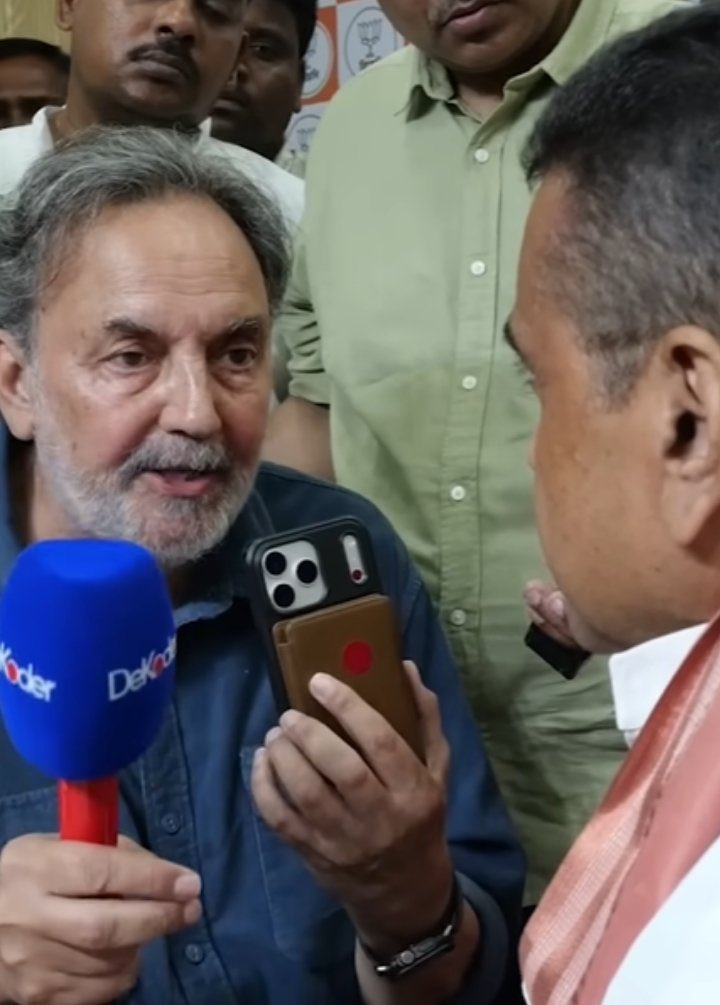
A word of advice for those “feeling bad” at seeing this photograph because “he is having to work like this at the age of seventy-plus while people who are not half as good as him are sitting in posh studios earning huge salaries”:
I have known Prannoy Roy for a long time as a viewer.
I have worked with him too.
This is him.
This is the way he had chosen to work.
Let him.
He has earned the right.
He could have chosen to sit in a posh studio and earn a large salary if he wanted to.
He chose to work like this instead.
Don’t feel bad or sad for him.
He has never wanted sympathy.
Watch him and his content at @DeKoderAI and @dekoderhindi.
That’s all he wants. I don’t think he worries too much another what others are earning and where they are sitting.
This is what he has chosen to do.
Don’t feel bad for him.
Thank him for being out there in the field.
Not many are.
Proud of you, sir. As always.
A Stanford student got reported for academic misconduct last semester.
His research paper was so good his professor assumed he bought it.
The academic integrity hearing lasted 3 hours.
Here's what happened in that room.
The panel asked him to explain his methodology from scratch. He opened his laptop, pulled up https://t.co/LaaeCA6lbD, and started rebuilding the entire paper live in front of them.
First he fed it his raw notes and asked: "You are a research methodology expert. Here are my raw notes. Identify the 3 strongest arguments buried in this data, rank them by originality, and show me exactly where each one challenges or extends existing literature."
The professors went quiet.
Then he ran: "Now simulate a hostile peer reviewer with a PhD in this field. Generate every serious objection they would raise against my thesis. Then tell me which objections actually have merit and which ones I can dismantle."
One professor leaned forward and asked him to stop so she could write down the prompt.
He kept going. "Take my weakest argument and steelman it harder than I did. Show me what it would look like if it were airtight. Then tell me what I'd need to prove to get it there."
Then the one that ended the hearing. "You are my thesis advisor. I have 24 hours before submission. Read this draft and tell me the single change that would move this from a B+ to an A. Be brutal."
He walked them through how he'd used that last output to rewrite his conclusion three times until it held up under every objection in the room.
What took most PhD candidates 6 months of back-and-forth with advisors, he was doing in real-time inside a single workflow.
The panel didn't just clear him.
They gave him the highest grade in the department's history and asked him to present the workflow to faculty.
The irony is beautiful. The paper looked too good to be human because he'd found a way to think harder than most humans bother to.
That's not cheating. That's the new ceiling.
Though I will miss Parliament because of the ongoing #KeralaElections, I am following reports of legislative developments there.
I’m deeply concerned by the Transgender Persons (Protection of Rights) Amendment Bill, 2026, introduced in the Lok Sabha, which was tabled rather surreptitiously and without proper stakeholder consultation. The Bill appears to represent a fundamental reversal of the rights-based framework established after the Supreme Court’s landmark NALSA (2014) judgment.
The amendments delete Section 4(2) of the 2019 Act, which guaranteed the right to self-perceived gender identity, and replace it with systems of medical board verification and bureaucratic certification before identity can be recognised. In effect, the State now proposes to sit in judgment over a citizen’s own understanding of who they are — an intrusion that sits uneasily with the constitutional promise of dignity and personal liberty.
Equally troubling is the drastically narrowed definition of “transgender person”, which risks excluding trans-men, trans-women, non-binary and gender-diverse persons who were previously recognised under the law, while reducing gender identity to biological markers or a handful of socio-cultural categories.
The Bill further introduces mandatory reporting of gender-affirming surgeries to authorities, raising serious concerns about privacy and creating the prospect of a State registry of deeply personal medical decisions—difficult to reconcile with the Supreme Court’s Puttaswamy judgment on the right to privacy.
Taken together, these provisions risk pushing large sections of India’s transgender community, which has faced acute historical marginalisation, back into legal invisibility. At the very least, a Bill with such far-reaching consequences must be referred to a Standing Committee for proper scrutiny. One can only hope that reason and constitutional morality will ultimately prevail over this deeply regressive proposal.
Sharing an interview about my latest book "We, The People of India" featured in Indian Express. Click the link below for the full article:
https://t.co/z4btnGYjnE
Order the book on Amazon. Link below:
https://t.co/p69DFWP0qT
@WestlandBooks@IndianExpress
Resonating words "Was it easy? No, it was not. Was it worthwhile? Yes, definitely it was worthwhile". Great story of real entrepreneurship.
Doctors Who Could’ve Left — Why They Stayed in Rural India For 30 Years ... https://t.co/A9hTu6Gdzp via @YouTube
Something strange is happening in India's stock markets
In 2025, 63% IPO money raised didn't go to companies, but went to promoters and private equity
And this is not by accident, I spent weeks digging SEBI filings to understand how IPOs are rigged, here's what I found
1/12
So, far I have voted in a number of elections from parliament to panchayaths, until last year's parliament elections. So, one day election commission thought all of that is wrong and let's start afresh and have fun. To put it very modestly, this is tyrrany.
@ECISVEEP
Election commission says we have to prove that we are indian citizens if we haven't voted in 2002. It doesn't matter how many times you have voted after that. So, I am not an Indian citizen but I hold this country's passport, Aadhaar card, Voter's ID, PAN, ration card etc.
My brother Kumar wrote a post titled: "How patient execution beats aggressive capital" which is a must read for entrepreneurs:
https://t.co/CDQuY3thr9
Kumar started the company in Chennai that eventually became the Zoho today. Practically every senior manager at Zoho was personally recruited fresh from college and trained by Kumar back in the 1990s. Zoho would not exist without Kumar.
I want to quote this gem from his post:
"முயலும் வெல்லும் (the hare can win)
ஆமையும் வெல்லும் (the tortoise can also win)
முயலாமை என்றுமே வெல்லாது (but not trying never wins)"
The word "Muyalaamai" in Tamil combines "muyal" (rabbit or hare) and "aamai" (tortoise) and it also means "not trying" and Muyalaamai comes from the word "muyarchi" which means "effort" or "trying".
So it means "Go fast like a rabbit or go slow like a tortoise but keep trying" but the Tamil version is much more poetic.
Feelings are data, not dangers. When we decode them, we build resilience. Parents don’t need to shield kids from every bad feeling. https://t.co/d09hCi5qHO via @nireyal
We need to wait and see how it is going to impact students' thinking process. Already our education system gives more weightage to memorisation than creativity, or an attempt at being creative. Thanks for bringing this up @Ullekh!
My story about @sama's India ambitions
As @OpenAI eyes India’s education sector in a strategic move, AI experts & the govt are thrilled but academics cautiously optimistic--while critics warn it’s repeating @Microsoft's Windows-era playbook: quietly colonising young minds
https://t.co/5O5XlAMHmP
The miracle of China's transformation from the "cheap labor, cheap goods" label to world-leading tech-driven industrial prowess is dawning on America's elite.
We in India must study China like a diligent student. Unfortunately the ideas that dominate the Indian corporate world are still mostly from American business schools (and often Indian professors!). It is those business schools that caused the decline of American prowess by teaching spurious doctrines like "shareholder value". The Chinese (like the Japanese before them) had no fascination with American business schools.
We have had intellectual charlatans like C K Prahalad teaching nonsense like "wealth at the bottom of the pyramid" i.e, big companies should sell to the poorest people. The only wealth at the bottom of the pyramid comes from transforming the poorest people into *producers* not consumers, first.
Yet this basic intellectual confusion between production and consumption still persists. Notice the "financial inclusion" language we often hear - all it amounts to in practise in rural India is "let's push even more debt to people who are already drowing in debt".
What our poor citizens need is the opportunity for productive work, first and foremost: jobs, jobs, jobs. Consumption only after production. Expense only after income.
Bad philosophy is extremely costly to people and nations. China recovered from Mao's disastrous philosophy. We can recover from Prahalad but we must first understand why that is wrong. I am planning an industrial pilgrimage to China soon.
Screenshot from NY Times, thanks to Greg Ip.








![AndrewYNg's tweet photo. One of the new, buzzy jobs in Silicon Valley is the AI Forward Deployed Engineer (FDE), an engineer who is embedded within a client organization to help customize solutions, such as building and tuning agentic workflows that suit the client’s particular needs. I’ve heard from people who are wondering anew about the FDE career path since OpenAI and Anthropic started building new teams to place FDEs within client organizations.
The rise of FDEs for AI workloads is one way AI is creating new jobs (and why the jobpolcalypse narrative of upcoming job market collapse is false -- there will be many AI and non-AI jobs). However, I believe there will be far more AI Engineer jobs than FDEs, as I explain below.
The FDE role was pioneered about two decades ago by Palantir, which sent engineers to government locations to work on secure, air-gapped networks. In addition to having good technical skills, FDEs need communication skills and sometimes business skills. For example, they may need to speak with clients to understand their needs, formulate a strategy to prioritize projects, explain complex technology, and respectfully push back if a client asks for something unrealistic. They’re enjoying a resurgence because of the amount of work involved in taking an off-the-shelf LLM and building it into a custom agentic workflow that fits particular business needs.
However, I believe the number of AI Engineer jobs will be far larger. A company might accept a few FDEs to be embedded within its organization. But most companies will want far more of their own employees working on their projects. While my organizations do hire FDEs, we hire far more AI Engineers! Also, a common client concern is that it is hard to find vendor-neutral FDEs — they are, after all, there to deeply integrate a particular vendor’s product into a company. In this moment when it’s hard to predict which AI service will be the best one in a year’s time, optionality (the ability to pick whatever vendor turns out to fit best in the future) is very valuable. In contrast, letting FDEs tightly bind a company’s processes significantly reduces optionality.
Right now, I see surging demand for AI Engineers who can build software applications using AI software components (like LLM prompting, agentic frameworks, evals, etc.) and effectively use AI coding agents (like Claude Code, Codex, Antigravity CLI, and OpenCode). As the AI Engineer role matures, I expect it to fragment into more specialized roles, like the generic Software Engineer role from decades ago fragmented into frontend, backend, mobile, data engineering, devops, and so on.
What will be the future, specialized AI engineering roles? I don’t know. Perhaps there will be AI FDEs, LLMOps Engineers, Evals Engineers, AI Data Engineers, Harness Engineers, and other roles we don’t have names for yet. But for now, I see a lot of AI engineers who are generalists create a lot of value. Skilled AI Engineers are in very high demand! As our field continues to mature over the coming decade, I look forward to new specializations within AI Engineering that create even more job opportunities.
[Original text: The Batch newsletter]](https://pbs.twimg.com/media/HJvWmCHagAAnTxQ.jpg)