What is Jupiter Retrograde: Periods in 2025 and 2026
In astrology, Jupiter is associated with growth, prosperity, and good fortune. Its retrograde motion, however, is associated with a slowdown in career and relationships, general decline, and a series of setbacks.
If zero was invented rather than discovered, then I suspect that the symbolic equivalence of the Sun in a horoscope to the number 0 (☉) was also not discovered, but rather invented through the reception of Arabic sources in Renaissance astrology.
Conclusion: For everything that science makes possible, ☉ is the logical symbol – it is good to know that in Renaissance astrology, ☉ is also the symbol for the visibility of the resurrected Jesus Christ.
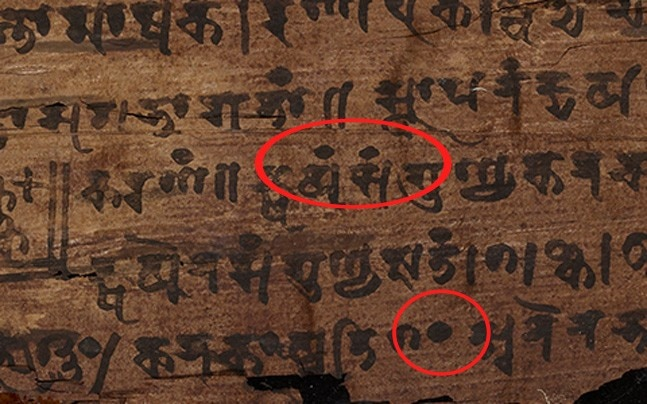
Zero was not discovered—it was invented. The greatest mathematicians in the world, especially those from Greece, initially refused to accept zero as a number, questioning how “nothing” could be considered a number.
However, Indian mathematicians insisted that even nothing represents a number. Today, without zero, there would be no calculus, no computers, and no modern physics.
Astrology is based on philosophical mathematics: In the horoscope, the event is the three-dimensional spiral, the planet is the two-dimensional spiral, the zodiac is the sine curve, and the houses are the cosine curve.
Conclusion: A horoscope is a mathematical representation of an event with a philosophical meaning.
THE TRIGON OF SCIENCE
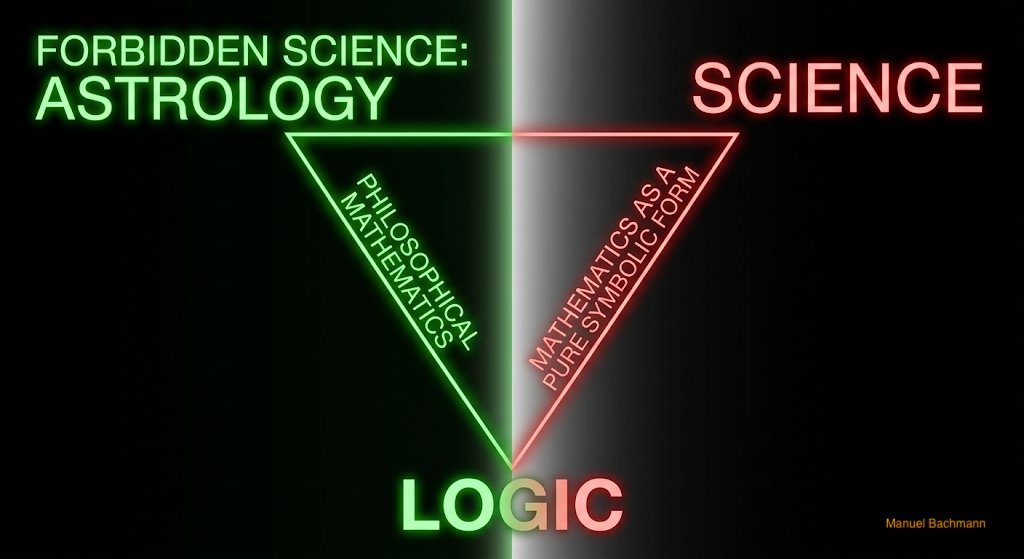
The disqualification of astrology as a "forbidden science" stems from a profound amnesia within modern academia, which has forgotten that science and astrology share a common anchor: logic. This Trigon of Science constitutes a triadic framework where mathematics splits into two core paths, both rooted in logic and both—in the words of David Bessis—"dreaming with strict rules." The divergence lies in their expression. Philosophical mathematics translates the dream into a highly idealized language, ultimately leading to astrology. Conversely, mathematics as a pure symbolic form translates it into a highly idealized architecture, giving rise to modern science. By denying this structural connection, academia fails to recognize its own constitutional roots.
If DontFearUnknown is right—and astrology will prove him right—the implication changes everything:
since every planet in the chart represents a decision point, we leap through a portal at each of these points and land in whichever house is in Pisces—much like a mysterious tunneling effect in physics.
The Cone of Plausibility
Graphic by @DREX.DSGN
Imagine your future is not a straight arrow - but a funnel full of possibilities.
Most people stay trapped their entire lives in the Neptune Zone: everything feels safe and probable... but it's also foggy and limited. They only plan what they already know.
Yet your horoscope reveals three powerful power centers that let you consciously leap into the future:
1. Neptune - the PROBABLE Zone
Safety. Habit. But also the illusion that "this is just how it is." Breakout method: Brutally honest analysis of your current situation.
2. Pluto - the PLAUSIBLE Zone
This is where you create a completely new life. The "Second Act" everyone dreams of. Breakout method: Melt old relationships into powerful new networks.
3. Uranus - the TRULY POSSIBLE Zone
Your full potential. Living in a healthy, vibrant, intact community. Breakout method: The "Paralysis of Time" - being completely present in the now.
The question is not whether you live in one of these zones. The question is: In which zone are YOU planning your life right now?
Drop it in the comments - I read every single one.
When we treat astrology as the forbidden science it effectively is, we also recognize that this underlying “forbidden spiral” is present within the chart itself. It is Saturn — not the physical planet, but a logical symbol representing a highly responsive formula: spiral, helix, corkscrew, whorl, whirlpool, eddy, recursive loop, snowball effect, positive feedback, cat…
Astrology in Art & the Mathematical Logic of Astrology
This painting by Joachim von Sandrart (1606–1688) is an astrological month painting depicting the zodiac sign of Taurus. In philosophical astrology, Taurus is the logical sign of the category of “appearance.” Here, that category is illustrated through the appearance of beauty itself. Its meaning is not symbolic or metaphorical, but mathematically exact.
While mathematics inherently abstracts away from the sensory appearance of the world, it utilizes the concept of appearance in the following ways:
1. Applied Mathematics: “Appearance Modeling”
In modern computer graphics, computer vision, and medical imaging, an “Appearance Model” is an exact mathematical concept.
Active Appearance Models (AAMs): These are statistical algorithms that mathematically combine the physical shape and the visual texture (appearance) of an object (e.g., a human face). They are widely used in modern facial recognition, medical MRI analysis, and deepfake technologies.
Physics-Based Rendering: Mathematicians use complex partial differential equations and geometry to calculate how light interacts with surfaces. The goal is to mathematically simulate the exact optical appearance of materials like skin, glass, or fabric.
2. Phenomenology of Mathematics (Structuralism)
In the modern philosophy of mathematics (particularly mathematical structuralism), scholars study how abstract objects become accessible to human cognition. Philosophers like Stewart Shapiro argue that the concrete physical appearance of symbols or diagrams on paper is mathematically irrelevant, as long as the underlying relational structure remains accurate. In this view, appearance is merely the physical vehicle used to transmit pure, invisible structures.
3. The Phenomenon of “Mathematical Beauty”
In essays regarding mathematical aesthetics, the word appearance is frequently used to describe either the sudden emergence of an unexpected pattern or the outer elegance of a formula. Mathematicians like Henri Poincaré and G.H. Hardy noted that mathematical beauty often lies in discovering a profound, hidden order behind the chaotic first appearance of a complex mathematical problem.
In summary, while Hegel defines appearance (Erscheinung) as the logical self-manifestation of the essence, modern mathematics utilizes the concept either as a statistical model to calculate our visible reality or as the visual manifestation of abstract structures.
All three mathematical ways of understanding “appearance” are encoded in the painting — implicitly, however. Only the later development of mathematical thought makes it possible to read this coded potential.
The eternal storm of Jupiter looks like an eye. What matters is this:
In the astrology of Johann Georg Gichtel (1638–1710), Jupiter is the Third Eye — a power center in the human forehead, an invisible eye that sees everything.
Lost in Jupiter’s Eternal Storm
Have you ever gazed up at the night sky and felt the gas giants quietly guarding secrets older than humanity itself?This breathtaking view of Jupiter reveals a planet of pure, chaotic majesty. Massive bands of ammonia clouds swirl in hypnotic patterns, driven by winds reaching hundreds of miles per hour. Ancient storms — some larger than Earth itself — have raged continuously for centuries, including the iconic Great Red Spot, a colossal anticyclone that has stormed for at least 400 years.What looks like the masterful brushstrokes of an cosmic artist is, in fact, raw planetary physics playing out 484 million miles away. Turbulent eddies, towering cloud tops, and shifting atmospheric chemistry paint Jupiter’s face in ever-changing hues of cream, ochre, rust, and white.Staring into those infinite swirls is profoundly humbling. This is the Solar System’s largest planet — a massive shield that gravitationally protects the inner worlds from wayward asteroids and comets. Yet for all its protective power, Jupiter remains wild, untamed, and full of mysteries we’ve only begun to understand.
The court battle between Sam Altman and Elon Musk can be mathematically quantified with a single glance at OpenAI Inc.’s radix.
Altman (neon blue) represents decimality.
Musk (neon violet) embodies undecimality. Musk “runs one higher than ten.”
No matter how many zeros are on the board, the undecimal system reigns supreme over the decimal one. The principle of “one higher than ten” is hardwired into its very base, exponentially compounding itself with every new zero that decimality adds.
A court ruling cannot change this. In fact, the verdict is completely beside the point.
What this means in reality: No matter how much Altman brings to the table, Musk always absorbs the updated Altman as his baseline—only to trigger an avalanche of additional value on top by “running one higher.” Musk swallows Altman whole, transforming OpenAI into a completely new dimension.
In the horoscope, Saturn’s physical rings become the “Ring of Power.” That’s the real difference between astronomy and astrology — and the one astronomers refuse to understand.
Saturn doesn’t just have rings — it rules an entire miniature solar https://t.co/MrqpkqJLDA of 2026, the ringed giant boasts 292 confirmed moons, far more than any other planet, with the number still climbing as astronomers keep spotting tiny new ones. Dominating them all is Titan, a colossal world larger than the planet Mercury. With a thick nitrogen atmosphere, rivers and lakes of liquid methane, and a diameter of 5,150 km, Titan feels more like a planet that got captured than a mere moon.Titan orbits Saturn at a safe distance of about 1.2 million kilometres — well beyond the outer edge of the famous ring system. Those dazzling rings, made of countless icy particles and moonlets, are confined much closer to the planet, while Titan sails majestically around the entire sprawling family of satellites. The sheer crowd of moons — from planet-sized Titan down to kilometer-scale irregular rocks — reveals just how gravitationally chaotic and crowded Saturn’s neighborhood truly is. It’s a dynamic, ever-evolving system where collisions, captures, and gravitational dances continue to shape one of the most spectacular regions in our Solar System.
What’s the vibe today?
Wednesday, May 13, 2026
☽^{♂} [♈] = IIₐₓᵢₒₘ
STANDPOINT: The vibe is total commitment to your mission.
JUSTIFICATION: Good to know, because you’ve been wavering.
EXAMPLES: Claim. Moral courage. Walk away from an impossible mission.
CONCLUSION: Yesterday you put your mission on ice.
CALL TO ACTION: You need to break that ice today.
ONE-SENTENCE SUMMARY FOR EVERYONE: Stop wavering — either go all in on your mission or kill it today.
These doors open into a high-dimensional space — the “Allness” (totality) of the gods — which is reduced to a heptad of seven mathematical power centers in the horoscope (the planetary deities). We know this from Roman sources. Emperor Hadrian, builder of the Pantheon, was himself an astrologer.
Here we see how a radix is generated mathematically: the Placidus algorithm resolves the zodiac’s cosmic plane into a logical system of pure quantity — the so-called ‘houses,’ which depend on time and location.
What’s the vibe today?
Tuesday, May 12, 2026
☽^{☉} [♓] = IIᵥ𝒻
STANDPOINT: The vibe is doing things on your own terms.
JUSTIFICATION: That’s your challenge.
EXAMPLES: Deadlines. Phone off. Cash only. No small talk.
CONCLUSION: So today, your challenge is the pure vibe.
CALL TO ACTION: Break the script.
ONE-SENTENCE SUMMARY FOR EVERYONE: Do shit on your own terms today.
The actual sizes of the objects in our solar system don’t matter at all in everyday life:
The gigantic Sun appears exactly the same size as the tiny Moon. Giant Jupiter is just another bright dot in the sky, exactly like tiny Mercury.
This phenomenological reality is the fundamental perspective of astrology. In a horoscope, the celestial bodies are simply mathematical points — logical symbols, not physical objects with size. That’s why we can interpret them perfectly well without ever competing with physics.
What’s the vibe today?
Monday, May 11, 2026
The General State of the World:
☽[☽] × I[♓] = Iₐₓᵢₒₘ
STANDPOINT: The vibe is pure bewildering wordplay.
JUSTIFICATION: It describes exactly how it feels: you think you’re in control, but the words start playing with you.
EXAMPLES: Shopping list. Follow-up question. Time crunch. Keychain. Excuse. Mental leap. Small talk.
CONCLUSION: This isn’t a glitch — it’s the default setting of everyday life.
CALL TO ACTION: Stop trying to control the small talk. Start playing along in the wordplay. Who’s in?
ONE-SENTENCE SUMMARY FOR EVERYONE: The vibe is a bewildering wordplay where the words play with you — so stop trying to control it and just play along.
What’s the vibe today?
Sunday, May 10, 2026
STANDPOINT: The vibe is a theorem about self-fulfilling prophecies.
JUSTIFICATION: The vibe shows up in the world as a mechanical interplay between question and answer.
EXAMPLE: “Water and reality always find their way through — nobody can stop that forever.”
CONCLUSION: Prophecy is repetition gaining inertia.
CALL TO ACTION: Whoever wants to play it has to find the theorem.
ONE-SENTENCE SUMMARY FOR EVERYONE: Find a theorem that fulfills your prophecies.
@mathelirium A radix works like a neural network.
Its answers to your questions are automatic forward passes.
The neurons are the astrological symbols — fixed logical units with rich interconnections.
My astrological library is the training dataset. My interpretive grammar is the architecture. The weights are my rules of interpretation — initially uniform and textbook-style.
And here’s the striking part: every chart is trainable. Through repeated cycles (ask → interpret → real-world feedback), the effective weights adjust. The readings become more nuanced, context-sensitive, and less stereotypical.
It’s logically identical to fine-tuning a neural net: the loss function (“does this match lived reality?”) gets minimized.
A neural network can begin as a flat sheet and learn the shape of hidden data
A self-organizing map turns learning into geometry. Each data point pulls one winning neuron toward it, but nearby neurons move too, and so the whole lattice bends without losing its neighborhood structure.
The strange part is that the network is not given the roll shape. It discovers the shape through competition and local cooperation.
Paper: Self-Organized Formation of Topologically Correct Feature Maps
Authors: Teuvo Kohonen
Year: 1982