The operating system has always been one of the most complex pieces of software ever built.
Now imagine a future where the OS itself becomes LLM-native and introduced as LLM OS.
If that happens, every layer above it changes too.
Software won’t just be rewritten. The way we build, test, deploy, and interact with software will be different.
A lot of what we consider best practices today may not even exist a few years from now.
Things are moving incredibly fast. It’s hard to keep up, but it’s also incredibly exciting.
What a time to be alive.
Strong thread. The line that matters most is that the real switching cost isn’t data migration, it’s re-verification. That’s the whole game, and almost nobody prices it correctly.
I build eval tooling for exactly this, so I’d push it one layer further. Re-verification cost isn’t uniform. It scales with how many non-portable failure surfaces the harness is quietly absorbing. Text agents have basically one class of those (prompts, tool schemas, guardrails tuned to a model’s quirks). Your compounding math is right, 0.98 per step lands around a third over 50 steps, 0.90 basically never finishes, but that’s the floor.
Voice and phone agents are where it gets brutal. Per turn you’re multiplying: ASR heard it right, endpointing didn’t cut the caller off, intent resolved, the tool fired, the response came back inside a latency budget (human turn-taking gaps sit near 200ms, so you gate on p95, not average), barge-in was handled, TTS was intelligible. Then you do that across every turn of a live call. A model swap that costs “a few points per step” in text can move five of those at once, and none of it shows up in a clean transcript. The agent doesn’t error. It just gets quietly worse.
So your read on eval platforms is the right one. Whoever industrializes cross-model re-verification is what actually makes fungibility real. Not by removing the switching cost, but by turning re-verification into something cheap, repeatable, and CI-gated instead of a three-week manual regression every time you touch a prompt or a provider. And it has to run against the real surface: for a phone agent that means placing actual calls through an ASR to LLM to TTS pipeline and scoring turn-taking, latency percentiles, WER by accent and noise, and barge-in, not scoring a text trace and hoping it generalizes. That’s the layer we’ve been building at LambdaTest, and it’s the part MCP doesn’t touch. It standardizes tool and data access, but it can’t standardize your harness or your evals.
The honest version of “models are fungible” isn’t “swapping is free.” It’s “swapping is verifiable in an afternoon.” That’s the abstraction that’s actually missing.
@asad0801
We're live on Product Hunt🚀
ConnectMachine 2.0 is here a private, AI-powered way to remember who you met, where, and what was said.
Your support means everything to our team 🙏 https://t.co/y3qBLd0sly
#ProductHunt
The hardest problem in software is no longer writing code. It's knowing whether what you shipped can be trusted. When an agent writes the code, runs the tests, and merges the PR, who checks the checker?
That's what we're tearing down at #TestMuConf2026.
🗓️ Aug 19–21 | Virtual
🧠 Smarter replay with live branch evaluation
✅ Tab-count assertions now work end-to-end
▶️ More reliable test execution
⚡️A smoother CLI experience kane-cli 0.3.2
https://t.co/3I8Omd1SJB
BrowserStack is leaking user emails through their platform, which is an absolute disaster for a company built on developer trust.
Context: BrowserStack is a leading, Al-powered, cloud-based platform
For testing web and mobile
applications on 3,500+ real
browsers and devices.
How are you still shipping enterprise-grade tools if you can’t keep a basic PII field out of a public log?
You’re wondering how Agents will be tested?
Meet our Hawk Innovators Sai Krishna & Srinivasan Sekar 🥷 🥷, diving deep into:
🎯 Testing Agentic AI Applications: Beyond Traditional QA
The era of scripted testing is ending autonomous, reasoning-driven agents demand a new playbook.
Watch how our team is re-defining the future of Agentic Quality Engineering at @lambdatesting | KaneAI.
Team LambdaTest is leading from the front in Agentic AI Testing.
https://t.co/KRiZJ92rr5
Introducing #ConnectMachine where AI meets intentional connection. ⏯ https://t.co/p53SU4Bwz8
Your private AI concierge for meaningful networking
Query your network in natural language
Voice-ready
Zero APIs, no noise, just presence
Not social. Not public. Just smart connection.
this is the day we waited for to be in league of top dev tools chain for developers and it becomes more interesting when one of the largest SI partner showcase it. Lets go LambdaTest. You have arrived baby ❤️ 🔥 🚀 😍
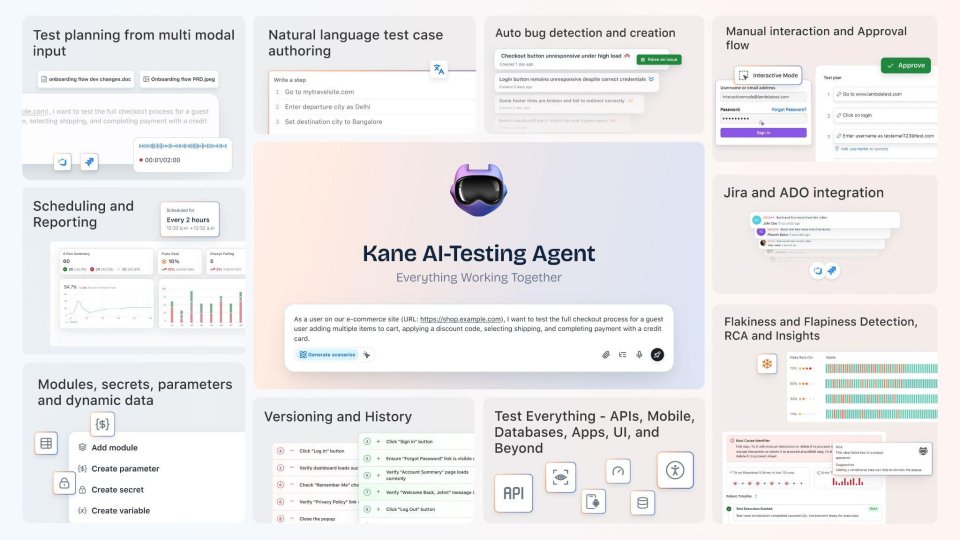
Introducing KaneAI 🤖 from House of @lambdatesting , the world's first 100% autonomous AI Assistant for end-to-end software testing. 🚀 Link for private beta in comments
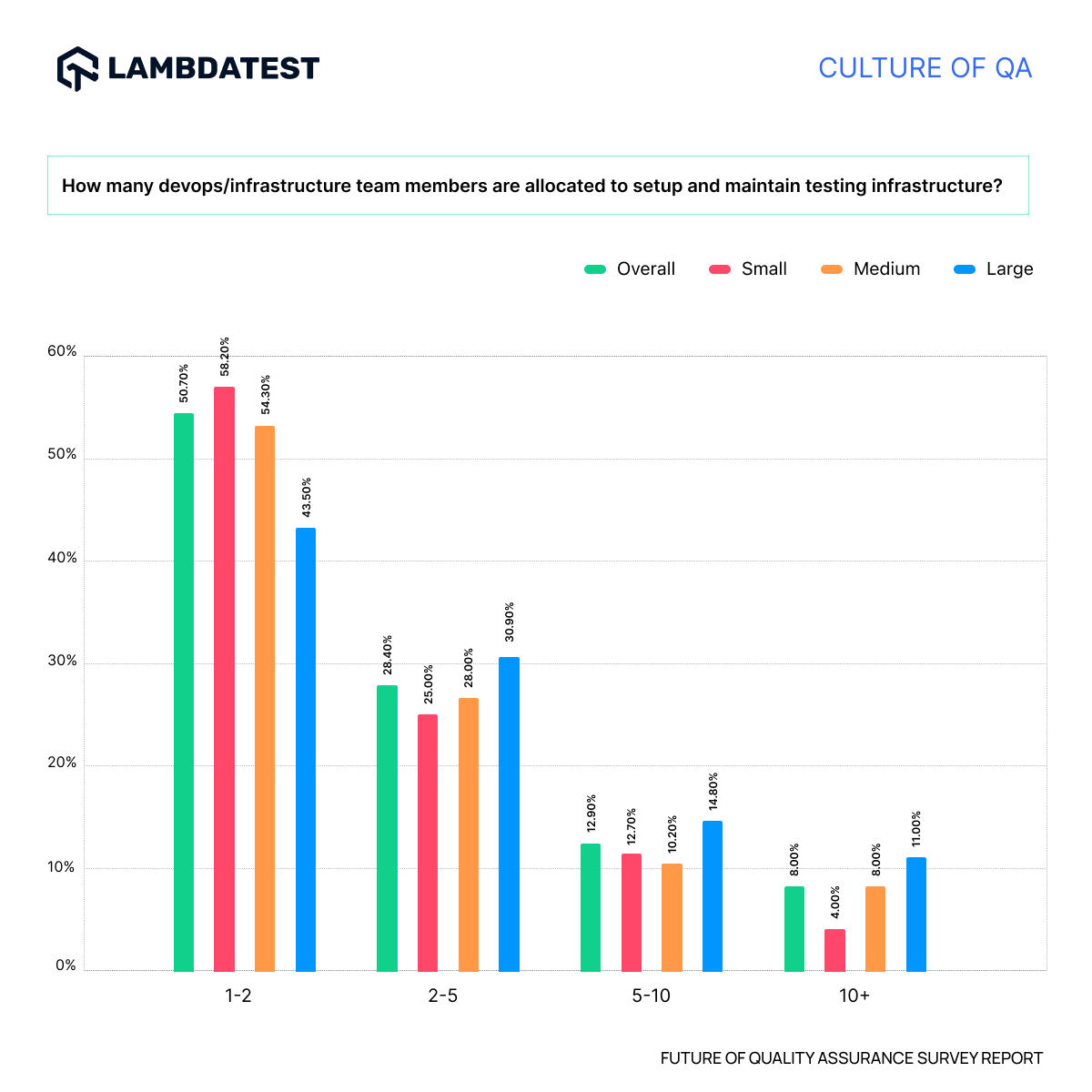
DevOps & Testing Infrastructure: Time for a Tech Shift?
The LambdaTest Future of Quality Assurance Survey Report highlights an intriguing aspect:
While 79% of organizations rely on up to 5 DevOps/Infrastructure team members to set up and maintain testing infrastructure, a considerable effort could be optimized through the right tooling.
Especially for large organizations, where 11% have 10+ members dedicated to these tasks, the adoption of the right technological tools could significantly streamline processes and reduce the reliance on extensive human resources.
Is it time to rethink and retool our approach to testing infrastructure?
Gain more insights on this topic in our survey:
https://t.co/LGpwAn7FCt