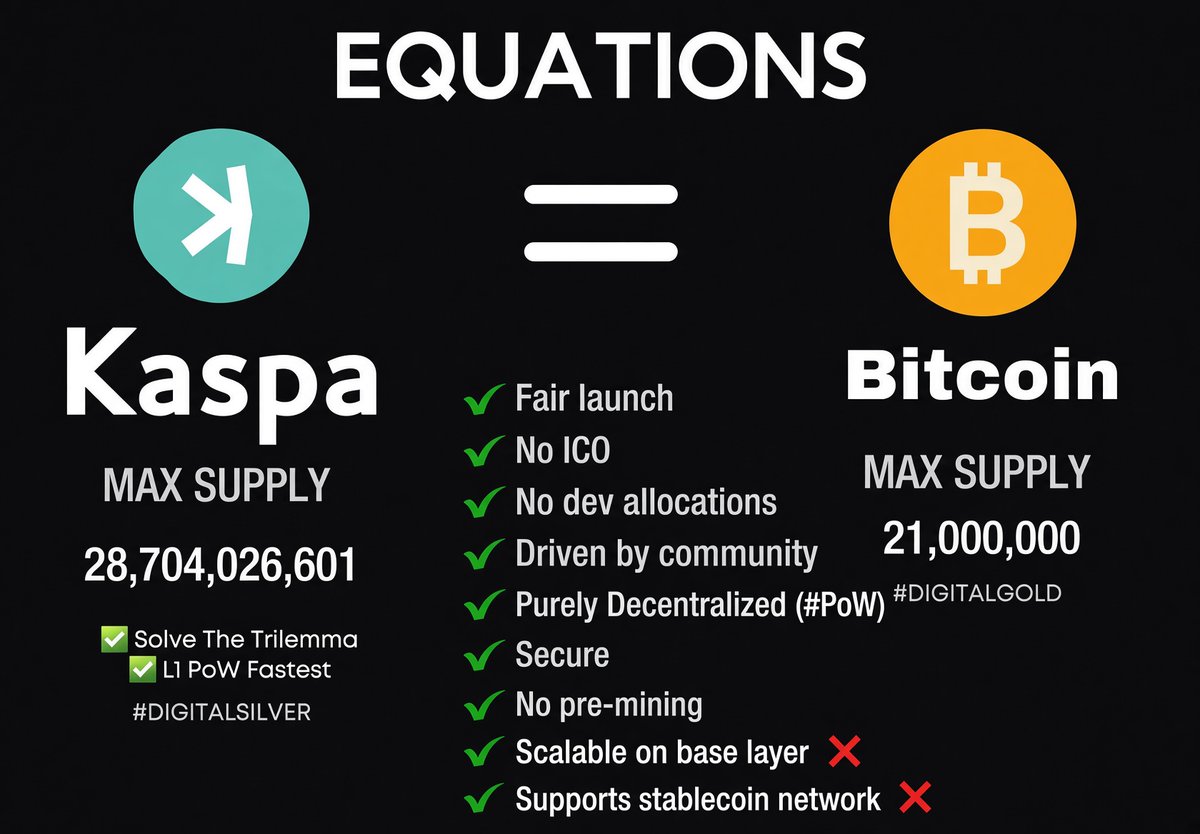
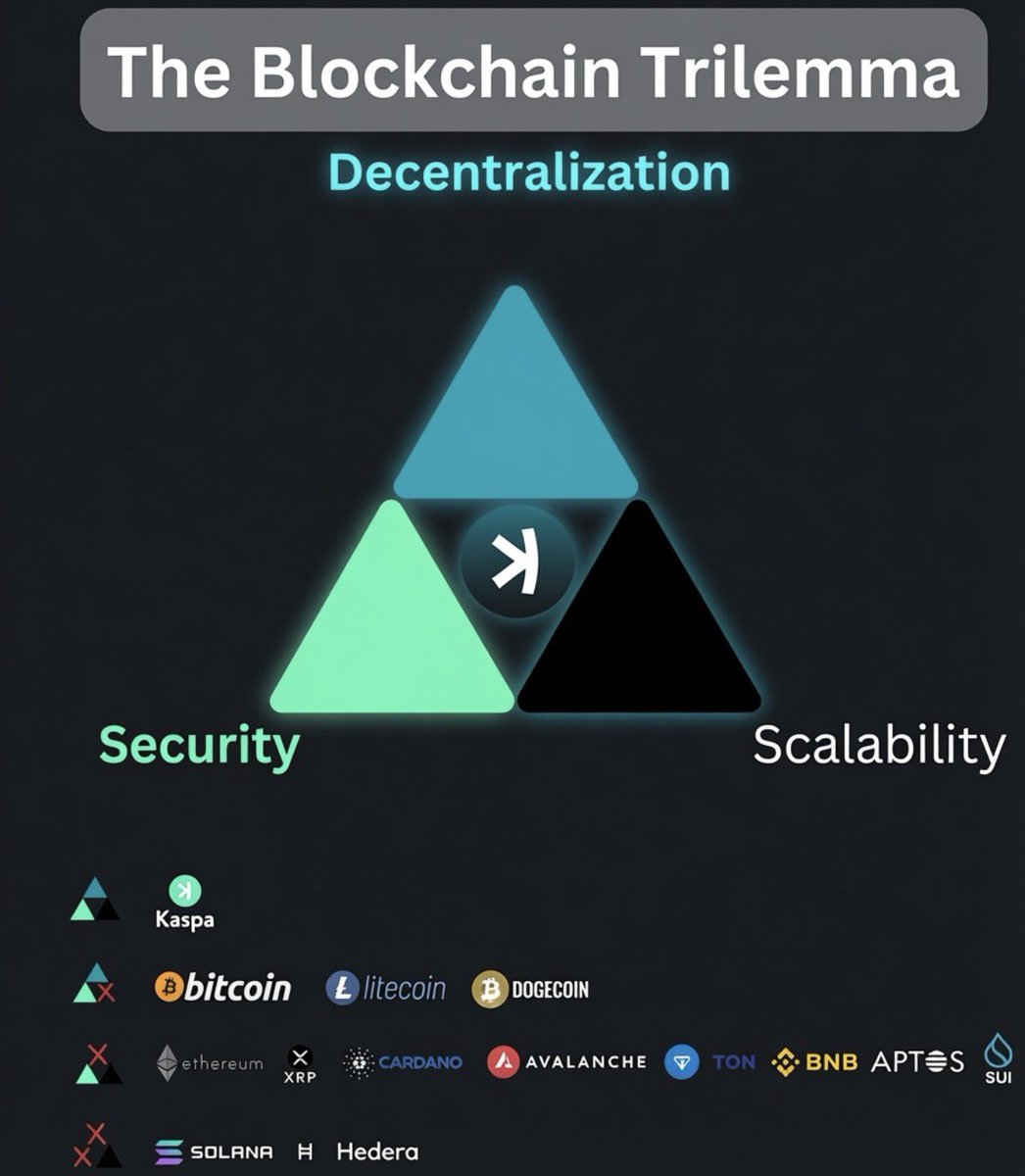
$KAS just turned five, and the fair launch still stands out.
Kaspa launched in November 2021 with no pre-sale, no ICO and no insiders getting a head start. Just proof-of-work, like Bitcoin, built to be seriously fast with BlockDAG.
Five years on the numbers are proper. Over 2.4 billion transactions. 587 million blocks. Getting on for 600,000 wallets.
The biggest stat though. It survived. $KAS made it through some of the most brutal years crypto has ever seen, the kind that wiped out hundreds of projects.
And it is not standing still. Developers are pushing toward smart contracts and stablecoins, which would open Kaspa up to a whole new world of apps.
One catch. Those new capabilities are still being built, not fully live as everyday apps yet.
Happy birthday $KAS. Surviving five years as a fair-launch proof-of-work chain is rarer than the hype cycle admits.
When someone says Kaspa is dead and its trading volume is shit. And then says only bitcoin. Maybe they should try not shitting on a chair and then sitting in it.
KaspaDollar whitepaper is now live! Please find it under the /whitepaper page on our website. Do note, that this is a working document that is subject to both internal and external review!
As part of this release we also want to talk about why KaspaDollar is not just a stablecoin and why $KAS is the only collateral possible. That is, in this post we want to go through some of the decisions that have been taken so far and the thinking behind them, because a few of them look strange from the outside until you see what they protect.
KaspaDollar is not a business. There is no planned revenue that will be extracted from the community and there is neither any developer fee. The deployed contracts will not have an admin key and no central form of control at all. Our goal is to design it into a self-sustaining system that inherits the properties of the base layer itself. Therefore, it should be considered a product designed for the people of $KAS, owned by $KAS miners, if anything.
Let’s backtrack a little bit to understand the motivations behind this.
Why do we want decentralization and why do we resist censorship? Because there are countless examples of centralized entities abusing their power in their own favor. When it comes to stablecoins we can see this concretely with freezes. A concrete example is when Circle blacklisted the Tornado Cash contracts in 2022, every depositor in those pools had their USDC frozen with them. In addition, Tether blacklisted more than a billion dollars of USDT in 2025 alone. One can argue that most of the cases are in line with a criminal investigation but what prevents a centralized issuer from freezing without proper cause? What is the point of a decentralized PoW if a centralized stablecoin captures the majority of the TVL. Some might argue that this is why we should just stick to $KAS. But $KAS comes with a volatility not every holder can accept. Many people want to offload profits or losses into a stable asset knowing that the value of $KSD will with near certainty equal the same value tomorrow.
Everyone in the Kaspa movement has their own reasons for being here, but we believe and hope that all of them are rooted in the core crypto ethos.
Kaspa is a PoW-backed L1 with capabilities that exceed any other PoW network, and it is PoW for a reason, because this is the consensus mechanism that has proven to be the most decentralized way of agreeing on chain.
Some people point out that mining hashrate on Kaspa, and on Bitcoin, is too concentrated in a handful of pools or miners. That is true, but the same is true of staking on PoS networks like Ethereum with one major difference. The difference is that PoW is actual hardware, an ASIC machine that took years and a tremendous amount of capital to develop that can do exactly one thing, mine $KAS.
Attacking a PoW network with hardware you bought means attacking the only income your hardware will ever have. A PoS attacker’s stake can be slashed only for misbehavior the protocol can prove, and voting a false price or censoring a transaction is not one of them. Therefore in a PoS system, the stake could simply be retargeted.
Now the reason why $KSD only uses $KAS for its collateral is to bind it to the success and health of the network. The price that $KSD runs on is voted by the miners themselves. So the only party that can attack $KSD is a large miner, and that miner would be doing it in public, against the asset that pays for its hardware. Therefore, the more of Kaspa’s economy settles in $KSD, the more an attack on $KSD is an attack on $KAS itself, and the reward would be in the very asset the attack is destroying.
Some have suggested that we should use gold or $ETH as collateral. If we did this, $KSD would actually become more likely to be attacked and exploited. With $ETH or gold the reward would be paid in an asset the attack does not impact. It would also mean that the collateral is no longer on Kaspa at all. Gold on Kaspa is only a claim on gold that is held by a custodian, and $ETH on Kaspa is a claim on $ETH secured by PoS.
$KAS is the only asset that exists natively on the base layer, with no issuer and no bridge in front of it. So ironically, through less diversification we get a stronger system, one that is closer to the security properties of $KAS itself.
However, we can also not ignore the fact that centralized issuance is needed for adoption. That is why KaspaDollar also creates the infrastructure that any future issuer on Kaspa will need, including centralized ones like @circle or @tether if they ever come. The biggest piece is the oracle itself, a price feed voted by the miners that any Kaspa protocol can read, whether it is a lending market or a DEX. Simply put, providing technical rails that are built and verified by the core team can have a very beneficial stamp of approval, which could make issuance and building on Kaspa less daunting.
Consider what Kaspa DeFi would look like if it were built on bridged stablecoins or on stablecoins that originate on an L2. A covenant on the base layer can have flawless security and still hold nothing more than a claim on money that lives somewhere else, with completely different security properties.
If the dollar inside it is bridged, its value depends on the bridge’s multisig. If the dollar comes from an L2, its value depends on that L2’s sequencer and the L2’s security. If the L2 has any form of centralized control, then the security of Kaspa’s DeFi inherits the security of an external system, that can be completely disjoint from the original sought properties.
Therefore, an important statement is that: the base layer implementation is only as secure as the weakest asset within the protocol. $KSD is the only dollar on Kaspa where both the collateral and the price are secured by the same miners that secure $KAS, and that is what makes it the foundation for Kaspa DeFi.
Bitcoin had Miami.
Ethereum had DEVCON.
Now it’s Kaspa’s turn.
Introducing the Kaspa Conference: a 4-day experience bringing together builders, investors, and the $KAS community.
And we’re investing up to $1,000,000 in Kaspa startups.
Here’s what we’re building. 🧵
watching the timeline with awe. human beings in a world of ai superintelligence. how humbling. @hashdag, crypto and defi need fundamental redesigns, i think you should be leading with more determination / visibility.
Kaspa is the most revolutionary thing I've had the chance to study.
The possibilities are endless.
Best part? 99.999999% of the world is unaware $KAS exists.
This is the opportunity. Study $KAS.