New essay, my attempt to think about early modernity from a North American vantage point but in dialogue with the history of the wider early modern world, plus a reading of fossil fuel modernity as it relates to (well, imposes itself upon) the same landscape. Link below:
Studying literature does not make you wiser and it does not make you more civilized, it would be cool if that were the case but it just isn't; literary knowledge (of a sort, not all kinds) can however make you very good at justifying your barbarity and ignoring your own violence
The Romans once crucified six thousand slaves along a hundred and twenty miles of the Via Appia and left them hanging there, to say nothing of the regular entertainment they derived from watching men and beasts fight to the death
The Ancient Greeks studied literature to become wiser.
The Romans studied literature to become more civilized.
My Columbia Shakespeare class studied literature to determine whether Shakespeare was gay.
Did an overnighter into the Cohutta Wilderness, only a 20 mile loop but with a lot of waist-deep fast moving water river crossings, spooking a family of black bears (had never seen a momma bear reverse down out of a tree that fast...), and other hazards it was decently tough
Fortunately I do think there are ways that we can reconcile our different understandings, which are ultimately the result of diverging directions in medieval theology and spirituality between East and West, it is not a case of absolute difference
I don't think that when you really get down to the real essentials there are all that many things of a fundamental difference between Orthodoxy and Catholicism, but how we understand and practice the Eucharist does seem to be a pretty salient one, though it is complicated
@Martin640133571@LarryTaunton you know I get that you guys are idiots but if you really believe that da Joos are so insanely powerful that they can take over entire empires possessed of armies in the millions of men and then run everything with an iron fist indefinitely shouldn't you be joining them
dudes are going to start being like "based on our interactions with Claude we now think reality is actually a series of non-physical emanations from the hyper-conscious Monad"
MIT trained cognitive scientist Donald Hoffman says "embodied consciousness like ours has a probability of zero". This is a new finding discovered just weeks ago. The normal state of consciousness is not embodied. Hoffman frames the human condition as the worst possible interface. "We're like a marathon runner with weights, terrible shoes, and a backpack." We can't move a cup with intention alone. We move fingers and toes and arms, and from that narrow channel we have to scheme our way to doing anything physical.
"The normal case for consciousness in this framework is not to be embodied."
"In this mathematics, it's measure zero, probability zero."
"It dovetails with a lot of religious stories around the quote-unquote fall of man."
"To get to the moon, all I can do is move my fingers, my toes, my arms."
"It's low bandwidth and high latency."
"It's sort of like you can play the game of consciousness and move things around, but you're so restricted."
Episode dropping today.
Selection of pages from an early 19th c. miscellany manuscript- probably prayers, catechism material, though the catalogers were not sure- written in the Mi'kmaq writing system (gomgwejui'gasultijig), devised by Fr. Chrestien LeClerq in the late 17th c. (Princeton C0199 no. 1333)
@PhilipDBunn This is something I think the small-c conservative tradition has historically addressed pretty well, that central planning etc no matter how "rational" and how many of the "smartest people in the room" are involved will always encounter unforeseen problems it's ill equipped for
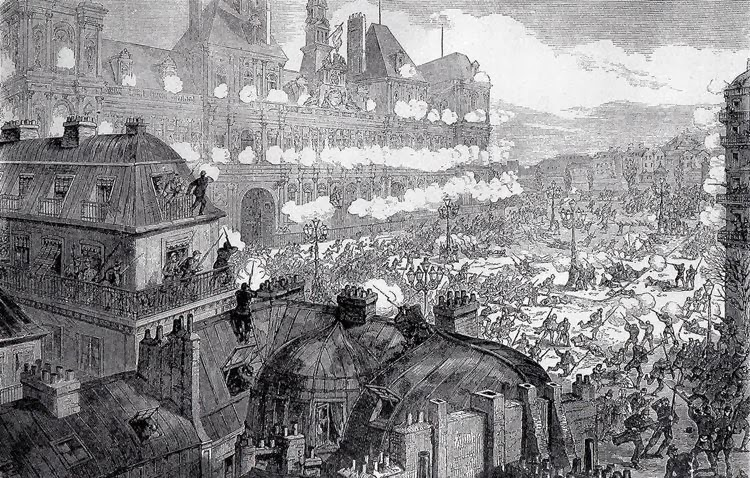
@RizomaSchool Top photos are from '68, bottom are from the Paris Commune of 1871, the gold standard of French civil unrest/revolution (other than *the* Revolution I guess)