THE COBRA EFFECT 🐍
During the British Raj, officials grew concerned about the rising number of venomous cobras in Delhi. To tackle the issue, they introduced a bounty for every dead snake.
At first, the policy seemed successful, many cobras were killed.
Una presentadora multimillonaria exige a Elon Musk que done su fortuna... Quedo destrozada con la respuesta que le dieron.
«¿Qué hace Elon Musk con su dinero? Va a ser trillonario. Podría salvar países enteros. ¿Lo va a hacer? No. ¿Es que crees que vas a vivir para siempre, Elon?
—Un par de apuntes, Joy. Menos del 0,1% del patrimonio de Elon es dinero en el banco. El 99,9% restante son acciones y propiedad de sus empresas: SpaceX, Tesla y otras.
Esas empresas han creado más de 160.000 empleos directos, 600.000 indirectos y 500.000 más inducidos. Al menos 1 millón de personas en el mundo ponen pan en su mesa gracias a ellas.
Tú, en cambio, tienes 30 millones de dólares. No has creado empleos. Y casi todo tu dinero está listo para gastarse.
¿Vas a vivir para siempre, Joy? ¿Por qué no regalas TÚ tu dinero? Con un tercio podrías alimentar a 3.000 personas un año entero.
¿Cuándo empieza tu donación?»
A Model Y driver started experiencing a medical emergency with chest pain mid-drive & called his son.
His son then remotely rerouted the car – which had FSD Supervised enabled – to the nearest hospital & let them know the vehicle was en route. ER staff were standing by on arrival.
Doctors later confirmed the quick reroute likely saved his life.
Elon Musk thinks the entire education system is built on a broken assumption.
That every student should learn the same thing. At the same speed. In the same order. At the same time.
Musk: “Everyone goes through from like 5th grade to 6th grade to 7th grade like it’s an assembly line. But people are not objects on an assembly line.”
The model was designed for a factory economy. Standardized inputs. Predictable outputs.
That economy is gone. The assembly line is gone.
But the education system still runs on its logic.
A student who masters algebra in two weeks sits through eight more weeks because the calendar says so. A student who struggles gets dragged forward because the schedule doesn’t wait.
Neither is being served. Both are being processed.
Musk: “Allow people to progress at the fastest pace that they can or are interested in, in each subject.”
AI doesn’t teach a classroom. It teaches a student.
One at a time. Every time.
It skips what a student already knows. It finds where they’re stuck and approaches it from a different angle.
It adjusts in real time. Not at the end of a semester when the damage is already done.
A student obsessed with basketball learns fractions through shooting percentages. A student who builds in Minecraft learns geometry through architecture.
The subject doesn’t change. The entry point does.
No teacher with thirty students can do this. Not because they lack skill.
Because the math doesn’t work.
AI doesn’t have that constraint.
Musk: “You do not need to tell your kid to play video games. They will play video games on autopilot all day. So if you can make it interactive and engaging, then you can make education far more compelling.”
The brain isn’t broken. The format is.
Kids learn complex systems and strategic thinking for hours voluntarily. Then walk into a classroom and can’t focus for twenty minutes.
That’s not a discipline problem. That’s a design problem.
Musk: “A university education is often unnecessary. You probably learn the vast majority of what you’re going to learn there in the first two years. And most of it is from your classmates.”
Four years. Six figures of debt.
And the real value comes from the people sitting next to you. Not the institution charging you.
The degree doesn’t certify knowledge. It certifies endurance.
Musk: “If the goal is to start a company, I would say no point in finishing college.”
The system was built to train employees. If you’re not trying to be one, it has nothing left to offer you.
Every lecture. Every textbook. Every curriculum. Now available instantly. Personalized to any learner. Adapted to any pace.
The question isn’t whether the old model survives.
It’s how long we keep forcing students through it while the replacement already exists.
MILTON FRIEDMAN ONCE HELD UP A PENCIL AND EXPLAINED THE ENTIRE FREE MARKET IN 2 MINUTES
"There's not a single person in the world who could make this pencil."
The wood came from Washington. The graphite from South America. The rubber from Malaya. The brass ferrule, the paint, the glue: he had no idea where they came from.
"Literally thousands of people cooperated to make this pencil. People who don't speak the same language, who practice different religions, who might hate one another if they ever met."
"There was no commissar sending out orders from some central office. It was the magic of the price system."
"When you buy this pencil, you are trading a few minutes of your time for a few seconds of the time of all those thousands of people."
One of the greatest explanations of capitalism ever recorded.
Elon Musk on why the smartest people drop out of college:
"You don't need college to learn. Learn stuff. Everything is available basically for free. You can learn anything you want for free. It is not a question of learning."
Musk explains what college actually provides:
"There is a value that colleges have, which is seeing whether somebody can work hard at something, including a bunch of annoying homework assignments, and still do their homework, and kind of soldier through and get it done. That's the main value of college. And also, you probably want to hang around with a bunch of people your own age for a while instead of going right into the workforce. So I think colleges are basically for fun and to prove you can do your chores. But they're not for learning."
On hiring at his companies:
"There is a requirement of evidence of exceptional ability. I don't consider going to college evidence of exceptional ability. In fact, ideally you dropped out and did something. Obviously, Gates is a pretty smart guy, he dropped out. Jobs was pretty smart, he dropped out. Larry Ellison, smart guy, he dropped out. Obviously not needed."
Musk shares how education should work:
"Generally, you want education to be as close to a video game as possible. Like a good video game. You do not need to tell your kid to play video games; they will play video games on autopilot all day. If you can make it interactive and engaging, you can make education far more compelling and far easier to do."
He challenges the current system:
"You really want to disconnect the whole 'grade level' thing from the subjects. Allow people to progress at the fastest pace that they can, or are interested in, in each subject. It seems like a really obvious thing."
Musk criticizes traditional teaching:
"Most teaching today is a lot like vaudeville. Somebody's standing up there lecturing to you. They've done the same lecture several years in a row. They're not necessarily all that engaged. That lack of enthusiasm is conveyed to the students; they're not very excited about it. They don't know why they're there. 'Why are we learning this stuff?' We don't even know why. A lot of things people learn, probably there's no point in learning them, because they never use them in the future."
On whether university is necessary:
"A university education is often unnecessary. That's not to say it's unnecessary for all people. But I think you learn about as much, the vast majority of what you're going to learn there, in the first two years. And most of it is from your classmates. If the goal is to start a company, I would say no point in finishing college."
Musk started his own school for his kids:
"I created a little school. It's small, only 14 kids now, and it'll have 20 in September. It's called Ad Astra, which means 'to the stars.'"
He explains what makes it different:
"There aren't any grades. There's no grade one, grade two, grade three. Not making all the children go in the same grade at the same time, like an assembly line. People are not objects on an assembly line. That's a ridiculous notion. Some people love English or languages. Some people love math. Some people love music. Different abilities at different times. It makes more sense to cater the education to match their aptitudes and abilities."
Musk shares a key principle:
"It's important to teach problem-solving, or teach to the problem, not to the tools. Let's say you're trying to teach people about how engines work. A more traditional approach would be: 'We're going to teach you all about screwdrivers and wrenches. You're going to have a course on screwdrivers, a course on wrenches.' This is a very difficult way to do it."
He offers a better approach:
"A much better way would be: 'Here's the engine. Now let's take it apart. How are we going to take it apart? Oh, you need a screwdriver, that's what the screwdriver is for. You need a wrench, that's what the wrench is for.' And then a very important thing happens: the relevance of the tools becomes clear."
The result:
"It seems to be going pretty well. The kids really love going to school. I think that's a good sign. I hated going to school when I was a kid; it was torture. The fact that they actually think vacations are too long, they want to go back to school. Weird, I know."
Musk reframes what education really is:
"If you think about it, what is education? You're basically downloading data and algorithms into your brain. And it's actually amazingly bad in conventional education. It shouldn't be this huge chore. The more you can gamify the process of learning, the better."
When Elon Musk hilariously trolled the BBC interviewer 😂
Elon Musk: "Do you like BBC?"
Interviewer: "I see what you are doing, I am not going to respond to that"
Elon Musk: "Surely you like BBC, come on"
Interviewer: "I am not engaging"
Jeff Bezos just identified the most expensive bureaucratic failure in the American economy.
It fits in one sentence.
Bezos: “Why does it take months and months and months to get a building permit? It doesn’t make any sense.”
It doesn’t make any sense because a building code is not a judgment call.
It is an algorithm. And algorithms should be executed by machines.
Bezos: “Miami should have an AI application that reads your building permit for a new house or a new building and it should give you a yes or a no in ten seconds.”
Ten seconds. Not three months. Not six weeks. Not whenever the reviewer clears their backlog.
Bezos: “If the answer is no, it should tell you the six things you have to change to get a yes.”
No ambiguity. No interpretation. No bureaucratic delay dressed up as due diligence.
Just a deterministic feedback loop compressing months of institutional friction into a single automated decision.
We are competing against sovereign adversaries deploying gigawatt data centers and scaling physical infrastructure at a pace that does not stop to ask permission.
And we are losing ground to countries that never needed to.
The AI arms race is not only fought in data centers. It is fought in the gap between when someone decides to build something and when the government allows it.
Every month this system runs on biological speed is a month that cannot be recovered.
The governments that integrate AI into their core civic functions will trigger a wave of physical development the old world could never produce.
The ones that refuse will still be reviewing the same forms a decade from now.
While the cities that said yes are already living inside the future they built.
The bottleneck was never ambition.
It was always the man holding the rubber stamp deciding when ambition was allowed to begin.
And the stamp is just a rubber version of the algorithm that should have been running this whole time.
🚨 BOOM! Trump’s White House just DROPPED the receipts, old video of Chuck Schumer DEMANDING voter ID to stop fraud!
Schumer in 1996: “Everywhere people go, they’re asked for Social Security or driver’s license! This is anti-fraud!”
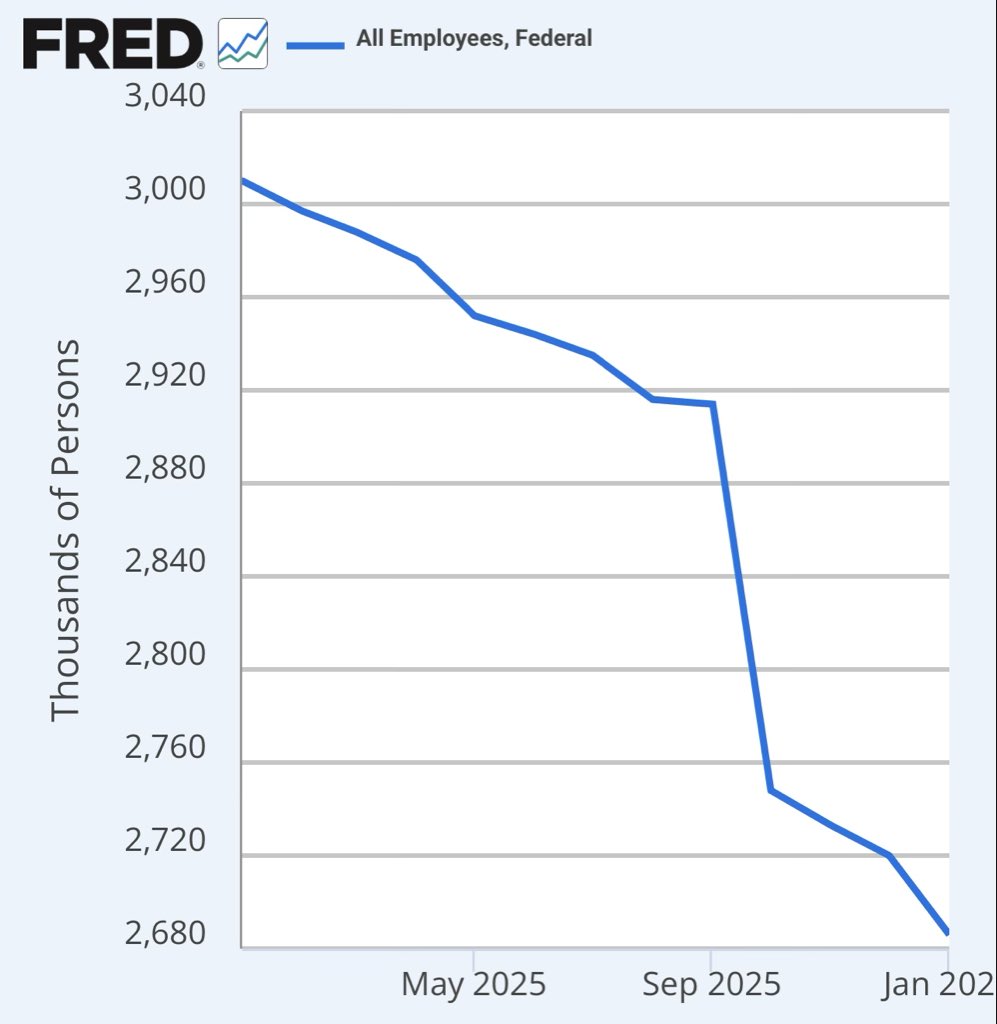
Over 330,000 Federal employees have been fired, resigned, or retired last year and were not replaced.
The Federal workforce is now at its lowest level since 1966.