Don't be too good at finding setups when they aren't working. The best pattern recognition in the world is a liability in a tape that isn't paying. Sometimes the most profitable skill is knowing when to turn the screens off.
When you're going through a tough time or feel like you're getting all the bad breaks, don't ask, "Why is this happening to me?"
Ask, "What can this do for me?"
What can I learn from this? What opportunity might this create? What door could this be opening that I just can't see yet?
And if it feels like every door is closing, then ask yourself one last question: What's the lesson?
There's always a lesson. If you learn from it, the setback wasn't a waste. It was a gift.
Stop being ungrateful when you get gifts in disguise. Say, thank you teacher.
I used to hate/dread bad or ugly opens in the stock market, now I try and simply see them for what they are. A simple cleansing where I do more watching than trading.
For starters if a stock opens below a stop you get OUT. Obey/adhere to all stops and your risk management plan period. Then I go through watchlists and see what stocks bounced immediately on the open, if any.
When a stock opens 'in the hole' and immediately bounces it at least says there is demand in the short run. Then I want to see how does the stock trade relative to the market. If the SPY/QQQ keeps going lower and a stock holds its intraday lows it gets my attention.
I'm also watching how we close and where volume runs and of course if the market opens down and a stock I'm stalking opens quiet and then proceeds to breakout I take that as a sign of exceptional strength.
As the market opens higher this morning, it's important to remain disciplined and avoid chasing an early rally—especially following a significant down day and a weak close on Friday.
One of the most common mistakes investors make is assuming that the first bounce marks the start of a sustainable advance. In many cases, the initial rally is simply an oversold reaction or what traders refer to as a "dead cat bounce."
Historically, after a sharp decline, I prefer to give the market time—often until midweek or even the end of the week—to see whether buyers are truly stepping in with conviction. Very often, after the first reaction higher, the market resumes its downtrend, undercuts the recent lows, and additional damage occurs.
Patience and selectivity are critical. Let the market reveal its true character before becoming overly aggressive. Focus on preserving capital, managing risk, and allowing the price action to confirm whether the move is the beginning of something meaningful or merely a temporary bounce within a larger decline. https://t.co/JXzFFTmMtn
After a market correction is over, don’t be too quick to sell the stocks that rally first and show the strongest relative strength.
That is not always “risk management.”
In many cases, it actually increases the risk of missing a potentially massive winner.
Even today, I still make this mistake sometimes.
Why?
Because the stocks that recover first after a correction are often not just random bounce plays.
They are usually the names where money is flowing back first.
They show relative strength before the crowd fully realizes the market has turned.
They may be the next leaders of the new uptrend.
Real risk management is not selling a strong stock simply because it has gone up.
Real risk management is managing position size, knowing your invalidation level, and watching whether the price action actually breaks down.
If a stock remains strong, money is still flowing in, and the fundamentals and narrative are still intact, selling too early can actually be poor risk management.
So the key is not “never sell.”
The key is:
Don’t sell the strongest market leaders too easily just because you are afraid of giving back existing profits.
Many times, what truly changes your trading return curve is not taking small profits again and again.
It is whether you can sit through the right leaders long enough during a real market uptrend.
Never quit. Some trading and life thoughts:
Keep drawdowns small enough to stay in the game.
When your edge is working, playing too small is an error like drawing down too much. Win bigger.
Don’t style drift. Master your style.
Jumping from system to system is how traders spiral.
Be proactive about achieving your life goals and define those goals. Get after it! 💪
...and don't forget to enjoy yourself, life is short.
Moving averages are not support. They are math.
Scot1and, a trader and educator who builds his entire framework around price and auction activity, breaks down why this distinction is critical. A moving average has no participants behind it. A price congestion zone does — real volume, real transactions, real memory baked into the chart. When those two things coincide and the moving average holds, traders credit the indicator when they should credit the zone. When they diverge, traders get hurt holding a level that was never real to begin with.
Real support is where the market has already done business. That is the only line worth watching.
We can't ignore the timeless principle of relative strength. I was reviewing this week pullback price action of the top 100 stocks by YTD percentage gain on @Barchart, and the results are incredible how some do not even revisit their 10-MA,while most don't violate their 20-MA.
Top 100 Stocks
https://t.co/ptxVQdIXkP
What I’ve found helpful to hold for bigger moves:
(Fully prepared for this to top the market 😂)
1. Turn off your PnL. Absolutely no reason to be staring at it everyday. Will only cause you to make emotional decisions over objective ones. I just track my positions in charting software apps and only log in to my broker when I need to do something.
2. Weekly charts. Once I have decent cushion I try and track my positions using mostly weekly charts. They smooth out the noise and make healthy pullbacks look less violent. Also much easier to see the bigger trend and find it makes it easier to stay objective.
3. Get off the screens. Once I’m heavily invested and have cushion I try to disengage a little from the markets. A stock is going to do what it wants whether you check it 2 or 50 times throughout the day. But just like the snack cupboard, the more you look the more likely you are to do something you know you shouldn’t.
4. Give them a little wiggle room. Once I have significant cushion I try to give them the benefit of the doubt. So if they crack a key MA or price level I like to give them chance to reclaim it. So if they break it intraday I try and wait until the close to see if they recover. If they break it midweek, I try to give them until the end of week.
Some discretion here, if they break hard and 20% below the key level then that’s different to 5-10% for example.
Sometimes it won’t work and you’ll sell a little lower than you’d like, but rarely significantly lower. A lot of other times it will be a shakeout and they’ll recover.
5. If a stock is doing nothing wrong then leave it alone.
SNDK a great example from the last run from 1/2-1/30. The entire leg up it just rode the 5ema. In cases like this I leave them alone until I see a change of character, in this case either a break of the 5ema or an upward acceleration away from it.
6. Accept you’ll never sell at the top. Another reason why staring at PnL isn’t helpful. You’ll always drawdown off highs, and that’s fine because it’s not the goal anyway. The goal is to catch the meat of the move and to make significantly more than your average loss over a long period of time.
Process over outcome. The goal should be to follow your process as strictly as possible. The money is just a side effect of doing this.
I don’t typically trim positions as I don’t see the point in taking a ~2-5R gain from a trim when my goal to to maximise the few big outliers each year. And it also doesn’t help me to hold for longer.
But if trimming helps you to hold for a bigger move and you’ve ran the numbers for your strategy then that can be helpful as well.
Longer post on 'IFs' and 'strategic thinking'...
Most of the time I'm doing my work/analysis my co-pm and I are looking for scenario's that would get us aggressive i.e. where we ask ourselves what we think should happen with a stock/trade as knowing that ahead of time IS everything.
The longer I've done this and the more I've tried to help people the more I think this is underrated. It is also why piggybacking successful traders never works because you can give someone an idea but never conviction as convictions cannot be given, they are only earned through time & experience.
This is also why I think a background in sports/games is sometimes a good backdrop for trading & speculation. I didn't play much baseball but I've watched/played enough to know the best hitters (Ted Williams wrote the bible on hitting) know their zone. So when they get a favorable count then they start looking to smash the right ball in the right zone. Selective aggressive is what it's all about, PTJ used a similar analogy with boxing in the interview I reposted.
I often say 'if xyz happens' I'll do 'abc' and it doesn't happen. Then people think I don't know what I'm doing because it didn't happen, which I find hilarious as I don't care (I literally had people posting/critiquing PTJ video I reposted this week, talk about arrogance and lack of respect). The point isn't about being right but knowing IF your strategic scenario plays out you are ready in real time to act/move. You don't need someone to tell you what to swing at because you are ready ahead of time.
I played O-line for years and called any changes to blocking out at the line and I could usually tell based on the call we had and the front we were facing in certain scenarios if we were gonna get a first down or not. I wasn't always right but again if you know what should happen given a set of circumstances you can't predict the future perfectly but you don't need to in order to have an edge, which is what this game is all about.
Here's my current working example. We've had a face ripping rally off the lows that most people seem to be hating or fading. Meanwhile there are a number of highly liquid names that have doubled in short period of time ($AAOI, $ARM, $AMKR, $BE, $AEHR, $MRVL, $INTC just to name a few). I've been screening the market every day for going on 17 years and I don't know that I've seen this many names quite like this. I'm pretty long but if this market digests and some of these names setup pivots/flags I'm gonna get scary long. That's my 'IF' scenario currently. Closest thing to this I've seen was the stay at home type stocks off the C19 lows, they all started setting up through the summer and working. Will it happen? Probably not, but if it does...I'm ready.
Have a really great weekend if you read this far!
As a swing trader, I shouldn’t take unrealized gains at face value. Going into a momentum-style swing trade, I should already be committed to trailing moving averages with ~50% of my remaining position.
Assuming the 10DSMA is the standard trail, by the time price closes below it, price has usually already retraced 2–3 APTRs from local highs—anywhere from 15–30%, depending on the stock’s volatility in most instances.
That said, whatever my current unrealized gain is, I should be mentally discounting it by ~30% at all times. After reconditioning myself to view unrealized gains as a 70/30 split between me and the market, I became less emotionally attached to the big number that isn’t really mine.
If you think you can outsmart moving averages and don’t cut the market in on your profits, you’ll end up selling early and greatly underperforming over the long haul. If you do the deal and share that 30% with the market, it’ll reward you handsomely.
A meaningful number of setups have emerged from constructive bases, yet recent breakouts have been accompanied by an elevated rate of pivot sloppiness—an indication that follow-through remains inconsistent.
The sharp rise in oil prices underscores a lack of progress on the geopolitical front with Iran, adding another layer of uncertainty.
While the market’s resilience has been impressive and history is on the side of the bull when dealing with military conflicts, leadership has yet to deliver the kind of broad traction needed to warrant aggressive exposure. As such, I continue to approach this environment with measured caution.
There are certainly stocks I find compelling—names like $AEHR, $ARM, $AMD, $SPHR $MU, and $BE (some of which I currently own)—but many are extended beyond optimal entry points.
As always, patience and discipline are key, guided by my two core rules: No forced trades, no large losses.
https://t.co/JXzFFTmMtn
Start thinking of yourself as an elite trader.
In everything you do, do what an elite trader would.
Sleep like an elite trader.
Prepare like an elite trader.
Review like an elite trader.
Collaborate like an elite trader.
Build technology like an elite trader.
Eat like an elite trader.
Execute like an elite trader.
Risk Manage like an elite trader.
Exercise like an elite trader.
Research like an elite trader.
Build a PlayBook like an elite trader.
Be open-minded like an elite trader.
Think of yourself as an elite trader.
@MarkRitchie_II Hi Mark, relatively new trader here. How do you deal with FOMO and not try to cheat your way in the leading/strong stocks that just shoot their way up? Do you just get that kind of discipline & patience from having years of being in the market?
So many big bases breaking out. Wait for the first continuation setups to emerge. They will come as:
-1st touch dip buys of the 5, 10 and 20 DSMAs
-High tight flags & high tight pivots (10-20 bars wide)
-Classic continuation flags (20-40 bars wide).
No fomo allowed!
Reminder that the traders you admire have been through every single thing you're going through right now.
The drawdowns. The doubt. The stretches where nothing works. The wondering if you're cut out for this.
The difference isn't that they didn't feel it. They felt all of it. They just didn't quit during it. Dont quit. Your time is coming.
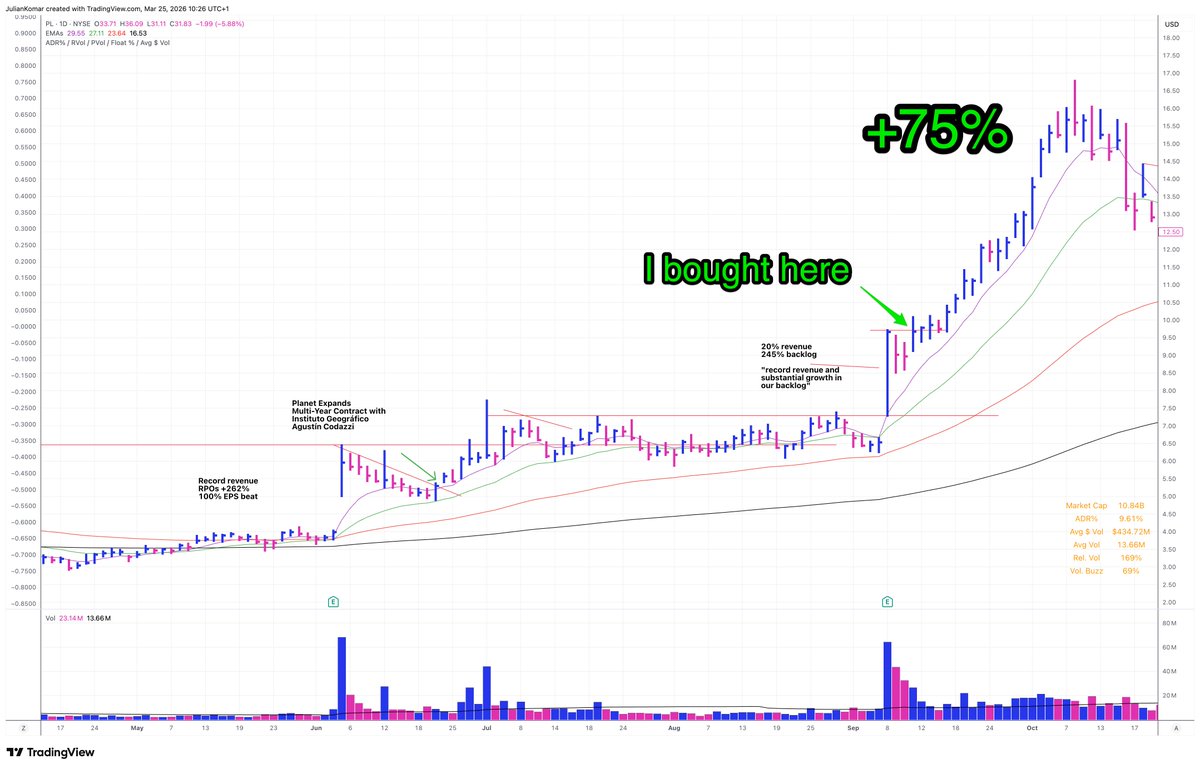
Most #traders chase the #gap. I wait after it.👇
Late-gap entries work better for me than trading the initial gap — and there’s a simple reason:
The first gap shows interest.
The setup after it shows commitment.
Here’s how I approach it:
1. Confirmation first: A big gap tells me institutions are buying. But I don’t need to be first. I want to see if the stock can hold those gains and build structure.
2. Let weak stocks fail: Many gap-ups fade and never recover. Good. That’s free information. I remove them and focus only on the ones that stay strong.
3. Wait for structure: The best ones pull back, tighten up, and go sideways for a few days or weeks. That’s where volatility contracts and risk becomes clear.
4. Define the entry: I’m not guessing the top or chasing strength. I enter when the stock starts to follow through from that tight area.
5. Control the risk: These setups often allow 3–5% stops. That’s exactly what I want — small risk with the chance for a big move.
6. Align with real demand: If a stock gaps, holds, and continues — that’s not retail. That’s institutional support.
7. Better risk-reward: I don’t need to catch the first move. I want the bigger move that comes after the setup.
8. Repeatable process:
Scan for big gap-ups → track them daily → wait for structure → execute when it’s ready.
Not every gap-up becomes a winner.
But the ones that build tight structure after the gap…
are often the next leaders.
These patterns repeat.
I trade them again and again.
I’ve taught this process to thousands of traders.
You can learn it too.