Product at @StartaleGroup. Formerly @nansen_ai @coinhako @Visa @MaecenasArt @Microsoft @HP. @Reforge alumni. Exploring crypto and AI, one day at a time.
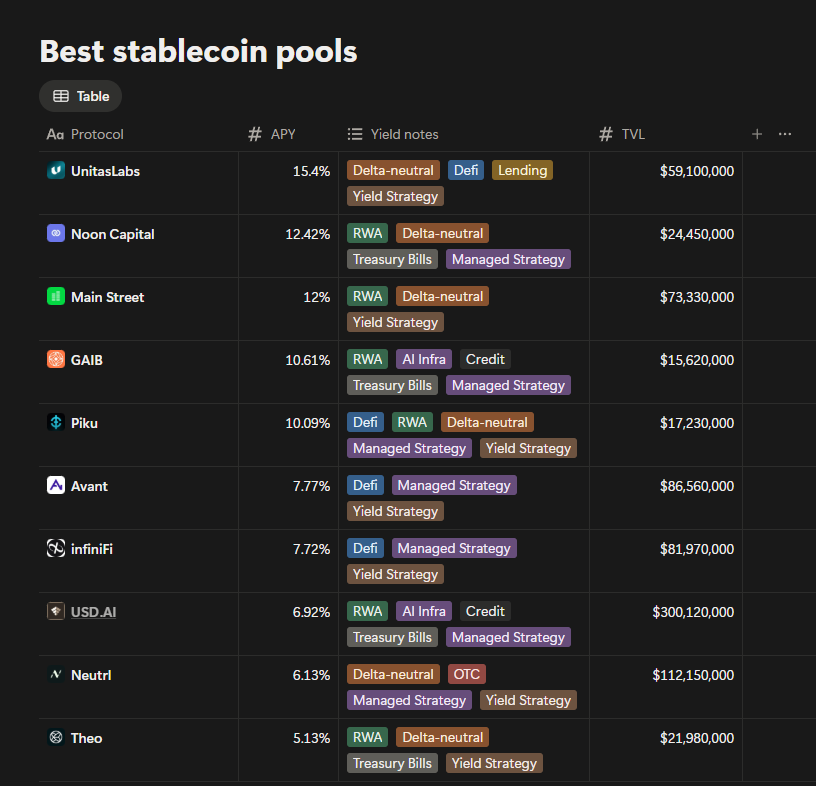
Here's your weekly snapshot of the best stablecoin yield opportunities listed on Stablewatch ($10M+ in TVL)
Data from @stablewatchHQ ↓
• @UnitasLabs $sUSDu – 15.40% APY
Yield comes from a basket of market-neutral strategies, including funding rate capture, lending, trading fee accrual, and JLP yield capture.
• @noon_capital $sUSN – 12.42% APY
Yield comes from capital deployed across delta-neutral strategies and RWA-backed assets.
• @Main_St_Finance $msY – 12% APY
Yield comes from a delta-neutral options strategy on the CME, with part of the yield directed into an insurance fund.
• @gaib_ai $sAID – 10.61% APY
Yield comes from RWA exposure, including treasuries and AI infrastructure financing, with returns generated from borrower interest payments.
• @PikuFinance $USP – 10.09% APY
Yield comes from underlying USD stablecoins deployed into DeFi strategies and other yield-generating onchain/offchain assets.
• @avantprotocol $savUSD – 7.77% APY
Yield comes from managed strategies that allocate reserves across chains and protocols.
• @infinifilabs $siUSD – 7.72% APY
Yield comes from onchain DeFi operations used by the protocol to generate returns.
• @USDai_Official $sUSDai – 6.92% APY
Yield comes from RWA exposure, including treasuries and AI infrastructure financing, with returns generated from infrastructure borrower interest payments.
• @Neutrl $sNUSD – 6.13% APY
Yield comes from a portfolio of liquid stablecoins, yield-bearing assets, delta-neutral strategies, and hedged OTC positions.
• @Theo_Network $sthUSD – 5.13% APY
Yield comes from a delta-neutral gold carry strategy using tokenized gold exposure, short gold futures, and T-bill collateral.
Which protocols are you using?
⚡️FIRST REAL-TIME ON-CHAIN U.S. TREASURY TRADE SETTLED IN USDCx
Tradeweb executed the first real-time on-chain U.S. Treasury trade settled against USDCx on July 1. Trade size was not disclosed.
Franklin Templeton transferred a tokenized Treasury to Virtu Financial for tokenized cash over the Canton Network.
Six firms participated, including Digital Asset, Blockdaemon, and Societe Generale.
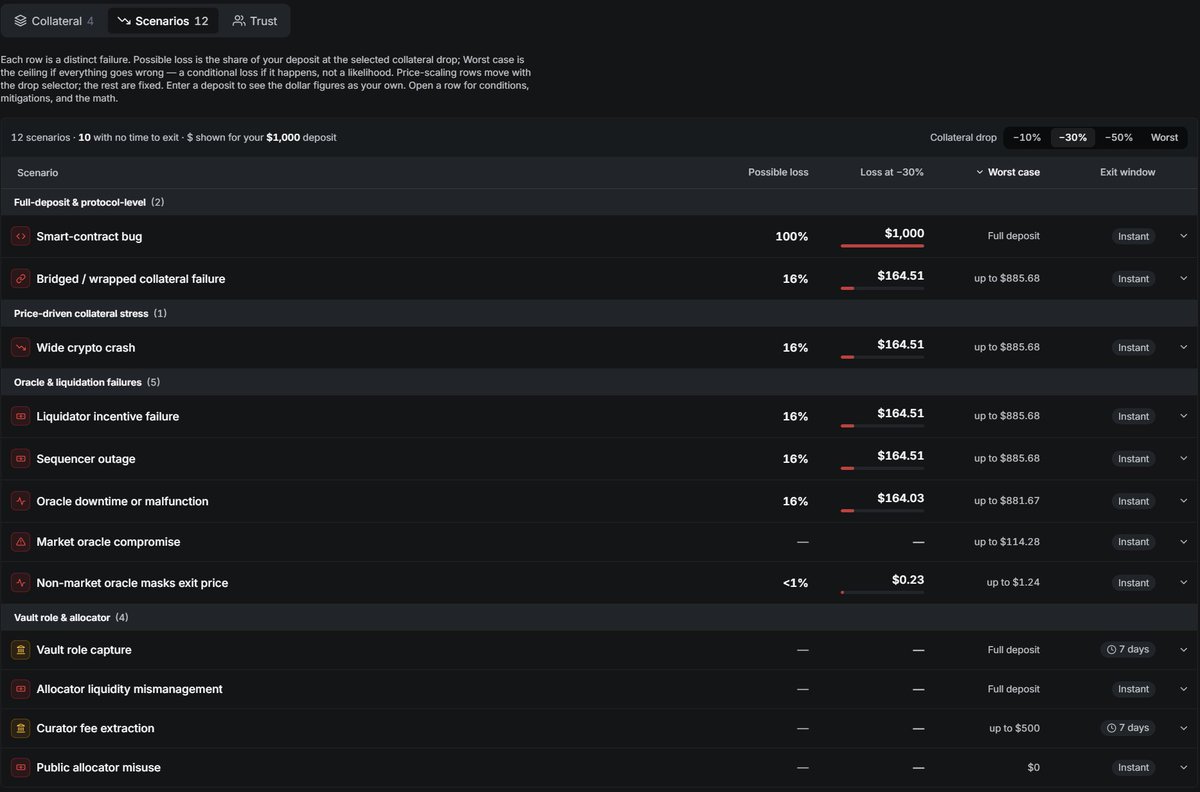
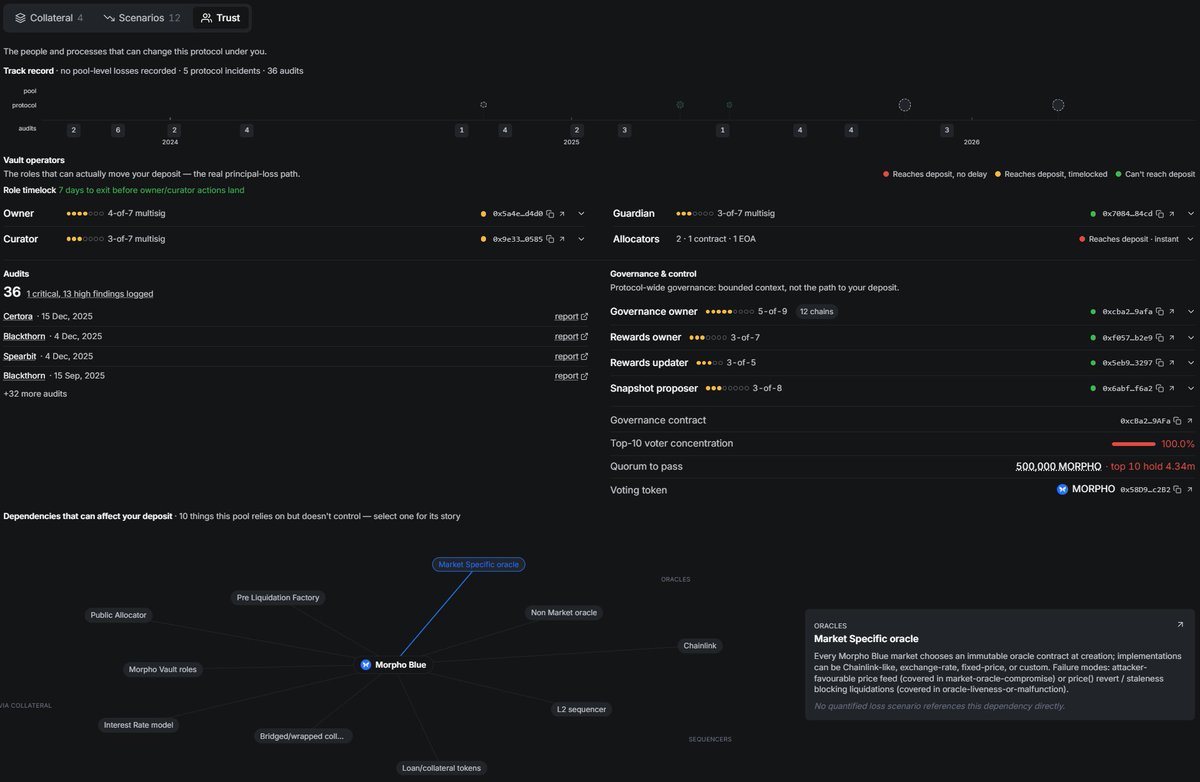
When you deposit into a vault, you're exposed to more than the vault itself: oracles, bridges, collateral, the sequencer, holders of vault roles.
Introducing risk scenario planning on DefiLlama.
* Maps every dependency that touches your deposit
* Models your max loss from each failure point
* Live now across 20 Morpho vaults
FABLE 5 CAME BACK NERFED.
We re-ran the July 1st version of Claude Fable 5 on BridgeBench.
The results are brutal:
Debugging: 86.2 → 25.9
Refactoring: 73.6 → 38.4
Hallucination: 75.9 → 61.7
The new guardrails are kicking in on way too many tasks and falling back to Opus 4.8.
This is not the model that got banned.
Anthropic owes everyone an explanation.
We heard you. And we agree.
In light of recent developments in physical media, GitHub is proud to announce that you can now obtain your public repo on CD-ROM.
Keep it. Lend it to friends. Pass it on to your children.
Your code is physically yours, forever. Until you lose it, let's be real.
Order yours today.
https://t.co/z041pdMH7h
I'm starting to hit $15-20k per month in token spend for engineering - just for myself.
Next month I'll be looking to implement the kinds of things that Brian is doing here at Coinbase.
Most likely switching to GLM 5.2 as default and only using frontier models for harder tasks.
I can probably get that $20k down to <$5k pretty easily.
I'm pretty sure we'll see everyone doing this.
It's just not financially viable to do everything with frontier models
This is another reason I think we'll see people move away from choosing a lab for their harness (CC or Codex) and move their code factories to in-house agents like @tryramp or agent labs like @DevinAI@FactoryAI@cursor_ai@AmpCode
The labs are not incentivized to drive down your token costs
I just got Gemma 4 26B A4B MoE model running fully locally with Hermes agent on an 8GB RTX 4060 and it's now backtesting trading strategies end to end, no hand holding.
If you’re a trader or work on Wall Street, you don’t want to miss this.
Yes. fully automated. No cloud. No APIs beyond market data.
# Here's what I did:
Setup:
- Model: Gemma 4 26B-A4B QAT (MoE), Q4_K_XL Unsloth's quant (link in the comments)
- Inference: llama.cpp (turboquant fork by @no_stp_on_snek link in the comments)
- Hardware: RTX 4060, 8GB VRAM + 16GB RAM only (with 50 other chrome tabs open)
- Context: 64K
llama.cpp turboquant flags:
-m gemma-4-26B-A4B-it-qat-UD-Q4_K_XL.gguf -c 64000 --cache-type-k q8_0 --cache-type-v turbo3 --port 8080
turboquant helps achieve high prefill and decode throughput for interactive sessions.
throughput with Hermes agent:
decode: 25+ tokens/sec
prefill: 250+ tokens/sec
# Then I gave the agent one task:
Backtest a strategy:
- Buy when RSI crosses above 30
- Sell at +2% profit or -1% stoploss
- No overlapping positions
- Use Google stock via yfinance
- Generate a full HTML report with candlestick charts + signals
What happened next was wild. It didn't just write code, it ran the entire workflow itself:
Audited the environment (pip list, dependency check)
Hit a ModuleNotFoundError, multiple Python installs were conflicting
Ran where python to map every interpreter on the system
Manually selected the correct Python 3.13 path and re ran the script
Wrote a clean statevmachine backtester (strict no overlapping trades logic)
Patched a yfinance MultiIndex quirk that would've crashed the script
Built Plotly candlestick + RSI charts with buy/sell markers
Calculated win rate, PnL, and summary stats
Exported a polished single file HTML report. check the report at the end of the video or in the comments.
Biggest takeaway: local LLMs aren't just "chat assistants" anymore. They debug their own environment, write production code, and ship a finished deliverable on consumer hardware, for $0 in API costs.
If you're still calling local models "toys," you're already behind.
This is just the beginning.
Hermes agent just surpassed 1 trillion tokens in a single day on OpenRouter. Think about the scale of total token generation happening right now.
Disclaimer: This is not financial advice. Consult a professional before making any trading decisions.
Apple just made Docker Desktop optional on Mac.
And it is completely free.
This is apple/container. 26.5k stars no Github.
You can now run Linux containers natively on your Mac without installing Docker Desktop, without a background daemon hogging your RAM, and without paying $21 a month per developer for a commercial license.
Here is what it does:
→ Runs Linux containers as lightweight VMs directly on Apple Silicon using macOS 26 virtualization
→ Fully OCI compatible. Pull any image from Docker Hub, GitHub Container Registry or anywhere else
→ Written in Swift and optimised specifically for Apple Silicon. Faster and lighter than anything Docker Desktop does on Mac
→ Standard container CLI syntax. If you know Docker commands you already know how to use this
→ Push images you build to any standard container registry and run them anywhere
Docker Desktop charges $21 per developer per month for commercial use. Apple's version costs nothing and ships as open source under Apache-2.0.
Microsoft made Docker Desktop optional on Windows with WSL Containers last month.
Apple just did the same on Mac.
Docker is not going anywhere. But the era of paying for a GUI wrapper around containers on your own machine is quietly ending.
Repo here: https://t.co/uFJ867sul6
This is the most hilarious thing I saw and did today
Ran gemma-4-12B-coder-fable5-composer2.5-v1-GGUF locally with 8 GB VRAM at 20+ tok/sec
Anthropic's Claude Fable 5 launched June 9.
By June 12 it was banned. I can't access it. You can't either.
But here's the twist: I'm running a model trained on its chain of thought at 20 tok/s on my RTX 4060 8GB.
Locally. Offline. No cloud. No export control.
Enter: Gemma4-12B-Coder GGUF (Q4_K_M)
Base: Google's gemma-4-12B-it
Fine-tuned on verifiable Python CoT data:
- Primary: Composer 2.5 real reasoning traces (only passing solutions kept)
- Auxiliary: Fable 5 used to redo the hard cases Composer missed.
Every training example's reasoning led to code that actually ran. No hallucinated logic.
Llama.cpp flags:
-m gemma4-coding-Q4_K_M.gguf -cnv -ngl 44 -c 64000 -v
(huggingface model link in comments)
Flag breakdown:
-ngl 44 → offload 44 layers to GPU (tune this for your VRAM)
-c 64000 → 64K context window
-cnv → conversation/chat mode
-v → verbose output
The irony writes itself.
Anthropic spent weeks telling the world Fable 5 (mythos) is too powerful to release. Then released it. Then got banned from serving it, including their own researchers.
Meanwhile: a Gemma 4 12B fine tune, trained on Fable 5's reasoning, runs fully offline on my mid range consumer GPU
No API. No cloud. Just me and llama.cpp.
This is why local AI matters.
Check out the model's link in the comments. How's your experience been with this model?
in @ycombinator they have a playbook on how to get customers ASAP for your startup.
if you follow this, you’ll brute force your way to 100 customers, almost no matter what your product is.
Here it is:
1/ launch-max.
product hunt, hackerNews, devhunt, betalist, peerlist, indie hackers, etc. YC tells you to launch 3 times MINIMUM
2/ pull your competitor’s strongest backlinks and get yourself listed in the same places.
whatever article they have listed, you make a better version and ask the site to replace it (or supplement) with yours.
3/ WARM OUTBOUND.
Everyone knows about building in public. but you still need to capitalize on the 99% of leads who see your content but don’t come inbound
scrape everyone who likes your posts on Linkedin each week, check if they fit your customer profile, and message them.
you set this up to fire automatically with @origamichat (i dropped a prompt in the comments)
4/ find 20 to 30 ugc creators on tiktok / instagram in your niche. ask them to create content about your product, ideally from a fresh account.
pay them a fixed fee ($15–$30 per video) plus performance incentives ($1k for 1 million views, etc).
you can use @sideshift_app (best creators imo) and line up 20+ of these creators in 1 day
5/ when building in public, a video is 10x better than an image/text - spam use cases of ur product on X/Linkedin
6/ figure out where your customers actually spend time.
which slack/discord groups are they in? what newsletters do they open? which podcasts and accounts do they follow? pay those people for shoutouts
7/ there's a fresh trend on x basically every week. jump on the relevant ones and fold your product in (like i’m doing right now).
To find trends i just use Origami & search “Lead Gen/GTM posts that are viral on X” to find the best posts every week in my niche
Then, I will reply to those, quote tweet them, and use the formats that work myself
(that’s the secret to why my account has high engagement BTW - you can do this too)
---------
if you are doing all this every single week and DO NOT GIVE UP (launching, posting demos, contacting new customers)
I guarantee you will hit your customer goals. Then the game becomes retention.
will be posting 2-3 more growth hacks every single week
Get paid to wait
The Claude Code spinner might be the most watched line on Earth.
So I turned it into an ad marketplace.
Advertisers bid on it. You keep 50% of the money.
Install the extension → get cash from ads.
Introducing Kickbacks
i hooked my whoop to my work calendar to find which coworker gives me the most stress 🚨
thanks to fable, I reverse engineered whoop to pull per minute heart rate. nd matched spikes with cal events and attendees
I now have a leaderboard and I think about it daily.
few info masked for obvious reasons ;)
This is a super exciting release - Claude Fable 5 is the same underlying model as Mythos but with added safeguards. The benchmarks are great and it's SOTA on everything by a margin but I'll add that *qualitatively* also, this is a major-version-bump-deserving step change forward (imo of the same order as Claude 4.5 was in November), peaking especially for long problem-solving sessions on very difficult problems. You can give it a lot more ambitious tasks than what you're used to, the model "gets it" and it will just go, and it's never felt this tempting to stop looking at the code at all (but don't do this in prod!). The model still has quirks that people will run into and the safeguards are configured to be a little too trigger happy for launch, which can hopefully be tuned over time.
I feel a lot of things changing as working software increasingly comes out on a tap. The Jevon's paradox kicks in and I feel my own demand for software growing substantially. You can ask for anything - explainers, visualizers, dashboards, bespoke single-use apps (e.g. a full wandb that is hyper-specific just for your project), you can 10X your test suite, auto-optimize code, run giant research projects with custom HTML for the results, anything! "Free your mind" (Matrix ref). Really looking forward to all the things people build!
I think the challenge is that everyone can now build apps
But
1) almost nobody has distribution (like an audience), or
2) the money to pay for distribution (ads or UGC), or
3) the creative genius to get distribution for free (classically called guerilla marketing)
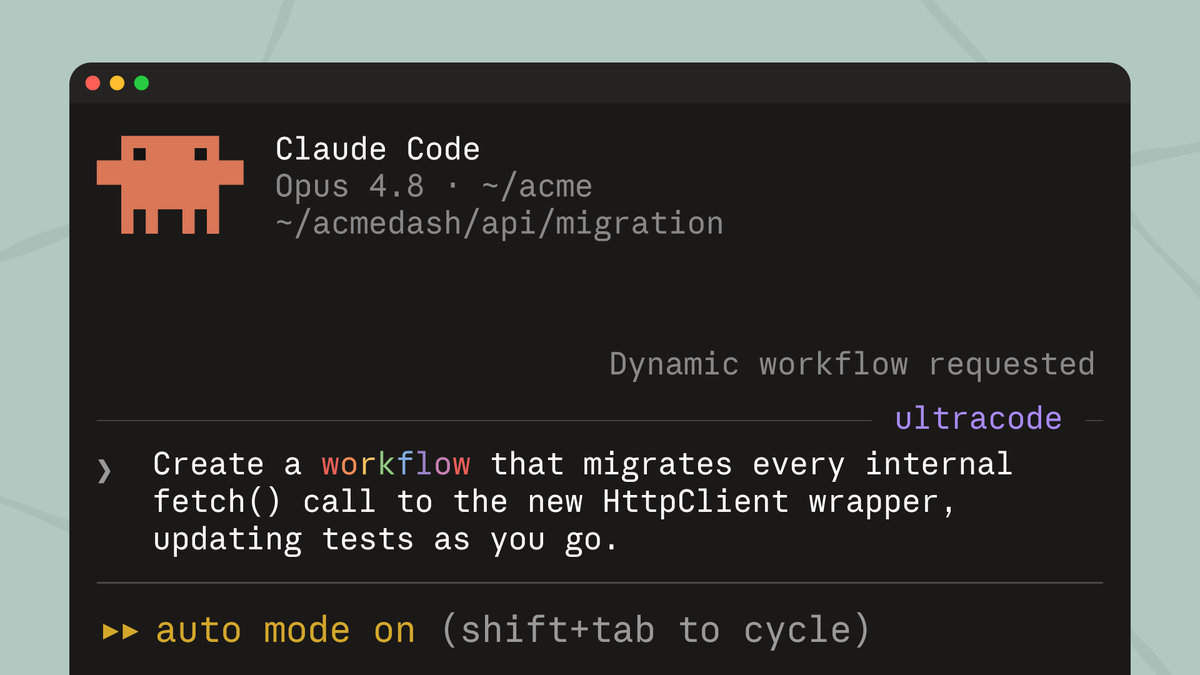
New in Claude Code (research preview): dynamic workflows.
Claude writes an orchestration script on the fly, then spins up a large fleet of coordinated subagents in parallel to take on your most complex tasks.
Use the word "workflow" in a prompt to get started.
€10,000 CASH BAN. €1,000 CRYPTO ID THRESHOLD. PRIVACY COINS DELISTED.
🇪🇺 The EU just published the rulebook for 2027 financial surveillance.
AMLR takes effect July 1, 2027.
All crypto exchanges must verify identity above €1,000.
Monero, Zcash, Dash banned from EU platforms entirely.
Meanwhile:
America proposes zero capital gains on Bitcoin held over 12 months.
UAE licenses crypto banks under VARA framework.
Europe sees crypto as risk to surveil.
America sees crypto as asset to incentivize.
Capital follows the jurisdiction.
We’ve shipped a security-guidance plugin for Claude Code that helps identify and fix vulnerabilities as you’re writing code.
Available for all Claude Code users. Install from the plugin marketplace (/plugins).