I share content on advanced endoscopy, clinical research and, sometimes, music. Posts in English and Spanish
-
Comparto contenidos sobre endoscopia avanzada, investigación clínica y, a veces, música. Publicaciones en inglés y español
As some of you may remember, this year I’m sharing my “CV of failures.”
Previous score: 3 failures – 0 successes.
Three months later, the balance has improved… modestly:
❌ 4 rejections (+1 unsuccessful grant)
✅ 1 acceptance (+1 paper published)
Still time for a comeback ⚽️
March feels like a good time to start my 2026 “CV of failures”: rejected grants, papers, ideas (https://t.co/1G9MveQHiO). It sounds like a joke, but it shows that every success hides a lot of effort. Current March score: Rejection 3 — Acceptance 0.
-
CV negativo: score trimestral
Our final review on CADx for colonic lesions is out! Not a typical narrative review, this is a practical guide for anyone questioning AI’s true value in colonoscopy, with clear insights on how to interpret CADx study results. Worth a read 👉
https://t.co/vMIYz5dHhu
Optical diagnosis of a juvenile polyp:
👉reddish or red-brown color
👉smooth to slightly granular surface with frequent erosions and adherent mucus
👉low pit density with broad/irregular crypt openings and prominent but regular capillaries.
NICE, JNET and Kudo do not apply!
Recently, a French study challenged the rectal location as a risk factor for SMIC contradicting findings, among others, from the classic Australian group study (Burgess, Gastroenterol2017). Now, see the Australian response in Gut. Is this a major takedown? https://t.co/lkhp90VGGn
New data in @endoscopyjrnl: 68.4% of postcolonoscopy colorectal cancers (PCCRC) may stem from missed lesions. Nearly 70% of PCCRCs could be preventable! Time to raise the bar for #Quality in #Colonoscopy 💪 @ESGE_news@aegastro doi:10.1055/a-2681-5642
This recent study in @GIE_Journal analyzed recurrence after pEMR. Only tubulovillous histology was associated with overall recurrence. But, 🧐 methodological issues. Other studies (Bobay GIE 2024; Tate GIE 2017) have identified size or HGD as risk factors https://t.co/AKII7nCZqf
Polyp from a patient with sessile serrated polyposis. Detected with TXI (A), delineated with acetic acid (B), injected for further delineation/resection (C,D), and resected with piecemeal cold EMR (E,F). Follow the @ESGE_news EMR guidelines for better practice!💪
This trial offers the first high-quality data to address this important clinical question 👋 🇪🇸🇪🇸🇪🇸We now look forward to the TRIASSIC study results, from The Netherlands, to be presented at UEGW 2025. 🤨
A Spanish study 🇪🇸 compared ESD and TAMIS for rectal lesions. Looking for solid data to discuss with your surgical colleagues? Follow the thread 👇🧵
--
Comparación entre DSE y TAMIS para el tratamiento de las lesiones rectales: ¿por fin una respuesta?
Today I've performed a colonoscopy on a patient because of a 3-mm polyp diagnosed in a CT scan. Please, remember that, in CRC screening, the ACR specifically recommends that ≤5 mm polyps detected at CT colonography should be ignored and not reported 👉https://t.co/WR01ITcg8o
Endosponge works even in complex cases of anastomotic leaks. This was a cavity with secondary trajectories (arrows) one of them 10 cm-long ending in the peritoneal cavity. With 9 exchanges we get a 15 mm-long good-looking cavity.
-
¡La terapia de vacío funciona!
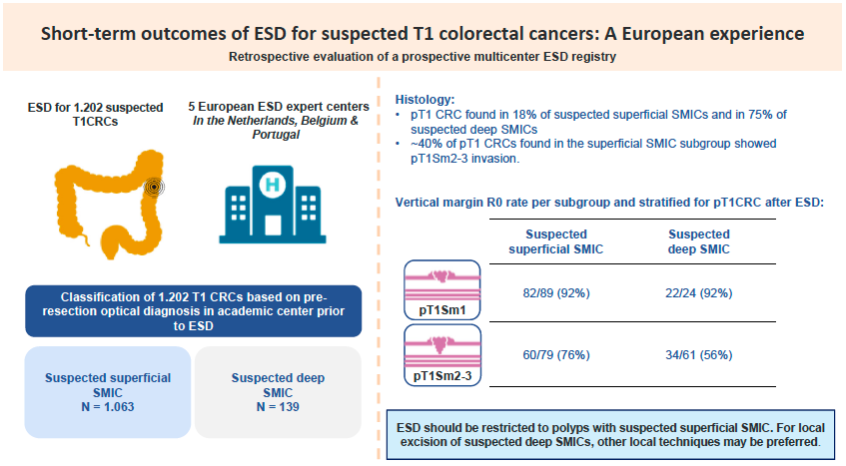
Should we try endoscopic therapy if we suspect SMIC? Look at this study in @GIE_Journal. 1202 patients treated with ESD:
➡️ superficial SMIC vs deep SMIC: en bloc 90% vs 62%; vertical margin R0 91% vs 55%
Suggestion:⛔️ESD if deep SMIC is suspected.
doi: 10.1016/j.gie.2025.04.003