Late notice perhaps, but we're back in the loving embrace of the City Pride on Tuesday next week (20th January)! Come along to chat with your fellow humans about working with humans and machines. https://t.co/QFsD0oqlTl
Heard something today that will stuck with me for a while:
Nowadays, People cannot tell the difference between “hate speech”, and “speech they hate”.
So true …
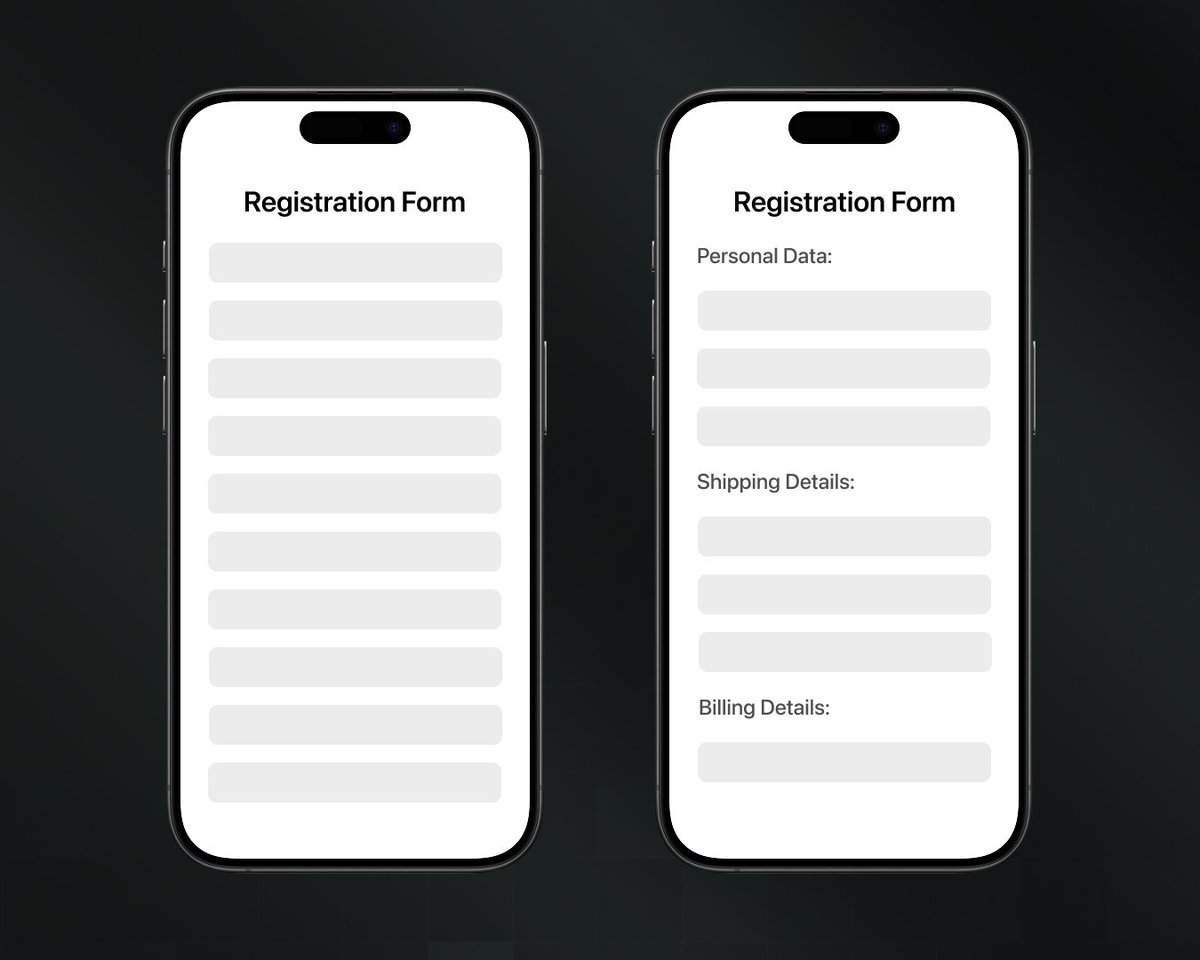
Look at these 2 UIs.
One of them will 100% outperform the other for one reason.
Miller's Law.
Here's how this psychological principle works & how to use it in your products:
@levelsio Spot on, left Italy 12 years ago because it was difficult to even imagine how my future would look like, how could I build a family there etc.
I was told that, of course, Agile is all about project management because that phrase appears in the Manifesto. The Agile Manifesto was written a quarter century ago. How agile would we be if we hadn't learned and adapted over those 24 years? Back then, everybody thought in terms of projects. The notion that a product focus was better appeared on the scene about 7-8 years ago, if I remember correctly, and it's now dominant. In fact, the Manifesto signatories that I know don't use "project" anymore. Similarly, we've learned to deliver work every few days—a "couple months" is now considered suboptimal. Very few orgs outside of megacorporations or government contractors create "comprehensive documentation," and they're not in the least bit Agile. So, the details have changed a bit, but the thinking that underlies the values and principles is still quite valid (and valuable). To me, an Agile shop embodies that core thinking. In any event, the Manifesto was never intended to be anything other than a snapshot in time. It was never intended to be fixed-in-concrete doctrine. To be Agile, you need to be—agile;
@temprlflux@marclou Out of curiosity is it enforceable if your provide capabilities in your product to get a refund (rather than just asking them to contact you)? Ie if you bypass our official (and self served) refund process you’ll be charged 50$.
Nobody wants data (particularly in tabular form). Everybody wants answers to questions. Don't foist the work of figuring out the answer onto your users. The best software gives them the answer, often with no data in sight. There's a middle ground of showing the graphs you need to get the answer, but that's still not providing an answer. Do the work. Don't present the wherewithal to do the work.
You can argue all day about what customers want or need, what they'll love or hate, but if you don't ask them, you know nothing. Guesswork has no place in product design (unless it forms the basis of a controlled experiment like an MVP that you'll validate with actual conversation & feedback).
Do you remember all those rushed changes that your developers implemented three years ago and how they complained about the design damage they caused to make that happen?
It's all still in the codebase. It never disappears. Only YOU forgot it, they still pay for it.
As for putting one of those mythical 10x programmers onto an average or low-performing team, local optimization doesn't work unless you're optimizing at a bottleneck/constraint. It's the speed of the entire system that matters. A trail runner in the middle of the pack who can run 4x faster than everybody else will slow down when they bump into the slower person in front of them. In a software-development system, what matters is when the last person crosses the finish line. Form a team comprised entirely of high performers and then put them at the bottleneck. Everywhere else, they're wasted. Better yet, put them to work teaching others how to become "high performing."
Certain workflows require sharing the entire screen, if the presenter has a much larger display than the audience it can be hard to see what is happening.
DeskPad creates a virtual mirrored display that is easily shareable and customisable: https://t.co/EWqGwNrBaj
@shashiwhocodes@catalinmpit If you are practicing trunk-based development and TDD it sure does show every little steps building up the solution gradually, it shows how you decomposed the problem, how you prioritised solving those, and the quality of your work.
@adymitruk TDD is a test-first approach, where refactoring is more about the internal design choices that do not alter behaviour, ie make code easier to read and maintain. Stats say we spend more time reading code vs writing it, and IME readable code is the result of continuous refactoring.
@adymitruk Have seen plenty of good developers practice it improperly. Not sure what your criteria are, but even if you have the perfect upfront design, TDD can still be really helpful to incrementally build and (more importantly) validate that design with very short feedback loops.