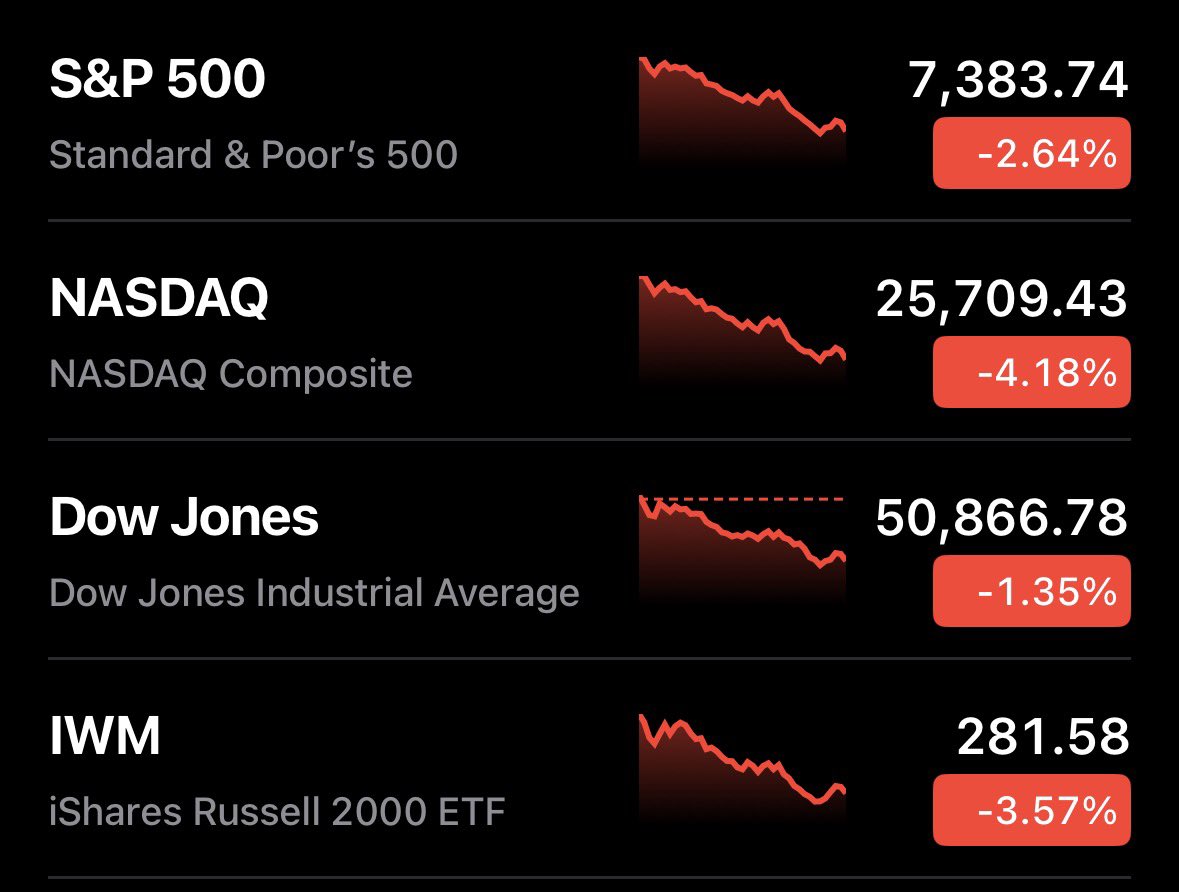
$1.3T erased in 2 hours on the S&P 500 today.
Opened strong and reversed hard. Tech and mega-caps led the selloff as profit-taking kicked in fast.
Friday's jobs data already killed rate-cut hopes. Today confirmed the 2026 rally is running on thin ice.
Source: @KobeissiLetter / Writers: Lucas, Oliver
The Netherlands was forced into taxing unrealized gains.
Their Supreme Court struck down the old Box 3 system in 2021. The previous framework assumed a fictional rate of return on your assets and taxed you on profits you never actually made. The court ruled it unconstitutional. That left a €2.3 billion annual hole in the Dutch treasury and no legal way to tax investment returns at all.
So parliament passed the replacement with 93 votes (needed 75). Multiple parties that voted yes publicly said taxing unrealized gains was not their preferred approach. They backed it because the alternative was collecting zero on investment returns indefinitely while refunding €1.2 billion in overpaid taxes from the old illegal system.
The math on what happens next is predictable. France ran this experiment for 20 years. Between 1988 and 2007, an estimated €200 billion in capital fled the country. 60,000 millionaires left between 2000 and 2017. The wealth tax cost France roughly €7 billion in annual fiscal shortfall, about twice what it actually collected. Macron killed it in 2018.
The Netherlands just approved something far more aggressive. France taxed total wealth at progressive rates starting around 0.5%. The Dutch version taxes annual paper gains at a flat 36%. Your portfolio goes up €100,000 on paper, you owe €36,000 in cash. You haven’t sold a single share. The government acknowledged this liquidity problem directly, which is why they exempted real estate and startup shares. Stocks, bonds, and crypto get no such protection.
The bill still needs Senate approval. Implementation targets 2028. But the EU has free movement of capital and people. Portugal, Malta, and Cyprus are a short flight away.
This matters for the US because unrealized gains taxation keeps surfacing in American policy proposals. California has a wealth tax ballot initiative that’s already triggered an estimated $2 trillion in capital flight threats. The Biden administration proposed taxing unrealized gains above $100M. The Netherlands is about to become the first country to broadly implement one at scale.
France spent 20 years proving the model fails. The Netherlands is about to rerun the experiment at 36%.
NEW: Dutch Parliament Member Michel Hoogeveen explains how the 36% unrealized capital gains tax, just passed by the House of Representatives, will work.
Here is a more detailed example:
Step 1. Starting position
You own 500 shares.
Value on Jan 1, 2028: €50,000
Value on Jan 1, 2029: €100,000
So the paper gain is:
€100,000 − €50,000 = €50,000 unrealized profit
You did not sell. But for tax purposes, that €50,000 is treated as income.
Step 2. Apply exemption
You are married, so you get a €3,600 exemption.
€50,000 − €3,600 = €46,400 taxable amount
Tax rate: 36%
€46,400 × 36% = €16,704 tax bill
That bill is due in May, even though you never sold anything.
Step 3. Market falls before you pay
Now suppose by May the shares drop in value.
New total value: €60,000
So your portfolio is no longer worth €100,000. It’s worth €60,000.
But the tax bill is still €16,704, because it was calculated based on the January 1 valuation.
Step 4. You must sell shares to pay tax
To raise €16,704, you sell part of your shares.
After paying the tax, you’re left with:
€60,000 − €16,704 = €43,296
Originally you had 500 shares.
Now you have 360 shares left.
You were forced to sell 140 shares.
140 ÷ 500 = 28% of your shares gone.
Step 5. What happened economically?
Before the correction:
Paper gain was €50,000.
After the correction:
Portfolio is worth €60,000.
Original cost basis was €50,000.
Real gain is only €10,000.
But you paid €16,704 in tax.
So instead of being up €10,000, you are now:
€43,296 − €50,000 = €6,704 below your original starting value.
You turned a €10,000 real gain into a €6,704 net loss.
And you lost 28% of your shares permanently.
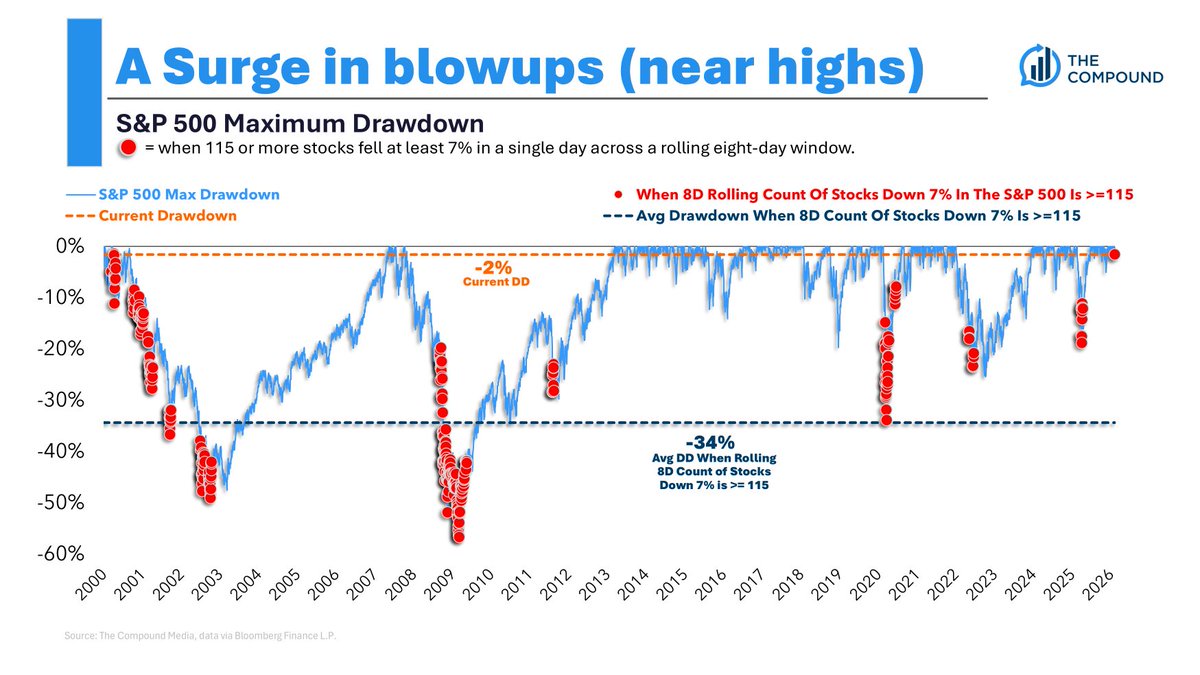
Wild market. We haven't seen anything like this since the dotcom bubble burst.
Over the last 8 sessions, 115 stocks in the S&P 500 have decline 7% or more in a single day.
The average drawdown when that happens is 34%. Right now we're 1.5% below the all-time high.
🇺🇸 PRESIDENT DONALD TRUMP JUST ANNOUNCED 34% RECIPROCAL TARIFFS ON CHINA 🇨🇳
🇺🇸 PRESIDENT DONALD TRUMP JUST ANNOUNCED 20% RECIPROCAL TARIFFS ON THE EUROPEAN UNION 🇪🇺
Bill Ackman is one of the best investors of our generation.
In the last five years, his fund returned 183% against 102% return of S&P 500.
Yesterday, I re-watched his 3 hours long interview with Lex Fridman.
Here are the 7 things you can't miss: 🧵
(No. 5 is critical)