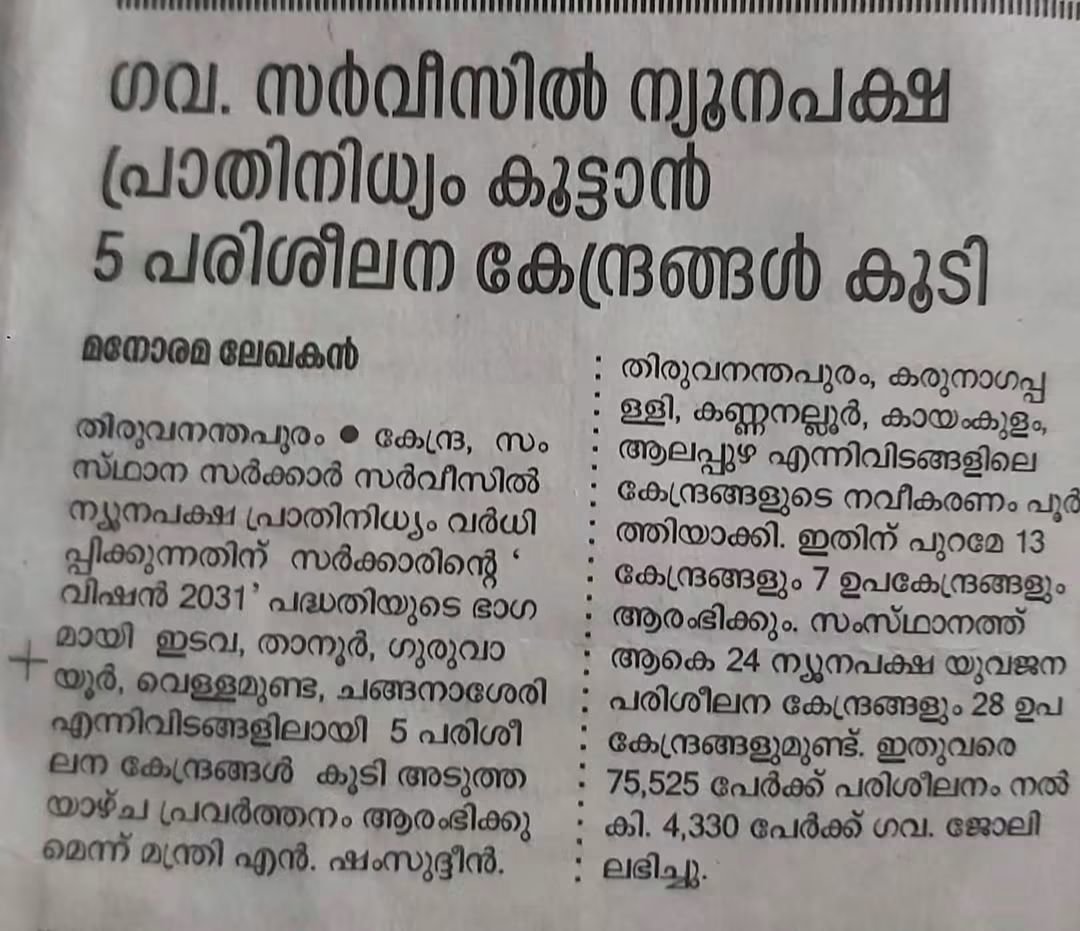
Five additional training centers for minorities in Kerala, on top of the existing 52 centers aimed at increasing the number of minorities in central and state govt jobs.
Thanks to the jobless poor Hindus in Kerala who vote for Congress and Communists and make this possible 👏👏
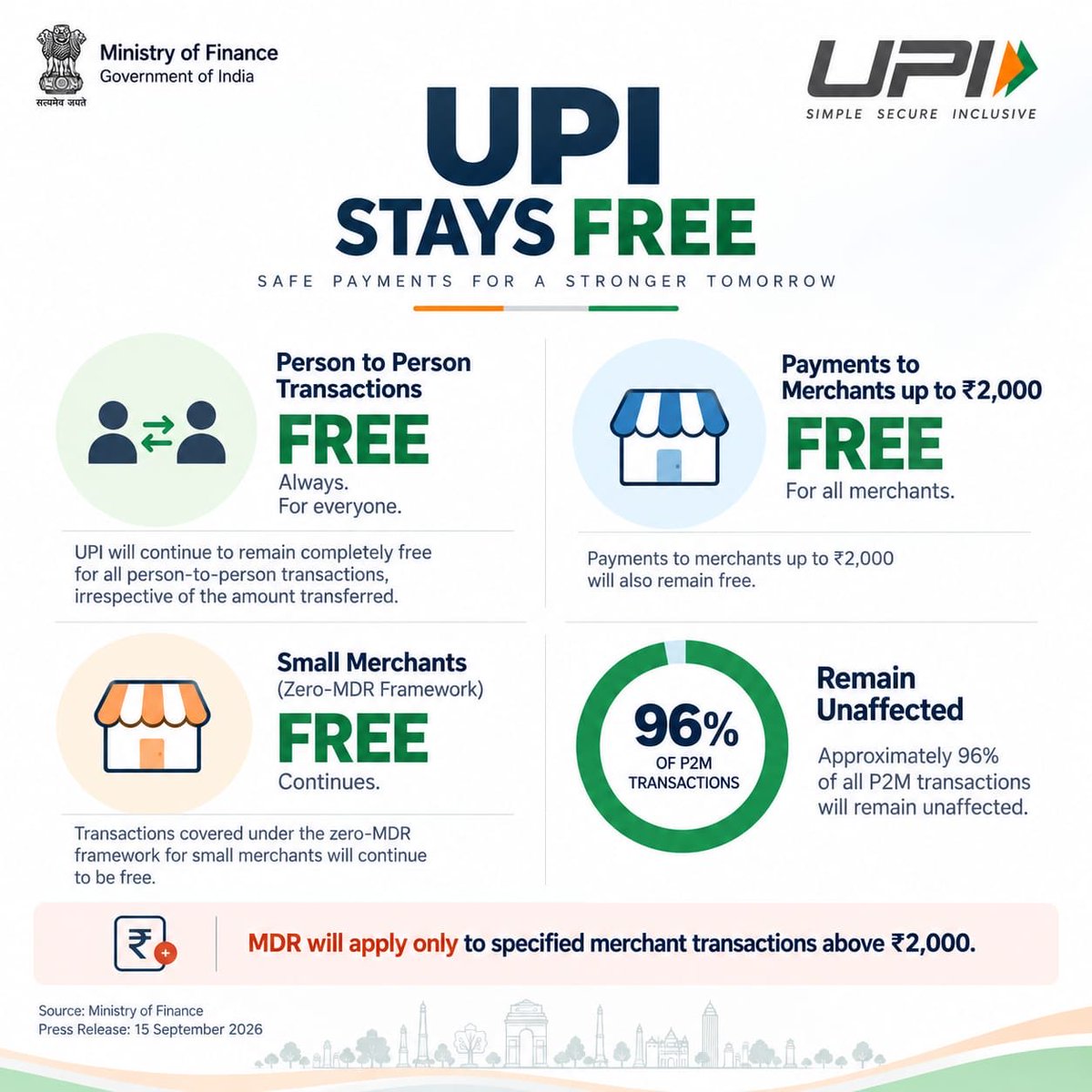
👉 UPI Continues to Remain Free for Peer to Peer Transactions and 96% of Merchant Transactions
👉 The new UPI framework introduced has no impact on any person to person transactions
👉 UPI will continue to remain completely free for all person-to-person transactions, irrespective of the amount transferred
👉 Payments to merchants up to ₹2,000, along with transactions covered under the zero-MDR framework for small merchants, will also remain free
👉 Consequently, approximately 96% of all P2M transactions will remain unaffected. MDR will apply only to specified merchant transactions above ₹2,000
👉 It is clarified that MDR is neither a tax nor a charge collected by the Government or @NPCI_NPCI. It is distributed among payment ecosystem participants, including banks and payment application providers, to support the operation and continued expansion of the UPI ecosystem
👉 Introduced under the Payment and Settlement Systems Act, 2007, following detailed deliberations by the UPI Steering Committee, the framework seeks to ensure the long-term sustainability of UPI while protecting individuals and small merchants from additional charges
Read here for full details ➡️ https://t.co/KGxlX3SVC0
NDA'S UPI CLARIFICATION: 6 KEY POINTS
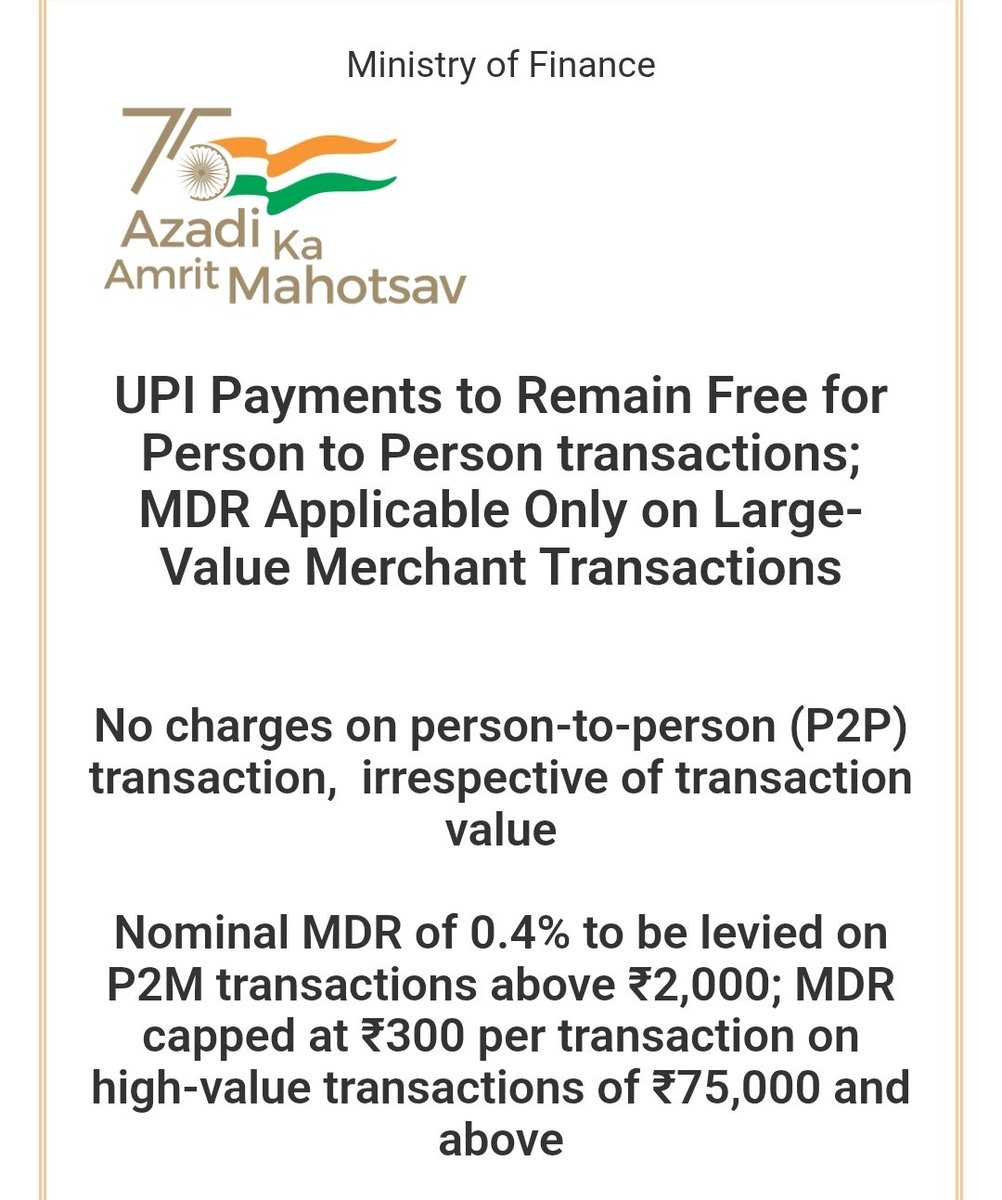
1. 0.4% MDR ABOVE Rs 2,000
UPI merchant payments above Rs 2,000 will attract a nominal 0.4% MDR, shared across the payment ecosystem.
2. Rs 300 MAXIMUM ON BIG PAYMENTS
For UPI payments of Rs 75,000 and above, MDR will be capped at Rs 300 per transaction.
3. Rs 5 FLAT FEE FOR ESSENTIAL SERVICES
Railways, telecom, insurance, fuel, agriculture inputs and other essential sectors will pay just Rs 5 MDR per transaction above Rs 2,000.
4. CAPITAL MARKET PAYMENTS: JUST 0.02%
UPI payments to mutual funds, stock brokers, securities and dealers will attract 0.02% MDR, capped at Rs 300.
5. SMALL VENDORS: ZERO MDR
Small merchants receiving up to Rs 1 lakh a month through UPI QR will continue to pay zero MDR under the P2PM framework.
6. SMALL PAYMENTS PROTECTED
The framework keeps everyday small UPI payments free, while introducing nominal charges on selected higher-value merchant transactions.
The ’80s are trending again - this time, through retro edits.
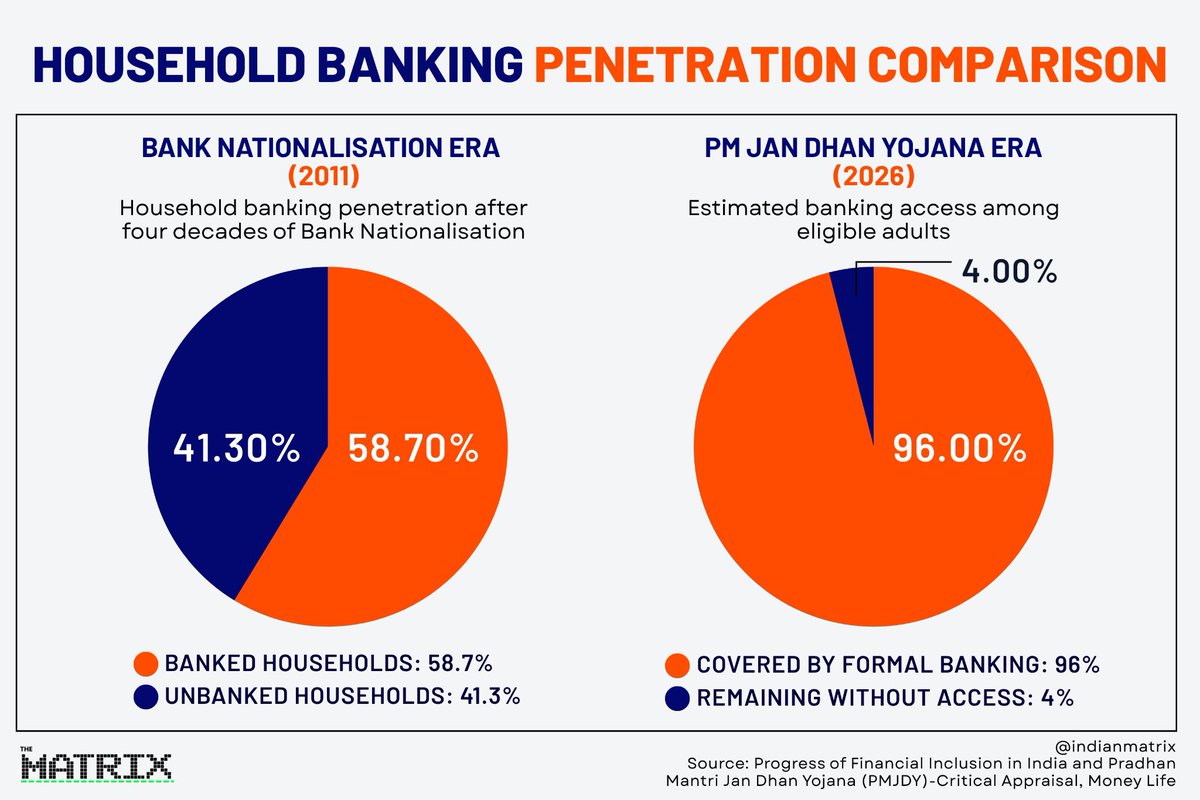
But beyond the aesthetic lies a very different story: an India where the banking sector was deeply troubled.
Read our Substack for the deeper analysis: https://t.co/ZlpdLns9Rm
11 years. 50,000 modern railway coaches. 🔥
Meanwhile, 10 years of Congress — couldn’t even build 50,000 toilets. 😂
PM @narendramodi Ji totally EXPOSES Congress:
Does India really need millions of NGOs, or they are actually stalling our progress?
Dive into why a surplus of organisations might be doing more harm than good: https://t.co/Yf4GeGxCXV
India is hailed as a global startup hub, but our research reveals a startling friction: For every 1 Startup, there are 2.5 NGOs. In strategic border states, this ratio hits as high as 14:1.
Is India becoming a nation of builders or gatekeepers?
Read the full report: https://t.co/25t1eM2Rs9 🧵
While 6 lakh NGOs are officially registered, total estimates reach 37 lakh-roughly 1/3rd of all NGOs in the entire G20.
This means the real Institutional Energy ratio is closer to 15 NGOs for every 1 startup. We’ve built an ecosystem where ‘monitoring’ and 'advocacy' have become more lucrative than 'creating' and 'manufacturing.'
(1/6)
Is a 3% Activism Tax keeping India from superpower status?
From stalling nuclear plants to a lopsided NGO-to-Startup ratio, the Invisible Friction of foreign-funded NGOs costs India 2-3% of GDP annually.
For your must reads, here's the full breakdown: https://t.co/Yf4GeGxCXV
How much of India’s mass consumption happened after 2014?
- 71% of ACs
- 70% of Mobile Phones
-70% of Washing Machines
- 67% of Refrigerators
- 65% of PCs
- 65% of Passenger Vehicles
- 65% of Two-Wheelers
Consumption is built on the purchasing power of the masses.
But some decades consume more than others as millions enter higher levels of prosperity.
Public sector banks have recovered Rs 10.16 lakh crore in NPAs and written-off loans from defaulters.
This is why NPAs have fallen substantially, and this recovery is boosting the profits of all Public sector banks.
GST collections crossed almost ₹2 lakh crore in August: ₹1,99,853 Crore.
> Up 14.8%. Third straight month of double-digit growth.
What does that mean in simple terms?
Most of this money came from inside India.
- Domestic GST rose 9.3%. That is people and businesses buying goods and services.
The rest came from imports, ₹62,604 crore, up 29%.
Crude, fertiliser, gold and other incoming cargo paid more tax.
Refunds also went up to ₹31,795 crore.
Even after giving that money back, net collection was ₹1,68,057 crore, still 8.3% higher 😳
Rates were cut last September.
The world is not easy. Yet the tax till kept filling.
When GST rises like this, it usually means one thing: the economy is still moving.
7.8% GDP INDIA'S "HURCULEAN FEAT" IS GETTING NOTICED.
"DOOMSAYERS" WON'T LIKE THIS
Japan Credit Rating Agency (JCR) has upgraded India's sovereign credit rating from BBB+ to A-
A MASSIVE VOTE OF CONFIDENCE IN INDIA'S ABILITY TO REPAY ITS DEBT
JCR cited India's strong economic growth, robust domestic consumption, continued public investment, improving banking-sector health and fiscal consolidation. It also noted that India's fiscal deficit had narrowed while capital expenditure remained high.
Crazy statistical illiteracy. Garg compares this year’s new-series GDP with last year’s old-series GDP! He gets 2.6% nominal. Congress then sells that as 2.6% real growth.
If you change the base year and the methodology, you do not freeze last year’s Q1. Either restate both quarters on the new series, or calculate this year’s Q1 on the old base and methods and then compare. You cannot mix the two. Growth is always same series, same method.
Q1 vs Q1 on the new 2022-23 series is 7.8% real and 10.3% nominal. That is the only valid comparison. It is embarrassing that this disgruntled man was Finance Secretary in the Modi Govt. WDTP
As the political discourse discusses cups, mugs, & chai, something far more sinister needs attention.
Your favourite morning coffee spot was/remains on a terror hit list.
On November 10, 2025, a blast in Delhi claimed 15 lives. But intelligence audits reveal that this was merely the pilot run of a much larger, coordinated synchronicity.
The plot aimed to target 504 stores across 81 cities simultaneously.
This wasn't a plan executed by uneducated foot soldiers. It was engineered by MDs, Engineers, and PhDs.
We analysed the dossier to understand the new anatomy of terror.
1. The "Poverty" Myth is Dead
For decades, the prevailing narrative linked radicalisation to economic deprivation and lack of education. The profiles of this module dismantle that theory entirely:
• Dr Umar Un Nabi (MBBS, MD)
• Dr Muzammil Ahmad (DNB, MBBS)
• Dr Shaheena Saeed (MBBS, MD)
These individuals weren't radicalised in remote caves; they were radicalised in elite medical colleges and hospitals. The hand that held the scalpel built the bomb.
2. The Geography of Hate (81 Cities)
We audited the city list from the intercept. The grid was not limited to Metros; it was a pan-Indian encirclement.
• North: From the valleys of Srinagar to the plains of Jalandhar, Bathinda, and Noida.
• West: Commercial hubs like Mumbai, Pune, Surat, and tourist centres like Calangute (Goa).
• South: Tech corridors of Bengaluru & Hyderabad, and temple towns like Tirupati & Warangal.
• East: Kolkata, Guwahati, Siliguri, and Bhubaneswar.
The target selection reveals a clear intent: to strike not just political centres, but the lifestyle of the urban middle class in Tier-2 and Tier-3 India.
3. The Ideological Import
Why this specific coffee chain? Intelligence suggests the targets were chosen solely for being "Jewish-owned."
This signals a dangerous shift: the importation of a global conflict into India’s internal security matrix. The objective wasn't territorial (Kashmir); it was ideological (Global Jihad). They weaponised a global grievance to justify mass casualties among Indian civilians.
65% of the terror module members originated from STEM and Liberal Arts backgrounds. The radicalisation pipeline has shifted from the Madrasa to the university campus and the corporate cubicle.
The era of the 'uneducated terrorist' is over. We are now facing the 'Intellectual Terrorist' - highly skilled, economically integrated, and ideologically hardened.
This is a more important conversation to be had.
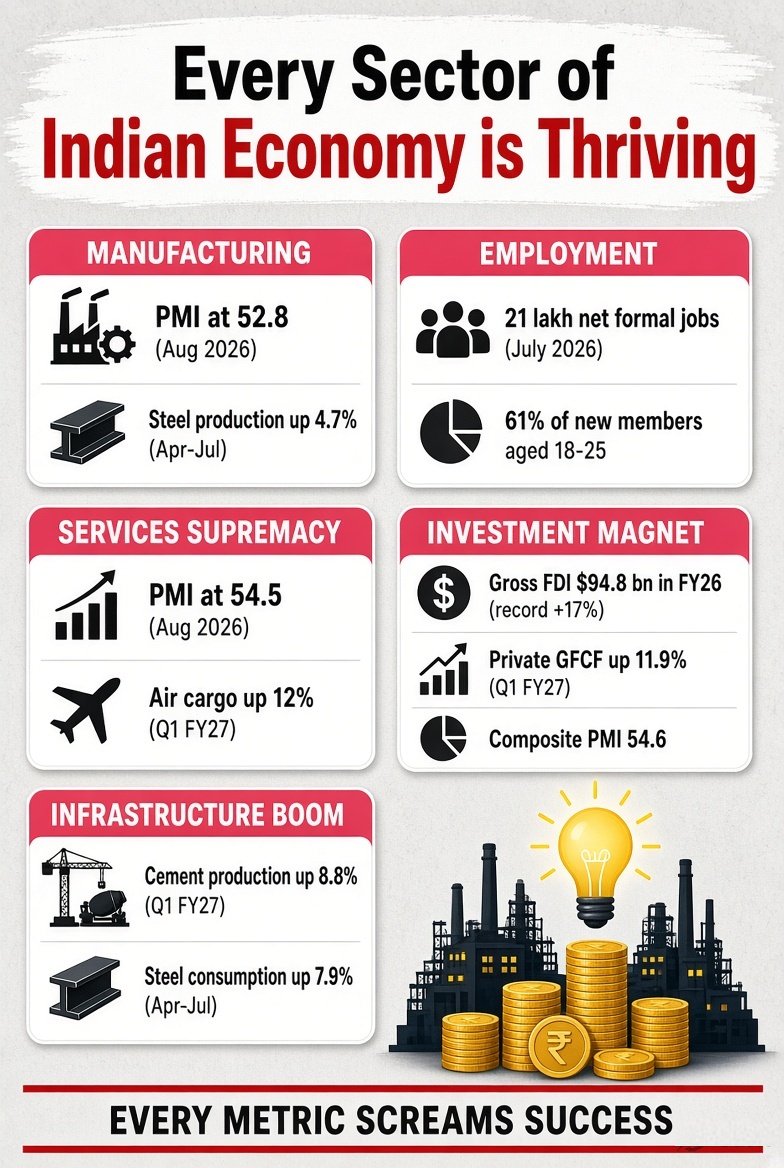
India’s economy is growing, and the numbers speak for themselves. 🇮🇳
Forex reserves have hit a record $𝟕𝟐𝟗 𝐛𝐢𝐥𝐥𝐢𝐨𝐧, rising for 𝟖 𝐜𝐨𝐧𝐬𝐞𝐜𝐮𝐭𝐢𝐯𝐞 𝐰𝐞𝐞𝐤𝐬.
𝐓𝐡𝐞 𝐦𝐞𝐬𝐬𝐚𝐠𝐞 𝐢𝐬 𝐜𝐥𝐞𝐚𝐫: 𝐈𝐧𝐝𝐢𝐚’𝐬 𝐠𝐫𝐨𝐰𝐭𝐡 𝐬𝐭𝐨𝐫𝐲 𝐢𝐬 𝐠𝐚𝐢𝐧𝐢𝐧𝐠 𝐞𝐯𝐞𝐧 𝐦𝐨𝐫𝐞 𝐦𝐨𝐦𝐞𝐧𝐭𝐮𝐦. 📈