Organisations are designed to produce specific, repeatable processes through specialised roles, norms, & behaviours. When we start working in a new organisation, we learn the social cues to start conforming & fitting in.
It's why, when we set out to lead change, we're likely to find resistance. All of those subtle forces built up over time are designed to support existing behaviours & norms. For large scale change, we need to shift from a "manager mindset" rooted in the status quo, to a "changemaker mindset" that can move things in a different direction. Three shifts are needed:
1) From building consensus to building coalition: build a smaller coalition of people who are already enthusiastic about change & can begin to build new norms & expectations
2) From working in an atmosphere of predictability to one of uncertainty: we won't know if things will work until we've tried them - expect them to go wrong & leave room for testing & error
3) From a focus on implementation to exploration: if we don't explore, we won't find better ways of doing things - or better things to do
We need both a manager & a changemaker mindset. We have to be able to mode shift between them:
https://t.co/U62mJMmbRI. By @Digitaltonto
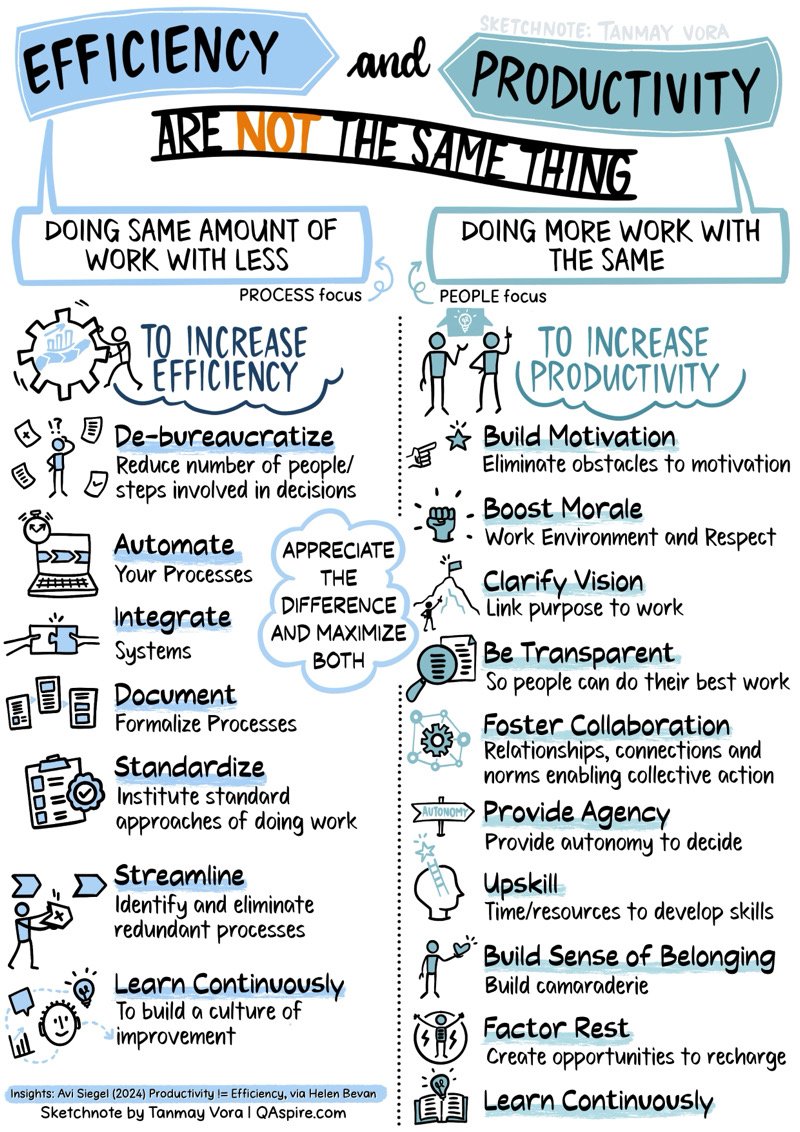
The post I made a couple of days ago on the differences between efficiency and productivity has been turned into a superb sketchnote & accompanying blog by @tnvora: https://t.co/rERGwYpHbt. For those who couldn't open the original article by Avi Siegal, here's another link: https://t.co/gwOr9qhXGk.
Improvement toolkits & good practice databases are useful but they only take us so far. As much as 80% of the knowledge in an organisation isn't written down. It's not a failure of documentation. it's to do with the nature of the knowledge and the way it gets spread. That's why it is critical that we make time & space for networks, communities of learning/practice, huddles & sharing conversations if we want change & improvement to happen: https://t.co/10ikbAwVBe. Thanks @nickknoco
The book that will change everything you know about African history:
When We Ruled by Robin Walker.
In 700 pages of groundbreaking research, Walker uncovers the hidden story of Africa's past.
If you don't have a couple of months to read it yourself, here are 10 important things I learned:
1. The Nubian Kingdom of Ta-Seti is the oldest kingdom on Earth
2. Sudan has more pyramids than Egypt.
3. The libraries of Timbuktu housed more books than any European collection during the Middle Ages.
4. In 951 AD, a cheque was written in Aoudaghost (Ancient Ghana) worth 42,000 dinars.
5. Ile-Ife (Nigeria) had streets paved with maize cobs in 1000 AD - But maize comes from America and Columbus didn't get there for another 400 years 🤯
6. Malian voyagers set sail for America in 1311 AD, 181 years before Columbus.
7. The Malian Emperor, Mansa Musa, is the richest man in recorded history - On his journey to Mecca, he stopped in Cairo, and spent so much of his gold that Cairo's economy crashed due to the inflation, and didn't recover for 12 years.
8. In the 14th Century, Timbuktu was 5 times larger than London.
9. 15th Century manuscripts from Timbuktu show the planets revolving around the sun. They were written over 150 year before Nicolaus Copernicus discovered this in 1543
10. The longest earthworks in the world carried out prior to the mechanical era are the Ancient Walls of Benin and Ishan, located in Edo State in present-day Nigeria.
23. Photographer Loes Heerink transformed the ordinary into a stunning collection by waking up at 4 am and positioning herself on various bridges around Hanoi, patiently waiting for the passage of street vendors.
"I once spent five hours in a location with no shots," Heerink explained. "This project started my fascination for the women carrying their goods. They have no clue how beautiful their bicycles are, no idea they create little pieces of art every day."
PETITION 🔴 We're asking for the CLOSURE of mass asylum containment sites.
🚑 Over 74% of our patients are in severe psychological distress, with 41% experiencing suicidal thoughts or planning. The lack of adequate mental health support is deeply concerning.
Tomorrow, a crucial piece of legislation around healthcare will be scrutinised by MPs.
It will happen in a committee room, away from the main chambers, on a whisper.
If it passes, it will worsen the health of the UK population.
Did you know about it? No?
A thread 🧵