AI agents are approaching to be commodities - with tools like @dify_ai , devs need to commit there is no magic in creating agents. It’s like content - everyone can create contents. The only difference is a matter of are you a good creator or not.
My contrarian view to the folks tokenising AI agents and tokenising everything of them is that tokenising ai agents is not going to work in the short term. A real world example would be @Flippa, a piece of software is only useful when it has reputation and value instead of the middle layer for tokenisation.
Why is the deployment of our entire demo app in jeopardy when we only want to downgrade from the pro to the hobby plan with @vercel?!!
This is what happened. @_buildspace secured a promotion with Vercel for credits as part of the many exclusive perks for the s4 cohort.
wk2 update for @_nightsweekends@_buildspace. The toy is a demo of the end-user flow of @DALN_io.
The demo illustrates the entire process of onboarding, pulling cc transaction data from a test account with Plaid, minting an SBT, and burning the token to exit the DAO.
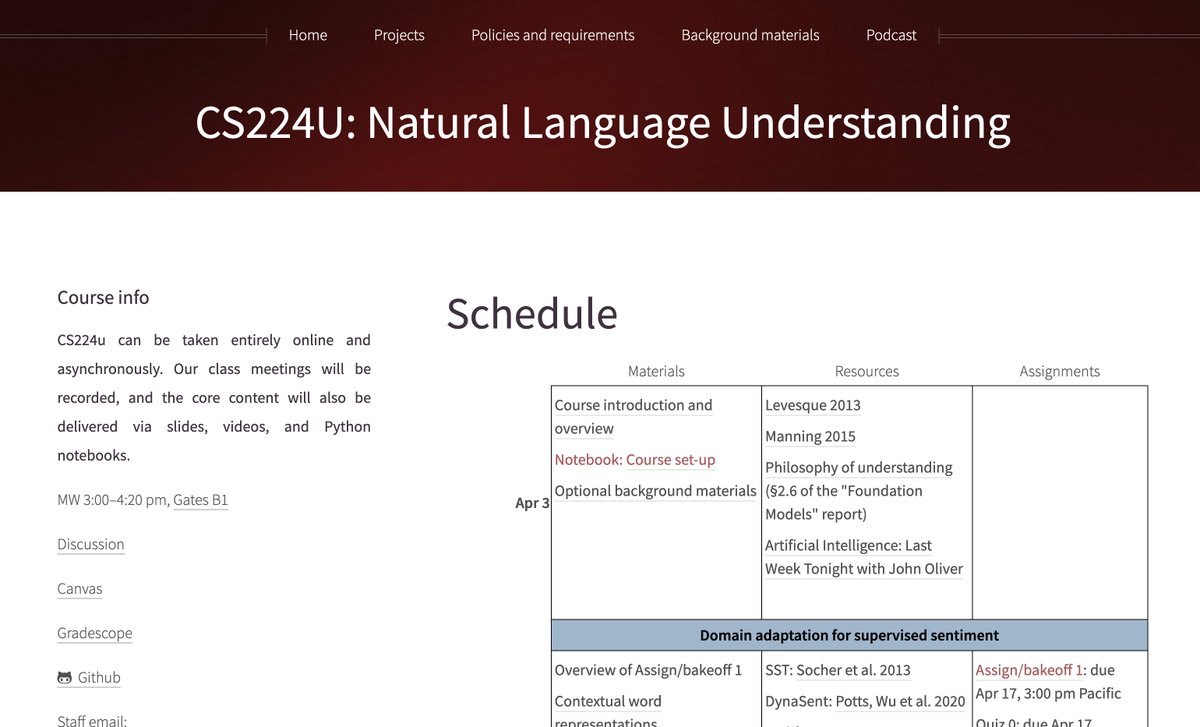
An open-source course for your weekend learning sprint: CS224U, taught by Stanford prof Chris Potts.
In addition to the usual LLM agenda, there're quite a few gems:
- Classic ways for information retrieval: TF-IDF, BM25 ranking score, Pyserini (python tool), and IR metrics. Resist your knee-jerk instinct to reach for GPTs. Sometimes simpler methods are far more efficient for apps that don't need bigger guns.
For example, @karpathy's https://t.co/epAkN1qjzq uses TF-IDF for paper recommendation: https://t.co/bq8oehOG1w
- Diffusion for text: yes, it's an emerging research field. Diffusion simulates how a coherent sentence can materialize by denoising "fuzzy words" in parallel. Doesn't quite work well yet, but it could become an alternative to the dominant autoregressive way.
- Systematic approaches for NLU system evaluation: probing, feature attribution, interventions.
CS224U slides: https://t.co/0q7ZuEdsJl
Code repo: https://t.co/505gAJxjcQ
OG post from @suzatweet
Happy to share that NVIDIA is partnering with HuggingFace! We ❤️ OSS community.
NVIDIA DGX Cloud will be accessible with HuggingFace to create & customize generative AI models for the enterprise. Yes, we do have a cloud!
- Each node is either 8x H100 or A100.
- NVIDIA nForce3 Pro will be the networking technology that powers massive scaling.
- NVIDIA Base Command will be the OS for DGX Cloud. It includes a cluster API that I use on a daily basis for AI research work.
How might we craft an artificial society that reflects human behavior? My paper, which introduced “generative agents,” will be presented at #UIST2023 and now has an open-source repo! w/ @joseph_c_obrien@carriejcai@merrierm@percyliang@msbernst
https://t.co/yESmpevNlv 🧵
📣 All aboard, Bacalhau crew! 🐟 Have you heard? With Bacalhau 1.0, you’ve got the power to run Bacalhau on Private Clusters! 🎉 Think of it like your own private island in the sea of data, where you call the shots on privacy and security. 🏝️
Plus, you can even drop a bridge to the public @IPFS network when you need to. Intrigued? Let's explore this together! 🐟 https://t.co/capVtphFR2
@ExpansoIO
#Innovation #DataPrivacy #DataSecurity #BigData #AI #MachineLearning #CloudComputing #DataScience #Cybersecurity #IoT #NetworkSecurity #Privacy #DataGovernance #DataProcessing #DigitalTransformation #DataDriven #DeepLearning #BacalhauProject #BacalhauCommunity #BacalhauOnTheRise #Bacalhau #ComputeOverData #Expanso #ExpansoTeam