Cancer is a parasite. Vax/PCR test have parasites.
Use zeolite/milk thistle as detoxifiers. Look up the health benefits of clove, shilajit, kalawalla, moringa.
A freshly mowed yard. A neighbor in tears. A kid with a mower.
She hadn't asked for help. She was too proud for that.
Miss Eleanor, 81 years old, had lived in the same house for 52 years. She'd raised four kids in that yard, buried a husband, and kept every blade of grass in line until her hip gave out last spring. By July, the lawn had grown past her knees. Her neighbor had slipped a note under the door: "The city might fine you."
She cried for an hour after reading it.
Then, on a Tuesday morning, she heard something through the window. A lawnmower. Then another. Then voices young voices,
Five boys. None older than 14. They showed up in worn sneakers and old T-shirts with a push mower, a trimmer, and zero hesitation. They introduced themselves, asked if they could help, and got straight to work without waiting for an answer.
Two hours later, her yard looked better than it had in years.
When Miss Eleanor came outside to thank them and reached into her purse, the oldest boy a 13-year-old named Marcus gently put his hand up.
"No ma'am. We don't do this for money. We do it because it's right. We'll be back next month."
And they were. Every single month.
These boys are part of Raising Men Lawn Care Service, a crew of young volunteers who show up, week after week, with their own equipment and their whole hearts. No charge. No cameras. No fanfare. Just kids who decided that elderly neighbors, veterans, disabled folks, and single moms shouldn't have to stress about a lawn.
They track every yard. They return to the same homes. They remember names.
Miss Eleanor told us she keeps the curtain open on Tuesday mornings now just in case.
"I didn't know young people still did things like this," she said, wiping her eyes. "I think God sent them."
The next generation is going to be just fine!
So proud of this fellow Virginian and she is only 18 years old👏🏻👏🏻👏🏻
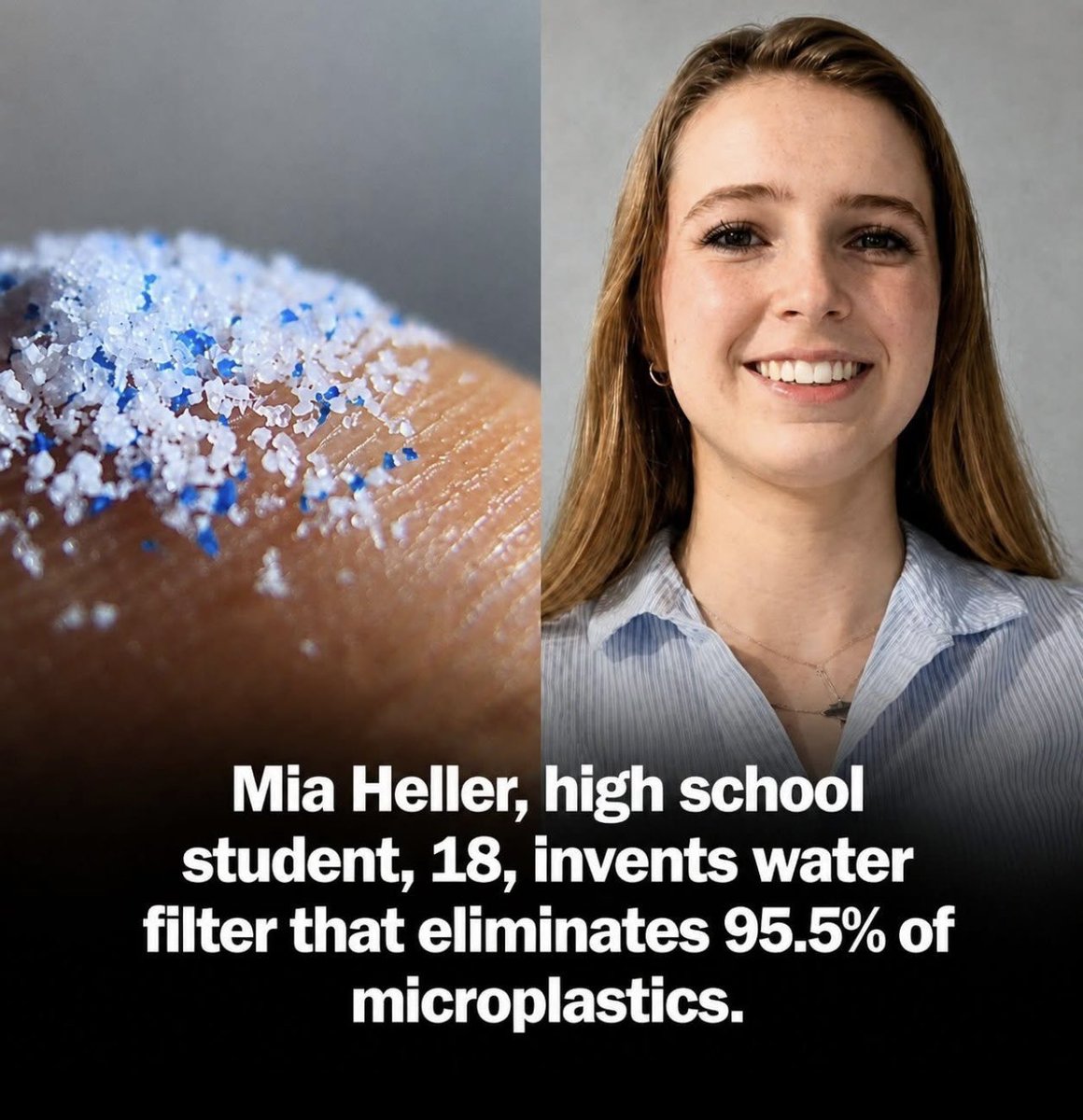
An 18-year-old just did what billion-dollar water companies couldn't.
Meet Mia Heller.
A high school junior from Warrenton, Virginia who built a water filter in her garage that strips out 95.5% of microplastics from drinking water.
That's better than most government treatment plants, which sit somewhere between 70% and 90%.
Her secret weapon? Ferrofluid. A magnetized liquid made of oil and powder that latches onto microplastic particles. Then a magnet yanks them out. No membranes. No constant filter replacements. No endless maintenance bills.
The ferrofluid even gets recycled, around 87% of it, in a closed loop.
The spark for all of this wasn't a classroom project. It was a local newspaper article warning that her town's tap water was loaded with PFAS and microplastics, and that nobody was coming to fix it.
So she watched her mom swap out filter after filter and thought, there has to be a smarter way.
She built the prototype herself. Tested it with a homemade turbidity sensor. Then walked into the Regeneron International Science and Engineering Fair and walked out with a special award from the Patent and Trademark Office Society.
Up against nearly 1,700 students from 62 countries.
She's now eyeing a household version that sits under your kitchen sink.
The future of clean water might not come from a lab in Silicon Valley. It might come from a teenager's garage in Virginia.
Source-
@SmithsonianMag
They didn't kill the cancer. They told it to go home.
A team of Korean scientists at KAIST just pulled off something that sounds like science fiction.
Instead of nuking colon cancer cells with chemo or radiation, they convinced them to turn back into normal, healthy colon cells.
No killing. No collateral damage. Just a quiet U-turn at the cellular level.
Here's how it works.
Led by Professor Kwang-Hyun Cho at the Department of Bio and Brain Engineering, the team built a "digital twin" of the gene network that controls how a normal cell becomes cancerous.
They ran simulations. They hunted for the exact moment a healthy cell flips into a malignant one.
Then they found the switches.
Three master regulator genes — MYB, HDAC2, and FOXA2 — were the keys to the whole transformation.
Flip those switches back, and the cancer cell stops behaving like a cancer cell. It starts looking and acting like a normal enterocyte, the kind of cell that lines a healthy intestine.
No gene editing. No permanent rewiring. Just the body's own natural signals, used in reverse.
The team confirmed it in molecular experiments, cellular experiments, and animal studies. The malignant cells stopped multiplying out of control and went back to doing their actual job.
The research has already been handed off to a company called BioRevert Inc. to develop into real-world treatments.
This isn't a cure tomorrow. But it rewrites the entire playbook for how we think about cancer.
You don't always have to destroy the enemy.
Sometimes you just have to remind it who it used to be.
Source: KAIST / Advanced Science (Gong et al., 2024) via ScienceDaily and OncoDaily