🚨BREAKING: France wiped Google and Microsoft off 2.5 million government computers.
Germany moved 30,000 PCs off Windows. Denmark dropped Microsoft Office.
Here's exactly what they switched to and how to do the same:
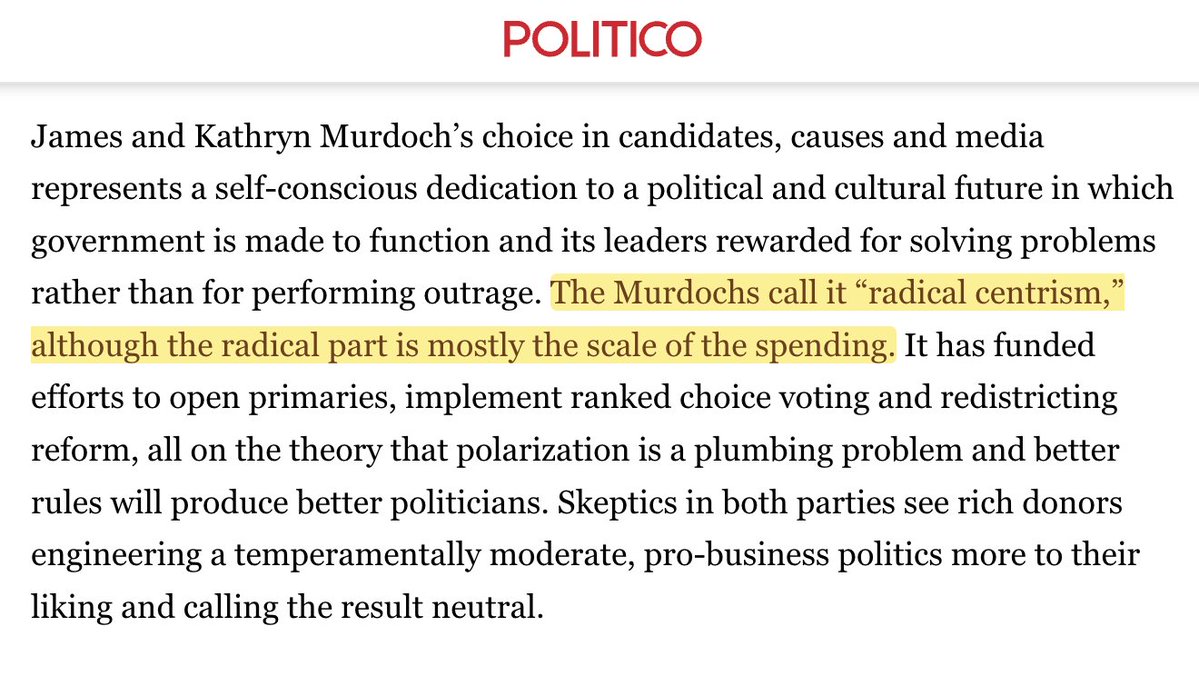
The "liberal" Murdoch billionaire is funding Josh Shapiro and Pete Buttigieg (dating back to 2019). After purchasing NY Mag and Vox, they're looking to buy Crooked Media, and already fund The Bulwark and the @MajorityDems PAC.
Their stated goal is to promote "radical centrism."
🎯 @Calli_Jones: “The (Republican/Trump) playbook is simple — break it. Complain about it. Privatize it.”
Bingo. Air traffic. Education. Health care. Roads. Everything.
And if they don’t get their cut they call it communism.
I want you to sit with a single contradiction.
The United States has 4% of the world's population.
It has nearly half of the world's civilian-owned guns.
It has more people in prison than any country on earth.
In absolute numbers. Not per capita.
More than China.
More than Russia.
More than the entire European Union combined.
It spends more on its military than the next six countries combined.
And its life expectancy ranks 47th in the world.
This is not a glitch.
This is not mismanagement.
This is not a country that meant to do better and fell short.
This is a country that has made its choices.
And the choices have names, and the names have donors, and the donors have returns on investment.
And the people paying the price keep being told they live in "the freest nation on earth."
And enough of them believe it to keep the whole thing running.
Here’s a simple idea: Billionaires (and trillionaires) whose companies have federal govt contracts shouldn’t be allowed to contribute millions to elect candidates who could help them get more taxpayer-funded contracts.
I have a bill to shut down this corrupt pay-to-play scheme.
We Dodged a Bullet
The blue tsunami changed what comes next. Now Democrats have to deliver on the mandate voters gave them
“Now this is not the end. It is not even the beginning of the end. But it is, perhaps, the end of the beginning.” -Winston Churchill
By about 10 p.m. Eastern on election night, sitting at the Bucks County Democrats’ watch party in Pennsylvania, I began to feel something I had not allowed myself to feel in a very long time.
Relief.
I had already seen enough in the voter polling to know Democrats were headed for a very good night. Ninety percent of voters called government corruption a crucial or major factor in their vote. Eighty-nine percent said the same about the cost of living. That was an electorate with a very clear set of grievances.
Then the wins kept stacking up: Texas, Georgia, Iowa, even South Carolina! As the picture emerging from Texas and the rest of the country grew clearer, the scope of what was happening began to sink in. We were getting the tsunami American democracy needed to survive, a wave so big it washed away conditions for the post-election nightmare so many of us had spent months and millions preparing for.
You were worried. I was worried. A narrow Democratic victory could have left control of Congress hanging on a handful of races, with every disputed ballot and certification deadline becoming an opportunity to manufacture chaos. I could easily imagine a 51-seat Senate majority getting dragged through weeks of efforts to keep the decisive winner from taking office.
By around 10pm, my assessment of that risk had changed dramatically. The returns were outrunning the scenario I had feared. Look at Texas. James Talarico’s lead in the reported Senate results stands at roughly twelve percentage points. This happened under Texas’s existing voter-ID requirements.
What the fuck are you going to do with that, MAGA?
You can still yell “fraud.” Trump will always yell “fraud” but even his most doped up cult members knew they got their ass kicked. MAGA twitter is still in hiding. In what I will forever call the F.A.F.O midterm, repudiation stretched across the country, including states Republicans have controlled for decades.
The early aftermath reinforced that assessment. Republican candidates conceded widely. AP reported that the anticipated immediate wave of legal challenges did not materialize. Even prominent election-denial voices acknowledged a defeat that conspiracy theories could not explain away.
That matters. The scale of this victory changed the political conditions in which any attempt to overturn it would have to operate. And the incoming Congress does not need Donald Trump’s permission to exist. Congressional terms begin January 3; each chamber judges its own members’ elections and qualifications. The president has no constitutional veto over seating Congress.
I expect these majorities to take office. Individual disputes remain possible, but I no longer see a narrow, contested outcome that could plausibly leave control of Congress hanging in the balance. For everyone who has been living with that particular fear: you can take a breath.
We have stepped back from the edge of the cliff (but we’re still on the cliff!)
Trump still controls the executive branch, and the Supreme Court’s immunity ruling still shields substantial presidential official conduct from criminal prosecution. The constitutional crisis did not disappear on election night. But the voters have given us a much stronger position from which to confront it.
A Democratic House can control its committees and pursue oversight. A Democratic Senate can scrutinize and reject nominees. Together, they can challenge the administration’s spending priorities and force its conduct into public view. Those are consequential powers.
Now Democrats have to use them in service of the mandate they actually received. That mandate is straightforward: make shit cheaper and put a check on Trump’s corruption.
Democrats should be very careful about interpreting a sweeping rejection of Trump as an equally sweeping endorsement of Democrats. People who helped deliver this majority want relief. They want a government that pays attention to their bills. They want public office to stop looking like an opportunity for the people in charge to cash in.
That should determine the opening agenda.
Move legislation to repeal the tariffs. Put concrete measures to lower household costs on the floor. Use Congress’s powers to press for an end to the Iran war. Make the connection between those actions and people’s daily lives so clear that nobody needs a political science degree to understand what Democrats are trying to accomplish.
And make a serious effort to get those measures enacted.
There will be obstacles before anything reaches Trump’s desk. Under existing Senate rules, most legislation can face a 60-vote hurdle to overcome a filibuster. A Democratic majority alone does not eliminate that barrier. But leadership’s job is to pursue every available route, seek the votes, and make the outcome visible.
If Republicans block an affordability measure, make them own that vote. If a bill passes both chambers and Trump vetoes it, make him own that decision. Voters need to see the proposal, understand how it would help, and most importantly, know who stopped it. They need to see Democrats trying.
Because the political danger is obvious: people give Democrats Congress, their lives do not improve, and they conclude Democrats did nothing. Preventing that conclusion requires sustained, visible work on the problems that produced this majority.
Accountability requires the same discipline. I understand the desire to see Pete Hegseth impeached. But we need to be honest about what that would accomplish. A House majority can approve articles of impeachment. Removing him requires conviction in the Senate, with two-thirds of the senators present voting to convict: 67 if all 100 are present.
Even if the Democratic caucus reaches 56 seats once Alaska is resolved, a united caucus would still need 11 Republicans. That is the arithmetic, and nobody should build public expectations around those 11 votes simply appearing.
Part of the confusion comes from the vocabulary. We hear “trial,” “evidence,” and “conviction,” and picture an ordinary criminal courtroom. An impeachment trial is a constitutional proceeding conducted by elected politicians. Senators take an oath to do impartial justice, but the process cannot make them put evidence ahead of partisan loyalty.
Trump’s second impeachment makes the distinction especially clear: 57 senators voted to convict him, and he was still acquitted because the vote fell short of two-thirds. That outcome did not establish that the underlying conduct never happened but Trump used the “acquittal” to claim he was exonerated and tuned out America believes it.
I do not want Democrats promising removal when they have no credible path to conviction. They should investigate thoroughly, establish the facts, and make strategic decisions about impeachment with the votes and consequences in view. Accountability cannot depend entirely on an outcome Republicans have the numbers to block.
There is substantial work Congress can do now: pursue documents, question officials under oath, follow the money, expose conflicts of interest, and preserve evidence. Subpoena fights and administration stonewalling will complicate that work. They are reasons to prepare carefully and begin promptly.
Congress can also make criminal referrals. It cannot prosecute people itself or force the Justice Department to bring charges. A referral asks executive-branch law enforcement to act; it does not guarantee an investigation or an indictment.
Nor should we promise that every case can simply wait until Trump leaves office. His pardon power can protect people from federal criminal liability for past conduct, including before charges are filed. It does not cover state crimes or erase impeachment, but it can permanently foreclose some federal prosecutions. We need to understand those limits so we can pursue accountability intelligently.
Public exposure has value. Preserving evidence has value. Preventing an abusive appointment has value. Forcing officials to explain what they did, who benefited, and who paid has value. Investigations can inform legislation, constrain future misconduct, and establish a record that survives this administration.
Democrats should describe those objectives clearly and then show people the work. Above all, I want us to recognize the magnitude of what we have already accomplished.
For months, so much of our energy went into the fear that even winning might not be enough. We worried about whether the result would be honored, whether the winners would take their seats, whether the country would get another meaningful opportunity to restrain this president.
There are still very difficult fights ahead, but we now have congressional majorities with the power to take those fights directly to the administration. We have an electorate that has demanded affordability and accountability. We have a chance to make that demand count.
We dodged a bullet. We are allowed to feel good about that. Now Democrats need to honor what voters hired us for: get to work lowering costs, exposing corruption, and putting the power they won to use.
The Cycle- On Substack is a reader-supported publication. To receive new posts and support my work, consider becoming a free or paid subscriber.
https://t.co/B3u1GvroOh
Using a government plane to fly to a football game is an abuse of taxpayer funds.
This is even worse when other Americans can't fly anywhere because the government is not doing its job.
Mullin should resign.
https://t.co/CSFH8TSIwQ
Van Hollen hits Shcumer over his opposition to Obama’s JCPOA Iran nuclear deal:
"I don't see how after an election like this where ending the war and bringing down prices was a priority, we can cast a vote to fund the war...And of course, you know, Senator Schumer was one of the folks who originally opposed President Obama and the JCPOA"
Somewhat counterpoint? In today's media/social media environment, you gotta do both. Do good work, but then you HAVE to go and tell people about it. Don't be someone who runs for a camera without a story to tell, but don't expect people will know about that story if you aren't out there constantly communicating.
The RAND Corporation, not a bastion of democratic socialism, tells us that $79 trillion in wealth has been redistributed from the bottom 90% to the top 1% in the past 50 years.
It’s time for a Democratic Congress to turn that around. Yes. We need a wealth tax on billionaires.
Do any of our capitalist allies want to give up their universal care for an insane system where employers must give healthcare as part of a compensation package?
Do our capitalist allies w/universal care want a system where private insurance companies get in between patients and doctors for insane profits?
Can any of our capitalist allies w/universal care say the top reason for bankruptcies is an inability to pay healthcare costs? Do citizens have to create GoFundMe's to cover their surgeries?
What's the GOP plan that provides better coverage and lower premiums than single payer?
As secretary, I made sure to leave air travel in better condition than when we arrived. We reversed a decade of decline in air traffic controller staffing, drove down runway safety incidents, and when I left office we were experiencing the lowest flight cancellation rates in years.
As part of that work, I launched a project to transition the FAA's communications system from copper wire to a modern network. I am glad the Trump administration has continued that work, but they have so far failed to explain why their execution of it triggered the worst FAA communications breakdown this century.
I support more funding for FAA upgrades, but this episode is another blow to the public’s confidence that the administration can deliver. The Trump administration owes Americans an honest accounting of how they have spent the billions of dollars already authorized, clearer answers on why their repair work brought down the entire system on Friday, and an explanation of what they are doing to make sure this failure is not repeated.