I would like to remind people that @elonmusk came up with the "pseudonym doxxing is forbidden" rule because journalists tried to expose one of his online idols, @KanekoaTheGreat. It's not even written in the ToS, it's just something he came up with while attending a Twitter Space.
Now accounts are being locked and suspended left and right for exposing the real name of a edgy cartoonist StoneToss. And yet when other accounts were doxxed and exposed, @Safety did absolutely nothing.
During the Munich conference I was asked why I am so gloomy. Well, somebody has to tell it like it is, so here’s how it is: Things are not going well. 🧵
In today's #vatniksoup, I'll introduce a South African-American(!) businessman and social media figure, Elon Musk (@elonmusk). He's best-known for being the wealthiest man in the world, running Tesla Inc., SpaceX & Twitter, and for parroting Kremlin's propaganda narratives.
1/24
572nd day of invasion
Hundreds of thousands killed, entire regions devastated
And the authorities start noticing 🧐 that Russian capacities for producing weaponry are almost fully based upon the *continuous* import of machinery from the US allies
Better late than never
Analysis of the Ukrainian counter-offensive so far Or how to disagree with editors sitting in a newsroom in New York or Washington:
1. "The counteroffensive is going badly compared to expectations".
1.1 We'd better define expectations first, right? Expectations mean what? Reaching the Sea of Azov in 60 days? Flushing the Russians out of Ukraine next week? Putin surrendering tomorrow?
Example of a difficult situation and its duration: After the Normandy landings (codenamed Neptune - part of Operation Overlord) publicly known as D-Day, the stabilization of the front and the breakthrough from the beachhead happened with the completion of the Battle of Caen. Do you know when this was completed? On 6 August 1944. That's exactly two months after the Normandy landings.
Operation Overlord, as the Battle for Normandy was called, lasted almost 3 months and involved over 2 million Allied troops against an estimated 600,000 troops of Nazi Germany.
1.2 By comparison, the start of this counteroffensive began with shaping actions, and recon-in-force in late May, early June, and now came up against the most formidable fortified defensive line of the contemporary era of warfare: the Surovikin Line. I know, we like to underestimate our opponents. I don't.
The Surovikin Line is composed of several layers, successive lines each serving several objectives. Some, the front ones, allow for elastic Russian defenses, raids, lightning Russian counterattacks, and diversions, without using their reserves in the rear lines. The middle ones protect the front lines and are the best fortified. The complexity of these defensive lines (trenches, antitank trenches, dragon's teeth) is beyond the scope of this post.
But I can assure you that from what we can all see from Maxar, and Sentinel satellites, and from what information is coming in from the field, the Russians have created an almost impenetrable system of fortifications. I stress ALMOST! Ukraine will demonstrate by late fall once again that the impossible will be possible.
Give save to this post and berate me for my optimism at the end of the year, not now, that now many are berating me without any real arguments.
1.3 Also by comparison: when did the counter-offensive in Harkiv start last year? In the second week of September and ended in October. The Harkiv counteroffensive will be etched in history for its sheer magnitude, spanning hundreds of kilometers and occurring simultaneously with another counterattack: the Herson counteroffensive. The Herson counteroffensive was several hundred kilometers long, and it was running at the same time. For those who are interested in what this extraordinary thing is, I would ask them to look for any two counter-offensives, executed simultaneously, on two fronts a thousand miles apart and which counter-offensives, both of them to succeed.
I would like us to take a breath, take a deep breath, and read the last paragraph again. Then let's ask ourselves one more time whether Ukraine understands anything about this war or not. I think it not only understands but understands more than those sitting in an office in New York or London do.
2. "Ukraine does not use tactics and training learned in the West".
2.1 It was shocking to read this from journalists in the civilized West. Sometimes I get the impression that they not only don't understand what is going on in Eastern Europe and beyond, but in the extreme and uncivilized East of Europe (here I mean from the eastern border of Ukraine to the further east - that is the land of uncivilization). But not only do they not seem to understand this, they do not seem to have read a single page of Soviet military doctrine, American military doctrine, or Western European military doctrine.
Why do I say that, without trying to offend anyone? Because American, Western doctrine in general is based on air supremacy or at least air superiority. An often-used example of a successful ground operation, forgetting the air side: Operation Desert Storm had a massive initial air phase, on a scale unimaginable until Operation Shock and Awe, which lasted about two weeks, in which US and allied states against Iraq destroyed absolutely everything that could be destroyed in terms of military infrastructure, military logistics and knocked out Iraqi supply lines. Only then did phase two begin, where over 700,000 troops from dozens of countries invaded Iraq and where the Bradley M2A2 ODS proved it could blow a T-72 to smithereens (in fact, it was the main "culprit" for destroying Iraqi tanks, contrary to the myth known to the West that the Ambrams M1A1 or A-10 Thunderbold (nicknamed the "tank killer") would be the ones to destroy the most tanks).
In Operation Desert Storm, the Iraqis had no fortified positions left standing after the massive US and Allied air campaign, no intact supply routes, and no ammunition dumps. They were practically in hell, but Saddam was willing to see the fight through to the end, and this resulted in the total annihilation of Iraqi armor that had come into conflict with thousands of Allied armor.
2.2 [Imaginary dialogue with an editor of a Western publication who can indulge in bombastic headlines for the sake of coverage] Does Ukraine have air supremacy? No. But if it doesn't have air supremacy, does it at least have air superiority? No. But if it doesn't have air superiority in general, at least in specific sectors of the front over 1200 km, does it? No. Then why are you still talking about the Ukrainians not implementing Western doctrine? First of all, if we Westerners gave them F-16s (at least with Block 50 avionics) in sufficient numbers (not 16, 20, 50), we could then talk about a crossing over the Surovikin Line much easier for the Ukrainians to accomplish, with much less loss of equipment and ESPECIALLY with much less loss of life.
So, my dear imaginary editor who likes bombastic headlines, before you write them, consider the following: Ukraine has no air superiority or supremacy. It doesn't have enough anti-mine vehicles. It does not have enough thermal imaging and night vision equipment to navigate at night. Ukraine doesn't have ATACMS missiles, to be able to destroy the fortifications on the Surovikin line, nor the LNR, or DNR depots supplying the southern front, nor does it have any kind of navy, because it was stolen from it in 2014, when our politicians (mine and yours) stood by and turned a blind eye to what was happening in Crimea (notable exception John McCain, may his soul rest in peace).
3. But why doesn't the counteroffensive like the one in Harkiv last year work?
3.1 Because it is not the same thing. The Harkiv counteroffensive was exceptionally well worked by the Armed Forces of Ukraine (AFU), making use primarily of the telegraphing months in advance of the Herson counteroffensive. This resulted in large chunks of the Russian Army relocating to the southern front and then across the Dnieper River to the Herson front.
3.1a Because the Russians had no fortification lines (except for the normal trenches) in their defensive lines, unlike the Surovikin Line, which I described above.
3.1b Because the HIMARS had just entered the war theatre and the Russians did not have time to adapt to the devastating hits on ammunition dumps, concentrations of Russian troops, and the hitting of important tactical targets (radars, anti-aircraft systems, etc).
3.2c Because without the Surovikin Line, the Russians fled once the counter-offensive began in force.
3.2 Because this counteroffensive is operationally totally different from the one in Harkiv. If at the operational level, the objective of the Harkiv counteroffensive was to liberate Harkiv, keep the Ukrainians' logistical lines short, inflict minimal losses, and make rapid gains, including in Lugansk Oblast, in this counteroffensive, at the operational level, we can only guess at the objective, but it may even be at the strategic level, which has not yet been seen in this war, and here I am referring to preparing the ground for the recapture of Crimea. Or it may mean the liberation of Mariupol. Or it may simply mean the elimination of the Russians' only operational victory since the beginning of the invasion: the land corridor between Donbas and Crimea.
4. "Oh dear, no time, winter is coming. What shall we do?"
When did the Harkiv counteroffensive start? In the second week of September 2022. When was it completed? The first week of October.
Do you know why it ended in October? Because one of the objectives of the operation was to keep logistical lines to a minimum length. Otherwise, today, Svatove was under the control of the Ukrainian Armed Forces, but we don't know and will never know if it would have been sustainable to advance another few dozen kilometers and make the logistic lines vulnerable, thus making the gains unsustainable and increasing the risk of loss of life. Here the Ukrainian commanders' reason trumped the irrationality, emotion, and effervescence of the Western public, all emotions I support and share. But it is good that we are not the commanders of the Ukrainian Army, but those who can keep their cool in critical moments.
So to answer the question: What do we do? We deliver as much ammunition and equipment as we can so that in September we can penetrate all the "layers" of the Surkovikin Line and in October the operation will lead to achieving one of the objectives that I can sense: severing the Donbas-Crimea land bridge.
5. So where do we stand after all? Are we going well? Are we going badly?
5.1 This is war. War itself, is an unpredictable, fluid human activity that doesn't take into account what some people want or dream about on Twitter. Therefore, we can't (or I can't) predict the future like reading from a crystal ball. But there are already, with all the losses we've discussed before, breakthroughs of the first defensive lines of the Surovikin Line.
At the same time, the Ukrainian Armed Forces are slowly opening a new front in Herson, putting the Russian commanders in a dilemma. We are defending the Zaporizhzhia or Crimean Front (for from Hola Prystan - Herson, the eastern bank of the Dnieper, to Armiansk is 95 km away) where there are only 3-5 Russian brigades (and those mostly made up of reservists or those mobilized in the fall), indicating a huge vulnerability on that front.
5.2 The breakthrough of the first Surovikin Lines, was possible only after the Armed Forces of Ukraine (AFU) changed their attack tactics and started to remove the main pillar of Russian military doctrine: artillery. Without artillery disappearing from some front sectors, there was no way to get through millions of anti-armor mines, mines laid out in such a way that the Russians could predict exactly which attack lane you would use. Right now Russia is losing 0.5-1% of the total artillery guns it had BEFORE the invasion, per day. I repeat: per day. Thank you M30 and M31 from the MSLR family of HIMARS, M270, LRU, and MARS II. This will drastically thin the Russian's ability to defend themselves. The Herson front is generated to move troops from the Zaporojie front area and annihilate the AFU on the only viable M-14 route before they reach Cossack Camps, Oleshky, or Hola Prystan.
6. Well? So it's good?
6.1 It's better than most Western publications write. That's my opinion and it wouldn't be the first time I've gone against the grain of Western military analysts. Last year, they (analysts) were announcing a counter-offensive in April. April, I wonder? Well, April is the month Hitler wanted to attack Kursk and Hans Guderian suggested he should wait until May. Whether this was Guderian's good or bad decision, we will never know.
We do know that we had the greatest armored/tank battle in the history of mankind and we also know that this battle took place because it was dry ground. If Nazi Germany had attacked through Operation Citadel when Hitler gave the order (in April), we would have had no battle at all, because the Nazi armor would have remained stuck in the mud.
I said there would be no counteroffensive in April, but it would start in May-June at the earliest (as I said in January in a podcast, that this year's would start in May at the latest - and somehow I happened to be right. I'm not bragging, just merely observing). Last year's started then, with the attack from the Herson front on Mykolaiv (many of you may have forgotten, surely most editors have forgotten Schevchenkove, Posad-Pokrovske, Kyselivka, Chornobaivka), from the successful bridgehead over Ihnulets, from Davydiv Brid and from the north from Novovoskrensenske to Mylove. It took months. But it achieved its goal: on 10.11.2022, Herson was liberated. Almost 6 months of counter-offensive.
6. 2 The counteroffensive now is much harder than Herson and Harkiv put together, but the intelligence of the Ukrainian commanders, the high morale of the Ukrainian Armed Forces, and the low morale of the Russians (who now just HOPE Ukrainians won't cross the Surovikin Line - I repeat, save this post - I'll show you that it will be breached, and are getting drunk with cold water by repeatedly reading the Western headlines), the change in AFU tactics, the piercing in some important areas of the first defensive lines, the huge manpower reserves the Ukrainian Armed Forces have and the Russians don't, leads me to one thought (but maybe I'm wrong):
Ukraine will accomplish at least one goal this year: They will reach the Sea of Azov.
6.3 If they reach Mariupol as well, we will witness one of the biggest genocides in decades, and then the West will be morally obliged not to turn its head, but to act decisively in helping Ukrainians win in this unjust, unfair, immoral, illegal and illegitimate war started by Russia in 2014 and continued with the full-scale invasion on 24 February 2022.
----
Thank you to all of you who have resisted reading this post this far. I know I write long and my posts are not always to your liking, but I am trying to bring, to the best of my knowledge, value to the discussion here.
If you find that value in this post I invite you to share (retweet, xtweet?), leave your opinion in a comment, and hit the like button. Why? Let's not forget that there is also an informational front and I think it's important and push back on the Russian lies, but also the narratives that give them credibility, with arguments. Calm, cold, factual.
SlavaUkraini!
Why does the Battle for Bakhmut matter?
By following @secretsqrl123 , who doesn't need the source "trust me bro" because we have the Sentinel satellites, if we need to see how the Russian troops are moving on the front, I found out that the Russians want to bring at least 2 divisions from their reserves to fight against 2 Ukrainian brigades, presumably in the north, but especially in the south.
1. Why do I think it's especially in the South? Because after AFU liberates Klisckiivcha (it's just a matter of time), they can attack obliquely/asymmetrically. For those interested in what the asymmetric attack means, there is a whole literature related to it, but to better understand what I mean, an example would be the attack of Alexander the Great's army against Darius' army at the Battle of Gaugamela, where Alexander the Great attacked obliquely, being outnumbered, attacking the right and center flank (where Darius' guards - the famous Immortals - were stationed) and practically through this method, they managed to penetrate a much better prepared, larger adversary on its own territory, having all the possible advantages.
In that battle and in others in history, including the most famous one using the encirclement method, but not through what we call a "pincer" or a clamp, but by drawing a semicircle, is the Battle of Tobruk.
In both situations, presented here (which are not exceptions, but the rule), the attackers were outnumbered in terms of force, but the use of oblique/asymmetric attack and encirclement, using part of the army to distract the enemy, led them to achieve their goal. In the case of Alexander the Great, the objective was the retreat of Darius and his advance, and in the case of Erwin Rommel's Afrika Korps, it was the conquest of the port of Tobruk, which shortened the Nazi logistic lines from Italy to North Africa.
2. Let's get back to the subject after this introduction. If we assume that the Russians will try to strengthen their positions in the north of Bakhmut (Krasna Hora, Soledar, and obviously Bakhmut) by mobilizing at least 5-6,000 additional people from the eastern front, AFU can use the encirclement tactic well beyond Bakhmut in the east and make a junction with their forces north of Soledar. This would not only cut off the Russian supply lines but also trap tens of thousands of Russian soldiers in that area.
3. What I announced almost 2 days ago about Klischiivka has been confirmed, now there is evidence including through geolocation that the Ukrainians are at the gates of the town (some sources say that the town has already been entered last night - but these are unconfirmed sources). And this opens up the possibility of using the aforementioned tactic.
4. Well, you want to sound smart and keep talking about technical stuff, tell us once, what does this mean for Ukraine and its goal of liberating its territories?
At the operational level, the objective for this year [SPECULATING here, it's an opinion] is to sever the land bridge between Donbas and Crimea. And for that, the complexity of maneuvers is needed. Carl von Clausewitz, considered one of the greatest theorists of war, said that "all things in war are simple, but the simplest thing is difficult" - in other words, everything seems easy on paper, but it is very hard to put into practice, especially when we are talking about the lives of people.
Therefore, alongside the simulated attacks from the entire southern front, technically called "feign attacks," which practically force the Russians - who at the command level appear extremely incapable and constantly fall into this trap - attacks that are intended to weaken the defense lines in front of and along the Surovikin Line, the Ukrainians must also use other tactical-level operations to achieve their aforementioned objective. Why?
Because, as I mentioned before, they are numerically outnumbered in all weapons (land, naval, air - sometimes clearly outnumbered by the number of Russian equipment), and they must not only rely on what exists in military theory and military practice but also innovate.
Thus, fixing tens of thousands of Russians, convinced by the Ukrainians - who planned to turn Bakhmut into a symbol, but also into what I call the "Wagner Cemetery" - that Bakhmut is essential (which it is not), makes their work easier on the southern front and significantly increases their chances of success.
-----
By the way, for those skeptical of my optimism: almost no one here knows me, but on Facebook, I have written analyses that have proven to be true, and Night Summaries (95 in the first 100 nights of the war, to give you an idea of my involvement and attention to it - this was BEFORE spending 3 months on the eastern front in the contact line - and I'm still doing this when not in Ukraine with a bit more important things to do), and I was met with skepticism and even accused of being too optimistic.
I want to remind you of a few fundamental things that we seem to forget:
1. Russia's strategic objective was to capture the Ukrainian government or at least force it to leave Kyiv, and control Ukraine through a puppet government and president. This initial objective failed.
2. The subsequent strategic objective was the division of Ukraine and the control of all illegally annexed parts through a decree by Vladimir Putin. This subsequent objective also failed.
3. The subsequent strategic objective was to maintain the conquered territories (including a large part of the Kharkiv Oblast and Kherson Oblast west of the Dnieper River). This subsequent objective also failed.
4. The next strategic objective of Russia was the conquest of Donbas. This one also failed miserably.
The only successful operational-level objective for the Russians was this land bridge between Donbas and Crimea. This will also be lost by the end of the year.
Therefore, the decision of the Ukrainian Central Military Command, the Battle for Bakhmut led by the exceptional General Sirskyi, against all warnings from the Collective West, was one that I (you have no way of knowing, as I wrote these analyses on Facebook in Romanian) applauded with sadness, knowing the losses Ukraine would suffer, but at the same time understanding its long-term motivation. I was part of a minority. Even many Ukrainians, listening to respectable and honorable Western military analysts (no irony here), were disoriented and frightened. HOWEVER!
-----
That decision has proven to have repercussions not only in Ukraine, the incredible weakening of the Russian Army, the decline in morale, disorientation, and inability to coordinate, but it also has repercussions inside Russia, within its own state (Progojin's incursion, the disappearance of Surovikin, the deaths by falling from windows of important people in the state, the disappearance of others, etc).
Conclusion:
The Battle for Bakhmut, which I consider the Second Battle for Bakhmut, regardless of what Wikipedia says, or what others say, is essential for Ukraine's operational objective to reach the Sea of Azov, if not even an attempt to penetrate Crimea. But as I said before, and I will say it again: don't forget to keep an eye on the eastern front.
The night is long and full of terror for the Russians. On the land of sunrise, the sun sets.
Russia has already lost. Now Ukraine just needs to win! For that, we need each and every one of you! Because we are in a space of informational warfare. If you believe that this micro-analysis deserves to be known, especially by those who are still unconvinced of the usefulness of the Battle for Bakhmut or why the Ukrainians are still attacking there, then please disseminate the information through likes, retweets, or simply by engaging with the post through comments.
Ukraine will prevail as long as we all stand up against the skeptics and trolls on our "battlefield," and for that, we need accurate information, especially information that brings value to those who read these texts, which, yes, I know, are lengthy.
Glory to Ukraine!
We thank the “Ministry of Defense” of 🇷🇺 for successful cooperation in organizing the "Izyum 2.0" exercise. Almost all russian troops deployed to Lyman were successfully redeployed either into body bags or into 🇺🇦 captivity. We have one question for you: Would you like a repeat?
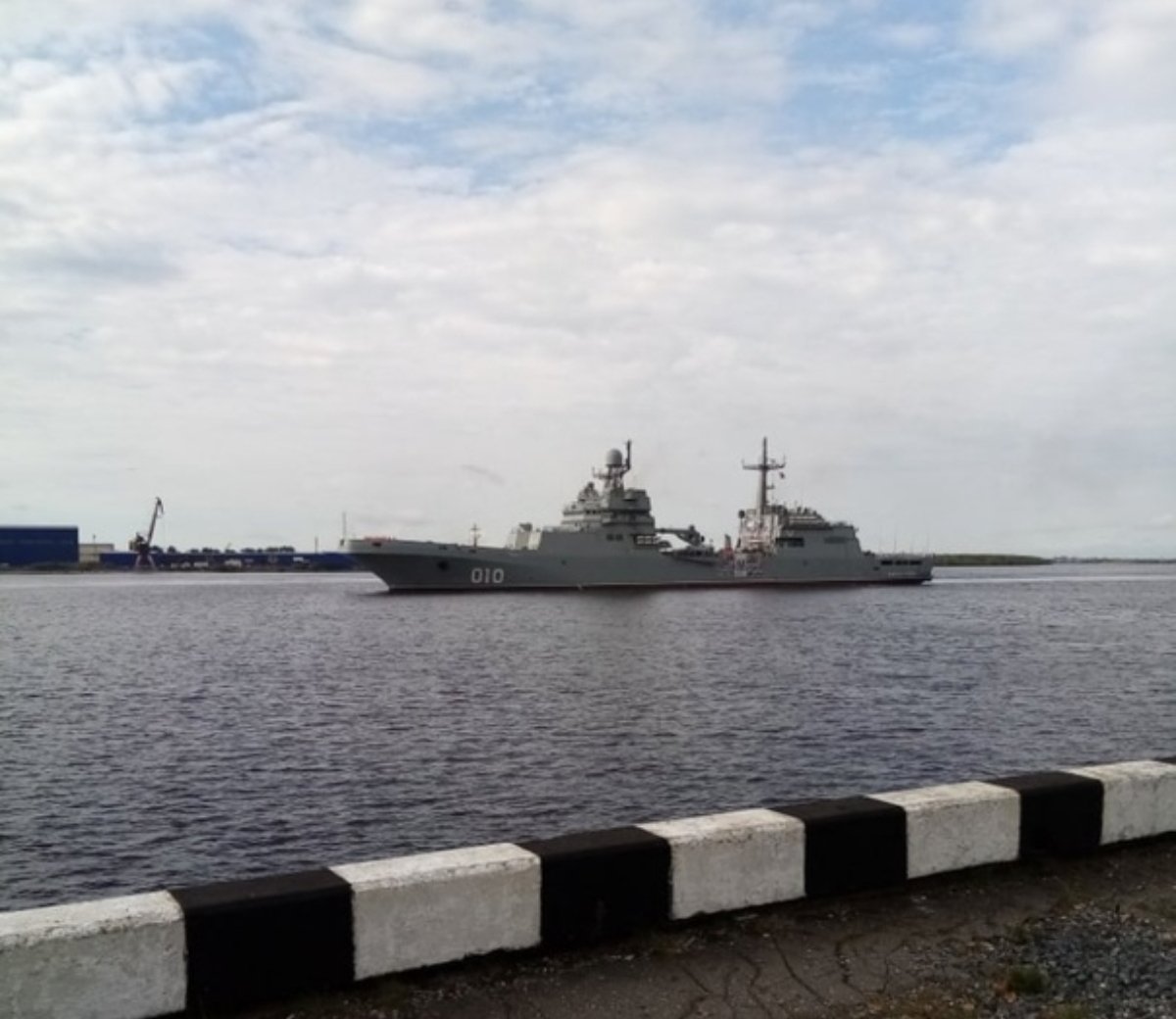
The Northern Fleet Ivan Gren-class LST Ivan Gren has arrived in Arkhangelsk today, the second port-visit of the “The Power is in Truth” propaganda campaign.
Photos via https://t.co/KMysjfgdjI