Exciting to see AI agents search genomic databases at this scale! Enjoyed talking with @nature about next steps, testing candidates with increasingly strong hard verifiers and feeding the results back into the loop
More on verification of AI outputs in biology and how it differs fundamentally from verification in coding and mathematics https://t.co/1oVw3RZ75r
AI titan Anthropic has launched a biology ‘wet lab’ where human scientists and AI agents will work together to design and conduct experiments. The company has released one of the team’s first finds: a peculiar pattern of DNA in the genomes of several giant viruses.
https://t.co/3uJJnf2OMK
AutoScientists - self-organizing agent teams for running scientific experiments over long time horizons @GaoShanghua@AdaFang_@NeurIPSConf 👇
https://t.co/JHAkbEwuKE
Excited that AutoScientists has been accepted to NeurIPS! 🎉 Huge thanks to my amazing co-authors @AdaFang_ and @marinkazitnik for making this work possible!
Our core idea is to let AI scientists self-organize into research teams.
There is no fixed workflow or central planner. Agents form teams around promising directions, explore in parallel, share successes and failures, and reorganize as new evidence emerges.
We see this as a step toward long-running, self-improving AI research systems, and ultimately toward recursive self-improvement for scientific discovery.
Paper: https://t.co/NDd97OYXXv
Code: https://t.co/OFcjizXpMS
In this piece we discuss how to define world models in biomedicine, how they relate to foundation models, agents, and other model classes, and which datasets we can use today versus which we still need 👇
Enjoyed discussing opportunities for using and evaluating AI in aging research with @Nature, and highlighting the latest paper by @biogerontology in @CellCellPress, which introduces an open benchmark and language models for AI in aging biology
https://t.co/gWkPvwTZEx
1M downloads and we’re just getting started! 🚀
ToolUniverse v1.5.0 adds new tools for structure prediction, genomics, scientific search, and running advanced ML models locally.
Thank you for building with us!
Excited to share that "World models for biomedicine" is out in @CellCellPress, by stellar @ayushnoori@njwfish@AdaFang_ Lukas Fesser
https://t.co/Eqq4pkDuWf
In AI, a world model represents the state of a system and simulates how it evolves under alternative actions
Game agents and robots use world models to test actions internally before executing them
We ask what world models mean for biology, from molecules to cells, tissues, and patients
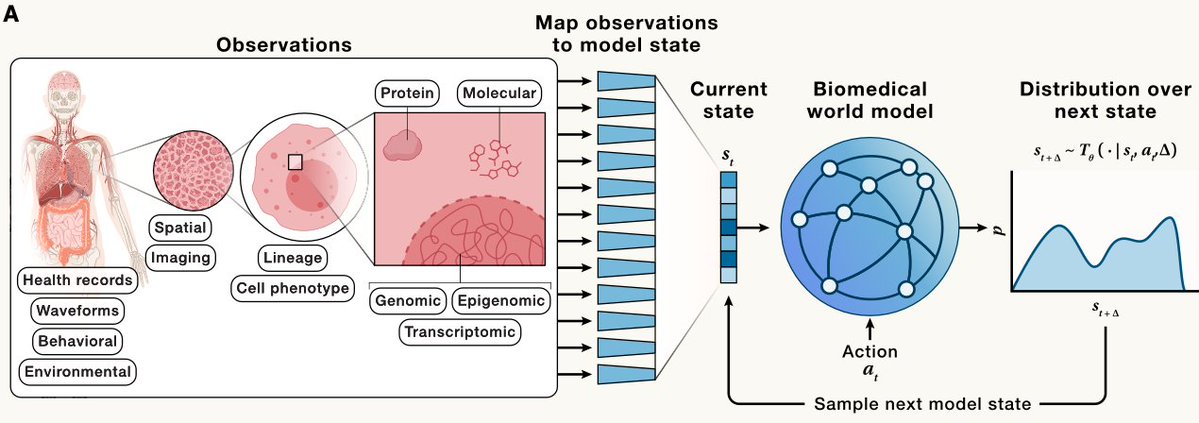
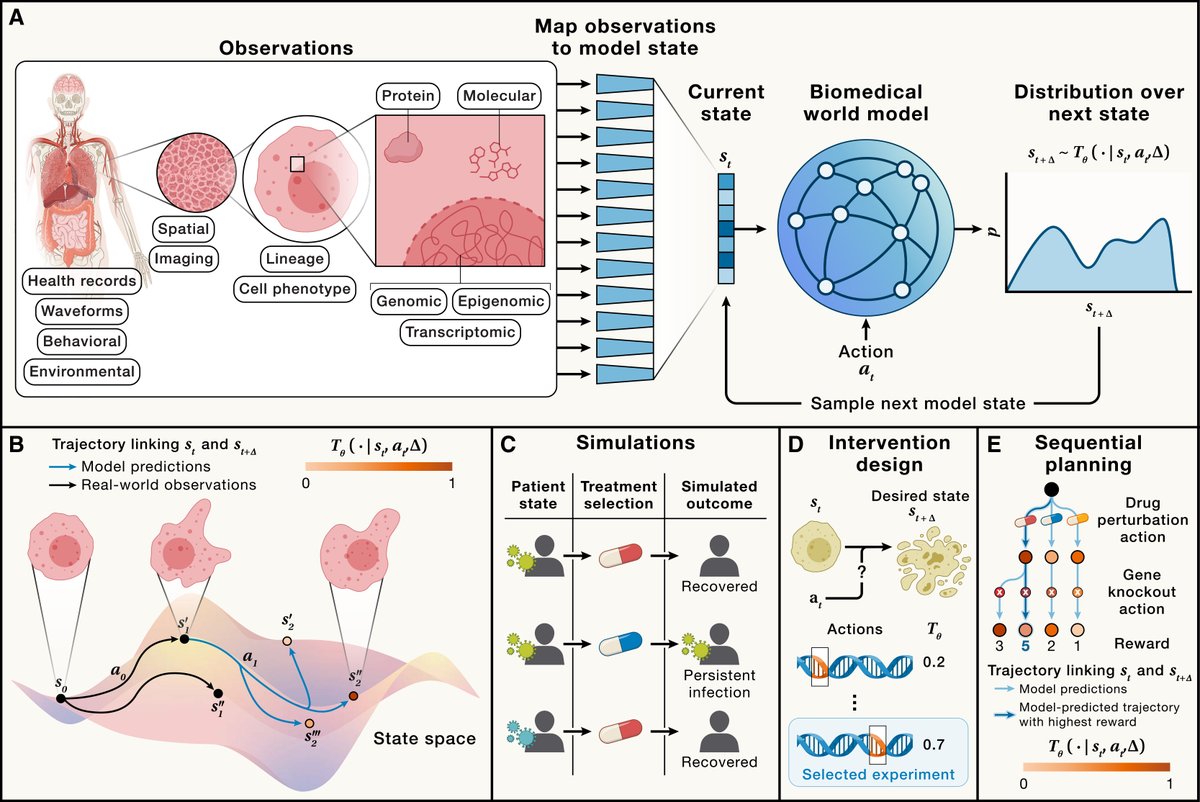
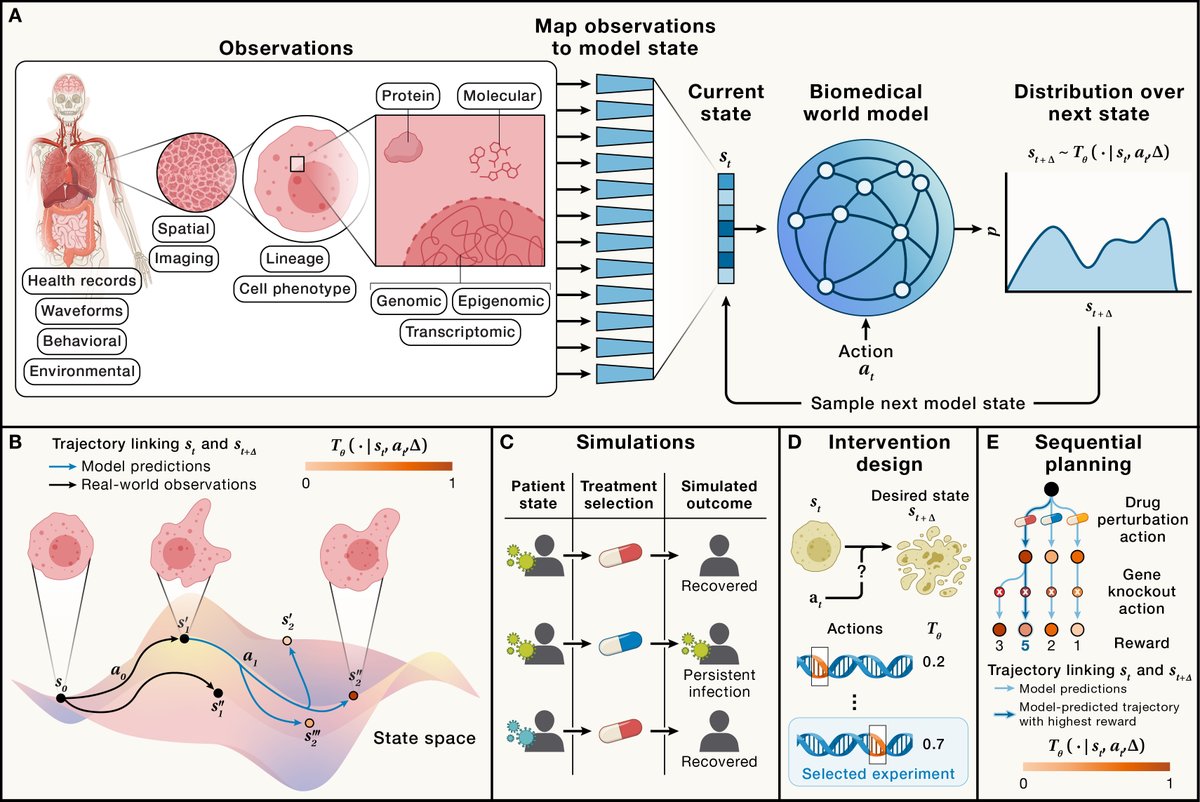
A biomedical world model maps observations across modalities to a model state, takes an action (a drug, a knockout, a change in culture conditions), predicts a distribution over next states, and continues simulation from its own predictions
What data and evaluations do we need to make this possible?
Three challenges need to be addressed in biomedical world models:
👉 Biological states are often partially observed
👉 Destructive assays produce snapshots instead of trajectories
👉 Observational data cover many states without interventions, while interventional data cover few states
Closing these gaps requires new data that link state, intervention, and resulting state over time. Non-destructive assays can measure the same cells repeatedly. Organoids and organ chips generate human-relevant interventional trajectories. Self-driving labs select informative experiments, and learning health systems embed randomization in routine care.
Simulating the consequences of an experiment before running it is a holy grail of AI for biology. How can we get there?
Our new paper, “World models for biomedicine,” which I led together with @njwfish, is out now in @CellCellPress’s special issue on AI in biology. We explore how biomedical world models could help scientists navigate the enormous space of possible biological interventions. In principle, they could:
🧪 Simulate how biological systems respond to interventions never previously tested
🎯 Search for interventions that drive cells, tissues, or patients toward desired states
🧭 Plan experimental campaigns over long time horizons
🤖 Power autonomous, closed-loop AI scientists
However, realizing this vision requires much more than calling a model a “world model.” What exactly defines a biomedical world model, and what capabilities distinguish it from related models? Where do today’s models already show promise, and where do they fall short? What new data and architectures are needed? What evaluations would demonstrate that a world model works?
We tackle these and other questions in this latest paper from @marinkazitnik's lab: https://t.co/musHiEcHMp
More below 🧵👇🏽 1/8
We wrote something about world models for biology! Taking a swing at discussing a new fad is tricky, but we gave it a shot. My perspective is that WMs in biology are really a series of complex missing data problems. This requires new forms of data and new methods to address.
This perspective was led by the incredible @ayushnoori and Nic Fishman, along with Lukas Fesser and @marinkazitnik
Read it here: https://t.co/5FVA7ok3oB
Biology does not need models that just describe the world. It needs models that predict what happens when we intervene.
In @CellCellPress Focus on AI in Biology, we lay out how to build biomedical world models, from the data they need to how they should be trained and evaluated.
AI has solved Navier-Stokes. What would it take for AI to make similar advances in life sciences?
In our latest preprint, led by @AdaFang_, we argue that, while fields like mathematics and programming can cheaply evaluate many AI-generated candidates at scale, "closing the loop" of hypothesis ➡️ experiment ➡️ revised hypothesis remains a central bottleneck in AI-driven biomedical discovery.
We outline a vision for autonomous AI scientists that:
🧠 Reason over scientific knowledge, multimodal data, competing hypotheses, and uncertainty across multi-loop campaigns lasting days to months.
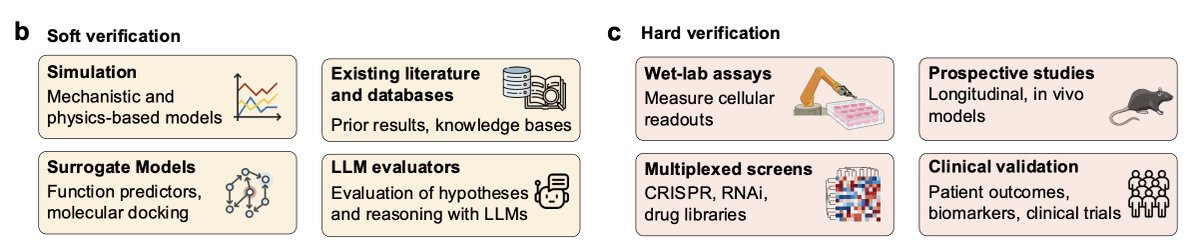
🔬 Learn under sparse and delayed feedback, combining soft verifiers (e.g., simulations, predictive models, and biological world models) with hard verifiers such as wet lab assays, robotic experiments, organoids, and clinical studies.
🎯 Allocate limited experimental budgets to tests with the greatest expected information gain.
We suggest that achieving this vision will require advances in long-horizon reasoning, process-based evaluation, uncertainty-aware exploration, self-driving laboratories, and human-on-the-loop oversight.
Read our paper here: https://t.co/etrBRjXC4O
More details below from @marinkazitnik. 👇🏽
Congratulations @NatureRevCancer on 25 years!
In this Viewpoint, six of us reflect on the past quarter century of cancer research and on where the field is heading
I write about agentic AI and human-AI co-science, and what it takes for them to work in cancer research
https://t.co/ozzqOV4Wvs
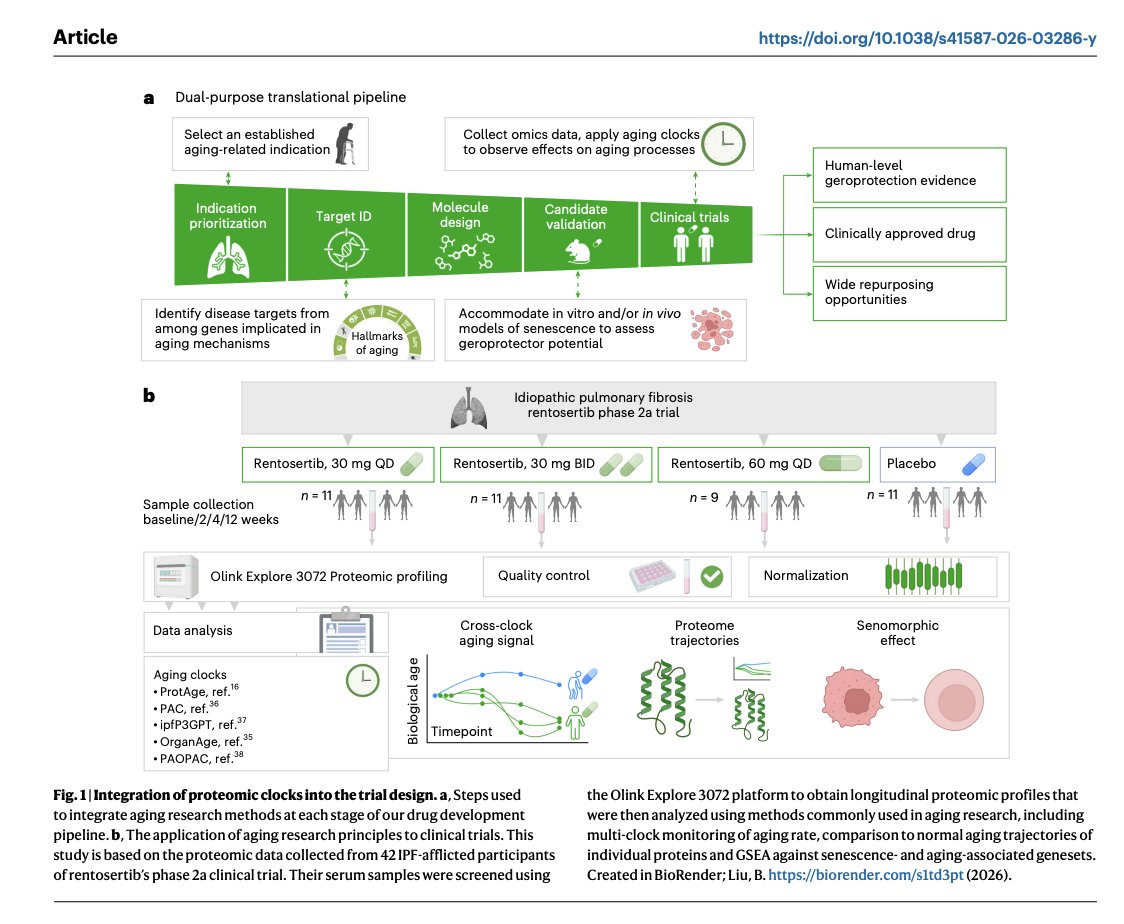
Congrats, Alex @biogerontology! The Phase 2a IPF trial that I commented on in @NatureMedicine https://t.co/9o7WeRwGOO now reads out through proteomic aging clocks
Dual-purpose clinical trial design, where aging endpoints are measured inside a disease study
My dear friends, I am happy to report the publication of the most important paper in my life to date (we have several great papers coming out but this is very special). Tomorrow, I will present this paper for the first time at the Nature AI Healthcare in Paris and will post a longer post on this story and its broader implications for how to conduct clinical trials. Please read it and comment on it.
Many thanks to the great co-authors of the study and everyone who contributed. Many thanks to the many reviewers (friendly and unfriendly) for spending so much time and helping make it better.
Link in the comments.
There is no autonomous scientific discovery without closing the loop between hypothesis and experiment.
Generating hypotheses is easy. The hard part is choosing what to test, learning from results, and what comes next.
We wrote about what it will take to close this loop in bio.