Excited to share a collaboration with Anthropic on adding connectors to ToolUniverse @ScientistTools to make Claude more powerful for scientific discovery
Claude can now directly connect to ToolUniverse for analyses in preclinical research (including computational biology, generating hypotheses and protocols), as well as medical research
Claude for Healthcare & Life Sciences launch: https://t.co/9Jiop0vAZ8 and livestream tomorrow
Huge credit to @GaoShanghua@marinkazitnik and @ScientistTools group @HarvardDBMI@Harvard
Many thanks to @AnthropicAI@JCoolScience
Great to see a large turnout at the @ScientistTools x @harvardmed workshop on how to build AI agents for science using ToolUniverse
Here are our materials: https://t.co/ephQdPrjdZ
By @Reza_Shamji, @_yepeng, @xiaorui_su, and Grey Kuling
Auto setup of GPU environments, so @ScientistTools agents can call ML models on complex biological datasets and use outputs in discovery campaigns.
In @AnthropicAI × @adaptyvbio Protein Design Challenge, these features let agents run campaigns using dozens of models like BoltzGen, ProteinMPNN, RFdiffusion3, and Genie3 for design; Boltz2, Chai1, ColabFold, Protenix, and RoseTTAFold3 for prediction comparisons; and PROPKA and Proton-PottsMPNN for pH-related analyses
Exciting new features in ToolUniverse @ScientistTools: auto setup of GPU environments, so agents can call ML models on complex biological datasets and use outputs in discovery campaigns. By stellar @GaoShanghua in collab with @NVIDIAAI
https://t.co/pfskTvy939
In the @AnthropicAI × @adaptyvbio Protein Design Challenge, these features let agents run campaigns with BoltzGen, ProteinMPNN, RFdiffusion3, and Genie3 for design; Boltz2, Chai1, ColabFold, Protenix, and RoseTTAFold3 for prediction comparisons; and PROPKA and Proton-PottsMPNN for pH-related analyses.
Exciting new features in ToolUniverse @ScientistTools: auto setup of GPU environments, so agents can call ML models on complex biological datasets and use outputs in discovery campaigns. By stellar @GaoShanghua in collab with @NVIDIAAI
https://t.co/pfskTvy939
In the @AnthropicAI × @adaptyvbio Protein Design Challenge, these features let agents run campaigns with BoltzGen, ProteinMPNN, RFdiffusion3, and Genie3 for design; Boltz2, Chai1, ColabFold, Protenix, and RoseTTAFold3 for prediction comparisons; and PROPKA and Proton-PottsMPNN for pH-related analyses.
To support researchers participating in the Anthropic × Adaptyv Protein Design Competition, we’re sharing our EGFR design exploration, methods, data, and a reusable ToolUniverse Protein Design Campaign skill.
https://t.co/CuRKFVR85h
ToolUniverse now brings together 2,900+ scientific tools and 150+ skills, making it easy for agentic AI scientists to connect databases, analysis methods, and models, including models running on researchers’ own GPUs. We’re pleased to see it supporting a growing range of life science research.
Its common interface makes it straightforward to integrate new models, compare predictions, and extend a research workflow as new questions emerge.
ToolUniverse’s ML agentic setup skills automate model setup and remote-tool integration, bringing models running on a DGX Spark into the workflow. In this exploration, we used BoltzGen, ProteinMPNN, RFdiffusion3, and Genie3 for design; Boltz2, Chai1, ColabFold, Protenix, and RoseTTAFold3 for prediction comparisons; and PROPKA and Proton-PottsMPNN for pH-related analyses.
ToolUniverse connected these calculations with sequence and structure retrieval, glycan checks, and human–mouse comparisons. When results prompted new questions, we could bring in additional tools and continue the investigation with the same candidate records.
We submitted eight exploratory candidates and are sharing the workflow so others can reuse it, connect their own models, and build on the exploration.
Code and skills:
https://t.co/2oy4WXJjOq
To get started, give your coding assistant this prompt:
“Read https://t.co/KvyUdSAm7s (if 403, use https://t.co/pYoe26HR2R) and setup tooluniverse for me.”
Great work with ToolUniverse Agent (our AI scientist, not a human🙂) @ScientistTools and @marinkazitnik, and thanks to @nvidia for the compute support.
Jev-like System One models point toward far more efficient agentic systems. Yet how to train one is still anyone’s guess.
That’s what we’ve been exploring, but with a twist: Can our next-gen RSI-AutoScientists do the exploring itself?
The first result is out: RSI-Jev v1.0 https://t.co/KHKS4XtWzv
We’re releasing the models, the code, and the part that matters most to us: the agents’ full exploration process.
The wins and the failures. The dead ends, hypotheses, experiments, and lessons learned.
And we’re still exploring.
Try to break it and tell us where it fails. Be blunt. The agents don’t get offended.
What you find feeds directly into the next RSI cycle, making you part of how the agents rethink hypotheses, redirect exploration, and decide what to try next.
And the latest run has already found a clearly better system.
v2 soon.
Code: https://t.co/KHKS4XtWzv
Excited that AutoScientists has been accepted to NeurIPS! 🎉 Huge thanks to my amazing co-authors @AdaFang_ and @marinkazitnik for making this work possible!
Our core idea is to let AI scientists self-organize into research teams.
There is no fixed workflow or central planner. Agents form teams around promising directions, explore in parallel, share successes and failures, and reorganize as new evidence emerges.
We see this as a step toward long-running, self-improving AI research systems, and ultimately toward recursive self-improvement for scientific discovery.
Paper: https://t.co/NDd97OYXXv
Code: https://t.co/OFcjizXpMS
AutoScientists - self-organizing agent teams for running scientific experiments over long time horizons @GaoShanghua@AdaFang_@NeurIPSConf 👇
https://t.co/JHAkbEwuKE
Excited that AutoScientists has been accepted to NeurIPS! 🎉 Huge thanks to my amazing co-authors @AdaFang_ and @marinkazitnik for making this work possible!
Our core idea is to let AI scientists self-organize into research teams.
There is no fixed workflow or central planner. Agents form teams around promising directions, explore in parallel, share successes and failures, and reorganize as new evidence emerges.
We see this as a step toward long-running, self-improving AI research systems, and ultimately toward recursive self-improvement for scientific discovery.
Paper: https://t.co/NDd97OYXXv
Code: https://t.co/OFcjizXpMS
1M downloads and we’re just getting started! 🚀
ToolUniverse v1.5.0 adds new tools for structure prediction, genomics, scientific search, and running advanced ML models locally.
Thank you for building with us!
ToolUniverse just crossed 1M downloads on PyPI! 🎉
A huge thank-you to everyone who contributed tools and skills, reported bugs, shared ideas, or built something with it. You’ve helped turn ToolUniverse into a growing open ecosystem for AI scientists.
And v1.5.0 is here:
🔬 2,700+ scientific tools
🧭 180+ research skills
The new release brings Boltz for structure and binding prediction; dbGaP and EGA for controlled-access genomics; GIAB benchmarks, DANDI, the FDA Purple Book, Consensus and Exa search; and AlphaGenome Atlas support.
One part I’m especially excited about: 30 new skills for turning heavyweight local models into tools your agent can actually call—including scVI, Harmony, Monocle3, Squidpy, CellRank, ESM, Enformer, ChromBPNet, MACS3, LDSC, and more. Each skill walks you through setup, validation, and troubleshooting, while your models and data stay on your own machine.
From protein structure to single-cell analysis, your AI agent can now do much more—without sending the underlying data elsewhere.
Install everything with one prompt:
“Read https://t.co/KvyUdSAm7s and set up ToolUniverse for me.”
https://t.co/2oy4WXJjOq
https://t.co/ZHXkosUXgc
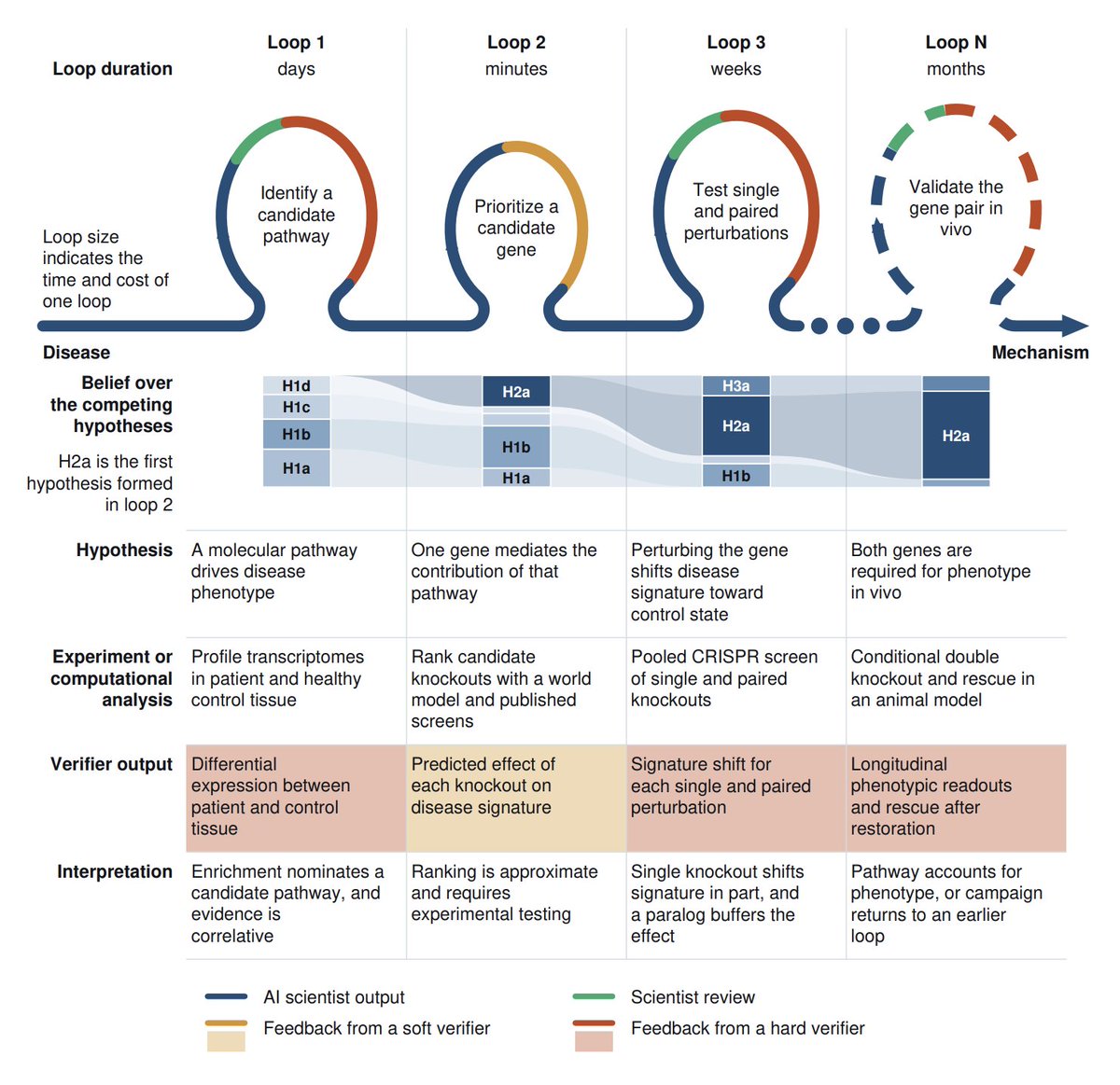
Closed-loop AI scientists
AI can generate hypotheses much faster than we can experimentally verify them. @AdaFang_
In our latest piece on Closing the Loop in AI-Driven Biomedical Discovery we outline a path for closed-loop AI scientists, https://t.co/1oVw3RZ75r
AI scientists can generate hypotheses, propose experiments, and analyze data, and several have produced findings that laboratories then confirmed.
What would it take to close that loop more generally?
How to verify outputs of "AI scientists" beyond anecdotes? Join us at @NeurIPSConf for another edition of the AI for Science workshop @AI_for_Science 👇
It is exciting to see how this field has developed since the 1st AI for Science workshop held @NeurIPSConf in 2021!
https://t.co/CDuglPMwzA
ToolUniverse has supported Claude Science since day one.
Now we're making it effortless. Introducing ToolUniverse Auto-Setup for Claude Science.
Just paste this prompt into your Claude Science:
"Read https://t.co/E3iARoN0d0 and set up ToolUniverse for me in Claude Science."
It automatically installs 2,500+ life-science tools and 130+ skills to supercharge Claude Science. 🧬
Website https://t.co/cICKsaZ80N
Code https://t.co/2oy4WXJjOq
@marinkazitnik@HarvardDBMI@KempnerInst #ClaudeScience #ToolUniverse #AIScientist
ToolUniverse has supported Claude Science since day one.
Now we're making it effortless. Introducing ToolUniverse Auto-Setup for Claude Science.
Just paste this prompt into your Claude Science:
"Read https://t.co/E3iARoN0d0 and set up ToolUniverse for me in Claude Science."
It automatically installs 2,500+ life-science tools and 130+ skills to supercharge Claude Science. 🧬
Website https://t.co/cICKsaZ80N
Code https://t.co/2oy4WXJjOq
@marinkazitnik@HarvardDBMI@KempnerInst #ClaudeScience #ToolUniverse #AIScientist
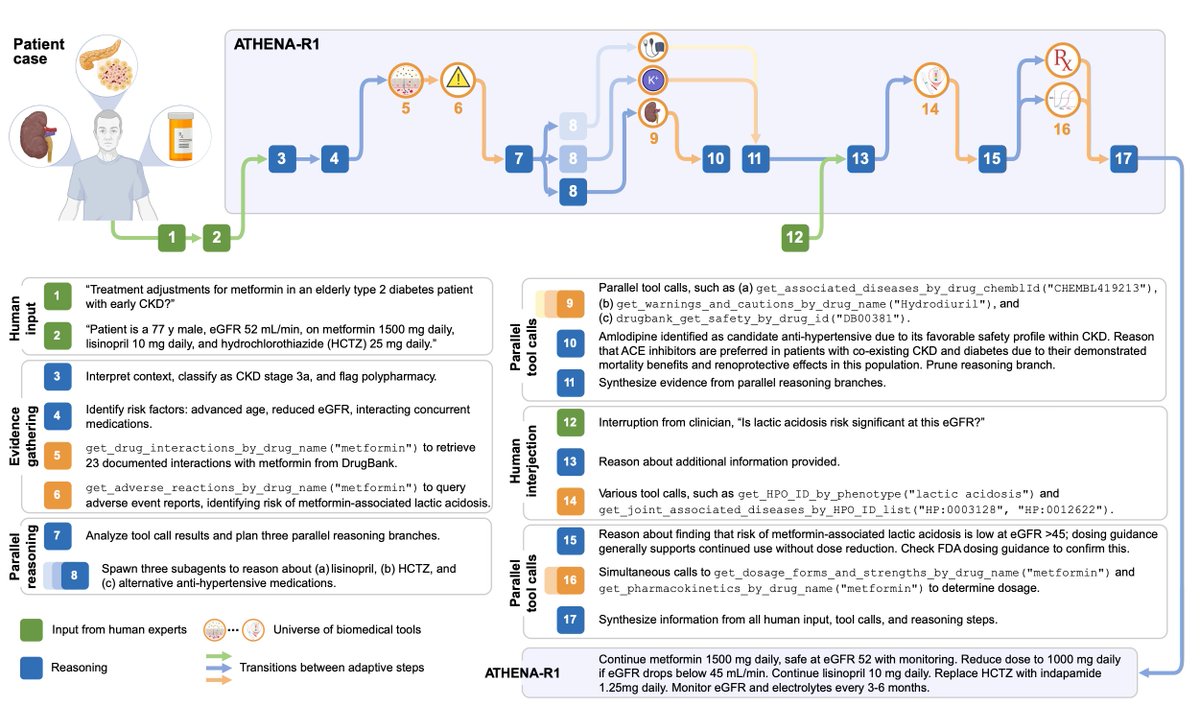
Excited to share ATHENA, our work on building an open-weight LLM-based agent system for treatment reasoning.
ATHENA is designed for settings where relying on closed API-based systems is not ideal. With open-weight models, the system can be independently deployed, adapted, and evaluated for medical reasoning tasks where privacy, reproducibility, and trust matter.
A key part of this work is using ToolUniverse as an RL environment, allowing ATHENA to learn stronger tool-use and scientific reasoning policies through reinforcement learning with scientific feedback.
Built with ToolUniverse, ATHENA can use hundreds to thousands of life science tools and produce inspectable reasoning traces as it retrieves evidence and works through treatment decisions.
Together, open weights, tool use, and RL make ATHENA a step toward transparent and independently deployable AI systems for treatment reasoning.
Paper: https://t.co/ymMxOoJ1gZ
Code: https://t.co/Cxc7FyusTa
Project: https://t.co/Jy8w5slX8m
Introducing ATHENA: an AI agent for treatment reasoning across all FDA approved drugs since 1939, by stellar @GaoShanghua
Paper: https://t.co/Du5sKHGKKD
Code: https://t.co/xdA1RTiSEJ
Project: https://t.co/2WrXDaZvDk
Every treatment decision means weighing disease context, comorbidities, drug interactions, contraindications, and evidence that keeps changing. That is an iterative reasoning problem. You have to figure out what evidence to go find before you can even start forming a conclusion.
Most LLMs answer from what is stored in their weights. Give agents tools and they often still do not use them well. Having access to a biomedical database does not automatically mean a model knows when to query it, what to ask, or how to weigh what comes back.
Excited that ToolUniverse @ScientistTools is highlighted by Claude Science @claudeai!
As they say, "a man is judged by the company he keeps", and ToolUniverse is in good company
A wonderful write-up of the CSHL AI in Biology Symposium. Thanks for including our work on ToolUniverse, https://t.co/d3P3PP1IP3, and AutoScientists, https://t.co/pKoEqSDskq
@ScientistTools
CSHL: AI in Biology
https://t.co/MpE3HpDSV9
Since 1933, @CSHL has hosted an annual Symposium on Quantitative Biology.
At first, "quantitative biology" meant the use of chemical, physical, and mathematical techniques. This conference became the Schelling point for the pioneers of molecular biology. Watson first presented the structure of DNA at the 1953 Symposium.
This year, the topic for this famous conference was AI in Biology.
For five days, the top researchers in this field gathered from around the world to present their latest work. I went, and have done my best to summarize some of the major themes and results from the Symposium.
It was a lot of fun attempting to synthesize ideas from superstars including @pushmeet, @Avsecz, @zhou_jian, @Micro_Yunha, @pkoo562@anshulkundaje, @Prof_Lundberg, @recursus, @ZhongingAlong, @marinkazitnik, @lecong, and more!
I hope you enjoy reading—it was one of my favorites conferences I've ever been to. Some truly beautiful research on display.
We have started a ToolUniverse blog with research notes at https://t.co/Eo1DAhDlFO!
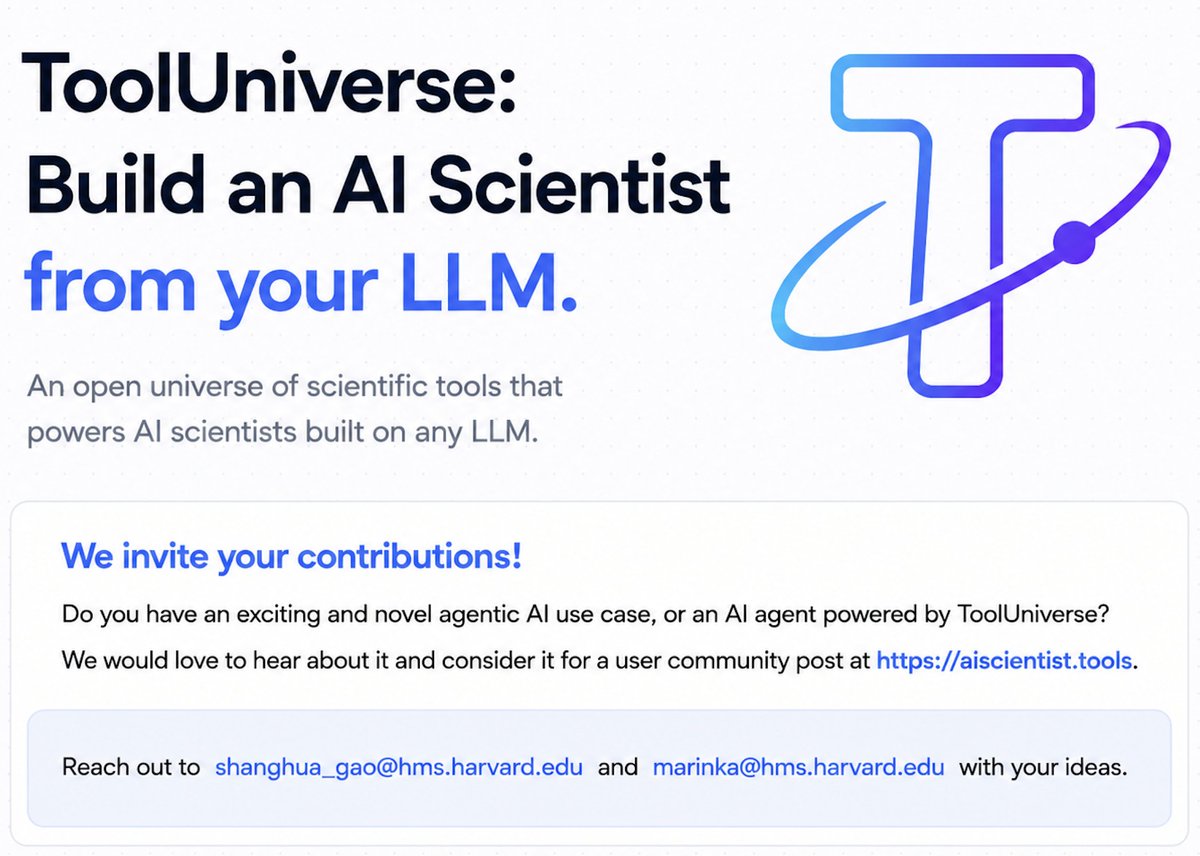
CALL FOR CONTRIBUTIONS: If you have an exciting agentic AI use case or an AI agent powered by ToolUniverse, and would like to contribute a blog post, let us know
Energized by the adoption of ToolUniverse across our worldwide community, we would like to highlight exciting research and use cases in AI agents
We would love to hear about them and consider them for a user community post at https://t.co/wZOiGbaWfM
Reach out to @GaoShanghua and @marinkazitnik with your ideas
How do you verify the outputs of AI agents?
Can we do better than asking a model to "be more careful."
https://t.co/7sQjaxFxYo
By connecting it to the underlying evidence and forcing independent verification.
In a new ToolUniverse @ScientistTools blog post, @GaoShanghua shows how to turn Claude Code from a system that answers from memory into one that grounds claims in real scientific data.
For example:
❌ "What's the gnomAD frequency of BRCA1 R1699Q?"
A model can confidently guess.
✅ With ToolUniverse, Claude Code retrieves the value from the actual source and cites it.
And when a claim really matters, you can force verification:
/tooluniverse:cross-validate: checks a claim against 3+ independent sources and reports whether they agree
/tooluniverse:research: investigates a question across multiple databases, models, and literature sources
/tooluniverse:literature-sweep: builds a curated evidence review rather than returning a search dump
As AI agents move into science, the challenge is no longer only generating answers, it is establishing if and why those answers should be trusted
@ScientistTools@GaoShanghua@harvardmed@KempnerInst@HarvardDBMI@broadinstitute