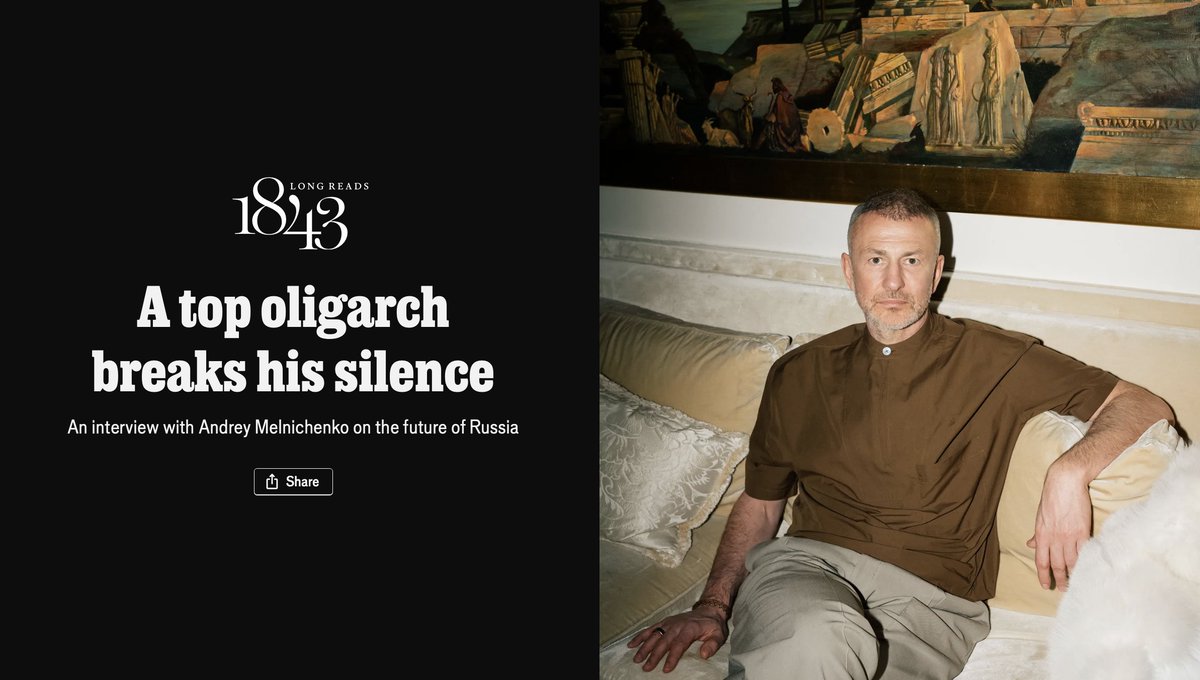
Russia’s most influential foreign policy analyst has issued an unusually swift commentary on Andrey Melnichenko’s Economist appeal.
Fyodor Lukyanov explains that Western readers are being encouraged to see it as “a sign of a split in Russia’s ruling class” and “evidence of rebellious moods” among big business, but he says that misses the real point.
In his reading, Russian big business was formed in the era of liberal globalisation, when serious entrepreneurs were expected to be “built into the Western system” and accept rules written by others. However, sanctions changed that and Russian business, he writes, became the object of “carpet-bombing” from the West, while its rights and interests in Western countries “largely ceased to be respected.”
As a result, the old globalised model is no longer possible, yet Russian big business, Lukyanov says, hasn't become isolationist and “still doesn't accept isolation,” but it's lost any remaining illusions of equal treatment by Western players.
The new task, he insists, is to build from “one’s own national base,” expand it, and seek diversified partnerships without autarky or becoming “an appendage” of China.
Lukyanov's conclusion is that the Soviet legacy is exhausted, integration into the West is no longer relevant, reliance on China is risky, and isolation is impossible. What remains is accelerated national development and a strategy Russia hasn't yet fully worked out.
An extraordinary interview with Russian billionaire Andrey Melnichenko in The Economist, in which he admits that the Russian elite made a historic mistake with its make money in Russia, but secure your wealth, family and future in the West system.
That model, he now says, has collapsed and his key line is blunt: “For the first time I feel I have no other country but Russia.”
So we have one of Russia’s richest men, and leading 'internationalists' who was living in Switzerland with property in France and Britain, acknowledging that the globalisation bargain which shaped the Russian elite for 30 years has broken down. And he obviously isn't a dissident, and not a pro-war zealot either.
No había podido ver está jugada en la cual Egipto reclamaba penal desde este ángulo.
Acá se nota clarísimo que es el jugador egipcio el que choca el pie del jugador Argentino, probablemente con la intención de dejarse caer al perder la pelota.
NO HAY FALTA!
@pisto_gol L’arbitro era sgradito, ma viene designato lo stesso. Per cui c’è l’ipotesi di illecito. 🤷♂️
E se invece non veniva designato e al posto suo un altro gradito, quindi non ci sarebbe un illecito?