@dr_stuartjames@olsonplanner This aggregate stat does not, but we do control for all other factors, and there is still a 7% gap. Here's the link to full report
https://t.co/vAGRQbDVOk
As we close out 2025, we want to say a huge thank you to our entire community!
In less than a year, more than 65,000 clinicians have come together to build one of the biggest and most comprehensive salary datasets in medicine. We now have 20,000+ anonymous salaries across all 50 states, plus MGMA specialty snapshots, all free for verified clinicians.
This was only possible because of every clinician who shared their salary, invited a colleague, or told a friend about Marit. We’re incredibly proud of what we’ve built together so far, and can’t wait for you to see what’s coming in 2026! Happy New Year! ✨
Salary transparency in medicine just took a big step forward...
🥳 We just crossed 20K real salaries shared anonymously on Marit, and it's thanks to clinicians like you who have helped build this community - one salary at a time.
And now we’re taking it further. We're excited to share that we just added MGMA 2025 benchmarks for your specialty - free for all verified clinicians on Marit who share their salary anonymously.
For the first time, you can see what your peers earn and how your compensation compares to the benchmarks employers rely on - all in one place.
🔓 It only takes 1 min to share your anonymous salary and unlock everything: https://t.co/5ytvMGAiU6 or use our link in bio
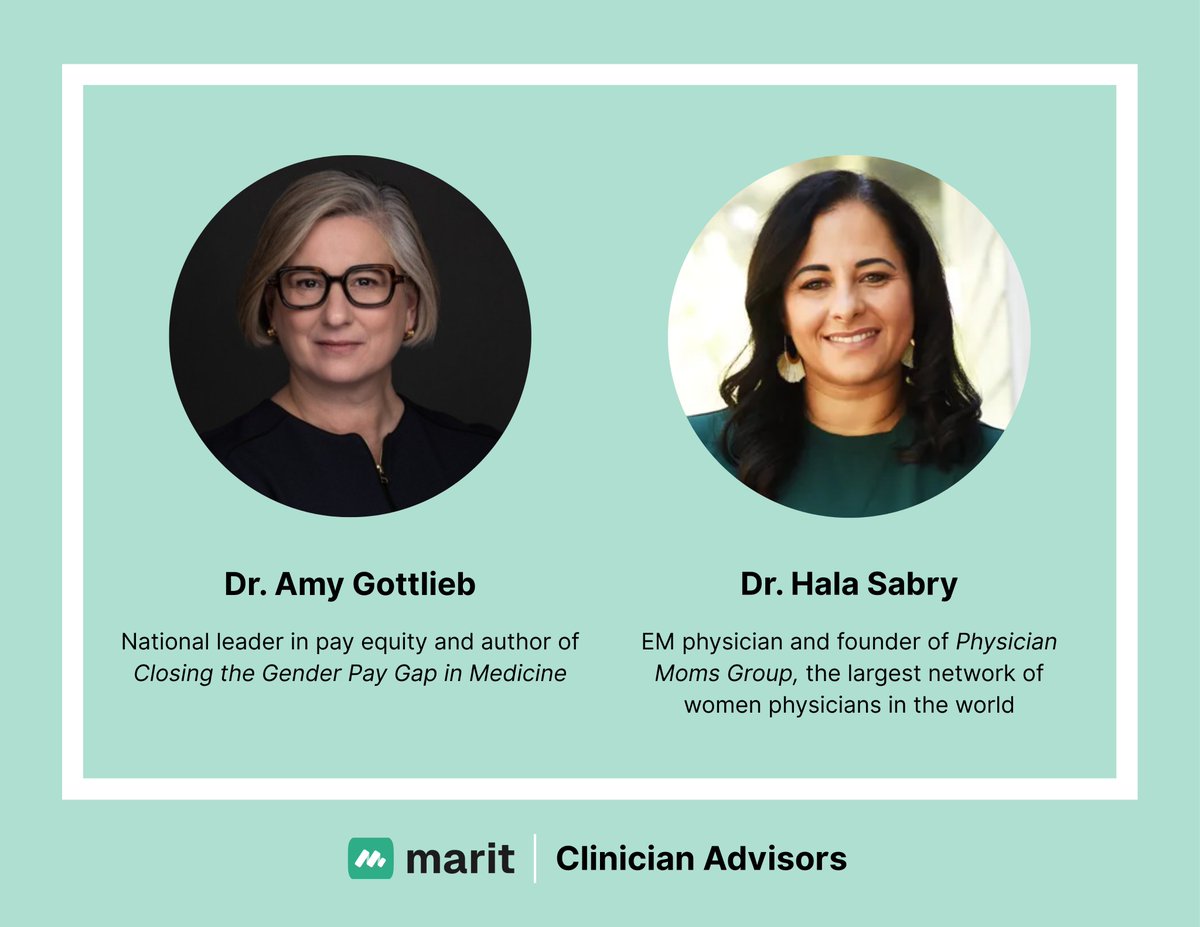
We’re thrilled to welcome two incredible physicians as Clinician Advisors to Marit Health: Dr. Amy Gottlieb and Dr. Hala Sabry
Both Dr. Gottlieb and Dr. Sabry have built incredible careers around the same mission that drives us: creating a more equitable, transparent, and supportive world for clinicians.
@amy_gottlieb is a nationally recognized expert in strategies that drive fair pay and professional opportunity, and the author of Closing the Gender Pay Gap in Medicine. Dr. Gottlieb has led the national conversation about how to close the gender pay gap in medicine through her publications, speaking engagements and leadership roles. Her work has helped shape compensation practices across academic and healthcare institutions nationwide.
@drhalasabry is an emergency medicine physician and founder of @PhysicianMomsGp, the largest community of women physicians in the world. Dr. Sabry is also the creator of National Women Physicians Day, a nationally recognized holiday and movement that elevates gender equity and representation in medicine. She brings deep expertise in physician advocacy and community building.
Together, they’ll help further Marit’s work in promoting pay equity, transparency, and collective empowerment for all clinicians.
We’re honored to have their leadership as we continue building towards our mission of empowering all clinicians to thrive in their careers.
Read the full announcement: https://t.co/ubHeAloiDS
Physicians: If you don’t know exactly how your comp is calculated, you’re flying blind.
Here’s how to figure out what you’ll actually take home before HR’s “projected earnings” fairy tale burns you.
👇🏻 🧵
@justindubinmd@CMSGov Thanks for flagging this. We have hundreds of urologists on Marit, so we will share this within our community as well and work on a deep-dive on the impact of these changes to put together a response
@anals_of_IR We collect detailed anonymized salaries on Marit as well, and these numbers line up with our data too - median $580k for IR
https://t.co/BErdNo6lFk
@olsonplanner@Flyers420_69@anals_of_IR Thanks for the tag. Yes, this was published by us and the full deep dive on the intra-specialty variance is here @Flyers420_69
https://t.co/be1rT8n4sv
And here's the deepdive on Academics vs PP
https://t.co/2RdwMcz8hR
How do wRVUs vary by specialty? Physician compensation is increasingly shifting to wRVU-based models - but the #wRVUs and reimbursement rate per wRVU varies widely by specialty.
The number of wRVUs you can generate largely depends on how CMS assigns Relative Value Units (RVUs) to different procedure codes. Unfortunately, Primary Care and related specialties like Pediatrics, Family Medicine, and Internal Medicine typically generate fewer wRVUs due to the nature of their high-volume, shorter duration visits.
Adding to the challenge, reimbursement rates ($/wRVU) for these specialties are often lower since they rarely benefit from significant facility fees.
This creates a double-whammy: fewer wRVUs at lower reimbursement rates.
On the other hand, surgical and procedural specialties like Neurosurgery, Orthopedics, and Cardiology typically produce higher wRVUs at higher reimbursement rates, driven by higher complexity, longer duration procedures, and associated facility fees.
Combine these factors, and the compensation gap between these specialties can be as large as 4x
@olsonplanner@pgipe Thanks for the ping. Yes!
Median is $53 / wRVU and median total wRVUs is 12,400. You can look through the individual anonymized salaries here. Hope this helps!
https://t.co/Ui0KNEiyuH
@imghelpinghand Thanks for tagging @AhmedElkomiMD@imghelpinghands you can see all the latest physician salary benchmarks on Marit and filter to NY State. These are based on anonymous and verified salary contributions by physicians
https://t.co/xCzXygFxiq
@TheAndrewWoods@olsonplanner Yes - you are exactly right, we bundled all physiatrists in that chart above.
PMR - Pain is more heavily private practice and averages $450k (https://t.co/5ddm1bcX25), while PMR - General is a mix of Academic and Non Acad, with Acad averaging $316k - https://t.co/tjRmGtVBMp
@TheAndrewWoods@olsonplanner It's the primary compensation model. Salary implies that they have a base salary and then a bonus based on productivity, quality, etc.