Assistant prof at UT Austin Finance (on leave), currently at Yale. Interested in household, public, and entrepreneurial finance, + aguardiente de agave
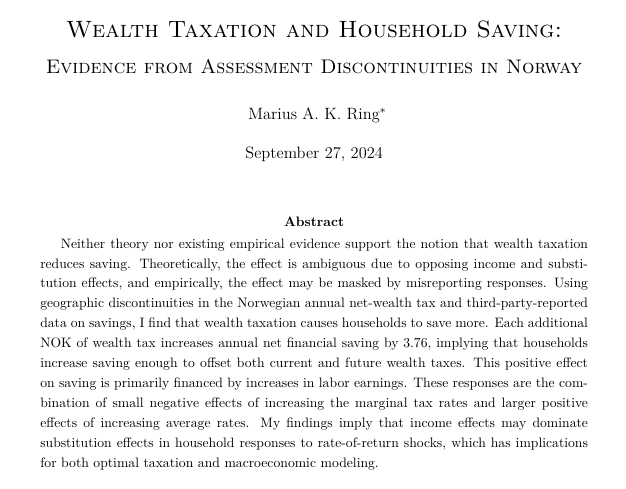
Very happy to see that my paper on the effects of wealth taxation on saving has found its new home. Short summary thread below. Special thanks to @DimitrisPapan20, @AnthonyDeFusco, @ProfNoto for bearing with me while I turned a research idea into a JMP!
Norway's controversial 2021–2024 reforms nearly doubled the tax on business wealth. Firms of affected owners did not invest less, and outmigration was limited to the very top, from @Mariusring https://t.co/keQcBoXwSk
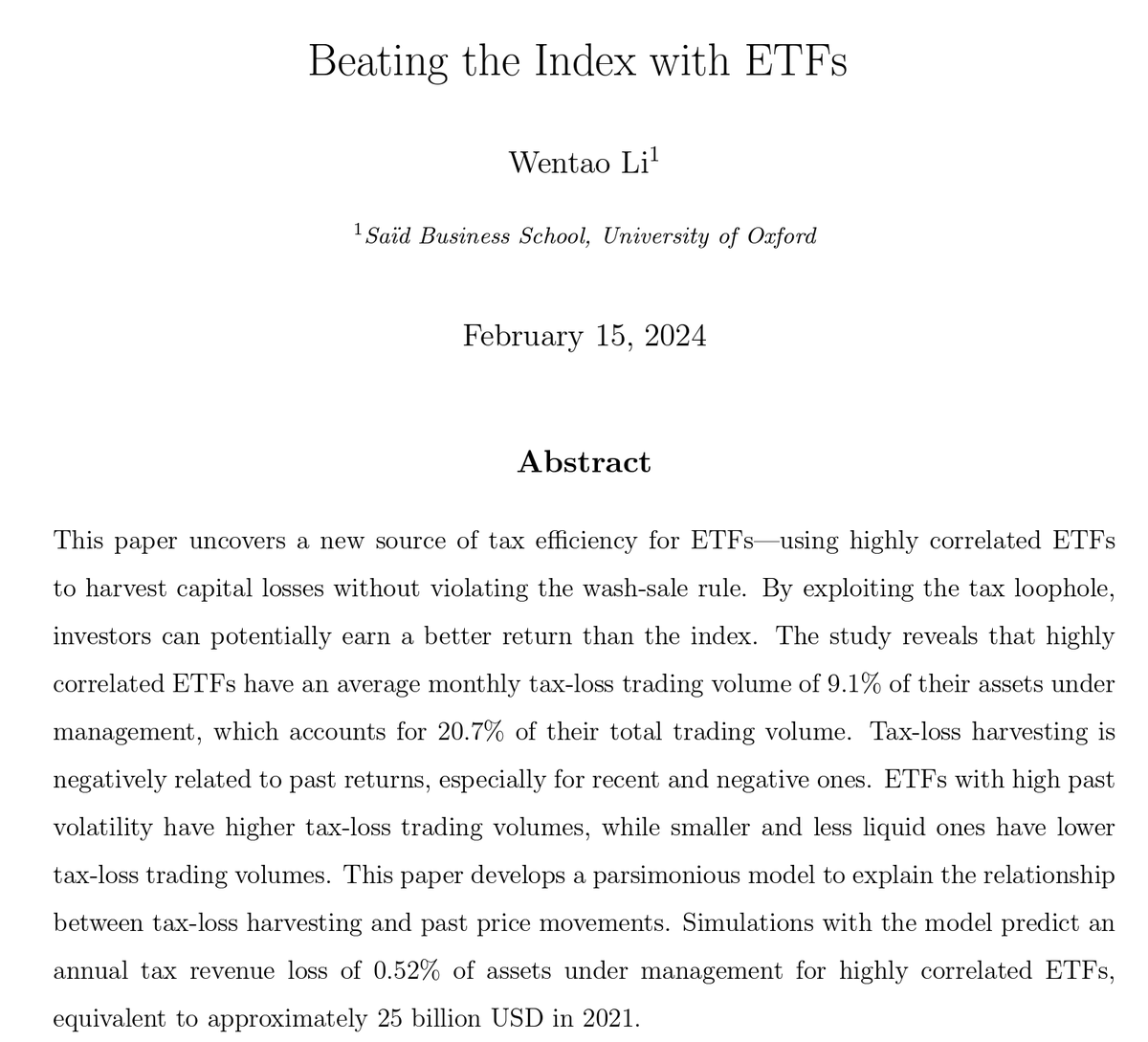
Investors can use highly correlated ETFs to harvest capital losses without violating the wash-sale rule. By exploiting the tax loophole, investors earn a better return than the index.
The annual tax revenue loss is equal to approximately $25 billion.
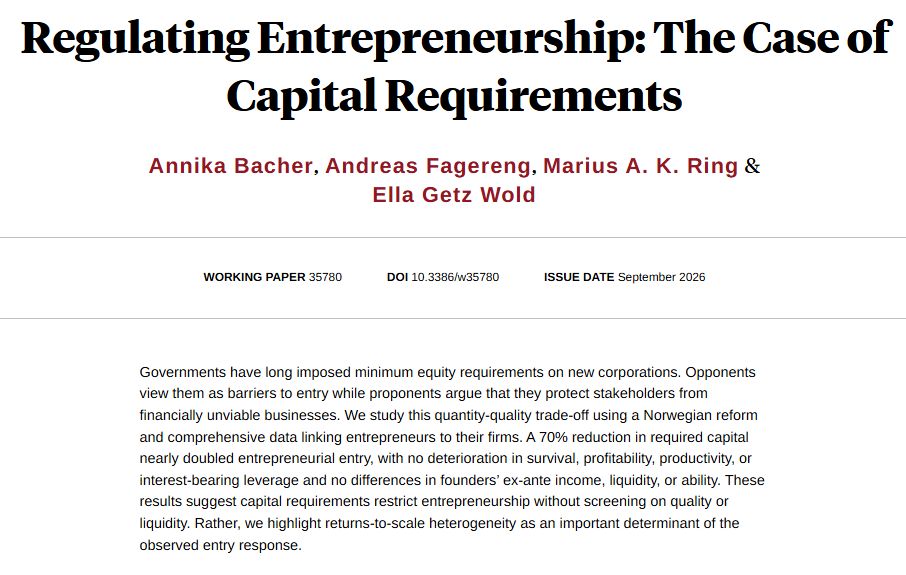
New evidence shows that incorporation capital requirements substantially reduce entrepreneurial entry without screening on entrepreneurial quality, from Annika Bacher, Andreas Fagereng, @Mariusring, and Ella Getz Wold https://t.co/S3VNTnVSjf
In the July issue, "Using Rich Lists to Study the Super-Rich and Top Wealth Inequality: Insights from Switzerland" by Enea Baselgia and Isabel Z. Martínez https://t.co/jH5Dj6eArO
📢 Hiring: Predoctoral Researcher @KOF_ETH to work with me on an SNSF-funded project on profit shifting, tax competition & tax havens. 70%, 1-year, starts Nov 2026. Great fit for anyone into public econ/taxation 👇
https://t.co/MkiAYruAxV
I'm 75% through my Fable usage on the 20x plan. Here are my impressions:
1. Fable has made incisive product-level judgments I haven't seen from any other model. A good comparison here is the quality of advice my PhD advisor, who won a Nobel in economics, would give on any big picture career or life advice, or any advice on anything in economic history.
Fable cannot give Joel's quality of advice on areas in which Joel is an expert, but Fable can give Joel-tier (IMO) advice on areas on which it's an expert through its innate ability PLUS you giving it the right context.
2. I also applied Fable to a wiki-style repo I've created for career planning/strategizing. Some of the advice Fable gave was off base, but this was because of incomplete context in the wiki which I had to remedy rather than Fable's own errors. Fable's advice was quite good after remedying those errors.
3. I used @shadcn 's "improve" skill (https://t.co/KiNaVcra5U) on several repos. For me the results were not mindblowing, and it missed some improvements I later found through conversation with Fable. But I still think the skill is a good use of tokens.
4. GPT-Pro *is* comparable to Fable IMO, but since it's harder to use interactively, you can only really use it to get "static" feedback on some code or doc. I had Fable use GPT Pro with Oracle a few times and Fable commented positively on GPT Pro's feedback.
5. I didn't experience a single instance of Fable getting routed to Opus 4.8 by the security classifier. Here's the set of projects to which I used Fable:
- A software to automate decision making in causal inference (difference-in-differences, regression discontinuity, etc)
- A software to automate my video editing
- An economics literature review automation software
- Cleanup of my skills repo & optimization of my skills
- The aforementioned career planning repo
Overall I like Fable, and I'd be very happy if Anthropic consistently gave you 50% of your usage a week with Fable, like they have in this post-export controls trial period.
I wouldn't call Fable mind-blowing, but it is better than GPT-5.5, and I'd keep using it consistently if Fable was available on my subscription.
The key to optimizing Fable usage is delegating implementation to Opus or Codex.
Documenting strong but slow portfolio responses to a wealth-tax-induced shock to the equity premium that are consistent with adjustment frictions and moderate risk aversion, from Andreas Fagereng, Luigi Guiso, and @Mariusring https://t.co/CGGostIAvB
At @SOLE_Labor_Econ 2019, @san_muly and I met for the first time. Both graduate students, both with a JMP about first jobs.
We started working on our paper on FSU immigrants and firms in Israel shortly after.
7 years later it is wonderful to see it come out @JEEA_News 🙏
1/3👇
I’m sure I��m not the first one to say this, but Sergio Correia deserves a prize for his service to the profession. I bet if we added up just the amount of hours that reghdfe has saved economists since it came out, his contribution would be in the top 10 for applied research.
I'm very excited to join the NBER as a Faculty Research Fellow in the Public Economics program! I'm continuously inspired by the great economists I get to interact with at the public meetings. Many thanks to those who nominated me! @nberpubs
https://t.co/DLIHirRYSt
@aniketapanjwani If Mythos or some tamed version of it will be released soonish, is it worth switching from Claude as the baseline? And do you think the new desktop app is (weakly) better than just using Claude on the terminal? Right now I’m struggling a bit with having 5+ terminal windows open
Now that there's a $100 ChatGPT Pro tier, it's a no brainer for any economist to choose ChatGPT over Claude at EVERY price point.
1. $100/mo now gets you access to Pro in the web UI, which is invaluable for academic work. See https://t.co/qPa92SE3Ge for how to optimally use Pro. No Anthropic model compares
2. $20/mo usage with Claude Code is a joke. $20/mo usage with Codex is limiting but not that far off of $100/mo Claude Code usage. I've myself experienced getting capped within an hour at $100/mo with Claude Code with normal usage. With $100/mo with Codex, for the typical economist's usage, you'll never hit 5 hour or weekly limits.
3. GPT 5.4 itself is a much better model than Opus 4.6 for almost everything economists would care about. CC has a better developed plugin ecosystem, subagents in CC work better IMO, and CC IMO is by default a better writer. For anything else - helping you understand papers, write code, plan out structural estimation, think through identification arguments, choose between estimators - I'd prefer Codex.
4. Whenever OpenAI has an outage, they reset usage for everyone, and they keep extending the length to which you get double usage from your subscription (now until end of May!). Anthropic is crunched heavily for compute and seems to be both explicitly (
https://t.co/ZkK5Zmxjoj) and perhaps surreptitiously (https://t.co/hQKb4FTHWk) trying to restrict their compute provision.
5. The Codex Desktop app is hands down the best interface for agentic coding right now. The Claude desktop app is probably the worst way to use Claude Code (go to /r/claudecode to read about all the bugs people encounter). There's a dearth of educational material about the Codex Desktop App though (which I will be solving soon)
I walk through each of these points in more detail in this YouTube video: https://t.co/9J5l8g0lPZ
So, what are the switching costs from Claude Code to Codex?
> The models feel different/act differently. You have to get used to it.
> Skills are an open format, so you can just copy all your skills over to ~/.agents/skills from ~/.claude/skills . There are some CC specific skill features which don't port over 1 to 1 to Codex.
> Subagents are configured differently and act differently in CC compared to Codex.
> Hooks are experimental in Codex and you have fewer options of harness actions onto which you can configure hooks.
I'd say if you haven't yet started with these tools, choose Codex for sure.
If you're hitting your Claude Code session limits regularly, then also switch to Codex for sure.
If you're not hitting your session limits, or you have a $200+ budget, I'd recommend getting a $20/mo Codex sub and just try it out/feel it out.
Codex and CC pair well together anyway, for example by having one write a plan/code and having the other review the plan/code.
I have Codex at a $200/mo subscription and CC at a $100/mo subscription - that works well for me, I use Codex 80% of the time and CC 20% of the time.
My #EconJMP, “The Labor Market Returns to Customized Job Training”, examines how subsidized firm training that aligns skill supply with skill demand affects workers and whether subsidies generate benefits that justify public investment.
Website: https://t.co/71S8CS0rHF
I’m on the #EconJobMarket! 🎓
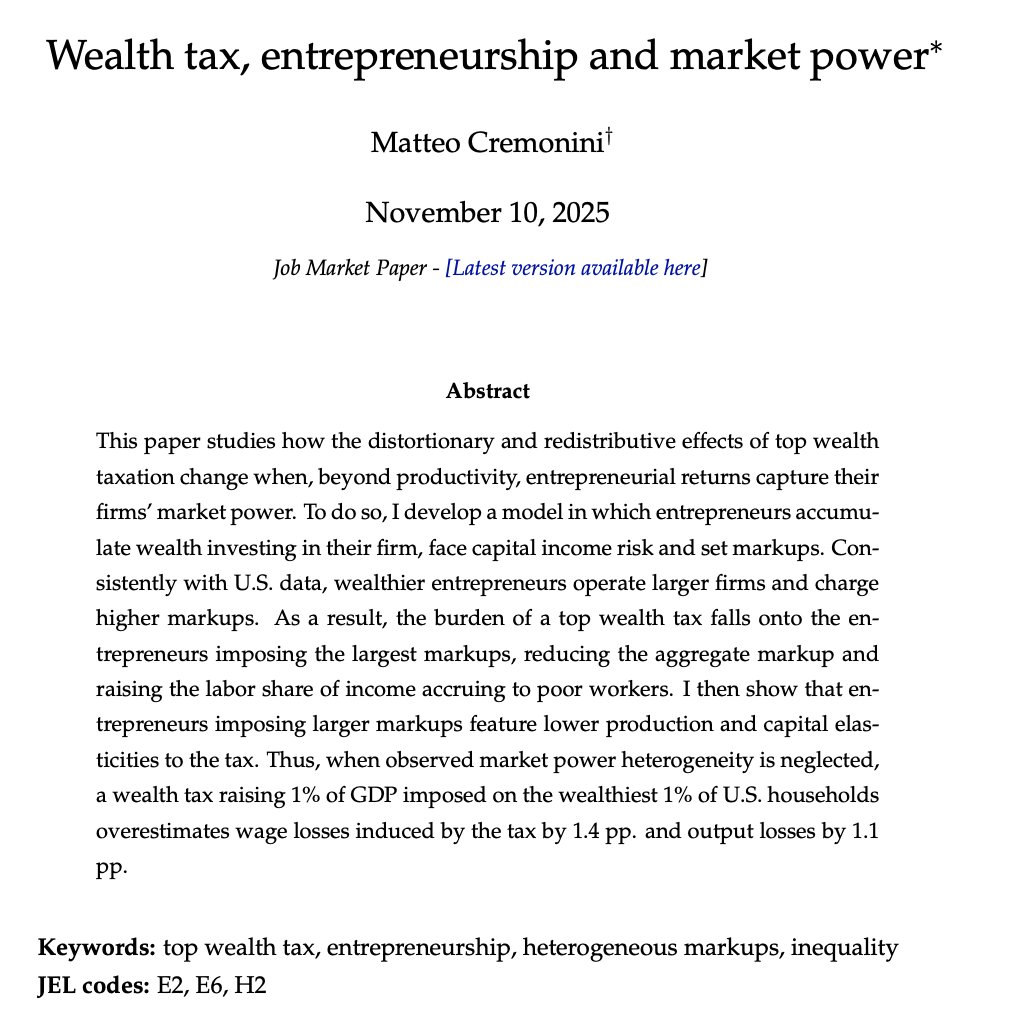
The wealthy earn high returns from their entrepreneurial activities, should we tax them?
My JMP shows a top wealth tax creates smaller distortions and stronger redistribution when high returns reflect market power, not just productivity.
👇 More
@Summers_AD@WouterLeenders@LevyAntoine@arunadvaniecon I'm not sure the Nov 29th 2022 announcement (can no longer escape CGT by spending 5 yrs abroad) was announced or "expected" earlier that year. Subseq changes were likely expected. Not clear to me how this would materially affect paper's interpretation (where data ends in 2022)
@LevyAntoine@WouterLeenders@arunadvaniecon@Roberto__Iacono Wasn't the main feature of exit tax (spending 5 yrs abroad doesn't erase unrealized CG) unexpected until it was announced as part of an agreement between the government majority coalition parties on Nov 29th 2022 (to be effective as of that date as well)?
Finance dept at BI Norwegian Biz School in Norway is hiring! Excellent department that spans many fields, co-located w/ a great econ dept, attractive teaching load, unique admin data opportunities, and v. nice place to live. Job post below
https://t.co/s5h1UVC0M2