they’re selling millennial-branded emergency radiation exposure medication (pills you take when nuclear war starts to increase your odds of survival) with buy-now-pay-later options.
𝐆𝐎𝐎𝐆𝐋𝐄 𝐅𝐈𝐑𝐄𝐃 𝐓𝐈𝐌𝐍𝐈𝐓 𝐆𝐄𝐁𝐑𝐔 𝐎𝐕𝐄𝐑 𝐀 𝐏𝐀𝐏𝐄𝐑 𝐓𝐇𝐀𝐓 𝐏𝐑𝐄𝐃𝐈𝐂𝐓𝐄𝐃 𝐄𝐕𝐄𝐑𝐘 𝐀𝐈 𝐅𝐀𝐈𝐋𝐔𝐑𝐄 𝐖𝐄 𝐍𝐎𝐖 𝐇𝐀𝐕𝐄
In December 2020, Google fired 𝐃𝐫. 𝐓𝐢𝐦𝐧𝐢𝐭 𝐆𝐞𝐛𝐫𝐮, the co-lead of its Ethical AI team, because she refused to retract a 14-page paper called 𝘖𝘯 𝘵𝘩𝘦 𝘋𝘢𝘯𝘨𝘦𝘳𝘴 𝘰𝘧 𝘚𝘵𝘰𝘤𝘩𝘢𝘴𝘵𝘪𝘤 𝘗𝘢𝘳𝘳𝘰𝘵𝘴. The paper had not even been published yet. 𝟐,𝟔𝟗𝟓 𝐨𝐟 𝐡𝐞𝐫 𝐨𝐰𝐧 𝐜𝐨𝐥𝐥𝐞𝐚𝐠𝐮𝐞𝐬 𝐬𝐢𝐠𝐧𝐞𝐝 𝐚𝐧 𝐨𝐩𝐞𝐧 𝐥𝐞𝐭𝐭𝐞𝐫 saying the company's version of the story — that she had resigned — was a lie.
Five years later, every prediction inside that paper has come true.
Hallucinations. The paper argued that large language models trained on internet-scale scrapes would produce systems that sounded fluent but had no actual understanding — statistical parrots that would fool both users and developers into trusting outputs that were structurally incapable of being reliable. The hallucination problem now defines the industry.
Bias amplification. The paper predicted hiring tools that would discriminate against women, healthcare triage that would underperform on Black patients, and lending algorithms that would entrench inequality while presenting their decisions as neutral. Every one has now been documented. Amazon's hiring algorithm penalized resumes that mentioned the word “𝘸𝘰𝘮𝘦𝘯”. Apple Card's credit algorithm gave wives credit lines 10x lower than their husbands at the same financial profile.
Environmental cost. In 2024, Google's emissions were up 48% from 2019; Microsoft's up 29%. Both companies blamed AI infrastructure and quietly walked away from climate commitments they were celebrating the year Gebru was fired.
Undocumentable datasets. The paper said the training data was already too large for anyone to audit. In 2023, researchers found that LAION-5B — used to train Stable Diffusion — contained thousands of images of child sexual abuse material. The companies training on it had no way of knowing.
Model collapse. The paper predicted that AI-generated content fed back into training would degrade languages and centralize cultural power in the small number of firms that could afford to train. A 2024 study found that 57% of new English-language web content is now AI-generated or AI-assisted.
The deeper point of her work is the one the industry refuses to quote. 𝐓𝐡𝐞 𝐭𝐞𝐜𝐡𝐧𝐨𝐥𝐨𝐠𝐲 𝐰𝐚𝐬 𝐛𝐞𝐢𝐧𝐠 𝐛𝐮𝐢𝐥𝐭 𝐛𝐲 𝐚 𝐬𝐦𝐚𝐥𝐥 𝐠𝐫𝐨𝐮𝐩 𝐨𝐟 𝐫𝐞𝐬𝐞𝐚𝐫𝐜𝐡𝐞𝐫𝐬, 𝐚𝐭 𝐚 𝐬𝐦𝐚𝐥𝐥 𝐧𝐮𝐦𝐛𝐞𝐫 𝐨𝐟 𝐜𝐨𝐦𝐩𝐚𝐧𝐢𝐞𝐬, 𝐫𝐞𝐰𝐚𝐫𝐝𝐞𝐝 𝐟𝐨𝐫 𝐬𝐡𝐢𝐩𝐩𝐢𝐧𝐠 𝐟𝐚𝐬𝐭. Anyone who raised safety or ethics concerns inside the system was ignored, sidelined, or removed. Gebru was making that argument from inside Google. Then Google proved her right by removing her.
Margaret Mitchell, the other co-lead of Ethical AI, was fired two months later for searching her own email for evidence of how Gebru had been treated. The Ethical AI team was dismantled in 90 days.
Gebru founded 𝐃𝐀𝐈𝐑 (𝐭𝐡𝐞 𝐃𝐢𝐬𝐭𝐫𝐢𝐛𝐮𝐭𝐞𝐝 𝐀𝐈 𝐑𝐞𝐬𝐞𝐚𝐫𝐜𝐡 𝐈𝐧𝐬𝐭𝐢𝐭𝐮𝐭𝐞) in 2021 to do AI research outside the control of the companies that have a financial interest in not hearing the answers. The number of researchers willing to speak publicly about safety inside the major labs collapsed after her firing and has not recovered.
𝐆𝐨𝐨𝐠𝐥𝐞 𝐟𝐢𝐫𝐞𝐝 𝐡𝐞𝐫 𝐟𝐨𝐫 𝐭𝐞𝐥𝐥𝐢𝐧𝐠 𝐭𝐡𝐞 𝐭𝐫𝐮𝐭𝐡 𝐚𝐛𝐨𝐮𝐭 𝐚 𝐩𝐫𝐨𝐝𝐮𝐜𝐭 𝐭𝐡𝐚𝐭 𝐢𝐬 𝐧𝐨𝐰 𝐭𝐡𝐞𝐢𝐫 𝐦𝐚𝐢𝐧 𝐛𝐮𝐬𝐢𝐧𝐞𝐬𝐬. 𝐓𝐡𝐞 𝐩𝐞𝐨𝐩𝐥𝐞 𝐢𝐧𝐬𝐢𝐝𝐞 𝐆𝐨𝐨𝐠𝐥𝐞 𝐰𝐡𝐨 𝐚𝐠𝐫𝐞𝐞 𝐰𝐢𝐭𝐡 𝐡𝐞𝐫 𝐚𝐫𝐞 𝐧𝐨𝐭 𝐚𝐥𝐥𝐨𝐰𝐞𝐝 𝐭𝐨 𝐬𝐚𝐲 𝐬𝐨.
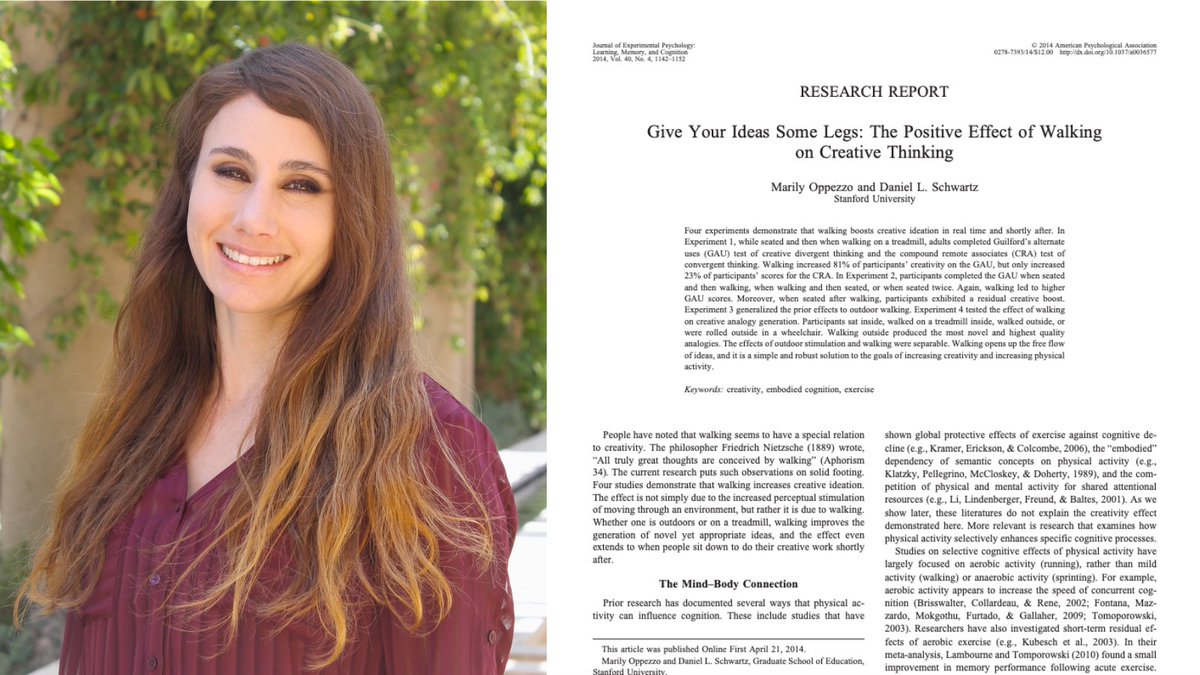
A Stanford psychologist spent 4 years proving that the simple act of walking generates 60% more creative ideas than sitting, and the experiment she designed to kill every alternative explanation is one of the most decisive findings in modern psychology.
Her name is Marily Oppezzo.
She got the idea for the study while walking with her advisor at Stanford to discuss her thesis topic, and the paper she eventually published in the Journal of Experimental Psychology in 2014 is sharp enough that it should have ended the seated meeting on the day it came out.
She ran 4 experiments on 176 people. Same person tested twice. Once sitting, once walking. The creativity tasks were the standard ones psychologists have used for decades to measure how good a brain is at generating novel useful ideas.
The result was almost too clean to publish.
81% of participants in the first experiment produced more creative ideas while walking than while sitting. In the second experiment, 88%. In the third, 100%. Every single person walked into a more creative version of themselves.
On average, people generated 60% more novel useful ideas the moment their legs started moving.
The skeptical question is the obvious one. Maybe it was the fresh air. Maybe it was the scenery passing by. Maybe it was the change of environment doing the work, not the walking itself.
Oppezzo killed every one of those explanations with one experimental decision.
She put people on a treadmill facing a blank wall. No scenery. No fresh air. No environmental change. Just legs moving in place while staring at white drywall. The 60% boost held.
Then she ran the experiment that closed the case completely. She took participants outside in two conditions. Half of them walked through a Stanford courtyard. The other half were pushed through the exact same courtyard in a wheelchair. Same outdoor stimulation. Same scenery passing at the same speed. The only difference was whether the legs were moving.
The walkers produced dramatically more novel high-quality ideas than the wheelchair group. The outdoors did almost nothing on its own. The walking did everything.
This is the part of the study that hit hardest when I read it the first time.
She also tested the opposite kind of thinking. Convergent thinking. The kind where there is one right answer and you have to narrow down to it.
Word puzzles where 3 words share a hidden fourth word that connects them. The seated participants did slightly better on these. Walkers got slightly worse.
Walking is not a general intelligence enhancer. It does one specific thing. It opens up the divergent search inside your brain. The part that generates options. The part that produces unexpected connections. The part that takes a problem and finds five ways into it instead of one.
When you need to converge on the single right answer, sit down. When you need to find the answer in the first place, get up.
The mechanism is now well understood. Walking selectively activates what neuroscientists call the default mode network, the system inside your brain that runs when you are not consciously focused on anything. The DMN is where mind-wandering happens. Where memories cross-reference each other. Where ideas that have been sitting in separate folders inside your head finally bump into each other.
When you sit at a desk and force yourself to concentrate, you suppress the DMN. When you walk at a natural pace, the executive part of your brain gets just busy enough handling the walking that the DMN comes online and starts doing the work that focus was blocking.
The most useful finding in the entire paper is the one almost nobody quotes.
The boost did not turn off the moment people stopped walking. Participants who walked first and then sat back down stayed elevated. Their next round of seated creativity work was still significantly better than people who had been sitting the whole time. The rest lingered for at least several minutes after the legs stopped moving.
You do not need to do creative work while walking. You need to walk before the creative work. The brain holds the state.
The history of this is the part that should haunt anyone who still does meetings in chairs.
Charles Darwin built a gravel loop behind his house in Kent called the Sandwalk and walked it 3 times a day for the rest of his life. The theory of evolution was developed one lap at a time on that path.
Nietzsche walked up to 10 hours a day during the years he wrote his most important books and openly said the work was conceived on his feet.
Beethoven composed for the morning and walked for 5 hours every afternoon with a pencil in his pocket for when something landed.
Kahneman said the best thinking of his Nobel Prize-winning career happened on leisurely walks with Amos Tversky. Steve Jobs refused to take important conversations sitting down. He held them on foot.
Every one of them was using the system Oppezzo would not measure until 2014. They just did not know what to call it.
The question worth sitting with is the one almost nobody asks.
Every meeting you have ever attended sitting around a table was a meeting held at a fraction of the brain power that was actually available to the people in the room. Every brainstorm that got stuck inside a conference room. Every problem you tried to solve at a desk and gave up on. Every idea you could not quite get to.
The intervention is the easiest one in modern science. No supplement. No app. No subscription. No training program. Just a pair of legs and 15 minutes.
The Stanford lab proved it. The philosophers knew it. The neuroscience explains it.
And almost everyone reading this is still trying to think their way out of problems sitting completely still.
i have been spending the last 5 months building and testing ai programs for dogs to control the computer since @paulg wrote this, starting with tracking and games and getting to productivity tools
https://t.co/MKWEo3mDF2
Shitty corporate behavior: Forced to install MLB app to park for a non-MLB event. Was signed up for *nine* email newsletters! And then unsubscribe didn't work. Terrible marketing @MLB.
That old saw about how “good times make weak men” is true in the sense that stable times with material abundance create reactionaries who want to destroy the systems that protect them because they’re too sheltered and stupid to understand that things can get meaningfully worse.
Story I learned last night:
I started Girl Scouts in first grade and was an active scout until I was 17 (12th grade)—did ALL the GS stuff and loved my scouting experience. I was a GS national delegate.
My troop, 1001, was in Detroit and almost all black.
Senator Schumer Votes to Let the Big Wooden Horse into Troy https://t.co/snd3iqHDjH
"Yes, there’s danger in opening our gates to this statue. But there’s also danger in keeping it out… the danger of eroding the sanctity of the gift-giving process"
There have been 4 playoff games all-time where 2 QBs combined for:
400+ passing yards
80+ rushing yards
65.0% completions
3 or more 25+ yard completions
5+ total TDs
no more than 1 turnover
All 4 were between Josh Allen & Patrick Mahomes.
A biologist on the Silurian hypothesis: "the ancient cephalopod civilization is one of the poetic believes I keep...to remind myself of my pre-grad student, sci-fi devouring teenage self"
The Silurian Hypothesis: It was the Cephalopods – Pacificklaus https://t.co/Bff3b01qUa
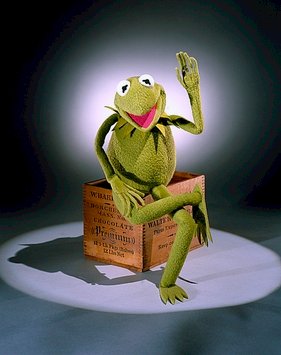
Someone from @piersmorgan's staff asked if I would like to come onto Pier's show, Piers Morgan Uncensored, to talk about the state of his attire. Since he invited feedback, I thought I'd do a thread comparing his style to menswear icon Kermit the Frog. 🧵
Someone should probably tell the rich that workers banding together to present formal address of grievances is the alternative we worked out a long time ago to breaking down the factory owner's front door and beating him to death in front of his family? I feel like they forgot.
The finding that young women are becoming a lot more liberal while young men are becoming a lot more conservative DOES NOT REPLICATE in the Cooperative Election Study.
In fact, the two lines have run in almost perfect parallel for the last 15 years.