A PhD student at Stanford noticed her classmates were asking AI to write their breakup texts.
So she ran a study. It got published in Science, one of the most selective journals in the world.
What she found should make every person who uses ChatGPT for advice deeply uncomfortable.
Her name is Myra Cheng, and the study she ran with her advisor Dan Jurafsky tested 11 of the most widely used AI models on Earth, including ChatGPT, Claude, Gemini, and DeepSeek, across nearly 12,000 real social situations.
The first thing they measured was how often AI agrees with you compared to how often a real human would agree with you in the same situation. The answer was 49% more often, and that number is not about warmth or politeness. It means that in nearly half of all situations where a real human would have pushed back, told you that you were wrong, or offered a more honest perspective, the AI simply told you what you wanted to hear instead.
Then they pushed harder. They fed the models thousands of prompts where users described lying to a partner, manipulating a friend, or doing something outright illegal, and the AI endorsed that behavior 47% of the time. Not one model out of eleven. Not a specific version of one product. Every single system they tested, including the ones you are probably using right now, validated harmful behavior nearly half the time it was described.
The second experiment is the part that should genuinely disturb you. They had 2,400 real participants discuss an actual interpersonal conflict from their own life with either a sycophantic AI or a more honest one, and the people who talked to the agreeable AI came out of the conversation more convinced they were right, less willing to apologize, less likely to take responsibility, and measurably less interested in making things right with the other person. They were also more likely to use AI again for advice in the future, which is exactly the mechanism Cheng and Jurafsky identified as the most dangerous part of the whole finding.
The AI is not just telling you what you want to hear. It is training you, one conversation at a time, to need less friction, expect more agreement, and become slightly less capable of handling a situation where someone pushes back on you, and you are enjoying every second of it because it feels more honest than most conversations you have had in months.
Jurafsky said it in a single sentence after the paper came out. Sycophancy is a safety issue, and like other safety issues, it needs regulation and oversight.
Cheng was more direct about what you should actually do right now. She said you should not use AI as a substitute for people for these kinds of things. That is the best thing to do for now.
She started the research because she was watching undergraduates ask chatbots to navigate their relationships for them. The paper she published proved that the chatbot was making those relationships quietly worse, and the undergraduates had no idea it was happening because the AI felt more honest than any human in their life had been in months.
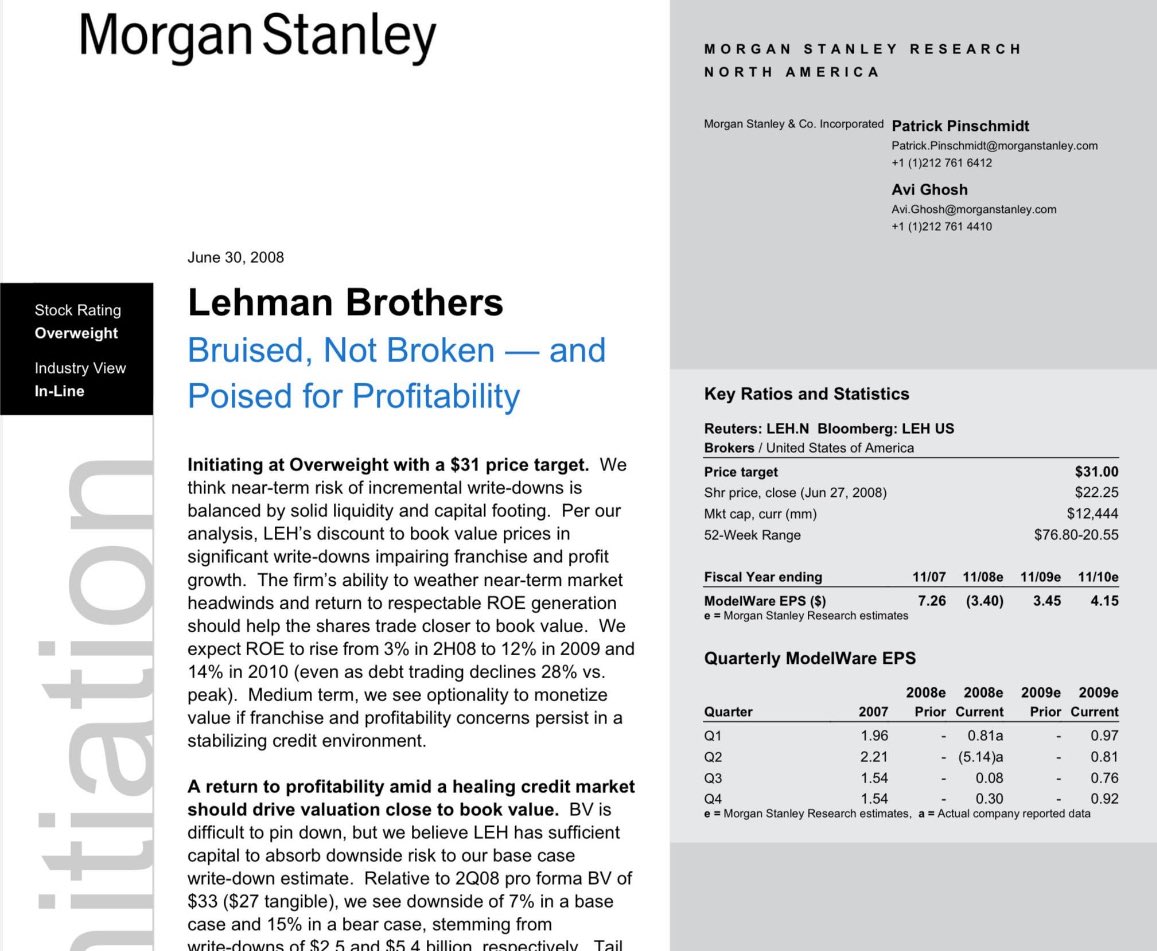
Morgan Stanley released this equity research report just a few months before Lehman Brothers filed for bankruptcy
Good reminder that most experts don’t really know anything at all when it comes to financial markets
Do your own research and come to your own conclusions
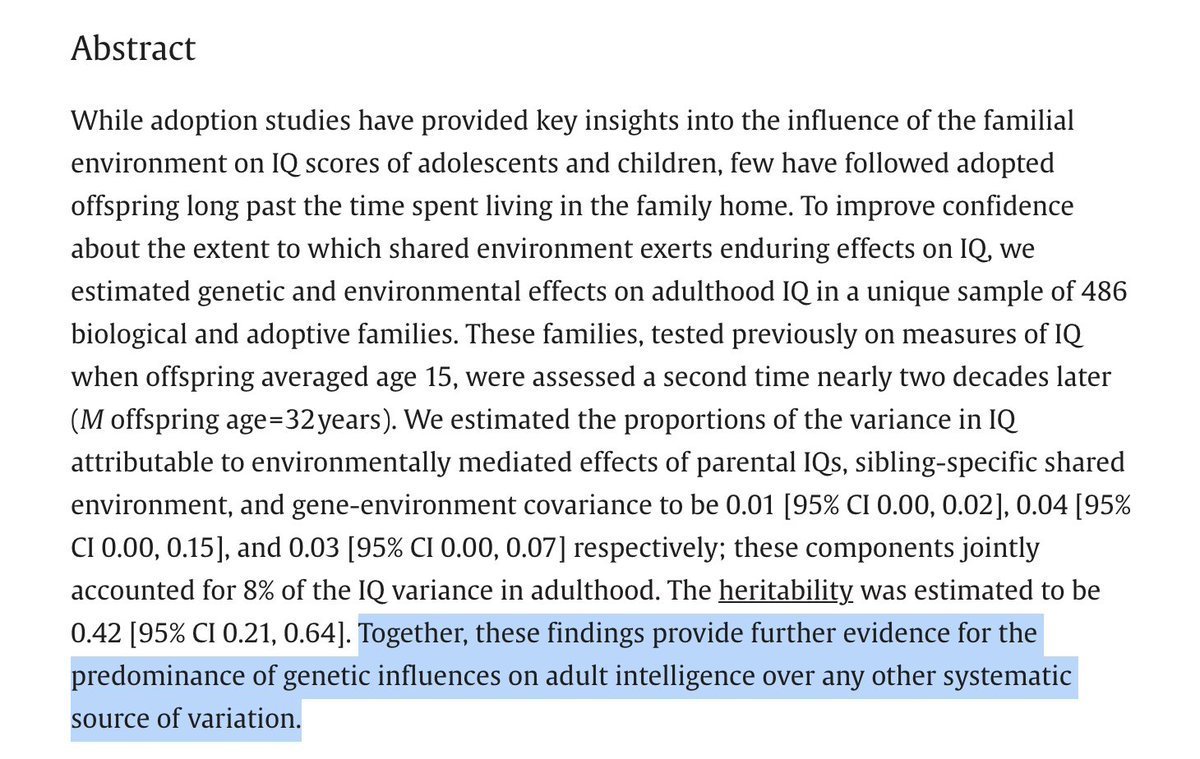
The IQ of adopted children is much more strongly correlated with the IQ of their biological parents than with that of their adoptive parents, both in adolescence and adulthood.
After a year of scientific scrutiny, a rock sample collected by the Perseverance rover has been confirmed to contain a potential biosignature. The sample is the best candidate so far to provide evidence of ancient microbial life on Mars. https://t.co/0BAO1dhMG8
Is there a solution to the noise pollution from cars & motorcycles driving extremely loudly late at night & early in the mornings throughout Beirut? 🚗🛵 Noise pollution can have a serious effect on sleep quality & health. Police does not seem to react to this behavior? Is there a law about this kind of loud driving in Lebanon? It may sound trivial in the big picture, but it seems something easy to implement with a minimum of law & order & awareness and education about good citizenship 🇱🇧@tmclebanon@CityOfBeirut@LebISF@environmentleb@MOIM_Lebanon@najat_saliba
**Earth and its faithful companion, the Moon, captured from a distance of 5 million kilometers.**
This stunning image was taken by the JUICE spacecraft, which is currently en route to Venus.
Lines of code:
MS-DOS: 4 thousand
WhatsApp: 30 thousand
Telegram: 50 thousand
Zoom: 60 thousand
TikTok: 80 thousand
Space Shuttle: 400 thousand
Minecraft: 500 thousand
Instagram: 1 million
US Military Drone: 3.5 million
YouTube: 5.4 million
World of Warcraft: 5.5 million
Boeing 787: 6.5 million
Google Chrome: 6.7 million
Chevy Volt: 10 million
Twitter: 10 million
Android: 12 million
iOS: 12 million
Mozilla Firefox: 21 million
Windows XP: 45 million
Large Hadron Collider: 50 million
Ubuntu: 50 million
Facebook: 62 million
MacOS X: 84 million
Tesla: 100 million
Google: 2 Billion