1) Comune per comune, spiaggia per spiaggia, il 50% deve essere sempre libero; 2) del restante 50%, il 20% attrezzato dai comuni, il 30% a bando; 3) sulle spiagge non deve rimanere alcuna struttura fra ottobre e aprile; 4) le concessioni non possono superare i 10 anni.
HADDOCK3 is the perfect chemistry and physics-based tool to enrich and complement the predictions made by machine learning algorithms in the post-AlphaFold era.
Check out the paper and the code!
🚀 Introducing HADDOCK3, the third version of the #HADDOCK software for biomolecular modelling. Here we've transformed the original, rigid protocol into a series of interchangeable modules that can be freely combined into custom workflows.
We then enriched the platform with powerful analysis tools and third party integrations, enabling a whole new range of modelling scenarios:
🔬 Alanine scanning
📊 Consensus scoring
🔁 Iterative clustering of models
🎯 Multi-interface targeting
...and many others!
Our webinar "Modelling antibodies in the post-Alphafold era: where are we now?" is next week on Tuesday 8 April at 15:00 CET
Don't forget to register ➡️ https://t.co/mb0BXaGkZ9
#antibody#HADDOCK#AlphaFold#proteindesign#compchem
Interested in #antibody modelling?
Marco Giulini will discuss the current state of antibody modelling in the post-AlphaFold era in our next webinar:
🗓️ 8 April 2025 (15:00 CET)
✍️ https://t.co/mb0BXaGkZ9
#HADDOCK#AlphaFold#proteindesign#compchem
Excited to share the latest #HADDOCK developments at the @BioExcelCoE conference, with some of the brightest minds in the field 🧬 amazing science and great atmosphere here in Brno!
Marco Giulini (@MarkDownThere) introduced #HADDOCK3 and told us about some of the remaining challenges for integrative modeling in the context of #alphafold highlighting #antibodies/#nanobodies and protein-glycan interactions as examples
Constructing structurally heterogeneous antibody ensembles seems to be the key factor for improved performance here.
And the HADDOCK semi-flexible refinement does a very good job, especially when driven by good information!
Finally out in #Bioinformatics 🥳
when you have some information on the antigen epitope, a fast #HADDOCK protocol starting from ML antibodies can provide accurate models of the complex (even when AF2 fails).
First published paper of the week is about #HADDOCK modelling of antibody-antigen complexes starting from AI-generated models by @MarkDownThere - https://t.co/VrR0J9JNIr
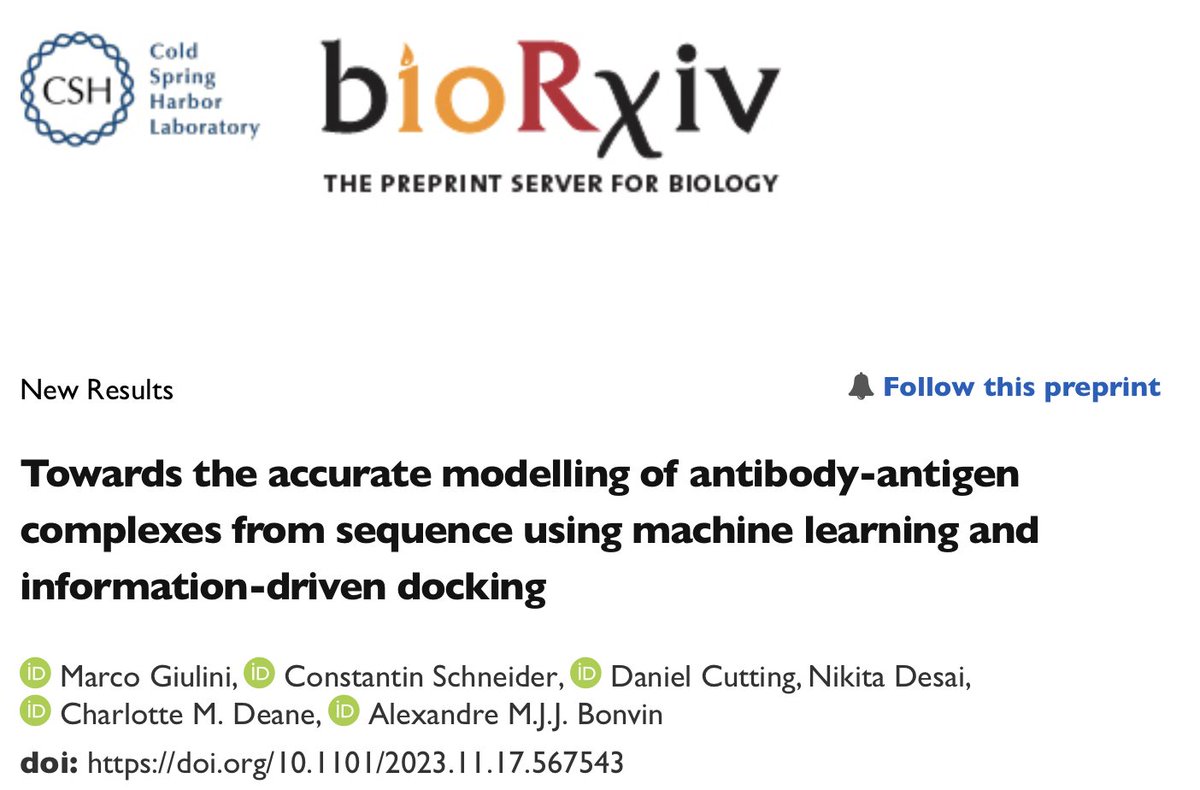
Towards the accurate modelling of antibody-antigen complexes from sequence using machine learning and information-driven docking
1/ This study develops a protocol that combines machine learning (ML) with information-driven docking to model antibody-antigen complexes from sequence data. It leverages ML-generated structures of antibodies and antigens to predict accurate docking models without relying on experimentally determined structures.
2/ A key finding is that the HADDOCK3 docking protocol, which uses ensembles of antibody structures predicted by ML tools and AlphaFold2-generated antigens, outperforms traditional docking methods like ZDOCK in predicting accurate antibody-antigen complexes.
3/ The study emphasizes the importance of incorporating structural diversity through ensembles of antibody models, showing that this approach significantly improves docking success rates, especially when combined with targeted docking strategies based on epitope and paratope information.
4/ HADDOCK3's success is attributed to its flexibility in refining antibody-antigen complexes and its ability to use partial information about the binding interface, making it an ideal tool for early-stage drug discovery and antibody design.
5/ The results demonstrate that ML-based antibody modelling tools, such as AlphaFold2, ABodyBuilder2, and IgFold, produce structures that, when combined with HADDOCK3, can generate near-native complex models, even without experimental structure data.
6/ This work establishes a new benchmarking dataset for antibody-antigen modelling and highlights how ML-driven methods can significantly enhance computational antibody discovery workflows, especially when no experimental structures are available.
@amjjbonvin@OPIGlets@con__schneider@MarkDownThere
💻Code: https://t.co/7xJ586s63B
📜Paper: https://t.co/SWvS75tpPl
Freshly out as preprint: Our work on modelling protein-glycan complexes with #HADDOCK! Great work of Anna, Marco and Angela, supported by @BioExcelCoE and @eScienceCenter . Check it out at https://t.co/qsWJBFDAeo
Happy to announce that our #HADDOCK team did very well in the CAPRI round 56, with a medium quality model of the difficult peptide-MHC-antibody complex submitted as top ranked prediction. Full story at https://t.co/1WtJpSDK5E
Happy the announce the publication of the ARCTIC-3D software, a tool to perform data mining and clustering of existing structural interface information coming from @PDBeurope
code available at https://t.co/wJfP6NGHvx
web server: https://t.co/lajJmFs9Io
Glad to see this out indeed! we demonstrated how ML methods are accurate in modelling antibody structures (especially when considering an ensemble) and then used them in a fast #HADDOCK docking protocol: even when sampling few tens of solutions we get a good model of the complex!
Glad to see our work lead by Marco Giulini @MarkDownThere on antibody-antigen modelling from sequence now in BioRxiv! A great collaboration with the team of Charlotte Deane at @exscientiaAI
https://t.co/VET2rEsmdh